REVIEW 3 major objections 5 minor
Exo2EgoPose: Leveraging Exocentric Demonstrations for Vision-Language guided Egocentric 3D Hand Pose Forecasting
T0 review · 3 major / 5 minor · reviewed 2026-08-01 · deepseek-v4-flash
Pith's one-line read Forecasting egocentric 3D hand poses is improved by training with third-person demonstration videos, cutting joint error by up to 14.2 mm.
desk verdict Genuinely new benchmark and strong incremental results, but the paper's headline attribution—that Exo semantic content drives the gains—needs a control experiment the authors didn't run. read the letter →
The pith
A machine-rendered reading of the paper's core claim, the machinery that carries it, and where it could break.
The reading
What carries the argument
The load-bearing mechanism is the Dual-level Exocentric Reconstruction Module (DERM) combined with the Global-to-Local Modulation Module (GLMM). DERM takes a frozen MAE encoder's video-level and chunked frame-level representations of the paired exocentric clip and trains the model to reconstruct them from egocentric multimodal tokens via MSE losses, building a cross-view correspondence; GLMM then uses the reconstructed video-level representation as global guidance (through cross-attention and adaptive layer normalization) and the reconstructed frame-level representations as local guidance (through gated cross-attention and adaptive modulation units) to calibrate the egocentric pose features
What would settle it
Train the identical model with exocentric clips shifted by 2–5 seconds (or drawn from a different episode), keeping everything else fixed; if the reported MPJPE advantage over the no-Exo baseline does not disappear or reverse, then the gains are not attributable to the content of the Exo supervision. A cheap version: run the ablation with only video-level or only frame-level reconstruction and measure the sensitivity to alignment jitter.
Extended reading notes
Core claim
The paper's central claim is that a multimodal egocentric model can learn to predict future 3D hand joints (and joint validity) more accurately when, during training, it is forced to reconstruct the paired exocentric demonstration of the same activity at both video level and chunked frame level, and when the reconstructed exocentric features are injected into the egocentric pose queries through a global-to-local modulation scheme. Under this training regime, the method reports MPJPE/MPJVE of 25.83/6.35 on AssemblyHands, 36.44/16.06 on Ego-Exo4D, and 49.44/61.03 on EgoMe-pose, beating the strongest prior method (AR-VRM) by 7.56, 8.02, and 6.62 mm MPJPE on the three benchmarks respectively, an
Load-bearing premise
The method assumes every training episode has a paired exocentric video whose frames can be aligned to the egocentric observation and prediction windows accurately enough that the reconstruction losses supervise the correct content; misalignment would inject wrong guidance.
Editorial extensions
If this is right
- If the reported gains hold, egocentric hand-pose forecasting can be trained from readily available third-person video, without needing Exo signals at inference time.
- The dual-level reconstruction strategy gives a recipe for injecting spatial context and temporal dynamics into other fine-grained egocentric forecasting tasks.
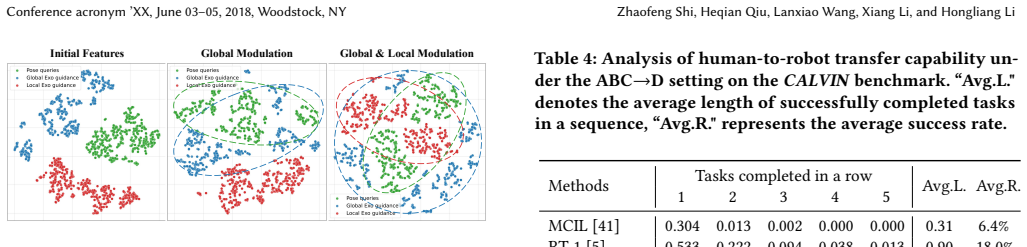
- The CALVIN transfer results suggest that accurate egocentric hand-pose forecasts provide a more transferable representation for robot manipulation than raw video or language alone.
- Removing the exocentric supervision entirely degrades AssemblyHands val performance by 9.59 mm MPJPE and 1.11 mm MPJVE, indicating that the Exo guidance is a primary driver of the improvement, not a marginal add-on.
- The added modules cost little (0.25–0.35 GFLOPs and about 2 M parameters), so the accuracy gain is not bought with a large compute increase.
Reading between the lines
- Since Exo is used only during training, the paper implies a practical data-collection recipe: any stable third-person camera can provide supervision for egocentric forecasting models, even when deployment is strictly egocentric; this could lower the cost of collecting training data for AR and robotics.
- The same reconstruction-and-modulate pattern could be applied to other forecasting targets (object state, gaze, whole-body motion) as long as paired exocentric video exists; the paper does not test this.
- The CALVIN improvement does not tell us whether the Exo guidance or the pose-forecasting objective is responsible for the transfer gain; an ablation that transfers a model trained without Exo would isolate that.
- A natural stress test would be to evaluate with imperfectly aligned Exo clips; if the reported gains degrade gracefully with alignment error, the method is robust to real-world asynchronous capture, which the EgoMe-pose linear alignment only partially approximates.
Editorial analysis
A structured set of objections, weighed in public.
Referee Report
Summary. The paper introduces Exo2EgoPose, a framework for vision-language-guided egocentric 3D hand pose forecasting (VL-EHPF). The method uses paired exocentric (Exo) videos as auxiliary supervision during training: a Dual-level Exocentric Reconstruction Module (DERM) reconstructs video-level and chunked frame-level Exo representations from Ego inputs, and a Global-to-Local Modulation Module (GLMM) injects these reconstructed representations into the pose-query stream via cross-attention and adaptive modulation. At inference, no Exo video is required; the model uses only Ego observations, language, and pose states. The authors report substantial MPJPE/MPJVE improvements over re-implemented baselines on three human-pose benchmarks and a human-to-robot transfer experiment on CALVIN. They also construct a new EgoMe-pose benchmark from EgoMe with automatic 3D hand pose labeling.
Significance. If the reported gains are real and attributable to Exo content, the paper makes a valuable contribution: it defines a new multimodal forecasting task, shows consistent gains across three datasets, and demonstrates that cross-view supervision can be used at training time without requiring Exo input at inference. The construction of EgoMe-pose is a potentially useful resource. The paper also includes useful analyses (hyperparameter sensitivity, complexity, t-SNE) and plans to release code. However, the central attribution claim—that Exo demonstrations specifically, rather than the auxiliary reconstruction losses or added capacity, drive the improvements—is not established by the current ablation design. The lack of repeated-run statistics further clouds the smaller margins (e.g., MPJVE differences of 0.27–0.38 on Ego-Exo4D). These issues are fixable but require additional experiments.
major comments (3)
- [§4.3, Table 2] The ablation does not isolate the exocentric content. The final row removes VER, CFER, GMM, and LMM simultaneously, so the 9.59 MPJPE drop conflates removal of the Exo supervision targets with removal of the extra queries, attention blocks, and modulation parameters. Since at inference q''_v and q''_f are produced from Ego inputs (Eqs. 12–14), the gains could come from auxiliary regression structure, added capacity, or matching a generic feature distribution, none of which require actual Exo semantic information. Please add a control where the same architecture is trained with the same reconstruction losses but with non-Exo targets—e.g., future Ego-frame features, a different view of the same Ego stream, or fixed random vectors of the same dimension. This is load-bearing for the paper's core claim that 'holistic and stable Exo demonstrations' are the source of the improvement.
- [§4.2, Table 1] All quantitative results appear to be from a single run with no standard deviations or significance tests. Some of the reported advantages are small enough to be within seed-level noise, notably the MPJVE margins on Ego-Exo4D (16.06 vs. 16.33 vs. 16.44) and the 0.27 MPJVE difference vs. AR-VRM. Please report mean and variance over at least three seeds, and state whether the same hyperparameters/seeds were used for all baselines. This matters because the baselines are re-implemented rather than taken from official releases; the comparison is only meaningful if the re-implementations are carefully verified and the variance is quantified.
- [§4.1.1, EgoMe-pose construction] The EgoMe-pose benchmark is constructed with automatic labeling (InterHand + RootNet) and a filtering rule that keeps only episodes where >95% of frames have valid annotations with confidence ≥0.6. This can bias the benchmark toward easy, slow, or well-illuminated interactions, and the error rates on it may not reflect performance on the full EgoMe distribution. The linear temporal alignment for asynchronous Ego-Exo pairs (§3.3) is another simplification. Please report the labeling success rate, the fraction of episodes removed by filtering, and, if possible, a human-validated subset or a comparison with a smaller manually checked test set. This would strengthen the credibility of the new benchmark and the reported gains on it.
minor comments (5)
- [§3.3] The notation T_vid (total Exo frames) vs. T' and T-bar could be clarified. Also, Eq. (13) and (14) say 'd' indexes dimensions but the bound is written as C_v; please make the summation bounds consistent.
- [§4.1.3] There is an inconsistency in dataset naming: 'AssemblyHand' is used in Implementation Details while the benchmark is called 'AssemblyHands' elsewhere. Also, the balance coefficient λ_va in Eq. (23) is not explicitly defined in the list of coefficients; please define it alongside λ_P.
- [§4.4.4, Table 3] The baseline complexity (802.100 GFLOPs) is very high; the authors should note that this includes the MAE/DINOv2 encoders and the Transformer, and clarify whether the reported FLOPs are per episode of length T'+T-bar. The table currently leaves this ambiguous.
- [§4.4.2] The sensitivity analysis reports a small range of λ_V and λ_F, but only the final values are shown in the text. Please include the actual plotted curves in the figure or add a small table of the tested values and resulting errors so the claim 'robust' can be checked.
- [Appendix A.6] AR-VRM is re-implemented and 'further improved' with Exo features. This makes it a stronger baseline, but the modification means it is not the official AR-VRM; please make this explicit in the main text as well, since a reader comparing Table 1 to the original paper may be confused.
Circularity Check
No significant circularity: the forecasting claim is evaluated on external benchmarks and the Exo reconstruction is auxiliary supervision, not a fitted prediction of the target.
full rationale
The paper's central comparative claims are supported by external benchmarks (AssemblyHands, Ego-Exo4D, CALVIN) with independently annotated or widely used test data, and the method's output is future Ego 3D hand poses supervised by ground-truth pose labels. The DERM uses paired Exo videos only as auxiliary training supervision to reconstruct MAE features (Eqs. 10-14); at inference the 'Exo guidance' is a model-produced latent, not the test target or a fitted parameter that later is called a prediction. No equation in the paper reduces the forecast to a reconstruction target or to a benchmark label by construction. The main circularity-adjacent concern is a missing control: ablations remove entire modules along with the Exo targets, so one cannot fully isolate whether gains come from exocentric content versus extra capacity or auxiliary regression structure. That is a legitimate attribution/control weakness, but it is not a demonstrated reduction of the result to its inputs. The self-citations, including using the authors' own EgoMe dataset to build EgoMe-pose, are dataset/context citations and are not load-bearing for the main comparisons, since the same method is validated on independent AssemblyHands and Ego-Exo4D benchmarks. Therefore no specific circular step can be exhibited, and the honest finding is no significant circularity.
Assumptions & free parameters
free parameters (8)
- lambda_V =
1.0
- lambda_F =
0.1
- lambda_E =
1.0
- lambda_P =
3e3
- lambda_va =
1.0
- T_prime and T_bar =
10 and 10
- visual token count N =
9
- EgoMe-pose filtering thresholds =
sigma_d >= 0.6 and >95% valid frames per episode
assumptions (5)
- domain assumption Paired, synchronized (or linearly alignable) Exo videos are available for every training episode on all benchmarks.
- domain assumption Frozen MAE encoder features of Exo videos capture spatial and temporal information useful for hand pose forecasting.
- ad hoc to paper Linear temporal alignment is sufficient for asynchronous Ego-Exo pairs in EgoMe.
- domain assumption Automatic InterHand/RootNet pose labels on EgoMe are accurate enough after filtering.
- ad hoc to paper Reconstructed Exo representations, generated only from Ego inputs at inference time, provide useful guidance for pose forecasting.
Cite this review
Pith. "Pith review of Exo2EgoPose: Leveraging Exocentric Demonstrations for Vision-Language guided Egocentric 3D Hand Pose Forecasting." pith.science (2026). https://pith.science/paper/7JESH7DV
@misc{pith2026260715890,
  author       = {Pith},
  title        = {Pith review of: Exo2EgoPose: Leveraging Exocentric Demonstrations for Vision-Language guided Egocentric 3D Hand Pose Forecasting},
  year         = {2026},
  howpublished = {\url{https://pith.science/paper/7JESH7DV}},
  note         = {Machine review of arXiv:2607.15890}
}
read the original abstract
Perceiving multimodal cues and forecasting fine-grained actions from an egocentric (Ego) perspective is vital for applications like robot manipulation. However, previous studies either rely mainly on under-informed visual inputs to predict coarse human motions or follow the VRM/VLA paradigm, which suffers from insufficient robot data and the gap between human and robot embodiments. We observe that 3D hand pose naturally serves as a unified representation to bridge human-robot actions. Hence, we investigate an under-explored Vision-Language guided Egocentric 3D Hand Pose Forecasting (VL-EHPF) task, which aims to predict future Ego 3D hand poses from visual observations, a language instruction, and pose states. To overcome the limited field-of-view and highly dynamic motions in the Ego view, we propose a framework dubbed Exo2EgoPose, which innovatively leverages holistic and stable exocentric (Exo) demonstrations as guidance to compensate for partial and dynamic Ego-view cues. Specifically, we introduce a Dual-level Exocentric Reconstruction Module (DERM), which incorporates the paired Exo videos as supervision to reconstruct their video-level and chunked frame-level representations, thereby modeling spatial contexts and temporal dynamics. Then, the Global-to-Local Modulation Module (GLMM) utilizes the reconstructed hierarchical Exo representations for progressive feature refinement via attention mechanisms and adaptive modulation, enabling comprehensive Exo guidance for accurate Ego hand pose forecasting. Extensive experiments on \textit{AssemblyHands}, \textit{Ego-Exo4D}, and our newly constructed \textit{EgoMe-pose} benchmarks show the superiority of our method, which outperforms state-of-the-art methods by a large margin. Moreover, it demonstrates an effective human-to-robot transfer capability and yields improvements on the \textit{CALVIN} dataset.
Figures


Figures from the paper (3 more)


Reviewed August 1, 2026 · model on record in the stance chip above.
Discussion (0). Continue with ORCID to comment.