REVIEW 5 major objections 5 minor 17 references
This paper proves that for every finite group G and every generating set S there is a 3-connected cubic graph D_{G,S} whose automorphism group is isomorphic to G and which carries an automorphism-invariant cycle double cover describing a po
Reviewed by Pith at T0; open to challenge. T0 means a machine referee read the full paper against a public rubric. the ladder, T0–T4 →
T0 review · deepseek-v4-flash
2026-08-01 11:34 UTC pith:Y6EHNCPY
load-bearing objection Clear new construction with a mostly solid automorphism proof, an underproved CDC half, and a minor false type claim — send to peer review. the 5 major comments →
Polyhedral Maps of Cubic Graphs with given Automorphism Groups
The pith
A machine-rendered reading of the paper's core claim, the machinery that carries it, and where it could break.
Core claim
The central claim is that a modified Cayley-graph construction yields a rigid, polyhedrally embeddable cubic graph: for every finite group G and generating set S, the graph D_{G,S} is cubic and 3-connected, its automorphism group is isomorphic to G via the left regular action, and there is an explicit cycle double cover Z = Z_i ∪ Z_r ∪ Z_b whose cycles form the faces of a polyhedral map and are permuted by all automorphisms of D_{G,S}. In addition, the roof and base cycles are not arbitrary: their vertex sets correspond exactly to left cosets of the cyclic subgroups generated by the product of all generators (for roof cycles) and by each individual generator (for base cycles). This coset str
What carries the argument
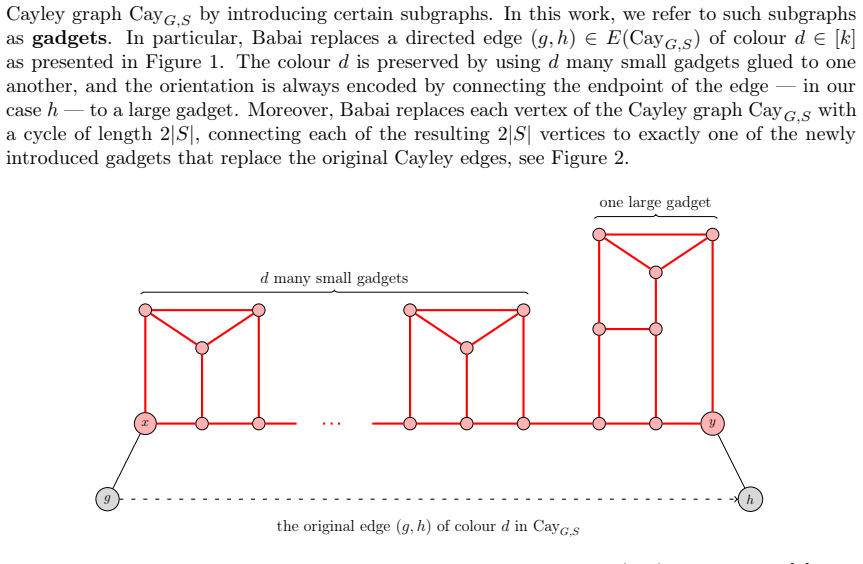
The load-bearing object is the gadget-substituted graph D_{G,S}. Each vertex g of the Cayley graph becomes a blow-up graph A_g made of s_d-blocks (connector and center vertices joined in a cycle), and each directed edge of colour d becomes a d-chain: a ladder of length d with an endgadget attached, whose endgadget connects to the neighbouring blow-up graphs. Rigidity is carried by vertex types, triples (λ1, λ2, λ3) of lengths of shortest cycles through pairs of incident edges, arranged in ascending order. The types in Table 1 are claimed to separate endgadget, ladder, connector, and center vertices, so an automorphism must move each blow-up graph and each chain as a whole, forcing left multi
Load-bearing premise
The rigidity argument depends on the unshown claim that the vertex-type triples in Table 1 are exactly as listed and mutually distinctive for the endgadget, ladder, connector, and center vertices; if any shortest-cycle computation differs, an automorphism could mix gadgets and Aut(D_{G,S}) ≅ G would not follow.
What would settle it
For a concrete small case, build D_{G,S} for G=C2 with S={s} (32 vertices, 48 edges) and enumerate all its automorphisms: if the automorphism group has more than two elements, the theorem fails. Alternatively, list all shortest cycles through pairs of incident edges at the ten endgadget vertices and compare the resulting type triples with Table 1; any mismatch would break the rigidity proof.
If this is right
- For any finite group, there exists a 3-connected cubic graph whose automorphism group, and whose polyhedral-map automorphism group, is isomorphic to that group.
- The face cycles of the polyhedral map are permuted by the full automorphism group, so the group acts on the map itself, not merely on the underlying graph.
- The explicit formulas give the number of cycles and the Euler characteristic in terms of n, k, and the orders of products of generators; for k=1 the resulting map is spherical.
- Varying the ordering of a fixed generating set can produce non-isomorphic graphs with the same prescribed automorphism group, yielding distinct realizations.
Where Pith is reading between the lines
- The left-coset description of roof and base cycles suggests a design principle the paper does not state: one could prescribe face lengths in the polyhedral map by choosing generators with specified orders and products, provided those orders are compatible with the group.
- If the vertex-type table is verified, it gives a potential recognition algorithm for these graphs: scan a cubic graph for the endgadget/ladder/connector/center type signatures, and matching signatures would identify the blow-up graphs and chains, from which the group and generating set could be recovered up to ordering.
- The paper says it is exploring k-regular analogues; a natural next step would be replacing the chain ladders with higher-degree carriers of more colours, though the vertex-type separation would need to be re-established for each degree.
Editorial analysis
A structured set of objections, weighed in public.
Referee Report
Summary. The paper proposes, for an arbitrary finite group G with generating set S, a cubic graph D_{G,S} obtained by modifying the directed coloured Cayley graph Cay(G,S): vertices are replaced by blow-up graphs A_g and each directed edge of colour d by a 'd-chain' (a ladder of length d plus an endgadget). The central claim is that D_{G,S} is 3-connected, Aut(D_{G,S}) is isomorphic to G, and a constructed set of cycles Z is a cycle double cover that induces a polyhedral map and is invariant under Aut(D_{G,S}). The automorphism claim is argued in Section 3.2 by vertex-type invariants; the CDC is constructed in Section 4 and its properties are discussed in Section 5.
Significance. If correct, the main theorem gives a strong finite realization result: every finite group occurs simultaneously as the automorphism group of a 3-connected cubic graph and of a polyhedral map carried by it, with face cycles preserved. The construction is explicit, includes vertex and cycle counts, connects roof/base cycles to left cosets, and is accompanied by GAP/Magma implementations; these are genuine strengths. It would improve on Babai's cubic graph construction, which is only 2-connected, and on the earlier CDC construction in [1] by controlling face intersections. The proof, however, is not complete in the submitted form.
major comments (5)
- [Section 3.2, after Table 1] The statement that every connector vertex has type (4,8,10) is not correct for k=1,2, and the sentence 'The remaining two cases simply follow by omitting the images of the non-existing center vertices' does not repair this. In the k=2 blow-up A_g depicted in Figure 5(b), the vertex a^{1,1}_g is incident with edges e1={a^{1,1}_g,a^{1,2}_g}, e2={a^{1,1}_g,a^{2,4}_g}, and e3={a^{1,1}_g,C[1,g,gs_1](u1)}. The cycle a^{1,1}_g - a^{1,2}_g - c^{1,1}_g - c^{2,1}_g - a^{2,3}_g - a^{2,4}_g - a^{1,1}_g has length 6 and contains e1 and e2, so the type is not (4,8,10). For k=1 the analogous pair is contained in the 4-cycle of A_g. Since Lemmas 3.4–3.6 use this invariant to force the partition V(A_G),V(C_G) and to determine d-chain images, the proof of Aut(D_{G,S}) is incomplete for k=1,2. The authors should either compute correct types for these cases or give a separate automorphism argument. Even for
- [Section 4.1] The inner face cycles are never formally defined; the text says 'Instead of providing a formal definition... describe the cycles and illustrate them graphically.' The subsequent claims that any two cycles in Z_i intersect in at most one edge and that every edge is contained in at least one cycle of Z_i are load-bearing for Theorem 5.2. A figure-based definition is not enough, especially because the paper itself notes the construction may not be planar and the 'green faces' are only described informally. Please provide an explicit list or algorithm and prove the intersection and coverage statements.
- [Section 4.2, Remark 4.1] The three properties that roof cycles are pairwise edge-disjoint, meet each inner face cycle in at most one edge, and cover exactly the stated set of edges are introduced with 'We only state these results without proof.' These properties are exactly what Theorem 5.2 needs; the same applies to base cycles by the sentence following Remark 4.1. Asserting them without proof is a gap, not a routine omission.
- [Section 5, Lemma 5.1 and Theorem 5.2] Lemma 5.1 is itself only sketched ('we only sketch the proof', 'observe that the same property still holds'), and Theorem 5.2 then invokes it to conclude completeness and correctness of the CDC. The proof of Theorem 5.2 does not verify the defining conditions of a CDC: it does not show every edge is contained in exactly two cycles, nor that every pair of cycles from the three families intersects in at most one edge. The sentence 'no roof edge cycle intersects with a base edge cycle, simply because they traverse different chain edges, as well as different blow-up graph vertices' addresses only one pair of families. This is a central part of the main theorem and needs a complete proof.
- [Section 5, Theorem 5.4] The invariance of Z under Aut(D_{G,S}) is one of the three stated properties of the main theorem, but the proof is only a prose paragraph ending 'Formally, we can prove...'. No formal argument is given. While this may follow from Lemmas 3.4–3.5 if the cycle families are characterized by local structure, the paper should spell out the argument, including why Z_i, Z_r, and Z_b are each invariant.
minor comments (5)
- [Section 3.2] In the first paragraph, 'the graph D_{G,S} from Theorem 3.1' should be 'Definition 3.1'.
- [Section 3.2] Cross-references are inconsistent: Lemmas 3.4 and 3.5 are sometimes called 'Theorem 3.4' and 'Theorem 3.5' in later proofs (e.g., in the proof of Lemma 3.5).
- [Section 5] In the proof of Theorem 5.2, 'Theorem 5.1' should be 'Lemma 5.1'.
- [Figure 5(b)] The k=2 case should state explicitly whether c^{1,1}_g and c^{2,1}_g are adjacent. The informal drawing is used in a load-bearing way, and the ambiguity affects the vertex-type computation.
- [Section 2] The expression 'd+1 modd k' is confusing; adding parentheses or a verbal explanation would help.
Circularity Check
No load-bearing circularity: the construction and automorphism proof are synthetic rather than derived from the theorem's conclusion; the main fragility is an unverified vertex-type computation, which is a correctness gap, not a circular step.
full rationale
The paper's central claim is not obtained by fitting a parameter to its own output or by importing an unverified uniqueness theorem from the same authors. The graph D_{G,S} is explicitly constructed from the Cayley graph of (G,S) in Definition 3.1, and the injection from G into Aut(D_{G,S}) is only one inclusion; the difficult direction, showing there are no extra automorphisms, is attempted through the local invariants in Section 3.2. The assertion that 'all connector vertices a^{d,i}_g have the type (4,8,10)' and that 'The values can be easily determined by reviewing Figures 4 to 6' is an invariant computation inside the constructed graph, not a premise that presupposes Aut(D_{G,S}) ≅ G. If that computation is wrong, especially for k=1,2, then the proof of Theorem 3.7 would be incomplete or invalid, but that is a factual/verification defect rather than circularity. Similarly, the CDC construction in Section 4 is an explicit set of cycles, and its correctness, completeness, and polyhedral property are argued in Section 5 through coset decompositions, not by assuming the conclusion. The citations to [1] and [6] include current authors, but they are used as background, motivation, or pointers to implementations; no load-bearing theorem is imported from them. There is therefore at most harmless self-citation, not a self-referential derivation chain.
Axiom & Free-Parameter Ledger
axioms (4)
- standard math Aut(Cay_{G,S}) = L(G) for the edge-coloured directed Cayley graph.
- domain assumption A cubic graph with a CDC inducing a polyhedral map is 3-connected (Mohar–Thomassen).
- ad hoc to paper The vertex-type triples in Table 1 are correct and separate the vertex classes.
- ad hoc to paper The inner face cycles have pairwise intersections of at most one edge and cover every edge at least once.
read the original abstract
L. Babai introduced a method for constructing a cubic graph whose automorphism group is isomorphic to a given finite group $G$, obtained by modifying a corresponding Cayley graph of $G$. Building on this approach, we construct a cubic graph that admits a polyhedral map whose automorphism group, as well as the automorphism group of the polyhedral map itself, is isomorphic to $G$.
Figures


Reference graph
Works this paper leans on
-
[1]
Simplicial surfaces with given automorphism group
Reymond Akpanya and Tom Goertzen. Simplicial surfaces with given automorphism group. Journal of Algebraic Combinatorics, 62, 07 2025
2025
-
[2]
Mitchell, MichaelTorpey, MariaTsalakou, andWilf A
JanDe Beule, Julius Jonušas, JamesD. Mitchell, MichaelTorpey, MariaTsalakou, andWilf A. Wilson. Digraphs - GAP package, version 1.10.0, Feb 2025
2025
-
[3]
The Magma algebra system
Wieb Bosma, John Cannon, and Catherine Playoust. The Magma algebra system. I. The user language. volume 24, pages 235–265. 1997. Computational algebra and number theory (London, 1993)
1997
-
[4]
Polyhedral maps
Ulrich Brehm and Egon Schulte. Polyhedral maps. In Jacob E. Goodman and Joseph O’Rourke, editors,Handbook of Discrete and Computational Geometry, chapter 20, pages 345–358. CRC Press, 1997
1997
-
[5]
Construction of maps with prescribed automorphism group
Robert Cori and Antonio Machì. Construction of maps with prescribed automorphism group. Theoret. Comput. Sci., 21(1):91–98, 1982
1982
-
[6]
Implementation.https://github.com/MeikeWeiss/ PolyhedralMapsWithGivenGroup, 2025
Ugo Detaille. Implementation.https://github.com/MeikeWeiss/ PolyhedralMapsWithGivenGroup, 2025
2025
-
[7]
Herstellung von Graphen mit vorgegebener abstrakter Gruppe.Compositio Math., 6:239–250, 1939
Robert Frucht. Herstellung von Graphen mit vorgegebener abstrakter Gruppe.Compositio Math., 6:239–250, 1939
1939
-
[8]
Graphs of degree three with a given abstract group.Canadian Journal of Mathematics, 1(4):365–378, 1949
Robert Frucht. Graphs of degree three with a given abstract group.Canadian Journal of Mathematics, 1(4):365–378, 1949
1949
-
[9]
How I became interested in graphs and groups.J
Roberto Frucht. How I became interested in graphs and groups.J. Graph Theory, 6(2):101– 104, 1982
1982
-
[10]
The GAP Group.GAP – Groups, Algorithms & Programming, Vers. 4.12.2
-
[11]
Gross and Thomas W
Jonathan L. Gross and Thomas W. Tucker.Topological graph theory. Dover Publications, Inc., Mineola, NY, 2001
2001
-
[12]
North-Holland Publishing Co., Ams- terdam, second edition, 1993
László Lovász.Combinatorial problems and exercises. North-Holland Publishing Co., Ams- terdam, second edition, 1993. p. 426
1993
-
[13]
Johns Hopkins Studies in the Mathematical Sciences
Bojan Mohar and Carsten Thomassen.Graphs on surfaces. Johns Hopkins Studies in the Mathematical Sciences. Johns Hopkins University Press, Baltimore, MD, 2001
2001
-
[14]
Graphs with given group and given graph-theoretical properties.Canadian J
Gert Sabidussi. Graphs with given group and given graph-theoretical properties.Canadian J. Math., 9:515–525, 1957
1957
-
[15]
P. D. Seymour. Sums of circuits. InGraph theory and related topics (Proc. Conf., Univ. Waterloo, Waterloo, Ont., 1977), pages 341–355. Academic Press, New York-London, 1979
1977
-
[16]
Szekeres
G. Szekeres. Polyhedral decompositions of cubic graphs.Bulletin of the Australian Mathe- matical Society, 8(3):367–387, 1973
1973
-
[17]
Orientableandnonorientablemapswithgivenautomorphism groups.Australas
JozefŠiráňandMartinŠkoviera. Orientableandnonorientablemapswithgivenautomorphism groups.Australas. J. Combin., 7:47–53, 1993. 17
1993
discussion (0)
Sign in with ORCID, Apple, or X to comment. Anyone can read and Pith papers without signing in.