REVIEW 4 major objections 5 minor 14 references
CATKit2-HCI: a collaborative framework for advancing high-contrast coronagraph testbeds
T0 review · 4 major / 5 minor · reviewed 2026-08-01 · deepseek-v4-flash
Pith's one-line read A shared software layer now links six coronagraph testbeds.
desk verdict A clear, honest architecture paper for shared coronagraph-testbed software; the duplication-reduction claim is a promise, not yet a demonstrated result. read the letter →
The pith
A machine-rendered reading of the paper's core claim, the machinery that carries it, and where it could break.
The reading
What carries the argument
The mechanism is a three-layer architecture: CATKit2 supplies testbed-agnostic hardware service control; CATKit2-HCI supplies the shared middle layer of HCI algorithms, calibration utilities, DM tools, modeling helpers, and dashboards; private repositories hold each bench's experiments and tuning. Within the shared layer, an estimator/controller/observer separation lets testbeds swap components without rewriting whole experiments. The load-bearing social mechanism is the rebasing norm — refactoring local code onto merged shared implementations to keep the shared layer a living common codebase rather than a set of forks.
What would settle it
Inspect the private repositories of the six testbeds one year after a mature algorithm has been merged into CATKit2-HCI: if most still contain substantial maintained copies of that algorithm, or if the shared repository shows little import activity from testbed-specific code, the central claim that the collaboration reduces duplicated effort fails.
Extended reading notes
Core claim
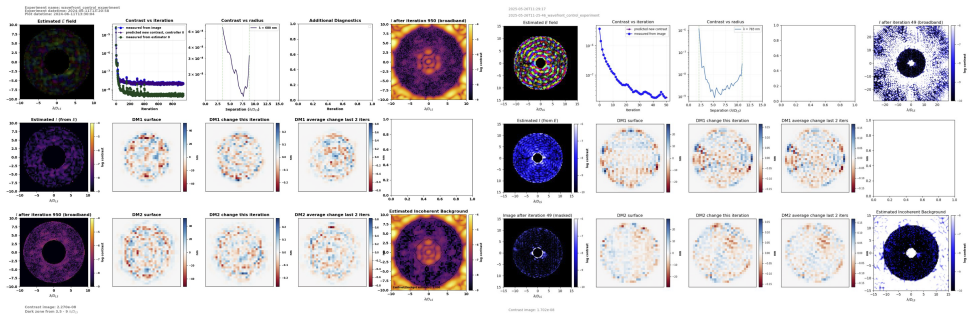
The paper's central claim is that CATKit2-HCI fills the missing software layer between public hardware control and private testbed-specific experiments, collecting mature high-contrast-imaging tools into a shared, reviewed repository. It states that the architecture separates estimators, controllers, observers, and testbed interfaces, so the same algorithm — electric field conjugation, pairwise probing, differential optical transfer function phase retrieval — can run in different optical environments. With six testbeds participating and a rebasing commitment, the authors argue the collaboration reduces duplicated development, improves code quality through shared review, enables direct cross-
Load-bearing premise
The framework only reduces duplication if each testbed actually refactors its local code to use the shared implementation once a capability is merged — the paper's rebasing norm is a shared commitment, not an enforcement mechanism.
Editorial extensions
If this is right
- Bug fixes, calibration tools, and improved algorithms merged into the shared layer benefit all participating testbeds at once.
- Researchers moving between labs inherit a common operational vocabulary and familiar plotting and monitoring tools, shortening onboarding.
- Cross-testbed comparisons become cleaner because the same estimator or observer can be exercised on different optical benches.
- Standardized implementations of classical algorithms such as EFC and pairwise probing reduce duplicated code across the collaboration.
- Maturation of the framework would accelerate coronagraph technology development for future exoplanet imaging facilities including the Habitable Worlds Observatory.
Reading between the lines
- The paper's strongest unproven premise is that teams will actually rebase: if testbeds merge tools but keep running their own forks, the shared repository accumulates code without reducing duplication. A quantitative duplication metric across the six repositories would test this.
- The common-needs assumption is demonstrated for only two of six testbeds; the framework's generality would be better supported by examples from the other four, such as a vortex coronagraph bench or a broadband spectroscopy bench.
- If the model works, it could generalize beyond coronagraphy to other distributed instrument-software collaborations, wherever hardware diversity coexists with shared algorithm needs.
- A concrete near-term success criterion the paper leaves implicit: the fraction of each testbed's daily operational code that imports from CATKit2-HCI rather than from local implementations.
Signed reviews
Editorial analysis
A structured set of objections, weighed in public.
Referee Report
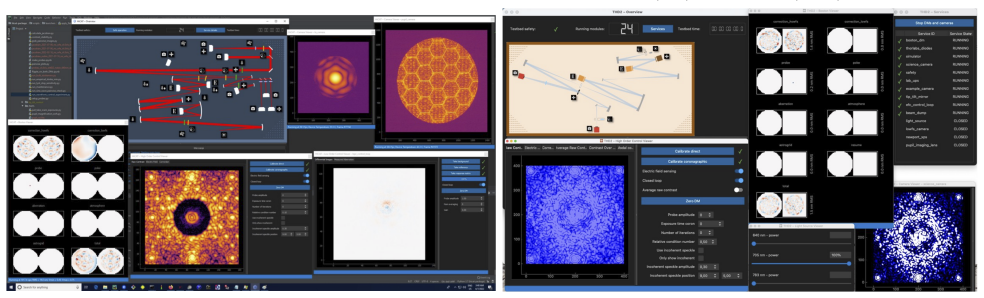
Summary. The paper describes CATKit2-HCI, a shared software layer for high-contrast coronagraph testbeds, built on the open-source CATKit2 hardware-control framework. It proposes a three-layer architecture (CATKit2, CATKit2-HCI, private testbed repositories), a collaboration model with a 'rebasing' norm, and lists shared capabilities in wavefront sensing/control, calibration, modeling, and visualization. Early examples from HiCAT and THD2 show common EFC plotting and dashboard concepts. The conclusions claim the framework reduces duplicated effort across six testbeds while preserving laboratory autonomy.
Significance. If validated, the framework would address a genuine bottleneck in laboratory astrophysics: many high-contrast testbeds independently reimplement similar wavefront sensing and control tools, calibration utilities, and monitoring dashboards. The open-source CATKit2 foundation is a concrete, citable asset, and the collaboration model for shared review and staff mobility is timely. The early HiCAT/THD2 examples are suggestive but not yet demonstrative of the central claim that duplication is actually reduced; stronger evidence of adoption and code migration is needed. The paper is valuable as a description of an ongoing community-infrastructure effort, but its functional claims currently outrun the presented evidence.
major comments (4)
- [§2.3] The load-bearing premise of the 'reduces duplicated effort' claim is the rebasing norm, but the paper states this norm 'is not intended primarily as an enforcement mechanism, but as a shared commitment.' No evidence is provided that any testbed has actually removed or refactored local code after a capability was merged into CATKit2-HCI, or that multiple testbeds invoke the same shared implementation for a given capability. Without adoption metrics or a concrete before/after case study, §4's conclusion that duplication is reduced is an assertion. Please provide at least one documented example of rebasing, or explicitly reframe the paper as a proposal rather than an achieved outcome.
- [§3, Figs. 2 and 3] The two early examples show visually similar EFC plots and dashboards for HiCAT and THD2, but they do not demonstrate that identical shared code is being invoked. The reader cannot tell whether these outputs come from CATKit2-HCI functions or from parallel local scripts that merely look alike. Please specify the exact modules/functions used by each testbed to produce these figures, and clarify what code was contributed to CATKit2-HCI versus what remains testbed-specific. Without this, the examples illustrate a concept, not a shared implementation.
- [§2.1 and §2.4] The repository is private and no information is given about the status of the other four participating testbeds (CAPSULE, SEAL, HCST, ExoSPEC). Since the central claim concerns six testbeds, the absence of any qualitative or quantitative evidence from those benches makes the 'six testbeds' framing unsupported. Please include a table or narrative describing, per testbed, which CATKit2-HCI capabilities are planned, under evaluation, or already in use. A private repository also prevents external audit; consider at least a public README or capability list.
- [§1.1 and §4] The premise that 'much of the software architecture is not fundamentally testbed-specific' is asserted but not supported by the examples, which focus on generic plotting and dashboards. To justify the claim of an HCI-specific shared layer, provide examples of more specialized algorithms (e.g., EFC, pairwise probing, dOTF) that have actually been implemented in CATKit2-HCI and used by more than one testbed. If such examples are not yet available, the paper should be careful to distinguish between planned capabilities and demonstrated ones.
minor comments (5)
- [§1.2] Heading contains 'CA TKit2' instead of 'CATKit2' (typo). Similar spacing issues appear in the author list and abstract.
- [Figure 1] The caption says 'See text for details' but does not describe the three layers in the caption itself. A self-contained caption would improve readability.
- [§3] The list of shared capabilities (EFC, pairwise probing, dOTF, etc.) is useful, but a table mapping each capability to its maturity status (planned, under development, mature) would help the reader assess the framework's current state.
- [General] The paper does not provide a link to the repository or a DOI beyond the CATKit2 reference [3]. Since software is the subject, a persistent identifier or public-facing description should be given.
- [References] Reference [3] is a Zenodo software release; consider including the version number and access date. Some SPIE references are formatted inconsistently with duplicated publisher names.
Circularity Check
No circularity: descriptive software-framework paper; self-citations are provenance, and the duplication-reduction claim rests on an unmeasured collaboration norm, not on a circular derivation.
full rationale
This is a systems/community paper, not a derivation. The central claim—that CATKit2-HCI fills the layer between CATKit2 hardware infrastructure and private testbed repositories and reduces duplicated effort—is a description of an intended software architecture and collaboration model, not a result obtained from equations or fitted data. There is no quantity to be predicted, no parameter fitted to a subset and then renamed as a prediction, and no uniqueness theorem imported from prior work to force a choice. Self-citations such as [3] (catkit2) and [4] (HiCAT) establish provenance for the foundation; they are not load-bearing evidence for the framework's value. The one notable limitation, stated in §2.3, is that the 'rebasing' norm 'is not intended primarily as an enforcement mechanism, but as a shared commitment.' This makes the duplication-reduction claim depend on future adoption behavior and on the two founding-testbed examples in §3 rather than on measured migration from the other four benches. That is an evidence gap and a correctness/verifiability risk, but it is not circular: no step in the paper reduces by construction to its own inputs. Per the hard rules, an honest non-finding is appropriate.
Assumptions & free parameters
assumptions (3)
- domain assumption HCI testbed software needs overlap enough across the six benches that a shared layer is worth maintaining.
- domain assumption The reciprocal 'rebasing' norm will be honored without enforcement.
- domain assumption CATKit2's service-based architecture generalizes to all six testbeds.
invented entities (1)
-
CATKit2-HCI shared repository layer
Cite this review
Pith. "Pith review of CATKit2-HCI: a collaborative framework for advancing high-contrast coronagraph testbeds." pith.science (2026). https://pith.science/paper/5WCHO6CL
@misc{pith2026260719921,
  author       = {Pith},
  title        = {Pith review of: CATKit2-HCI: a collaborative framework for advancing high-contrast coronagraph testbeds},
  year         = {2026},
  howpublished = {\url{https://pith.science/paper/5WCHO6CL}},
  note         = {Machine review of arXiv:2607.19921}
}
read the original abstract
High-contrast exoplanet imaging requires dedicated laboratory testbeds for the development and validation of coronagraph architectures, wavefront sensing and control methods, calibration strategies, and system-level observing concepts. These testbeds often share similar software needs, yet many tools are developed independently at each institution. The CATKit2-High-Contrast-Imaging collaboration, or CATKit2-HCI, addresses this gap by providing a shared software framework for reusable HCI infrastructure. Built on top of CATKit2, an open-source hardware control and synchronization framework originally developed for the High-contrast Imager for Complex Aperture Telescopes (HiCAT) testbed at the Space Telescope Science Institute, CATKit2-HCI provides the collaborative layer for HCI-specific algorithms, calibration tools, diagnostics, visualization, and performance metrics. The collaboration currently includes multiple coronagraph testbeds in the United States and Europe. Its goals are to reduce duplicated software development, improve code quality through shared review, enable more direct comparison of results across facilities, and facilitate the movement of students, postdoctoral researchers, and collaborators between laboratories. We describe the motivation, architecture, collaboration model, shared technical capabilities, and early cross-testbed examples of CATKit2-HCI as a framework for accelerating coronagraph technology development.
Figures

Reference graph
Works this paper leans on
-
[1]
The Habitable Worlds Observatory engineering view: status, plans, and opportunities,
Feinberg, L., Ziemer, J., Ansdell, M., Crooke, J., Dressing, C., Mennesson, B., O’Meara, J., Pepper, J., and Roberge, A., “The Habitable Worlds Observatory engineering view: status, plans, and opportunities,” in [Space Telescopes and Instrumentation 2024: Optical, Infrared, and Millimeter Wave], Coyle, L. E., Mat- suura, S., and Perrin, M. D., eds.,Societ...
2024
-
[2]
Foreword: The Habitable Worlds Observatory in Historical Context,
Postman, M. and Stapelfeldt, K., “Foreword: The Habitable Worlds Observatory in Historical Context,” in [Astronomical Society of the Pacific Conference Series], Lee, J. C., Noviello, J., LaMassa, S., and Postman, M., eds.,Astronomical Society of the Pacific Conference Series543, xii (Nov. 2026)
2026
-
[3]
spacetelescope/catkit2: v0.7.0. [Zenodo] 10.5281/zenodo.20843325,
Por, E. H., Laginja, I., Steiger, S., Soummer, R., Meier, L., Pougheon, E., Pourcelot, R., Philbin, M. P., Mazoyer, J., Sevin, A., Nguyen, M., Sahoo, A., Lau, A., Paviot, C., Egger, L., Delaye, L., Meredith, A., Lim, P. L., linarphy, and Fowler, J., “spacetelescope/catkit2: v0.7.0. [Zenodo] 10.5281/zenodo.20843325,” (June 2026)
-
[4]
H., Steiger, S., Laginja, I., Buralli, B., Redmond, S., Pueyo, L., Perrin, M
Soummer, R., Pourcelot, R., Por, E. H., Steiger, S., Laginja, I., Buralli, B., Redmond, S., Pueyo, L., Perrin, M. D., Ferrari, M., Fowler, J., Hagopian, J., N’Diaye, M., Nguyen, M., Nickson, B., Petrone, P., Sahoo, A., Sivaramakrishnan, A., and Will, S. D., “High-contrast imager for complex aperture telescopes (HiCAT):
-
[5]
Polarization effects on high contrast imaging: measurements on THD2 bench,
Baudoz, P., Desgrange, C., Galicher, R., and Laginja, I., “Polarization effects on high contrast imaging: measurements on THD2 bench,” in [Space Telescopes and Instrumentation 2024: Optical, Infrared, and Millimeter Wave], Coyle, L. E., Matsuura, S., and Perrin, M. D., eds.,13092, 130926L, SPIE (2024)
2024
-
[6]
The Santa Cruz Extreme AO Lab (SEAL) 2.0: a reflective, multiwavelength rebuild,
Jensen-Clem, R., Chambouleyron, V., Javier, P., Dillon, D., Por, E. H., Calvin, B., Cetre, S., Correa, R. A., Crowe, T., Diaz, J., Dobias, C., Doelman, D., Eikenberry, S., Fowler, J., Gerard, B. L., Hinz, P., Kupke, R., Moreno, A., Nguyen, T., Salama, M., Sengupta, A. R., Skaf, N., and Snik, F., “The Santa Cruz Extreme AO Lab (SEAL) 2.0: a reflective, mul...
2025
-
[7]
High-contrast spectroscopy testbed (HCST): tip/tilt sensing in re- flection of the vector vortex coronagraph (VVC),
Bertrou-Cantou, A., Redmond, S., Mawet, D., Sercel, G., Echeverri, D., Desai, N., Llop-Sayson, J., Ruane, G., Serabyn, E., and Wallace, J. K., “High-contrast spectroscopy testbed (HCST): tip/tilt sensing in re- flection of the vector vortex coronagraph (VVC),” in [Space Telescopes and Instrumentation 2024: Optical, Infrared, and Millimeter Wave], Coyle, L...
2024
-
[8]
ExoSpec project: exoplanet spectroscopy technologies for the Habitable Worlds Observatory at NASA’s Goddard Space Flight Center,
McElwain, M. W., Zimmerman, N. T., Rauscher, B., Groff, T., Mandell, A., Alei, E., Baines, T., Berrier, J., Bradley, H., Gong, Q., Howe, A., Juanola-Parramon, R., Kan, E., Kelly, D., Kofman, V., Sitarski, B., Stark, C., Subedi, H., Villanueva, G., and Will, S., “ExoSpec project: exoplanet spectroscopy technologies for the Habitable Worlds Observatory at N...
2024
Show all 14 references
-
[9]
Broadband wavefront correction algorithm for high-contrast imaging systems,
Give’on, A., Kern, B., Shaklan, S., Moody, D. C., and Pueyo, L., “Broadband wavefront correction algorithm for high-contrast imaging systems,” in [Astronomical Adaptive Optics Systems and Applications III], Tyson, R. K. and Lloyd-Hart, M., eds.,Society of Photo-Optical Instrum...
2007
-
[10]
Pair-wise, deformable mirror, image plane-based diversity electric field estimation for high contrast coronagraphy,
Give’on, A., Kern, B. D., and Shaklan, S., “Pair-wise, deformable mirror, image plane-based diversity electric field estimation for high contrast coronagraphy,” in [Techniques and Instrumentation for Detection of Exoplanets V], Shaklan, S., ed.,Society of Photo-Optical Instrum...
2011
-
[11]
E., Matsuura, S., and Perrin, M
System-level demonstration of the apodized pupil Lyot coronagraph with a segmented aperture in air,” in [Space Telescopes and Instrumentation 2024: Optical, Infrared, and Millimeter Wave], Coyle, L. E., Matsuura, S., and Perrin, M. D., eds.,13092, 130921Z, SPIE (2024)
2024
-
[12]
Differential optical transfer function wavefront sensing,
Codona, J. L., “Differential optical transfer function wavefront sensing,”Optical Engineering52, 097105 (Sept. 2013)
2013
-
[13]
Differential optical transfer function wavefront sensing and pupil calibration with the HiCAT testbed,
Nguyen, M. M., Por, E. H., Sahoo, A., Soummer, R., Pourcelot, R., Nickson, B. F., Pueyo, L., Perrin, M., and Laginja, I., “Differential optical transfer function wavefront sensing and pupil calibration with the HiCAT testbed,” in [Society of Photo-Optical Instrumentation Engin...
2023
-
[14]
High Contrast Imaging for Python (HCIPy): an open-source adaptive optics and coronagraph simulator,
Por, E. H., Haffert, S. Y., Radhakrishnan, V. M., Doelman, D. S., van Kooten, M., and Bos, S. P., “High Contrast Imaging for Python (HCIPy): an open-source adaptive optics and coronagraph simulator,” in [Adaptive Optics Systems VI], Close, L. M., Schreiber, L., and Schmidt, D....
2018
Reviewed August 1, 2026 · model on record in the stance chip above.
Discussion (0). Continue with ORCID to comment.