REVIEW 3 major objections 4 minor 1 cited by
Lattice quantum electrodynamics of a molecular emitter in a topological gap
T0 review · 3 major / 4 minor · reviewed 2026-08-01 · deepseek-v4-flash
Pith's one-line read A single molecule tuned into the band gap of an SSH cavity lattice traps its emitted photon in a vacancy-like bound state whose photonic part matches the eigenmode of the lattice with the emitter site removed.
desk verdict A solid proof-of-principle platform paper: the physics is mostly confirmatory, but the DBT/open-cavity lattice is a genuine new tool and the bound-state profiles are predicted, not fitted. read the letter →
The pith
A machine-rendered reading of the paper's core claim, the machinery that carries it, and where it could break.
The reading
What carries the argument
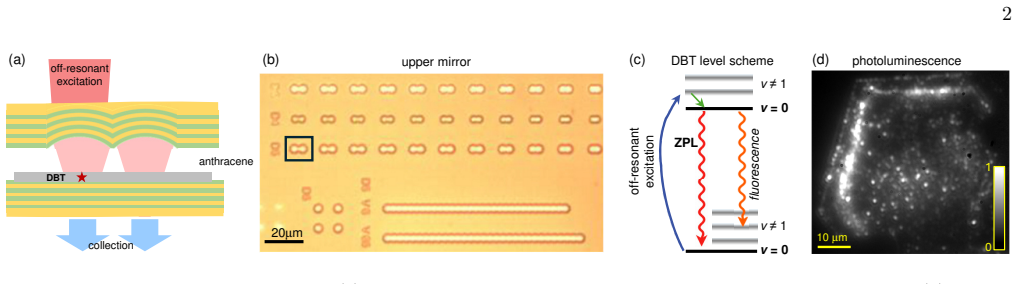
The central mechanism is the vacancy-like dressed state: when the emitter is at zero detuning, its coherent coupling to the cavity lattice effectively removes its own site, and the photonic part of the bound state becomes the eigenmode of the remaining 'vacancy dressed' lattice at the bare resonance energy. This is captured by the dissipative tight-binding model of Eq. (1), where a monochromatic source at the emitter site drives the coupled resonators, and destructive interference between the bonding and antibonding (or band and gap) modes cancels the field at the emitter site. In the SSH lattice, the staggered hoppings (intracell J=234 GHz, intercell J'=48 GHz) determine whether the vacancy
What would settle it
A measurement of the second-order autocorrelation g^(2)(0) of the light emitted from the 'dark' site (the site opposite the emitter at zero detuning) would test the vacancy picture: if the suppression at the emitter site arises from destructive interference of a coherent field, the dark site should emit a single-photon stream with g^(2)(0)<0.5, whereas incoherent emission or a second spectrally overlapping molecule would raise g^(2)(0) toward 1.
Extended reading notes
Core claim
When a DBT molecule is resonantly coupled to the bare cavity energy in the middle of the SSH gap, the photon field reaches a steady state that is not centered on the emitter. Instead, the emission is localized on the opposite site of the vacancy (for an emitter at site 7, emission appears at site 8) or decays exponentially away from the vacancy on a single sublattice (for emitters at edge site 8 or bulk site 3). This spatial profile is precisely the eigenstate of the photonic lattice with a vacancy at the emitter's position, showing that the emitter-photon bound state inherits the sublattice polarization and directional decay of the topological edge mode of the dressed vacancy lattice.
Load-bearing premise
The interpretation relies on the off-resonantly excited molecule acting as a coherent, monochromatic point source that couples only to the fundamental mode of its host hemisphere, and on the measured zero-phonon-line photoluminescence faithfully representing the steady-state photonic field of the lattice.
Editorial extensions
If this is right
- Emitter-photon bound states with engineered spatial profiles can be realized in all-optical lattices using single molecules, not just in superconducting or cold-atom systems.
- A molecule placed at the right lattice site effectively creates a topological edge inside the bulk, meaning the platform can write and reconfigure topological photonic modes by positioning or tuning emitters.
- The directional, sublattice-polarized decay of these bound states can mediate photon-mediated interactions between distant molecules with controlled range and symmetry, a step toward many-body lattice-QED Hamiltonians.
- The platform's site-resolved optical access and molecular frequency-tuning compatibility suggest a path to programmable, multi-emitter quantum optical circuits operating at near-infrared wavelengths.
Reading between the lines
- The vacancy-like description implies that a second emitter placed at the photonic bound state's site would experience a strong, localized interaction with the first emitter; this could be tested by tuning two molecules into the same gap.
- Because the bound state's spatial profile is set by the lattice's band structure and the emitter's position, dynamic Stark shifting of the molecule could act as a fast, all-optical switch that turns the topological edge mode on and off.
- The same vacancy principle should extend to two-dimensional lattices or to SSH lattices with longer-range hoppings; the directionality and decay length of the in-gap state would then probe the bulk topology of the dressed lattice.
- The observed weak emission at the emitter site in the SSH edge-state cases may indicate finite molecular alignment or residual disorder; a systematic study of the suppression ratio versus molecular position and cavity alignment could quantify how 'ideal' the vacancy approximation is.
Editorial analysis
A structured set of objections, weighed in public.
Referee Report
Summary. The paper introduces an optical lattice-QED platform in which individual DBT molecules embedded in anthracene are coupled to open microcavity lattices, and demonstrates emitter-photon bound states in a dimer and in SSH lattices. At zero detuning between the molecular ZPL and the bare cavity mode, the photoluminescence at the emitter site is suppressed and appears on the opposite hemisphere; in the SSH geometries, the in-gap emission is localized on a single sublattice and decays away from the emitter, matching the vacancy-dressed-lattice interpretation. The observations are compared to steady-state solutions of Eq. (1), a dissipative tight-binding model driven by a monochromatic source, with hopping parameters extracted from transmission measurements and loss/vibration parameters extracted from the dimer detuning curve.
Significance. If the vacancy-like dressed-state interpretation is correct, this is a valuable proof-of-principle: it realizes a predicted class of emitter-photon bound states in an optical, site-resolved, frequency-tunable platform and points toward many-emitter lattice QED. The paper has notable strengths: the SSH hopping parameters J and J' are measured from band transmission rather than fitted to the spatial profiles; the dimer parameters κ and σ are extracted from an independent detuning measurement; and the data are openly available. The central claims, however, rest on the equivalence between the coherent-source steady state of Eq. (1) and the actual incoherent single-photon photoluminescence, as well as on quantitative spatial profiles that currently lack statistical error bars and are supported by very few data points.
major comments (3)
- [§III, Eq. (1)] The paper states that the measured photoluminescence can be modeled by a dissipative lattice fed by a monochromatic coherent source, citing Ref. [75]. This is a load-bearing assumption: the near-zero intensity at the emitter site at Δ=0 is a destructive-interference node, and under the actual off-resonant incoherent pumping the measured intensity is not automatically |ψ_m|^2 from Eq. (1). The equivalence requires, at minimum, a derivation of the single-photon emission probability in the same lossy, vibration-broadened lattice, or an explicit statement of the theorem in Ref. [75] and its hypotheses. The paper currently provides neither. Please add this derivation or a precise statement of the mapping, and specify whether the emitter linewidth is negligible compared with κ and σ (justifying the monochromatic-source approximation).
- [Figs. 2–5] The quantitative claims — the suppression at the emitter site and the exponential decay of the SSH edge state — rest on single traces without error bars or replicate statistics. In particular, the semi-log insets of Figs. 4 and 5 show only two points on the bright sublattice (m=7 and m=5, or m=4 and m=6), which is insufficient to establish an exponential decay law; any localized profile would connect two points. Please provide uncertainty estimates, and if the exponential decay is a central claim, fit the decay length with a stated confidence interval, or soften the claim to sublattice-selective localization.
- [§IV, Figs. 3–5] The gray bars are said to be simulations of Eq. (1), but the parameter values used for the SSH lattice are not specified. The cavity is different from the dimer (480 nm vs 330 nm hemisphere depth), and κ and σ were extracted from the dimer system; their transfer to the SSH simulations requires justification, especially for the band-resonant panels where the profiles are disorder-sensitive. The text acknowledges that the band modes deviate from the disorder-free tight-binding model but does not quantify the effect. Please state the exact parameters used in the SSH simulations and, if on-site disorder is neglected, justify that it does not affect the in-gap conclusions.
minor comments (4)
- [§IV, Fig. 4(b)] The weak emission at the molecule site (m=8) is attributed to non-perfect alignment and disorder, but no quantitative bound or model is given. Since this is the site where a vacancy-like node is expected, a short discussion of how much residual coupling/misalignment would produce the observed contrast would be useful.
- [§III, Eq. (1)] The source amplitude F_m is introduced as proportional to the molecular dipole and coupling, but its normalization is not defined. Please specify how F_m relates to the physical coupling strength and to the cavity mode volume so that the absolute scale of the gray bars can be interpreted.
- [Appendix B] The vibration averaging (Eq. B1) is performed on the steady-state solution of Eq. (1). If the coherent-source mapping is justified, the same averaging is presumably valid; if not, this step compounds the issue. Please state this explicitly after resolving the coherence question.
- [General] There are several typos: 'wavelenghts' (Introduction), 'theses photons' (§II), 'computed computed' (Appendix D caption), 'correspoding' (Data availability). Please correct them.
Circularity Check
No significant circularity: the in-gap spatial profiles are parameter-free predictions of Eq. (1) using parameters extracted from separate measurements.
full rationale
The main derivation chain is parameter inference followed by independent profile comparison. In the dimer, Eq. (1) is fit to the detuning-dependent intensity curves (Fig. 2(b)), yielding κ and σ; the dimer mode splitting gives J, and the SSH white-light transmission gives J and J' (§IV). The in-gap profiles in Figs. 3–5 are then computed by solving Eq. (1) at fixed detunings with no adjustment to the spatial PL data, and the SSH decay is compared to the standard |ψ|^2 ~ exp[ln(J'/J) m] formula using the measured J,J'. Thus the dark node at the emitter site and the sublattice-polarized exponential localization are genuinely predicted, not fitted. The vacancy-like-state identification is supported by Refs [11,12,72], which include both an author's independent theoretical work and independent theoretical/experimental results (Leonforte–Carollo–Ciccarello; Kim et al.), so the central claim does not reduce to self-citation. The only author-overlap citation at a load-bearing point is Ref [75], used to justify the driven-dissipative coherent-source model of the zero-phonon line; this is a published peer-reviewed derivation (not an unverified ansatz) and no uniqueness theorem is invoked to forbid alternatives. No definitional reduction or fitted-input-called-prediction was found.
Assumptions & free parameters
free parameters (5)
- κ (cavity loss rate) =
11 GHz
- σ (mechanical vibration width) =
34 GHz
- J (dimer hopping) =
92.6 GHz
- J (SSH intracell hopping) =
234 GHz
- J' (SSH intercell hopping) =
48 GHz
assumptions (5)
- domain assumption The coupled hemispheres are described by a tight-binding lattice with a single mode per site and nearest-neighbor tunneling J (Eq. 1).
- domain assumption The molecule acts as a monochromatic coherent point source F_m at its ZPL frequency, with no saturation or quantum fluctuations.
- domain assumption The measured photoluminescence intensity at the ZPL energy is proportional to the steady-state |ψ_m|^2 of the photonic field.
- domain assumption On-site energy disorder (standard deviation 50 GHz) is small compared with the SSH gap and can be neglected for the in-gap states.
- standard math The standard SSH edge-state decay |ψ|^2 ~ exp(ln(J'/J) Δunit) applies to the vacancy-dressed termination.
Cite this review
Pith. "Pith review of Lattice quantum electrodynamics of a molecular emitter in a topological gap." pith.science (2026). https://pith.science/paper/GBHAETYK
@misc{pith2026260720231,
  author       = {Pith},
  title        = {Pith review of: Lattice quantum electrodynamics of a molecular emitter in a topological gap},
  year         = {2026},
  howpublished = {\url{https://pith.science/paper/GBHAETYK}},
  note         = {Machine review of arXiv:2607.20231}
}
read the original abstract
Engineering the photonic environment using lattices of coupled resonators, which we refer to as lattice quantum electrodynamics (QED), provides a route to control both the spontaneous emission of individual quantum emitters and the photon-mediated interactions between them. Here we introduce an optical lattice QED platform based on individual dibenzoterrylene (DBT) molecules embedded in anthracene crystals and coupled to lattices of open optical microcavities. This hybrid architecture benefits from narrow-linewidth molecular emitters, site-resolved optical access, engineered coupled-resonator bands, and compatibility with established molecular frequency-tuning techniques. As a proof-of-principle demonstration, we observe emitter-photon bound states formed when the optical transition of a single molecule is tuned to the band gap of a Su-Schrieffer-Heeger (SSH) cavity lattice. These in-gap states display directional localization and photon emission on a single sublattice, inherited from the vacancy-induced topological edge modes of the underlying SSH lattice. Our results establish open-cavity lattices coupled to DBT molecules as a versatile architecture for engineering many-emitter quantum optical systems with controllable photon-mediated interactions.
Figures


Figures from the paper (4 more)


Forward citations
Cited by 1 Pith paper
-
Breakdown of the optical saturation regime in molecular single-photon emitters
Single DBT molecules under strong continuous-wave drive show fluorescence suppression and extra line broadening, breaking the two-level saturation model, and an excited-state absorption model reproduces the curves.
Reference graph
Works this paper leans on
-
[75]
Gonz´ alez-Tudela, Connecting steady-states of driven- dissipative photonic lattices with spontaneous collective emission phenomena, New J
A. Gonz´ alez-Tudela, Connecting steady-states of driven- dissipative photonic lattices with spontaneous collective emission phenomena, New J. Phys.24, 043001 (2022)
2022
-
[1]
Kleppner, Inhibited Spontaneous Emission, Phys
D. Kleppner, Inhibited Spontaneous Emission, Phys. Rev. Lett.47, 233 (1981)
1981
-
[2]
Haroche and J.-M
S. Haroche and J.-M. Raimond, Exploring the Quantum (Oxford University Press, 2006)
2006
-
[3]
Ritsch, P
H. Ritsch, P. Domokos, F. Brennecke, and T. Esslinger, Cold atoms in cavity-generated dynamical optical poten- tials, Rev. Mod. Phys.85, 553 (2013)
2013
-
[4]
Chang, J
D. Chang, J. Douglas, A. Gonz´ alez-Tudela, C.-L. Hung, and H. Kimble, Colloquium: Quantum matter built from nanoscopic lattices of atoms and photons, Rev. Mod. Phys.90, 031002 (2018)
2018
-
[5]
A. S. Sheremet, M. I. Petrov, I. V. Iorsh, A. V. Poshakin- skiy, and A. N. Poddubny, Waveguide quantum electro- dynamics: Collective radiance and photon-photon corre- lations, Rev. Mod. Phys.95, 015002 (2023)
2023
-
[6]
Gonz´ alez-Tudela, A
A. Gonz´ alez-Tudela, A. Reiserer, J. J. Garc ´ ıa-Ripoll, and F. J. Garc ´ ıa-Vidal, Light–matter interactions in quantum nanophotonic devices, Nat. Rev. Phys.6, 166 (2024)
2024
-
[7]
Gonz´ alez-Tudela, C.-L
A. Gonz´ alez-Tudela, C.-L. Hung, D. Chang, J. Cirac, and H. Kimble, Subwavelength vacuum lattices and atom- atom interactions in two-dimensional photonic crystals, Nat. Photonics9, 320 (2015)
2015
Show all 85 references
-
[8]
J. S. Douglas, H. Habibian, C.-L. Hung, A. V. Gorshkov, H. J. Kimble, and D. E. Chang, Quantum many-body models with cold atoms coupled to photonic crystals, Nat. Photonics9, 326 (2015)
2015
-
[9]
Calaj´ o, F
G. Calaj´ o, F. Ciccarello, D. Chang, and P. Rabl, Atom- field dressed states in slow-light waveguide QED, Phys. Rev. A93, 033833 (2016). 10 Anti-bonding Destructive interf. Bonding Below DBT 1 µ m (a) (b) 0 emitted intensity (arb. units) detuning (GHz) Imax detuning (GHz) emi...
2016
-
[10]
Shi, Y.-H
T. Shi, Y.-H. Wu, A. Gonz´ alez-Tudela, and J. Cirac, Bound States in Boson Impurity Models, Phys. Rev. X 6, 021027 (2016)
2016
-
[11]
Bello, G
M. Bello, G. Platero, J. I. Cirac, and A. Gonz´ alez-Tudela, Unconventional quantum optics in topological waveguide QED, Sci. Adv.5, eaaw0297 (2019)
2019
-
[12]
Leonforte, A
L. Leonforte, A. Carollo, and F. Ciccarello, Vacancy-like Dressed States in Topological Waveguide QED, Phys. Rev. Lett.126, 063601 (2021)
2021
-
[13]
C. Vega, M. Bello, D. Porras, and A. Gonz´ alez-Tudela, Qubit-photon bound states in topological waveguides with long-range hoppings, Phys. Rev. A104, 053522 (2021)
2021
-
[14]
C. Vega, A. M. D. L. Heras, D. Porras, and A. Gonz´ alez- Tudela, Topological, multi-mode amplification induced by non-reciprocal, long-range dissipative couplings, Quantum9, 1861 (2025)
2025
-
[15]
De Bernardis, Z.-P
D. De Bernardis, Z.-P. Cian, I. Carusotto, M. Hafezi, and P. Rabl, Light-Matter Interactions in Synthetic Magnetic Fields: Landau-Photon Polaritons, Phys. Rev. Lett.126, 103603 (2021)
2021
-
[16]
Gonz´ alez-Tudela and J
A. Gonz´ alez-Tudela and J. Cirac, Quantum Emitters in Two-Dimensional Structured Reservoirs in the Nonper- turbative Regime, Phys. Rev. Lett.119, 143602 (2017)
2017
-
[17]
Gonz´ alez-Tudela and J
A. Gonz´ alez-Tudela and J. I. Cirac, Markovian and non- Markovian dynamics of quantum emitters coupled to two-dimensional structured reservoirs, Phys. Rev. A96, 043811 (2017)
2017
-
[18]
Gonz´ alez-Tudela and F
A. Gonz´ alez-Tudela and F. Galve, Anisotropic Quan- tum Emitter Interactions in Two-Dimensional Photonic- Crystal Baths, ACS Photonics6, 221 (2019)
2019
-
[19]
E. P. Navarro-Bar´ on, H. Vinck-Posada, and A. Gonz´ alez- Tudela, Directional spontaneous emission in photonic crystal slabs, Nanophotonics13, 1963 (2024)
1963
-
[20]
E. D. Benedetto, A. Gonzalez-Tudela, and F. Ciccarello, Dipole-dipole interactions mediated by a photonic flat band, Quantum9, 1671 (2025)
2025
-
[21]
Gonz´ alez-Tudela and J
A. Gonz´ alez-Tudela and J. I. Cirac, Exotic quantum dy- namics and purely long-range coherent interactions in Dirac conelike baths, Phys. Rev. A97, 043831 (2018)
2018
-
[22]
Perczel and M
J. Perczel and M. D. Lukin, Theory of dipole radiation near a Dirac photonic crystal, Phys. Rev. A101, 033822 (2020)
2020
-
[23]
E. P. Navarro-Bar´ on, H. Vinck-Posada, and A. Gonz´ alez- Tudela, Photon-Mediated Interactions near a Dirac Pho- tonic Crystal Slab, ACS Photonics8, 3209 (2021)
2021
-
[24]
Bello, G
M. Bello, G. Platero, and A. Gonz´ alez-Tudela, Spin Many-Body Phases in Standard- and Topological- Waveguide QED Simulators, PRX Quantum3, 010336 (2022)
2022
-
[25]
Teˇ cer, M
M. Teˇ cer, M. Di Liberto, P. Silvi, S. Montangero, F. Ro- manato, and G. Calaj´ o, Strongly Interacting Photons in 2D Waveguide QED, Phys. Rev. Lett.132, 163602 (2024)
2024
-
[26]
Calaj´ o, M
G. Calaj´ o, M. Teˇ cer, S. Montangero, P. Silvi, and M. Di Liberto, Many-body quantum dimerization in two- dimensional atomic arrays, Phys. Rev. A112, 013722 (2025)
2025
-
[27]
Teˇ cer, G
M. Teˇ cer, G. Calaj´ o, and M. D. Liberto, Flat-band- mediated photon-photon interactions in two-dimensional waveguide QED networks, Phys. Rev. A113, 013701 (2026)
2026
-
[28]
Pinto, Marcel AugustoLange, J.-M
W. Pinto, Marcel AugustoLange, J.-M. Gerard, M. Weng, Z. Wang, G. Luca Sferrazza, D. De Bernardis, and F. Ciccarello, Non-Markovian dynamics of a qubit due to accelerated light in a lattice, Phys. Scr.100, 105304 (2025)
2025
-
[29]
V. P. Bykov, Spontaneous emission from a medium with a band spectrum, Sov. J. Quantum Electron.4, 861 (1975)
1975
-
[30]
John and J
S. John and J. Wang, Quantum electrodynamics near a photonic band gap: Photon bound states and dressed atoms, Phys. Rev. Lett.64, 2418 (1990)
1990
-
[31]
Kurizki, Two-atom resonant radiative coupling in pho- tonic band structures, Phys
G. Kurizki, Two-atom resonant radiative coupling in pho- tonic band structures, Phys. Rev. A42, 2915 (1990)
1990
-
[32]
Goban, C.-L
A. Goban, C.-L. Hung, S.-P. Yu, J. D. Hood, J. A. Muniz, J. H. Lee, M. J. Martin, A. C. McClung, K. S. Choi, D. E. Chang, O. Painter, and H. J. Kimblemblrm, Atom-Light Interactions in Photonic Crystals, Nat. Commun.5, 3808 (2014)
2014
-
[33]
J. D. Thompson, T. G. Tiecke, N. P. de Leon, J. Feist, A. V. Akimov, M. Gullans, A. S. Zibrov, V. Vuletic, and M. D. Lukin, Coupling a Single Trapped Atom to a Nanoscale Optical Cavity, Science340, 1202 (2013). 11
2013
-
[34]
Goban, C.-L
A. Goban, C.-L. Hung, J. D. Hood, S.-P. Yu, J. A. Muniz, O. Painter, and H. J. Kimble, Superradiance for Atoms Trapped along a Photonic Crystal Waveguide, Phys. Rev. Lett.115, 63601 (2015)
2015
-
[35]
J. D. Hood, A. Goban, A. Asenjo-Garcia, M. Lu, S.-P. Yu, D. E. Chang, and H. J. Kimble, Atom–atom interac- tions around the band edge of a photonic crystal waveg- uide, Proc. Natl. Acad. Sci. U.S.A.113, 10507 (2016)
2016
-
[36]
J. B. Beguin, J. Laurat, X. Luan, A. P. Burgers, Z. Qin, and H. J. Kimble, Reduced volume and reflection for bright optical tweezers with radial Laguerre-Gauss beams, Proc. Natl. Acad. Sci. U.S.A.117, 26109 (2020)
2020
-
[37]
X. Zhou, H. Tamura, T.-H. Chang, and C.-L. Hung, Coupling Single Atoms to a Nanophotonic Whispering- Gallery-Mode Resonator via Optical Guiding, Phys. Rev. Lett.130, 103601 (2023)
2023
-
[38]
M. E. Kim, T.-H. Chang, B. M. Fields, C.-A. Chen, and C.-L. Hung, Trapping single atoms on a nanophotonic circuit with configurable tweezer lattices, Nat. Commun. 10, 1647 (2019)
2019
-
[39]
Samutpraphoot, P
P. Samutpraphoot, P. L. Ocola, H. Bernien, C. Senko, V. Vuleti´ c, and M. D. Lukin, Strong Coupling of Two Individually Controlled Atoms via a Nanophotonic Cav- ity, Phys. Rev. Lett.124, 063602 (2020)
2020
-
[40]
Dordevic, P
T. Dordevic, P. Samutpraphoot, P. L. Ocola, H. Bernien, B. Grinkemeyer, I. Dimitrova, V. Vuleti´ c, and M. D. Lukin, Entanglement transport and a nanophotonic in- terface for atoms in optical tweezers, Science373, 1511 (2021)
2021
-
[41]
S. G. Menon, N. Glachman, M. Pompili, A. Dibos, and H. Bernien, An integrated atom array-nanophotonic chip platform with background-free imaging, Nat. Comumnn. 15, 1 (2024)
2024
-
[42]
C. P. Dietrich, A. Fiore, M. G. Thompson, M. Kamp, and S. H¨ ofling, GaAs integrated quantum photonics: To- wards compact and multi-functional quantum photonic integrated circuits, Laser Photonics Rev.10, 870 (2016)
2016
-
[43]
Jurkat, S
J. Jurkat, S. Klembt, M. De Gregorio, M. Meinecke, Q. Buchinger, T. H. Harder, J. Beierlein, O. A. Egorov, M. Emmerling, C. Krause, C. Schneider, T. Huber- Loyola, and S. H¨ ofling, Single-Photon Source in a Topo- logical Cavity, Nano Lett.23, 820 (2023)
2023
-
[44]
X.-L. Chu, C. Papon, N. Bart, A. D. Wieck, A. Lud- wig, L. Midolo, N. Rotenberg, and P. Lodahl, Indepen- dent Electrical Control of Two Quantum Dots Coupled through a Photonic-Crystal Waveguide, Phys. Rev. Lett. 131, 033606 (2023)
2023
-
[45]
Hallett, J
D. Hallett, J. Wiercinski, L. Hallacy, S. Sheldon, R. Dost, N. Martin, A. Fenzl, I. Farrer, A. Verma, M. Cygorek, E. Gauger, M. Skolnick, and L. Wilson, Controlling co- herence between waveguide-coupled quantum dots, Phys. Rev. Appl.25, L021003 (2026)
2026
-
[46]
R. E. Evans, M. K. Bhaskar, D. D. Sukachev, C. T. Nguyen, A. Sipahigil, M. J. Burek, B. Machielse, G. H. Zhang, A. S. Zibrov, E. Bielejec, and others, Photon- mediated interactions between quantum emitters in a di- amond nanocavity, Science362, 662 (2018)
2018
-
[47]
A. E. Rugar, C. Dory, S. Aghaeimeibodi, H. Lu, S. Sun, S. D. Mishra, Z. X. Shen, N. A. Melosh, and J. Vuˇ ckovi´ c, Narrow-Linewidth Tin-Vacancy Centers in a Diamond Waveguide, ACS Photonics7, 2356 (2020)
2020
-
[48]
A. E. Rugar, S. Aghaeimeibodi, D. Riedel, C. Dory, H. Lu, P. J. McQuade, Z. X. Shen, N. A. Melosh, and J. Vuˇ ckovi´ c, Quantum Photonic Interface for Tin- Vacancy Centers in Diamond, Phys. Rev. X11, 031021 (2021)
2021
-
[49]
D. M. Lukin, M. A. Guidry, J. Yang, M. Ghezellou, S. Deb Mishra, H. Abe, T. Ohshima, J. Ul-Hassan, and J. Vuˇ ckovi´ c, Two-Emitter Multimode Cavity Quantum Electrodynamics in Thin-Film Silicon Carbide Photon- ics, Phys. Rev. X13, 011005 (2023)
2023
-
[50]
Liu and A
Y. Liu and A. A. Houck, Quantum electrodynamics near a photonic bandgap, Nat. Phys.13, 48 (2017)
2017
-
[51]
N. M. Sundaresan, R. Lundgren, G. Zhu, A. V. Gorshkov, and A. A. Houck, Interacting Qubit-Photon Bound States with Superconducting Circuits, Phys. Rev. X9, 011021 (2019)
2019
-
[52]
Mirhosseini, E
M. Mirhosseini, E. Kim, X. Zhang, A. Sipahigil, P. B. Dieterle, A. J. Keller, A. Asenjo-Garcia, D. E. Chang, and O. Painter, Cavity quantum electrodynamics with atom-like mirrors, Nature569, 692 (2019)
2019
-
[53]
Scigliuzzo, G
M. Scigliuzzo, G. Calaj` o, F. Ciccarello, D. Perez Lozano, A. Bengtsson, P. Scarlino, A. Wallraff, D. Chang, P. Delsing, and S. Gasparinetti, Controlling Atom- Photon Bound States in an Array of Josephson-Junction Resonators, Phys. Rev. X12, 031036 (2022)
2022
-
[54]
E. Kim, X. Zhang, V. S. Ferreira, J. Banker, J. K. Iverson, A. Sipahigil, M. Bello, A. Gonz´ alez-Tudela, M. Mirhosseini, and O. Painter, Quantum electrodynam- ics in a topological waveguide, Phys. Rev. X11, 011015 (2021)
2021
-
[55]
Zhang, J
H. Zhang, J. Li, H. Jiang, N. Li, J. Wang, J. Xu, C. Zhu, and Y. Yang, Coherent interaction of a quantum emitter and the edge states in two-dimensional optical topological insulators, Phys. Rev. A105, 053703 (2022)
2022
-
[56]
J. C. Owens, M. G. Panetta, B. Saxberg, G. Roberts, S. Chakram, R. Ma, A. Vrajitoarea, J. Simon, and D. I. Schuster, Chiral cavity quantum electrodynamics, Nat. Phys.18, 1048 (2022)
2022
-
[57]
Jouanny, L
V. Jouanny, L. Peyruchat, M. Scigliuzzo, A. Mercurio, E. Di Benedetto, D. De Bernardis, D. Sbroggi` o, S. Frasca, V. Savona, F. Ciccarello, and P. Scarlino, Superstrong Dynamics and Directional Emission of a Giant Atom in a Structured Bath, arXiv:2509.01579 (2025)
2025
-
[58]
Krinner, M
L. Krinner, M. Stewart, A. Pazmino, J. Kwon, and D. Schneble, Spontaneous emission of matter waves from a tunable open quantum system, Nature559, 589 (2018)
2018
-
[59]
J. Kwon, Y. Kim, A. Lanuza, and D. Schneble, Formation of matter-wave polaritons in an optical lattice, Nat. Phys. 18, 657 (2022)
2022
-
[60]
Y. Kim, A. Lanuza, and D. Schneble, Super- and subra- diant dynamics of quantum emitters mediated by atomic matter waves, Nat. Phys.21, 70 (2024)
2024
-
[61]
Toninelli, I
C. Toninelli, I. Gerhardt, A. S. Clark, A. Reserbat- Plantey, S. G¨ otzinger, Z. Ristanovi´ c, M. Colautti, P. Lombardi, K. D. Major, I. Deperasi´ nska, W. H. Per- nice, F. H. L. Koppens, B. Kozankiewicz, A. Gourdon, V. Sandoghdar, and M. Orrit, Single organic molecules for ph...
2021
-
[62]
Colautti, F
M. Colautti, F. S. Piccioli, Z. Ristanovi´ c, P. Lom- bardi, A. Moradi, S. Adhikari, I. Deperasinska, B. Kozankiewicz, M. Orrit, and C. Toninelli, Laser- Induced Frequency Tuning of Fourier-Limited Single- Molecule Emitters, ACS Nano14, 13584 (2020)
2020
-
[63]
Duquennoy, S
R. Duquennoy, S. Landrieux, D. De Bernardis, J. Mony, M. Colautti, L. Jin, W. H. Pernice, and C. Toninelli, En- hanced Control of Single-Molecule Emission Frequency 12 and Spectral Diffusion, ACS Nano18, 32508 (2024)
2024
-
[64]
Duquennoy, M
R. Duquennoy, M. Colautti, R. Emadi, P. Majumder, P. Lombardi, and C. Toninelli, Real-time two-photon in- terference from distinct molecules on the same chip, Op- tica9, 731 (2022)
2022
-
[65]
Huang, M
T. Huang, M. Xu, W. Jin, W. Liu, Y. Chi, J. Tang, P. Ren, S. Wei, Z. Bai, Y. Shi, and X.-W. Chen, On-chip quantum interference of indistinguishable single photons from integrated independent molecules, Nat. Nanotech- nol.20, 1748 (2025)
2025
-
[66]
Flatten, A
L. Flatten, A. Trichet, and J. Smith, Spectral engineering of coupled open-access microcavities: Spectral engineer- ing of coupled open-access microcavities, Laser Photonics Rev.10, 257 (2016)
2016
-
[67]
Dufferwiel, F
S. Dufferwiel, F. Li, A. A. P. Trichet, L. Giriunas, P. M. Walker, I. Farrer, D. A. Ritchie, J. M. Smith, M. S. Skolnick, and D. N. Krizhanovskii, Tunable polaritonic molecules in an open microcavity system, Appl. Phys. Lett.107, 201106 (2015)
2015
-
[68]
Dusel, S
M. Dusel, S. Betzold, O. A. Egorov, S. Klembt, J. Ohmer, U. Fischer, S. H¨ ofling, and C. Schneider, Room temper- ature organic exciton–polariton condensate in a lattice, Nat. Commun.11, 2863 (2020)
2020
-
[69]
D. Wang, H. Kelkar, D. Martin-Cano, D. Rattenbacher, A. Shkarin, T. Utikal, S. G¨ otzinger, and V. Sandoghdar, Turning a molecule into a coherent two-level quantum system, Nat. Phys.15, 483 (2019)
2019
-
[70]
Pscherer, M
A. Pscherer, M. Meierhofer, D. Wang, H. Kelkar, D. Mart ´ ın-Cano, T. Utikal, S. G¨ otzinger, and V. San- doghdar, Single-Molecule Vacuum Rabi Splitting: Four- Wave Mixing and Optical Switching at the Single-Photon Level, Phys. Rev. Lett.127, 133603 (2021)
2021
-
[71]
Nobakht, A
J. Nobakht, A. Pscherer, J. Renger, S. G¨ otzinger, and V. Sandoghdar, Hybridization of molecules via a common photonic mode, Proc. Natl. Acad. Sci.122, e2505161122 (2025)
2025
-
[72]
E. Kim, X. Zhang, V. S. Ferreira, J. Banker, J. K. Iverson, A. Sipahigil, M. Bello, A. Gonz´ alez-Tudela, M. Mirhosseini, and O. Painter, Quantum Electrodynam- ics in a Topological Waveguide, Phys. Rev. X11, 011015 (2021)
2021
-
[73]
A. A. L. Nicolet, P. Bordat, C. Hofmann, M. A. Kol’chenko, B. Kozankiewicz, R. Brown, and M. Or- rit, Single Dibenzoterrylene Molecules in an Anthracene Crystal: Main Insertion Sites, ChemPhysChem8, 1929 (2007)
1929
-
[74]
Pazzagli, P
S. Pazzagli, P. Lombardi, D. Martella, M. Colautti, B. Tiribilli, F. S. Cataliotti, and C. Toninelli, Self- Assembled Nanocrystals of Polycyclic Aromatic Hydro- carbons Show Photostable Single-Photon Emission, ACS Nano12, 4295 (2018)
2018
-
[76]
J. T. Shen and S. Fan, Coherent photon transport from spontaneous emission in one-dimensional waveguides, Opt. Lett.30, 2001 (2005)
2001
-
[77]
D. E. Chang, A. S. Sørensen, E. A. Demler, and M. D. Lukin, A single-photon transistor using nanoscale surface plasmons, Nat. Phys.3, 807 (2007)
2007
-
[78]
L. Zhou, Z. R. Gong, Y.-x. Liu, C. P. Sun, and F. Nori, Controllable Scattering of a Single Photon inside a One- Dimensional Resonator Waveguide, Phys. Rev. Lett. 101, 100501 (2008)
2008
-
[79]
L. Zhou, H. Dong, Y.-x. Liu, C. P. Sun, and F. Nori, Quantum supercavity with atomic mirrors, Phys. Rev. A 78, 063827 (2008)
2008
-
[80]
Delplace, D
P. Delplace, D. Ullmo, and G. Montambaux, Zak phase and the existence of edge states in graphene, Phys. Rev. B84, 195452 (2011)
2011
-
[81]
Asboth, L
J. Asboth, L. Oroszlany, and A. Palyi, A Short Course on Topological Insulators (Springer, 2015)
2015
-
[82]
The data sets correspoding to the figures of this article are available at doi:10.57745/bdxmnn
-
[83]
Nardin, T
G. Nardin, T. K. Para ¨ ıso, R. Cerna, B. Pietka, Y. L´ eger, O. El Daif, F. Morier-Genoud, and B. Deveaud-Pl´ edran, Probability density optical tomography of confined quasi- particles in a semiconductor microcavity, Appl. Phys. Lett.94, 181103 (2009)
2009
-
[84]
Klembt, T
S. Klembt, T. H. Harder, O. A. Egorov, K. Winkler, H. Suchomel, J. Beierlein, M. Emmerling, C. Schnei- der, and S. H¨ ofling, Polariton condensation in S- and P- flatbands in a two-dimensional Lieb lattice, Appl. Phys. Lett.111, 231102 (2017)
2017
-
[85]
C. E. Whittaker, E. Cancellieri, P. M. Walker, D. R. Gulevich, H. Schomerus, D. Vaitiekus, B. Royall, D. M. Whittaker, E. Clarke, I. V. Iorsh, I. A. Shelykh, M. S. Skolnick, and D. N. Krizhanovskii, Exciton Polaritons in a Two-Dimensional Lieb Lattice with Spin-Orbit Cou- plin...
2018
Reviewed August 1, 2026 · model on record in the stance chip above.
Discussion (0). Sign in to comment.