REVIEW 2 major objections 4 minor 95 references
ALP pair production at the LHC
T0 review · 2 major / 4 minor · reviewed 2026-08-01 · deepseek-v4-flash
Pith's one-line read This paper establishes that a four-photon search for non-resonant axion-like-particle pair production at the LHC could already at 300 fb^-1 probe the dimension-6 ALP-gluon coupling down to 10^-3 TeV^-2, while no single such search can ever
desk verdict First solid projection for non-resonant gg→aa→4γ at the LHC; the headline CG2 reach is conditional on a best-case ALP branching ratio, but the paper is transparent about that. read the letter →
The pith
A machine-rendered reading of the paper's core claim, the machinery that carries it, and where it could break.
The reading
What carries the argument
The engine of the analysis is an amplitude identity and a cancellation: the non-resonant gg→aa cross section factorizes as σ = C_G1⁴σ11 + C_G2²σ22 + C_G1²C_G2σ12, where the interference term σ12 is comparable to the pure terms and changes sign with C_G2; meanwhile the branching ratio Br(a→γγ) = [1 + F(m_a) + k²(m_a) r_γ²]^-1 depends only on the ratio r_γ = C_G1/C_γγ. Combining them, C_G1⁴ production growth cancels against the C_G1^-4 suppression of the branching ratio, creating a flat direction, and Br saturates for C_γγ ≳ 250 C_G1, creating another. Finite-size detector effects — the probability that both ALPs decay within the 1.08 m detector radius, which scales as (Γ_tot^a)² in the low-wi
What would settle it
Measure the ALP's photon branching ratio or any additional decay width: since the projected reach scales as Br(a→γγ)², detecting a non-negligible a→Zγ, a→W⁺W⁻, or fermionic channel (allowed by gauge invariance above 2m_W) would push the 10^-3 TeV^-2 sensitivity out of reach, directly testing the best-case assumption. Running the four-photon search itself at 300 fb^-1 also settles it: the predicted SM background is ~0.2 events, so a null result places the bound and a 4γ excess whose kinematic distributions disagree with the gg→aa prediction would falsify the EFT interpretation.
Extended reading notes
Core claim
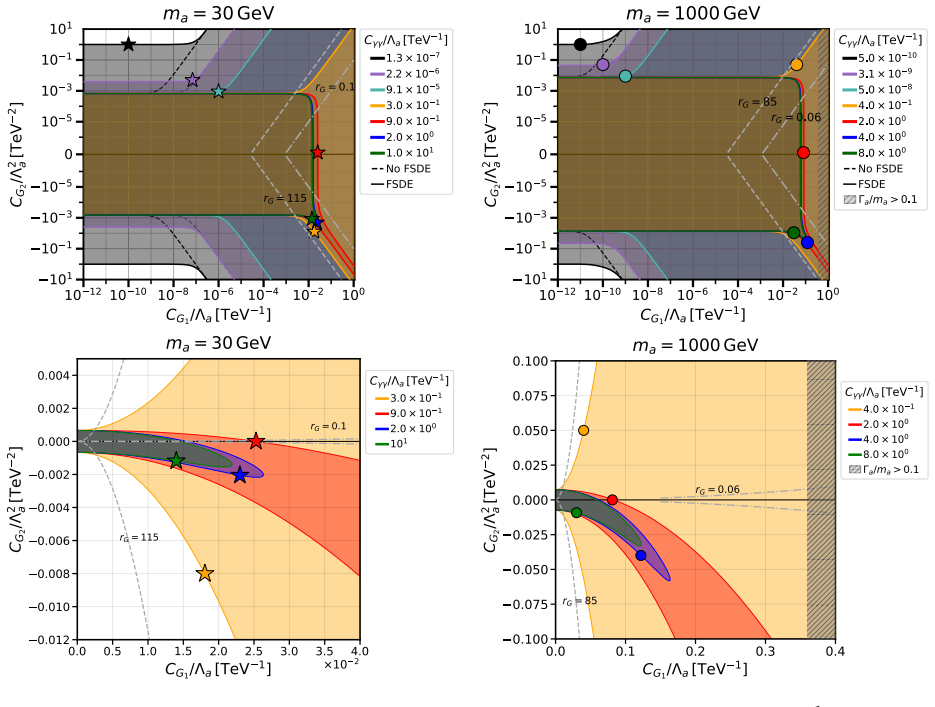
Double-ALP production at the LHC is a viable and competitive probe of ALP interactions beyond dimension-5. Focusing on gg→aa→4γ, the paper analyzes for the first time the non-resonant mode, whose rate is a polynomial in the couplings — pure C_G1⁴, pure C_G2², and an interference term C_G1²C_G2 — so different regimes test different operators, including the sign of C_G2. Because the same C_G1 that boosts production also suppresses Br(a→γγ) by opening gluonic decays, the signal is not monotonic: it contains regions where the coupling dependence cancels exactly, a valley of destructive interference for C_G2<0, and a long-lived-ALP regime where the pair escapes the detector before converting to p
Load-bearing premise
The projected reach assumes a best-case ALP whose electroweak decay couplings are tuned to maximize the photon branching ratio; if the real ALP decays more readily into W/Z pairs or fermions, the four-photon signal shrinks as Br(a→γγ)² and the quoted bounds weaken, in some regions by orders of magnitude.
Editorial extensions
If this is right
- A 300 fb^-1 four-photon search would set the first direct bound on the dimension-6 ALP-gluon contact operator, C_G2/Λ²a ≲ 10^-3 TeV^-2 for ma ≲ 300 GeV (10^-2 at 1 TeV), about an order of magnitude tighter than the Higgs-resonant channel's C_ah/Λ²a ≲ 10^-2 TeV^-2.
- No 4γ search alone closes the parameter space: allowed regions stay unbounded along four directions — C_G1 cancellation, C_γγ saturation, the C_G2<0 interference valley, and small-coupling long-lived escape.
- The same-coupling cancellation is generic, so cusps, thin allowed bands, and open regions should appear in any ALP search where one coupling controls both production and decay; interpreting such bounds requires a global fit.
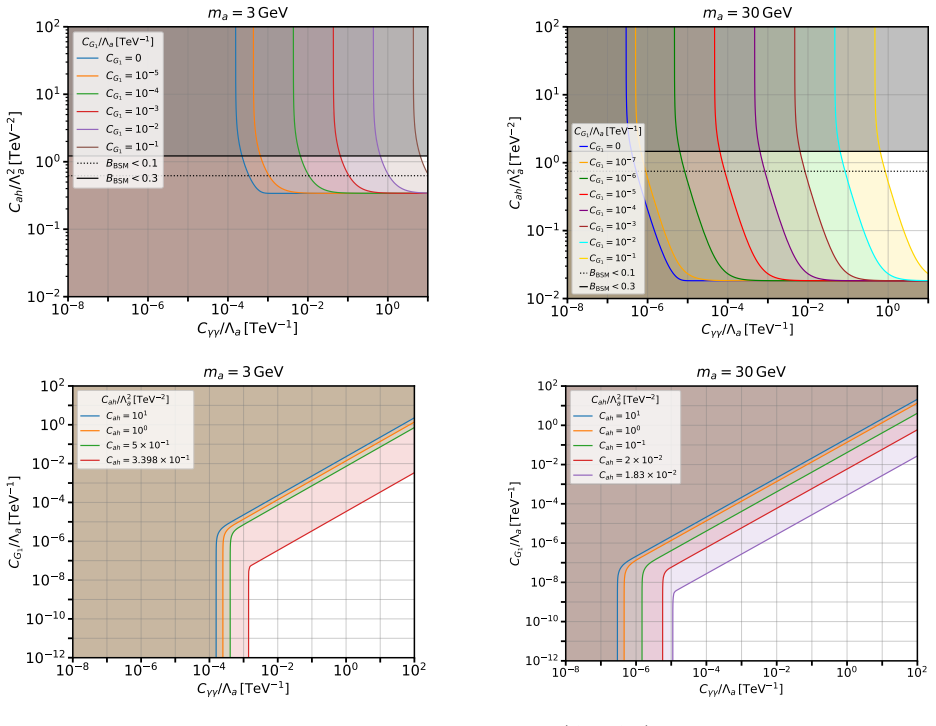
- In the Higgs-resonant recast, a non-zero C_G1 weakens the inferred limits on C_γγ by 3–5 orders of magnitude (e.g. for C_G1/Λa = 10^-3 TeV^-1), and meaningful C_γγ bounds exist only for C_ah inside a narrow, mass-dependent window.
- Sensitivity to the sign of C_G2 is possible only where interference matters (large C_G1); elsewhere the search probes |C_G2| alone, and the best-case Br assumption caps the photon branching ratio at 1/(1+F(ma)) ≈ 0.6 for ma ≫ 2m_W.
Reading between the lines
- The strongest apparent C_γγ exclusions (down to ~10^-9 TeV^-1 non-resonant, 10^-5–10^-7 TeV^-1 Higgs-resonant) live where a dimension-6 coefficient vastly exceeds dimension-5 ones; a global fit with EFT-power-counting priors would likely discard those points, reframing these as lifetime exclusions of long-lived ALPs rather than coupling bounds.
- Because the cancellation mechanism is structural, a quick cross-check of existing single-ALP limits for the same saturation direction (C_γγ → large, Br saturating) would reveal which published bounds are slices of open regions.
- A testable extension: push below ma = 30 GeV with merged-photon topologies for boosted ALPs; the paper's own efficiency curve (ϵ_cuts ≈ 0.002 at 10 GeV) predicts exactly where the non-resonant channel loses sensitivity.
- The LO-only gg→aa prediction leaves the σ11/σ12/σ22 ratios vulnerable to NLO QCD corrections; given K-factors of order 5 in the Higgs channel, the 10^-3 TeV^-2 number could move by a comparable factor once the calculation exists.
Editorial analysis
A structured set of objections, weighed in public.
Referee Report
Summary. The manuscript proposes and analyzes pp→aa→4γ searches at the LHC as a probe of the ALP EFT, focusing on the first study of non-resonant gg→aa production with dimension-5 (O_G1) and dimension-6 (O_G2) gluon couplings. The production amplitude is decomposed into σ11, σ22, σ12, computed with MadGraph and reweighting; ALP decays are treated in the NWA with Br(a→γγ) normalized to a 'best-case' total width (C_WW minimized, C_ψ=0). Detector effects are modeled with selection cuts, flat 95% photon efficiency, and finite-size detector effects with Ldet=1.08 m calibrated on the ATLAS f_aa. Under a background-free Poisson assumption, 95% CL projections are given for 300 fb^-1 at 13 TeV in two-dimensional slices, and the ATLAS h→aa→4γ search [46] is recast in (Cγγ, CG1, Cah). The main results are a projected reach on C_G2/Λ_a^2 down to ~10^-3 TeV^-2 and the observation that a pp→aa→4γ measurement alone leaves the parameter space unbounded in certain directions.
Significance. This is the first quantitative treatment of non-resonant ALP pair production through O_G2 and provides a clear analytic parameterization (Eqs. 4.3–4.8), a transparent Monte-Carlo reweighting procedure, and an explicit handling of the three components σ11/σ22/σ12 and their interference. The multidimensional presentation of allowed regions, including the sign dependence of C_G2 and finite-size detector effects, is a useful contribution. The central caveat — that the quoted reach assumes the maximal Br(a→γγ) by construction — is acknowledged internally but is not carried into the headline numbers in the abstract and conclusions.
major comments (2)
- [§4.2, Eqs. (4.30)–(4.32); §5.1, Eq. (5.1); §6] The headline reach C_G2/Λ_a^2 ≲ 10^-3 TeV^-2 is computed in the 'best-case' decay scenario: C_WW is fixed to the value minimizing Γ_a→EW (Appendix A) and all fermionic couplings C_ψ are set to zero, maximizing Br(a→γγ). These are independent ALP EFT parameters, not measured inputs. Since N_signal ∝ σ(pp→aa) Br(a→γγ)^2 and, in the C_G2-dominated region, σ(pp→aa) ∝ C_G2^2, a reduction of Br by a factor x weakens the projected bound on C_G2 by the same factor x. For m_a ≥ 2m_W, even the minimized EW width is nonzero (F(m_a) > 0, Eq. 4.29), and for a generic C_WW or non-vanishing fermionic couplings the maximum Br is smaller. The authors list this dependence as a future extension in Sec. 6, but the abstract and the conclusion quote the 10^-3 TeV^-2 value without this qualifier. Please quantify the degradation for representative non-minimal choices (e.g., C_WW=0 and a fermionic benchmark) and
- [§4.4, Eq. (4.48); lower panels of Fig. 9] The extreme bounds on C_γγ in the FSDE-dominated corners (values down to ~10^-9 TeV^-1 at m_a=1 TeV in the lower-right panel of Fig. 9) are sensitive to the modeling of the detector size. The parameter L_det=1.08 m is calibrated to reproduce the ATLAS f_aa, which is a reasonable choice, but the paper does not provide an uncertainty band. Since the bound in this regime is set by the exponential factor in P_aa and by Γ_tot^a, a factor-of-order-unity change in L_det can shift the contour. This does not affect the main C_G2 reach, but it is load-bearing for the statement that C_γγ can be constrained down to 10^-9 TeV^-1; a short scan over L_det (e.g., 0.9–1.5 m) would make the claim robust.
minor comments (4)
- [Eq. (5.7)] The symbol C_γγ is used both as the parameter being constrained and as the upper-limit value taken from Ref. [46]. Rename the latter, e.g. C_γγ^lim, to avoid ambiguity in the recast inequality.
- [Fig. 7] The three efficiency curves ε_cuts,11, ε_cuts,22, ε_cuts,12 are stated to completely overlap. The caption should state this explicitly; if the few-percent differences matter at m_a=30 GeV, they could be shown in a small inset.
- [§4.3, Eq. (4.41)] The flat 95% photon reconstruction efficiency is a useful approximation, but it neglects p_T/η dependence and possible merging of photons from boosted ALPs. The restriction m_a ≥ 30 GeV mitigates the latter; a sentence quantifying the residual uncertainty would be helpful.
- [§3.1] Typographical issue: 'can also be extracted from by di-photon resonance searches' should be 'can also be extracted from di-photon resonance searches'.
Circularity Check
No significant circularity: the projected C_G2/Λ_a^2 sensitivity follows from first-principles matrix elements and a disclosed best-case Br choice; self-citations are not load-bearing.
full rationale
Walking the derivation chain, the central non-resonant sensitivity claim is self-contained. The signal count is N_signal = L ε_reco σ_FSDE,cuts (Br(a→γγ))^2 (Eqs. 4.1 and 5.1), with σ(pp→aa) decomposed into components σ11, σ22, σ12 computed from the tree-level amplitudes in Eqs. (4.3)–(4.8) and Tab. 1, and Br(a→γγ) obtained from the partial-width ratios in Eqs. (4.23)–(4.32). None of these inputs is fitted to the reported 95% CL reach; the reach is obtained by setting the background-free Poisson bound N_signal≤3. The fixed value C_WW = C̄_WW in Sec. 4.2 is explicitly a disclosed best-case benchmark that minimizes Γ_a→EW and maximizes Br(a→γγ); it is a modeling assumption, acknowledged in the Conclusions, and it weakens but does not determine the final bound by construction. The detector-scale parameter L_det=1.08 m is calibrated to reproduce the ATLAS f_aa function (Sec. 4.4) and then used to recast the ATLAS h→aa→4γ limits (Sec. 5.2); this is an external-data validation/calibration, and the recast outputs are transformations of the ATLAS limits, not an independently predicted quantity recycled from the fit. Self-citations (e.g. Refs. [26,33,140,142]) are contextual—EFT formulation, running, NDA/unitarity remarks—and are not load-bearing for the projected reach; the unitarity bounds of Ref. [140] enter only the theoretical-context Table 3, not the derivation of the sensitivity. The unbounded-directions conclusion follows algebraically from cancellations and saturation (Sec. 5.3), not from a self-referential construction. Thus no step reduces to its own input; the score of 2 reflects only minor non-load-bearing self-citations and the disclosed optimistic Br assumption, not circularity.
Assumptions & free parameters
free parameters (4)
- C_WW (best-case EW ALP-decay coefficient) =
Piecewise: s_w^2 for mZ≤ma<2mW; s_w^4 λ^(3/2)_Zγ/(c_w^2 λ^(3/2)_WW + s_w^2 λ^(3/2)_Zγ) for 2mW≤ma<2mZ; etc. (Eq. A.1)
- Ldet (detector radius for finite-size detector effects) =
1.08 m
- ϵreco (flat photon reconstruction efficiency) =
(0.95)^4 ≈ 0.81
- K-factor for pp→h =
K ≈ 5
assumptions (5)
- domain assumption ALP EFT truncated at dimension 6 with CP-even operators and no fermionic couplings
- domain assumption Narrow-width approximation factorizes production and decay
- domain assumption SM background is negligible and nobs=0, so 95% CL is Nsignal≤3
- ad hoc to paper OG2 is retained while dimension-6 fermionic operators are discarded
- domain assumption Interference between Higgs-resonant and non-resonant amplitudes is neglected
Cite this review
Pith. "Pith review of ALP pair production at the LHC." pith.science (2026). https://pith.science/paper/YFHJZWQ6
@misc{pith2026260721712,
  author       = {Pith},
  title        = {Pith review of: ALP pair production at the LHC},
  year         = {2026},
  howpublished = {\url{https://pith.science/paper/YFHJZWQ6}},
  note         = {Machine review of arXiv:2607.21712}
}
abstract
We study axion-like particle (ALP) pair production at the LHC, investigating its sensitivity to the simultaneous presence of dimension-5 and dimension-6 ALP interactions. Focusing on the signature with four isolated photons, we analyze for the first time the non-resonant process $gg\to aa$, finding that it can constrain significantly ALP interactions, already at an integrated luminosity of 300 fb$^{-1}$. Particular attention is paid to the multidimensional nature of the ALP parameter space. To this end, we present a re-interpretation of a search for the Higgs-resonant process $gg\to h\to aa$ by the ATLAS Collaboration, recasting their results within a three-parameter space. We find that the multi-dimensional constraints resulting from both non-resonant and Higgs-resonant ALP pair production exhibit non-trivial features, that are expected to extend to other searches in which the ALPs decay into Standard Model particles.
Figures


Figures from the paper (15 more)






Reference graph
Works this paper leans on
-
[1]
L. Di Luzio, M. Giannotti, E. Nardi and L. Visinelli,The landscape of QCD axion models,Phys. Rept.870(2020) 1–117, [2003.01100]
arXiv 2020
-
[2]
K. Choi, S. H. Im and C. Sub Shin,Recent Progress in the Physics of Axions and Axion-Like Particles,Ann. Rev. Nucl. Part. Sci.71(2021) 225–252, [2012.05029]
arXiv 2021
-
[3]
L. Di Luzio, H. Gisbert, G. Levati, P. Paradisi and P. Sørensen,CP-Violating Axions: A Theory Review,2312.17310
-
[4]
A. Biek¨ otter and K. Mimasu,Axions and Axion-like particles: collider searches,2508.19358
-
[5]
A. Arza et al.,The COSMIC WISPers White Paper: The physics case for Weakly Interacting Slim Particles,2603.03433
-
[6]
R. D. Peccei and H. R. Quinn,CP Conservation in the Presence of Instantons,Phys. Rev. Lett.38 (1977) 1440–1443
1977
-
[7]
R. D. Peccei and H. R. Quinn,Constraints Imposed by CP Conservation in the Presence of Instantons,Phys. Rev. D16(1977) 1791–1797
1977
-
[8]
Weinberg,A New Light Boson?,Phys
S. Weinberg,A New Light Boson?,Phys. Rev. Lett.40(1978) 223–226
1978
Show all 95 references
-
[9]
Wilczek,Problem of StrongPandTInvariance in the Presence of Instantons,Phys
F. Wilczek,Problem of StrongPandTInvariance in the Presence of Instantons,Phys. Rev. Lett. 40(1978) 279–282
1978
-
[10]
P. W. Graham, D. E. Kaplan and S. Rajendran,Cosmological Relaxation of the Electroweak Scale, Phys. Rev. Lett.115(2015) 221801, [1504.07551]
2015 arXiv
-
[11]
G. B. Gelmini and M. Roncadelli,Left-Handed Neutrino Mass Scale and Spontaneously Broken Lepton Number,Phys. Lett. B99(1981) 411–415. – 56 –
1981
-
[12]
Chikashige, R
Y. Chikashige, R. N. Mohapatra and R. D. Peccei,Spontaneously Broken Lepton Number and Cosmological Constraints on the Neutrino Mass Spectrum,Phys. Rev. Lett.45(1980) 1926
1980
-
[13]
Chikashige, R
Y. Chikashige, R. N. Mohapatra and R. D. Peccei,Are There Real Goldstone Bosons Associated with Broken Lepton Number?,Phys. Lett. B98(1981) 265–268
1981
-
[14]
Schechter and J
J. Schechter and J. W. F. Valle,Neutrino Decay and Spontaneous Violation of Lepton Number, Phys. Rev. D25(1982) 774
1982
-
[15]
Calibbi, F
L. Calibbi, F. Goertz, D. Redigolo, R. Ziegler and J. Zupan,Minimal axion model from flavor, Phys. Rev. D95(2017) 095009, [1612.08040]
2017 arXiv
-
[16]
Y. Ema, K. Hamaguchi, T. Moroi and K. Nakayama,Flaxion: a minimal extension to solve puzzles in the standard model,JHEP01(2017) 096, [1612.05492]
2017 arXiv
-
[17]
Davidson and K
A. Davidson and K. C. Wali,Minimal flavor unification via multigenerational Peccei-Quinn symmetry,Phys. Rev. Lett.48(1982) 11
1982
-
[18]
Wilczek,Axions and Family Symmetry Breaking,Phys
F. Wilczek,Axions and Family Symmetry Breaking,Phys. Rev. Lett.49(1982) 1549–1552
1982
-
[19]
E. Katz, A. E. Nelson and D. G. E. Walker,The Intermediate Higgs,JHEP08(2005) 074, [hep-ph/0504252]
2005 arXiv
-
[20]
Contino, D
R. Contino, D. Marzocca, D. Pappadopulo and R. Rattazzi,On the effect of resonances in composite Higgs phenomenology,JHEP10(2011) 081, [1109.1570]
2011 arXiv
-
[21]
Witten,Some Properties of O(32) Superstrings,Phys
E. Witten,Some Properties of O(32) Superstrings,Phys. Lett. B149(1984) 351–356
1984
-
[22]
Svrcek and E
P. Svrcek and E. Witten,Axions In String Theory,JHEP06(2006) 051, [hep-th/0605206]
2006 arXiv
-
[23]
Georgi, D
H. Georgi, D. B. Kaplan and L. Randall,Manifesting the Invisible Axion at Low-energies,Phys. Lett. B169(1986) 73–78
1986
-
[24]
Buchmuller and D
W. Buchmuller and D. Wyler,Effective Lagrangian Analysis of New Interactions and Flavor Conservation,Nucl. Phys. B268(1986) 621–653
1986
-
[25]
Grzadkowski, M
B. Grzadkowski, M. Iskrzynski, M. Misiak and J. Rosiek,Dimension-Six Terms in the Standard Model Lagrangian,JHEP10(2010) 085, [1008.4884]
2010 arXiv
-
[26]
Brivio, M
I. Brivio, M. B. Gavela, L. Merlo, K. Mimasu, J. M. No, R. del Rey et al.,ALPs Effective Field Theory and Collider Signatures,Eur. Phys. J. C77(2017) 572, [1701.05379]
2017 arXiv
-
[27]
Buchalla, O
G. Buchalla, O. Cat` a and C. Krause,Complete Electroweak Chiral Lagrangian with a Light Higgs at NLO,Nucl. Phys. B880(2014) 552–573, [1307.5017]. [Erratum: Nucl.Phys.B 913, 475–478 (2016)]
2014 arXiv
-
[28]
Brivio, J
I. Brivio, J. Gonzalez-Fraile, M. C. Gonzalez-Garcia and L. Merlo,The complete HEFT Lagrangian after the LHC Run I,Eur. Phys. J. C76(2016) 416, [1604.06801]
2016 arXiv
-
[29]
Buchalla, A
G. Buchalla, A. J. Buras and M. E. Lautenbacher,Weak Decays beyond Leading Logarithms,Rev. Mod. Phys.68(1996) 1125–1144, [hep-ph/9512380]
1996 arXiv
-
[30]
E. E. Jenkins, A. V. Manohar and P. Stoffer,Low-Energy Effective Field Theory below the Electroweak Scale: Operators and Matching,JHEP03(2018) 016, [1709.04486]. [Erratum: JHEP 12, 043 (2023)]
2018 arXiv
-
[31]
Bauer, M
M. Bauer, M. Neubert, S. Renner, M. Schnubel and A. Thamm,The Low-Energy Effective Theory of Axions and ALPs,JHEP04(2021) 063, [2012.12272]
2021 arXiv
-
[32]
Chala, G
M. Chala, G. Guedes, M. Ramos and J. Santiago,Running in the ALPs,Eur. Phys. J. C81(2021) 181, [2012.09017]. – 57 –
2021 arXiv
-
[33]
Bonilla, I
J. Bonilla, I. Brivio, M. B. Gavela and V. Sanz,One-loop corrections to ALP couplings,JHEP11 (2021) 168, [2107.11392]
2021 arXiv
-
[34]
Bauer, M
M. Bauer, M. Neubert, S. Renner, M. Schnubel and A. Thamm,Consistent Treatment of Axions in the Weak Chiral Lagrangian,Phys. Rev. Lett.127(2021) 081803, [2102.13112]
2021 arXiv
-
[35]
Bauer, M
M. Bauer, M. Neubert, S. Renner, M. Schnubel and A. Thamm,Flavor probes of axion-like particles,JHEP09(2022) 056, [2110.10698]
2022 arXiv
-
[36]
Di Luzio, G
L. Di Luzio, G. Levati and P. Paradisi,The chiral Lagrangian of CP-violating axion-like particles, JHEP02(2024) 020, [2311.12158]
2024 arXiv
-
[37]
Das Bakshi, J
S. Das Bakshi, J. Machado-Rodr ´ ıguez and M. Ramos,Running beyond ALPs: shift-breaking and CP-violating effects,JHEP11(2023) 133, [2306.08036]
2023 arXiv
-
[38]
L. C. Bresciani, G. Brunello, G. Levati, P. Mastrolia and P. Paradisi,Renormalization of effective field theories via on-shell methods: the case of axion-like particles,JHEP10(2025) 190, [2412.04160]
2025 arXiv
-
[39]
cajohare/axionlimits: Axionlimits
C. O’Hare, “cajohare/axionlimits: Axionlimits.”https://cajohare.github.io/AxionLimits/, July, 2020. 10.5281/zenodo.3932430
2020 doi
-
[40]
Bauer, M
M. Bauer, M. Neubert and A. Thamm,Collider Probes of Axion-Like Particles,JHEP12(2017) 044, [1708.00443]. [41]ATLAScollaboration, M. Aaboud et al.,Search for Higgs boson decays into pairs of light (pseudo)scalar particles in theγγjjfinal state inppcollisions at √s= 13TeV with ...
2017 arXiv
-
[53]
Bonilla, I
J. Bonilla, I. Brivio, J. Machado-Rodr ´ ıguez and J. F. de Troc´ oniz,Nonresonant searches for axion-like particles in vector boson scattering processes at the LHC,JHEP06(2022) 113, [2202.03450]
2022 arXiv
-
[54]
Esser, A
F. Esser, A. Salas-Bernardez, M. Ubiali and V. Sanz,A global analysis of ALP-mediated multiboson production at the LHC,2510.24873
-
[55]
Bruggisser, L
S. Bruggisser, L. Grabitz and S. Westhoff,Global analysis of the ALP effective theory,JHEP01 (2024) 092, [2308.11703]
2024 arXiv
-
[56]
Biek¨ otter, J
A. Biek¨ otter, J. Fuentes-Mart ´ ın, A. M. Galda and M. Neubert,A global analysis of axion-like particle interactions using SMEFT fits,JHEP09(2023) 120, [2307.10372]
2023 arXiv
-
[57]
A. M. Galda and M. Neubert,ALP-LEFT Interference and the Muon(g−2),JHEP11(2023) 015, [2308.01338]
2023 arXiv
-
[58]
Bonnefoy, C
Q. Bonnefoy, C. Grojean and J. Kley,Shift-Invariant Orders of an Axionlike Particle,Phys. Rev. Lett.130(2023) 111803, [2206.04182]
2023 arXiv
-
[59]
Grojean, J
C. Grojean, J. Kley and C.-Y. Yao,Hilbert series for ALP EFTs,JHEP11(2023) 196, [2307.08563]
2023 arXiv
-
[60]
Bertuzzo, C
E. Bertuzzo, C. Grojean and G. M. Salla,ALPs, the on-shell way,JHEP05(2024) 175, [2311.16253]
2024 arXiv
-
[61]
L. C. Bresciani, G. Levati and P. Paradisi,Positivity and partial wave unitarity bounds on ALP theories via amplitude methods,2510.13953
-
[62]
Beadle, S
C. Beadle, S. A. R. Ellis, J. Quevillon and P. N. Hoa Vuong,Quadratic coupling of the axion to photons,Phys. Rev. D110(2024) 035019, [2307.10362]
2024 arXiv
-
[63]
H. Kim, A. Lenoci, G. Perez and W. Ratzinger,Probing an ultralight QCD axion with electromagnetic quadratic interaction,Phys. Rev. D109(2024) 015030, [2307.14962]
2024 arXiv
-
[64]
Draper and D
P. Draper and D. McKeen,Diphotons from Tetraphotons in the Decay of a 125 GeV Higgs at the LHC,Phys. Rev. D85(2012) 115023, [1204.1061]
2012 arXiv
-
[65]
Bauer, M
M. Bauer, M. Heiles, M. Neubert and A. Thamm,Axion-Like Particles at Future Colliders,Eur. Phys. J. C79(2019) 74, [1808.10323]
2019 arXiv
-
[66]
Bauer, G
M. Bauer, G. Rostagni and J. Spinner,Axion-Higgs portal,Phys. Rev. D107(2023) 015007, [2207.05762]
2023 arXiv
-
[67]
Craig, A
N. Craig, A. Hook and S. Kasko,The Photophobic ALP,JHEP09(2018) 028, [1805.06538]. – 59 – [68]ATLAScollaboration, G. Aad et al.,Search for new phenomena in events with at least three photons collected inppcollisions at √s= 8 TeV with the ATLAS detector,Eur. Phys. J. C76 (2016)...
2018 arXiv
-
[70]
Aloni, Y
D. Aloni, Y. Soreq and M. Williams,Coupling QCD-Scale Axionlike Particles to Gluons,Phys. Rev. Lett.123(2019) 031803, [1811.03474]
2019 arXiv
-
[71]
K. Choi, K. Kang and J. E. Kim,Effects ofη ′ in Low-energy Axion Physics,Phys. Lett. B181 (1986) 145–149
1986
-
[72]
Jaeckel and M
J. Jaeckel and M. Spannowsky,Probing MeV to 90 GeV axion-like particles with LEP and LHC, Phys. Lett. B753(2016) 482–487, [1509.00476]
2016 arXiv
-
[73]
Mimasu and V
K. Mimasu and V. Sanz,ALPs at Colliders,JHEP06(2015) 173, [1409.4792]. [74]OPALcollaboration, G. Abbiendi et al.,Multiphoton production in e+ e- collisions at s**(1/2) = 181-GeV to 209-GeV,Eur. Phys. J. C26(2003) 331–344, [hep-ex/0210016]
2015 arXiv
-
[75]
Knapen, T
S. Knapen, T. Lin, H. K. Lou and T. Melia,Searching for Axionlike Particles with Ultraperipheral Heavy-Ion Collisions,Phys. Rev. Lett.118(2017) 171801, [1607.06083]. [76]Belle-IIcollaboration, F. Abudin´ en et al.,Search for Axion-Like Particles produced ine +e− collisions at ...
2017 arXiv
-
[80]
Baldenegro, S
C. Baldenegro, S. Fichet, G. von Gersdorff and C. Royon,Searching for axion-like particles with proton tagging at the LHC,JHEP06(2018) 131, [1803.10835]. [81]TOTEM, CMScollaboration, A. Tumasyan et al.,Search for high-mass exclusive diphoton production with tagged protons in p...
2018 arXiv
-
[83]
V. P. Goncalves and W. K. Sauter,Exclusive axionlike particle production by gluon – induced interactions in hadronic collisions,Phys. Lett. B811(2020) 135981, [2006.16716]. [84]ATLAScollaboration, M. Aaboud et al.,Search for new phenomena in high-mass diphoton final states usi...
2020 arXiv
-
[88]
Mariotti, D
A. Mariotti, D. Redigolo, F. Sala and K. Tobioka,New LHC bound on low-mass diphoton resonances,Phys. Lett. B783(2018) 13–18, [1710.01743]. [89]CMScollaboration, A. Hayrapetyan et al.,Search for a standard model-like Higgs boson in the mass range between 70 and 110 GeV in the d...
2018 arXiv
-
[93]
d’Enterria,Collider constraints on axion-like particles, inWorkshop on Feebly Interacting Particles, 2, 2021.2102.08971
D. d’Enterria,Collider constraints on axion-like particles, inWorkshop on Feebly Interacting Particles, 2, 2021.2102.08971
2021
-
[94]
M. B. Gavela, J. M. No, V. Sanz and J. F. de Troc´ oniz,Nonresonant Searches for Axionlike Particles at the LHC,Phys. Rev. Lett.124(2020) 051802, [1905.12953]
2020 arXiv
-
[95]
Carra, V
S. Carra, V. Goumarre, R. Gupta, S. Heim, B. Heinemann, J. Kuechler et al.,Constraining off-shell production of axionlike particles with Zγand WW differential cross-section measurements,Phys. Rev. D104(2021) 092005, [2106.10085]. [96]CMScollaboration, A. Tumasyan et al.,Search...
2021 arXiv
-
[97]
Biswas,Probing the interactions of axion-like particles with electroweak bosons and the Higgs boson in the high energy regime at LHC,JHEP05(2024) 081, [2312.05992]
T. Biswas,Probing the interactions of axion-like particles with electroweak bosons and the Higgs boson in the high energy regime at LHC,JHEP05(2024) 081, [2312.05992]
2024 arXiv
-
[98]
Alonso- ´Alvarez, M
G. Alonso- ´Alvarez, M. B. Gavela and P. Quilez,Axion couplings to electroweak gauge bosons,Eur. Phys. J. C79(2019) 223, [1811.05466]
2019 arXiv
-
[99]
Cheung, W
K. Cheung, W. Hsiao, C. J. Ouseph and C. Wang,Probing the gauge-boson couplings of axion-like particle at the LHC and high-luminosity LHC,JHEP05(2024) 324, [2402.10550]
2024 arXiv
-
[100]
Sun, Z.-P
J. Sun, Z.-P. Xing and S. Yun,Revisiting axion-like particle couplings to electroweak gauge bosons, Chin. Phys. C49(2025) 113109, [2501.15250]
2025 arXiv
-
[101]
A. M. Galda, M. Neubert and S. Renner,ALP — SMEFT interference,JHEP06(2021) 135, [2105.01078]
2021 arXiv
-
[102]
Arganda, A
E. Arganda, A. D. Medina, N. I. Mileo, R. A. Morales and A. Szynkman,Constraining R-axion models through dijet searches at the LHC,Phys. Lett. B789(2019) 575–581, [1808.01292]. – 61 –
2019 arXiv
-
[103]
F. A. Ghebretinsaea, Z. S. Wang and K. Wang,Probing axion-like particles coupling to gluons at the LHC,JHEP07(2022) 070, [2203.01734]
2022 arXiv
-
[104]
Haghighat, D
G. Haghighat, D. Haji Raissi and M. Mohammadi Najafabadi,New collider searches for axionlike particles coupling to gluons,Phys. Rev. D102(2020) 115010, [2006.05302]. [105]ATLAScollaboration, G. Aad et al.,Search for new phenomena in events with an energetic jet and missing tra...
2020 arXiv
-
[106]
Anuar, A
A. Anuar, A. Biek¨ otter, T. Biek¨ otter, A. Grohsjean, S. Heinemeyer, L. Jeppe et al.,ALP-ine quests at the LHC: hunting axion-like particles via peaks and dips int tproduction,JHEP12(2024) 197, [2404.19014]
2024 arXiv
-
[107]
Esser, M
F. Esser, M. Madigan, V. Sanz and M. Ubiali,On the coupling of axion-like particles to the top quark,JHEP09(2023) 063, [2303.17634]. [108]CMScollaboration, A. Gevorgyan et al.,Measurement of dijet angular distributions and search for beyond the standard model physics in proton...
2023 arXiv
-
[109]
Ebadi, S
J. Ebadi, S. Khatibi and M. Mohammadi Najafabadi,New probes for axionlike particles at hadron colliders,Phys. Rev. D100(2019) 015016, [1901.03061]
2019 arXiv
-
[110]
Rygaard, J
L. Rygaard, J. Niedziela, R. Sch¨ afer, S. Bruggisser, J. Alimena, S. Westhoff et al.,Top Secrets: long-lived ALPs in top production,JHEP10(2023) 138, [2306.08686]
2023 arXiv
-
[111]
Hosseini and M
Y. Hosseini and M. Mohammadi Najafabadi,Exploring axionlike particle couplings through single top tW-channel and top pair production at the LHC,Phys. Rev. D110(2024) 055026, [2408.11588]
2024 arXiv
-
[112]
Butterworth, M
J. Butterworth, M. Cullingworth, J. Egan, F. Esser, V. Sanz and M. Ubiali,Probing the coupling of axions to tops and gluons with LHC measurements,JHEP02(2026) 073, [2508.21660]
2026 arXiv
-
[113]
A. V. Phan and S. Westhoff,Precise tests of the axion coupling to tops,JHEP05(2024) 075, [2312.00872]
2024 arXiv
-
[114]
Blasi, F
S. Blasi, F. Maltoni, A. Mariotti, K. Mimasu, D. Pagani and S. Tentori,Top-philic ALP phenomenology at the LHC: the elusive mass-window,JHEP06(2024) 077, [2311.16048]. [115]ATLAS, CMScollaboration, G. Aad et al.,Measurements of the Higgs boson production and decay rates and co...
2024 arXiv
-
[124]
Bonilla, B
J. Bonilla, B. Gavela and J. Machado-Rodr ´ ıguez,Limits on ALP-neutrino couplings from loop-level processes,Phys. Rev. D109(2024) 055023, [2309.15910]. [125]ATLAScollaboration, G. Aad et al.,Measurement of off-shell Higgs boson production in the H ∗ →ZZ→4ℓdecay channel using ...
2024 arXiv
-
[129]
Alwall, R
J. Alwall, R. Frederix, S. Frixione, V. Hirschi, F. Maltoni, O. Mattelaer et al.,The automated computation of tree-level and next-to-leading order differential cross sections, and their matching to parton shower simulations,JHEP07(2014) 079, [1405.0301]
2014 arXiv
-
[130]
Frederix, S
R. Frederix, S. Frixione, V. Hirschi, D. Pagani, H. S. Shao and M. Zaro,The automation of next-to-leading order electroweak calculations,JHEP07(2018) 185, [1804.10017]. [Erratum: JHEP 11, 085 (2021)]. [131]NNPDFcollaboration, R. D. Ball et al.,The path to proton structure at 1...
2018 arXiv
-
[132]
Anastasiou, C
C. Anastasiou, C. Duhr, F. Dulat, E. Furlan, T. Gehrmann, F. Herzog et al.,High precision determination of the gluon fusion Higgs boson cross-section at the LHC,JHEP05(2016) 058, [1602.00695]
2016 arXiv
-
[133]
Frixione,Isolated photons in perturbative QCD,Phys
S. Frixione,Isolated photons in perturbative QCD,Phys. Lett. B429(1998) 369–374, [hep-ph/9801442]. [134]ATLAScollaboration, G. Aad et al.,Electron and photon performance measurements with the ATLAS detector using the 2015–2017 LHC proton-proton collision data,JINST14(2019) P12...
1998 arXiv
-
[139]
Search for short- and long-lived axion-like particles inH→aa→4γdecays with the ATLAS experiment at the LHC
ATLAS Collaboration, “Search for short- and long-lived axion-like particles inH→aa→4γdecays with the ATLAS experiment at the LHC.” HEPData (collection), 2024. https://doi.org/10.17182/hepdata.144534
2024 doi
-
[140]
Brivio, O
I. Brivio, O. J. P. ´Eboli and M. C. Gonzalez-Garcia,Unitarity constraints on ALP interactions, Phys. Rev. D104(2021) 035027, [2106.05977]
2021 arXiv
-
[141]
Manohar and H
A. Manohar and H. Georgi,Chiral Quarks and the Nonrelativistic Quark Model,Nucl. Phys. B234 (1984) 189–212
1984
-
[142]
Brivio, R
I. Brivio, R. Gr¨ ober and K. Schmid,The Art of Counting: a reappraisal of the HEFT expansion, JHEP04(2026) 202, [2511.23410]
2026 arXiv
-
[143]
L. C. Bresciani, G. Levati and P. Paradisi,Amplitudes and partial wave unitarity bounds,Phys. Rev. D113(2026) L071702, [2504.12855]
2026 arXiv
-
[144]
J. E. Kim,Weak Interaction Singlet and Strong CP Invariance,Phys. Rev. Lett.43(1979) 103
1979
-
[145]
M. A. Shifman, A. I. Vainshtein and V. I. Zakharov,Can Confinement Ensure Natural CP Invariance of Strong Interactions?,Nucl. Phys. B166(1980) 493–506
1980
-
[146]
Palavri´ c, X
A. Palavri´ c, X. Ponce D ´ ıaz and H. Tiblom,The KSVZ Atlas: A Unified SMEFT-ALP Framework, 2606.12298. – 64 –
Reviewed August 1, 2026 · model on record in the stance chip above.
Discussion (0). Sign in to comment.