REVIEW 3 major objections 5 minor 25 references
Revisiting the invariant ring of two-qubit mixed states
T0 review · 3 major / 5 minor · reviewed 2026-08-01 · deepseek-v4-flash
Pith's one-line read 21 polynomials generate all two-qubit local-unitary invariants.
desk verdict A readable, honest re-derivation of King et al.'s two-qubit invariant ring results, with the Molien series done properly; the generator proof still has an enumeration-by-inspection gap that should be closed before publication. read the letter →
The pith
A machine-rendered reading of the paper's core claim, the machinery that carries it, and where it could break.
The reading
What carries the argument
The argument rests on two pieces. First, the Molien integral: after reducing GL(2)×GL(2) to SU(2)×SU(2) (scalar matrices act trivially, and SU(2) is Zariski dense in SL(2)), the representation on the 16-dimensional vectorized density matrix is diagonalized on the maximal torus diag(e^{iα/2}, e^{-iα/2})⊗diag(e^{-iα/2}, e^{iα/2})⊗diag(e^{iβ/2}, e^{-iβ/2})⊗diag(e^{-iβ/2}, e^{iβ/2}), turning the Haar integral into a double contour integral in z = e^{iα}, w = e^{iβ}. Repeated residue computations at the poles inside the unit circle yield the closed-form series. Second, the graphical tensor method: in the Bloch picture the action is SO(3)×SO(3), and all invariants are complete contractions built f
What would settle it
Use computer algebra to compute the Hilbert series of the ring generated by the 21 listed invariants and compare it coefficient-by-coefficient with the Molien series M_G(q) above; the first degree at which they differ would reveal a missed generator, while agreement to high degree would confirm the enumeration.
Extended reading notes
Core claim
The paper's central claim is that the invariant ring for two-qubit mixed states under G = SU(2)×SU(2) (equivalently GL(2)×GL(2)) has Molien series M_G(q) = (q^10 − q^8 − q^7 + 2q^6 + 2q^5 + 2q^4 − q^3 − q^2 + 1) / ((1−q)^10 (1+q)^6 (1+q^2)^2 (1+q+q^2)^3), and is generated as a C-algebra by the 21 invariants K1,...,K9, X1, X2, U1, U2, V1,...,V4, W1,...,W4. The paper supplies two things earlier treatments left opaque: a residue-calculus proof of the Molien series with every pole computed, and a systematic graph enumeration explaining why exactly these 21 are needed and why the other candidates reduce to combinations of them. The result is framed as a rigorous, self-contained exposition of a 20
Load-bearing premise
The whole generator proof rests on the assertion—made by visual inspection of the figures in Appendix C—that the connected graphs drawn for cases (24), (26), and (31) are all the connected graphs that can occur; if any connected graph was missed, the 21 polynomials might generate a proper subring of the invariant ring even though the Molien series is correct.
Editorial extensions
If this is right
- The 21 polynomials form an integrity basis: every polynomial local-unitary invariant of a two-qubit state is a polynomial in these 21, so any LU-invariant quantity is expressible, in principle, in terms of them.
- The Molien series gives the full graded dimension sequence of the invariant ring; from the denominator factors one can read off the degrees of a homogeneous system of parameters and the secondary invariants in a Hironaka decomposition.
- The explicit reduction identities—chain shortening and cross-product decomposition—show that only finitely many graph patterns need be checked, making the generator proof checkable by hand.
- The graphical strategy is specific to the two-qubit case: the paper argues it cannot be directly ported to qubit-qutrit systems because no surjective homomorphism SU(d)→SO(d^2−1) exists for d>2.
- The candidate enumeration includes two extra invariants that were missing from earlier enumerations, and the paper shows they reduce to combinations of the 21, confirming that the 21 suffice.
Reading between the lines
- If the enumeration is complete, the same graphical calculus can be turned into a computer program: generate all connected graphs up to the bounded chain length and verify the Hilbert series coefficient-by-coefficient against the Molien series, testing the generator claim without trusting hand-drawn figures.
- The gap between the 21 generators and the 18 invariants known to separate LU-equivalence classes suggests a two-tier structure—a small separation set plus extra generators needed to close the ring; making this gap explicit could help choose minimal measurement sets for entanglement detection.
- For qubit-qutrit systems, the paper's own remarks imply the contraction-based approach stalls at the absence of an SO(8) image; a likely workaround is to work directly with SU(3) invariant tensors rather than SO(8), at the cost of many more graph types.
- A numerical sampler could test the 21 generators empirically: generate random two-qubit states, evaluate a high-degree invariant known from the Molien-series dimension, and check that the 21 generators span it; disagreement would localize a gap in the enumeration.
Editorial analysis
A structured set of objections, weighed in public.
Referee Report
Summary. The paper revisits the known characterization, due to King, Welsh, and Jarvis, of the ring of local unitary polynomial invariants of two-qubit mixed states. It has two main parts: first, a detailed derivation of the Molien series for the action of SU(2)×SU(2) on the 16-dimensional space of density matrices, carried out by reducing to the maximal torus, applying Weyl integration, and evaluating the resulting double contour integral by residues; second, a graphical tensor method that constructs candidate invariants from Bloch-vector and correlation-matrix building blocks, reduces the candidate list using algebraic identities, and claims that the remaining 21 invariants generate the full invariant ring. The paper is explicitly framed as an exposition that fills in computational and pedagogical gaps in the original treatment. The final Molien series is stated in Theorem 3.5, and the 21-generator claim is stated in Theorem 4.4.
Significance. If the derivation is accepted, the paper provides a valuable self-contained exposition of a structurally important result: the Molien series is computed in unusual detail, and the expansion reproduces the known low-degree counts n0=1, n1=1, n2=4, which is a useful sanity check. The paper also gives an explicit, organized list of the 21 generating invariants and derives several nontrivial reduction identities. The main result is not new, but the expository value for quantum information and invariant theory audiences is real. However, the constructive part of the proof, especially the exhaustiveness of the graphical enumeration, is not yet presented at the standard of rigor that would make the paper a reliable reference.
major comments (3)
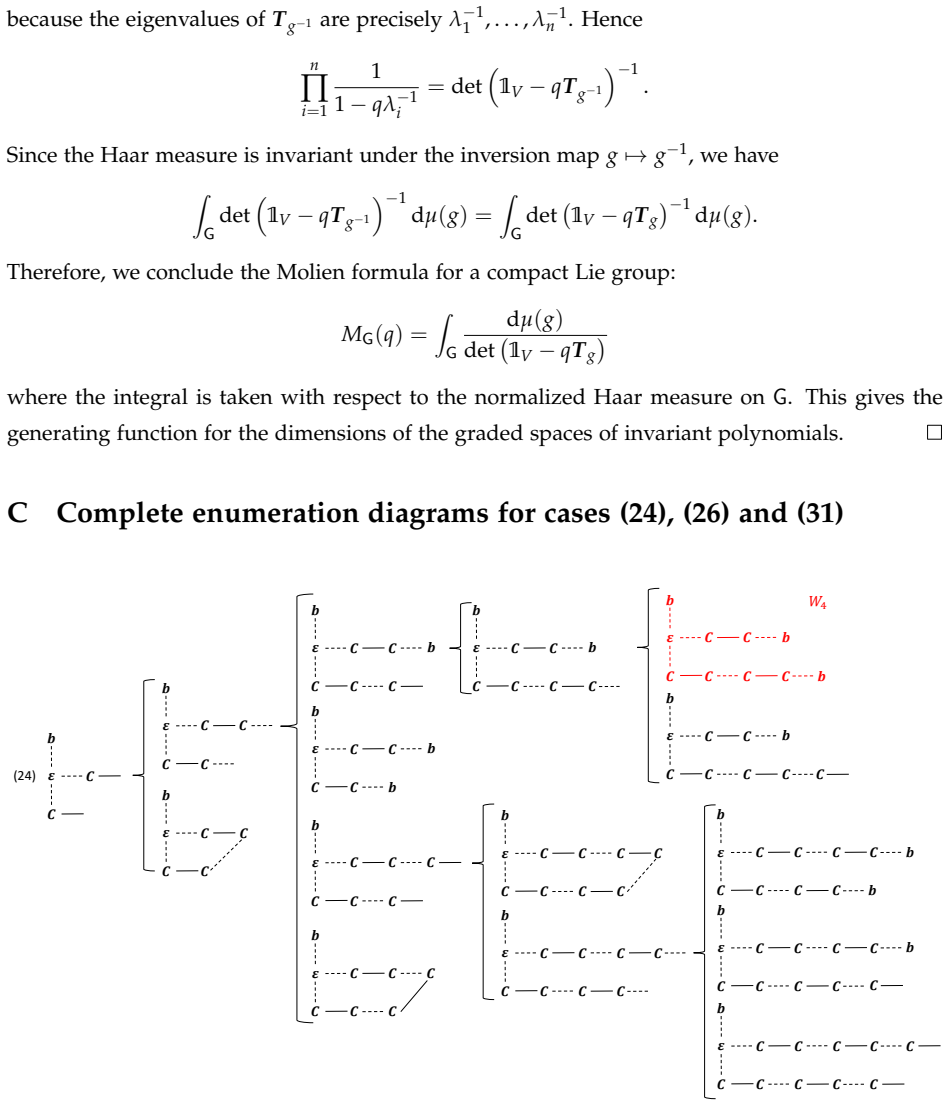
- [§4.2 (vii)–(ix), Appendix C] The proof of Theorem 4.4 rests on the claim that the connected graphs listed in Figures 7–11 exhaust all possibilities for cases (24), (26), and (31). The only support is the sentence after Figure 8: 'By enumerating all the connected graphs, it can be known that ...'. No algorithm, no counting argument, and no computer algebra check is supplied. This is load-bearing: the Molien series fixes only the dimensions of homogeneous invariant spaces and cannot by itself certify that the 21 listed polynomials generate the invariant ring. A missed connected graph could produce an invariant not expressible in terms of the 21 generators, invalidating the constructive claim. Because Proposition 4.1 bounds C-chains by at most four C-nodes, the enumeration is finite and could be made machine-checkable. I request either a rigorous combinatorial enumeration with an explicit counting bound, or a reproduci
- [§4.2 (ix), Figures 9–11] Even accepting the diagrams as exhaustive, the reduction in case (31) is not itemized. The text states that 'from these diagrams' all candidate invariants except U1, P1, P2 reduce to Q1 or Q2, but no per-graph reduction is given, and the 'arbitrary A-type and B-type vectors' in Q1 and Q2 are not defined with respect to which subgraphs they represent. A reader cannot verify that each of the numerous unlabeled graphs in Figures 9–11 is either zero, reducible to a product of lower-degree invariants, or expressible through the listed reductions. Please provide either the explicit polynomial identity for every non-generating graph or a script that performs these reductions symbolically.
- [§4.2 (vii), Figure 7] The treatment of case (24) is similarly terse. Figure 7 displays many graphs, but only one ('W4') is labeled as a surviving candidate; the others are dismissed with the comment that they 'can either be generated by other invariants or are identically zero.' No indication is given of which graph uses which identity. Since case (24) is one of the three cases on which the exhaustiveness of the 21-generator set depends, this omission weakens the proof of Theorem 4.4.
minor comments (5)
- [§4.2 (v)] The text says that situation (16) can only generate '⟨a|C|a⟩ and ⟨a|CC^TC|a⟩', but Table 3 and Figure 3 identify the surviving invariants as K6 = ⟨a|C|b⟩ and U2 = ⟨a|CC^TC|b⟩. This appears to be a typo and should be corrected to avoid confusion.
- [Section 5] There is a typo in the concluding remarks: 'Gerdtet al' should be 'Gerdt et al.'
- [§4.2, equations after (4.1)] The notation 'bC' and similar expressions is used before its definition as the transpose-adjugate of C. A short explicit sentence defining these symbols in one place, preferably near Table 1, would improve readability.
- [Appendix C] The captions of Figures 7–11 do not explain the color/red marking convention or the status of the unlabeled graphs. Adding a note such as 'red labels indicate surviving invariants; unlabeled graphs are excluded by one of the stated identities' would make the figures much easier to check.
- [§4.2 (ix)] The reductions of Q1 and Q2 use 'Lemmas B1 and B2' from reference [10] without restating them. For a paper whose goal is accessibility, stating these two lemmas explicitly in the text or an appendix would be helpful.
Circularity Check
No significant circularity: the central theorem is attributed to external work, the Molien series is derived by independent contour integration, and the authors' self-cited identities are parameter-free auxiliary lemmas that do not assume the target result.
full rationale
The main results of the paper are not derived from their own conclusions. Theorem 3.5 is proved by an explicit residue computation starting from Molien's theorem and the Weyl integral formula; the result is also credited to the external sources [4,6], and the derivation does not use the invariant-ring generators in any way. Theorem 4.4 is attributed to King et al. [6], an external paper, and the proof in Section 4 constructs candidate invariants by graphical enumeration; it does not assume the 21-generator statement in deriving it. The enumeration completeness claim in cases (24), (26), and (31) is asserted by diagrams and inspection rather than a formal algorithm, but that is a rigor/completeness concern, not circularity. Several algebraic identities used in the reductions are quoted from the authors' own prior work [10] (e.g., Proposition 4.1: 'Recall from [10, Corollary B1]...', and the case-(31) reductions: 'From in [10, Lemmas B1 and B2]...'). These are parameter-free matrix identities that do not incorporate the target theorem or any fitted data, so under the stated review rules they constitute independent support and do not raise the circularity score. There is no fitted input renamed as a prediction, no self-referential definition, and no unacknowledged renaming of a known result: the paper is explicitly an exposition of King et al. with independent computational detail.
Assumptions & free parameters
assumptions (5)
- standard math First Fundamental Theorem for SO(3): all polynomial invariants of the vector representation are generated by contractions with δ and ε.
- standard math Zariski density of SU(2) in SL(2) and triviality of scalar action justify replacing GL(2)×GL(2) by SU(2)×SU(2) for polynomial invariants.
- standard math Weyl integral formula for SU(2) with normalized Haar measure.
- standard math Molien's theorem for compact Lie groups.
- domain assumption Two-qubit Bloch parameterization and the equivalence of LU and GL polynomial invariants on density matrices.
Cite this review
Pith. "Pith review of Revisiting the invariant ring of two-qubit mixed states." pith.science (2026). https://pith.science/paper/7WYS572X
@misc{pith2026260723039,
  author       = {Pith},
  title        = {Pith review of: Revisiting the invariant ring of two-qubit mixed states},
  year         = {2026},
  howpublished = {\url{https://pith.science/paper/7WYS572X}},
  note         = {Machine review of arXiv:2607.23039}
}
read the original abstract
Local unitary equivalence serves as the cornerstone for classifying entanglement in bipartite quantum systems. Mathematically, it reduces to the study of polynomial invariants of the density matrix under the action of local unitary groups. The collection of all such polynomial invariants forms a ring, known as the invariant ring. However, identifying the complete generators of the invariant ring is the central issue. In 2007, for the two-qubit system, King et al fully characterized the structure of the invariant ring and determined its Cohen--Macaulay decomposition. In this paper, we revisit their work, with a focus on the computation of the Molien series and the construction of invariants. On one hand, we rigorously derive the Molien series via explicit contour integration over the maximal torus, filling in all previously omitted computational steps. On the other hand, we systematically construct all invariants using a graphical method, and then reduce the candidate set by applying various identities and algebraic relations, obtaining a generating set consisting of 21 invariants. This paper aims to make this important result more widely accessible to researchers in quantum information and invariant theory through the above discussions.
Figures


Figures from the paper (8 more)




Reference graph
Works this paper leans on
-
[1]
Schlienz and G
J. Schlienz and G. Mahler, Description of entanglement, Phys. Rev. A 52, 4396 (1995)
1995
-
[2]
L. Zhang and B. Xie, A Survey of Bargmann Invariants: Geometric Foundations and Appli- cations, arXiv:2601.01858 (2026)
arXiv 2026
-
[3]
Turner and J
J. Turner and J. Morton, A complete set of invariants for LU-equivalence of density opera- tors, SIGMA 13, 028 (2017)
2017
-
[4]
Grassl, M
M. Grassl, M. Rötteler, and T. Beth, Computing local invariants of quantum-bit systems, Phys. Rev. A 58, 1833 (1998). 36
1998
-
[5]
Makhlin, Nonlocal properties of two-qubit gates and mixed states, and the optimization of quantum computations, Quant
Y. Makhlin, Nonlocal properties of two-qubit gates and mixed states, and the optimization of quantum computations, Quant. Inf. Process. 1, 243 (2002)
2002
-
[6]
R. C. King, T. A. Welsh, and P . D. Jarvis, The mixed two-qubit system and the structure of its ring of local invariants, J. Phys. A 40, 10083 (2007)
2007
-
[7]
Albeverio, L
S. Albeverio, L. Cattaneo, and L. Di Persio, Local invariants for a finite multipartite quantum system, Rep. Math. Phys. 60, 229 (2007)
2007
-
[8]
V . P . Gerdt, A. Khvedelidze, and Y. Palii, On the ring of local polynomial invariants for a pair of entangled qubits, J. Math. Sci. 168, 368 (2010)
2010
Show all 25 references
-
[9]
V . P . Gerdt, A. Khvedelidze, D. Mladenov, and Y. Palii, On the ring of local unitary invariants for X-states of two qubits, J. Math. Sci. 224, 238 (2016)
2016
-
[10]
Zhang, B
L. Zhang, B. Xie, and Y. Tao, Bargmann-invariant framework for local unitary equivalence and entanglement, Phys. Rev. A 111, 062408 (2025)
2025
-
[11]
Y. Quek, E. Kaur, and M. M. Wilde, Multivariate tract estimation in constant quantum depth, Quantum 8, 1220 (2024)
2024
-
[12]
Weyl,The Classical Groups, Princeton University Press, Princeton, 1946
H. Weyl,The Classical Groups, Princeton University Press, Princeton, 1946
1946
-
[13]
Goodman and N
R. Goodman and N. R. Wallach,Representations and Invariants of the Classical Groups, Cam- bridge University Press, Cambridge, 1998
1998
-
[14]
Quesne,SU(2)×SU(2)scalars in the enveloping algebra ofSU(4), J
C. Quesne,SU(2)×SU(2)scalars in the enveloping algebra ofSU(4), J. Math. Phys.17, 1452 (1976)
1976
-
[15]
Hochster and J
M. Hochster and J. Roberts, Rings of invariants of reductive groups acting on regular rings are Cohen–Macaulay, Adv. Math. 13, 115 (1974)
1974
-
[16]
Sturmfels,Algorithms in Invariant Theory, Springer, Vienna, 1993
B. Sturmfels,Algorithms in Invariant Theory, Springer, Vienna, 1993
1993
-
[17]
Derksen and G
H. Derksen and G. Kemper,Computational Invariant Theory, Encyclopaedia of Mathematical Sciences, vol. 130, Springer, Berlin, 2015
2015
-
[18]
J. E. Marsden and M. J. Hoffman,Basic Complex Analysis, 2nd ed., W. H. Freeman and Company, New York, 1987
1987
-
[19]
B. C. Hall,Lie Groups, Lie Algebras, and Representations: An Elementary Introduction, Graduate Texts in Mathematics, vol. 222, Springer, New York, 2003. 37
2003
-
[20]
N. Jing, M. Yang, and H. Zhao, Local unitary equivalence of quantum states and simultane- ous orthogonal equivalence, J. Math. Phys. 57, 062205 (2016)
2016
-
[21]
Almumin, J
Y. Almumin, J. Baretz, and A. Rajaraman, On the calculation of invariant tensors in gauge theories, Acta Phys. Polon. B 54, 5-A2 (2023)
2023
-
[22]
T. A. Welsh, P . D. Jarvis, and R. C. King, Invariants of mixed qubit systems, inSymmetry, Spectroscopy and SCHUR: Proceedings of the Prof. Brian G. Wybourne Commemorative Meeting, edited by R. C. King, M. Bylicki, and J. Karwowski, N. Copernicus University Press, Toru ´ n, 20...
2006
-
[23]
Penrose, Applications of negative dimensional tensors, inCombinatorial Mathematics and Its Applications, edited by D
R. Penrose, Applications of negative dimensional tensors, inCombinatorial Mathematics and Its Applications, edited by D. J. A. Welsh, Academic Press, London, 1971, pp. 221–244
1971
-
[24]
V . P . Gerdt, D. M. Mladenov, Y. G. Palii, et al.,SU(6)Casimir invariants andSU(2)⊗SU(3) scalars for a mixed qubit-qutrit state, J. Math. Sci. 179, 102 (2011)
2011
-
[25]
Ma and R
M. Ma and R. Shi, Bargmann invariants and local unitary equivalence, arXiv:2607.16878 (2026). 38
2026 arXiv
Reviewed August 1, 2026 · model on record in the stance chip above.
Discussion (0). Continue with ORCID to comment.