REVIEW 4 major objections 6 minor 64 references
Beyond Appearance: A Multi-cue Framework and Large-scale Benchmark for Pedestrian Association and Tracking on Mobile Aerial-Ground Platforms
T0 review · 4 major / 6 minor · reviewed 2026-07-30 · grok-4.5
Pith's one-line read Pedestrian identity across moving aerial and ground cameras can be recovered by adaptively fusing appearance with local context, 3D body structure, and neighbor relations.
desk verdict RealMvMoAT is the real contribution; the SOTA margin over MvMHAT* is partly teacher distillation, not pure multi-cue magic. read the letter →
The pith
A machine-rendered reading of the paper's core claim, the machinery that carries it, and where it could break.
The reading
What carries the argument
Multi-cue Adaptive Combination (MAC): four parallel branches (appearance, local context, 3D pose/shape, neighbor graph) whose cosine similarities are weighted by a shared, frame-level softmax so the system can down-weight unreliable cues; paired with Online Multi-view Feature Synchronization (OMFS), which maintains a per-identity cue memory and refines trajectory embeddings by cross-attention before DeepSORT matching.
What would settle it
On RealMvMoAT’s held-out scenes, disable or replace the 3D and context branches with pure appearance (or with GT meshes and GT semantics) and check whether AF1 and IDF1 still rise by roughly the reported double-digit margins over the MvMHAT* baseline; if the gains vanish when those cues are noisy or removed, the multi-cue claim fails.
Extended reading notes
Core claim
Under large and changing viewpoints, cross-view pedestrian association and temporal tracking improve substantially when appearance similarity is adaptively combined with local-context, SMPL-based pose/shape, and neighbor-relation cues, and when trajectory features are continuously refreshed from historical and cross-view observations; the new RealMvMoAT benchmark makes that failure mode measurable at scale.
Load-bearing premise
Coarse self-supervised body pose/shape and segmentation-derived scene tags remain stable and discriminative enough under top-down drone views, motion blur, and detector noise to act as true viewpoint-invariant helpers rather than extra noise.
Editorial extensions
If this is right
- Mobile aerial–ground surveillance can keep person identities continuous without relying only on clothing appearance.
- RealMvMoAT becomes the primary stress test for any future method claiming robustness to irregular multi-platform motion.
- Similarity-level adaptive fusion of heterogeneous cues is a workable template beyond this specific tracker.
- Forensic trajectory reconstruction across cooperating cameras becomes more trustworthy when identity switches drop as reported.
- Systems that already have multi-view video can add MAC/OMFS-style heads without changing the detector front-end.
Reading between the lines
- The same cue mix may transfer to vehicle or animal multi-view tracking wherever 3D structure and local layout are more stable than texture.
- If top-down UAV views systematically break SMPL pose, the next design step is a viewpoint-conditioned 3D prior rather than a generic mesh decoder.
- Scene-level train/test splits with no shared locations imply the method is being sold as domain-general; failure on a new city plaza would be a direct stress test of that claim.
- Privacy-preserving releases that blur faces still leave body shape and group geometry intact, so the multi-cue approach may remain effective on redacted footage.
Editorial analysis
A structured set of objections, weighed in public.
Referee Report
Summary. The paper presents FUSION, a framework for multi-view multi-object association and tracking (MvMoAT) under mobile aerial–ground camera settings. A Multi-cue Adaptive Combination (MAC) module fuses appearance with local-context (segmentation-derived), SMPL-based 3D pose/shape, and graph-modeled neighbor cues at the similarity level, using frame-level adaptive weights shared across views; an Online Multi-view Feature Synchronization (OMFS) module maintains per-identity cross-view temporal memory refined by cross-attention for tracking. The authors also release RealMvMoAT, a 504.9K-frame, 7-camera (5 UAV + 2 ground), 10-scene benchmark with 7.3M identity-labeled boxes and irregular camera motion. On RealMvMoAT, FUSION raises AF1 from 55.1 to 65.7 and IDF1 from 60.8 to 74.4 over MvMHAT*, with consistent gains reported on six public benchmarks.
Significance. If the claims hold after disentangling supervision effects, the paper makes two solid contributions: (i) RealMvMoAT is by a clear margin the largest MvMoAT benchmark (504.9K frames, 7.3M identity-labeled boxes, 5–7 irregularly moving cameras per group, scene-level train/test split with no subject/location overlap), and its emphasis on irregular UAV motion and top-down views fills a genuine gap in existing benchmarks; (ii) the multi-cue design is well-motivated, and the manuscript includes unusually thorough component ablations (Tables III–V), loss-weight sensitivity, and latency analysis, plus consistent gains on six public benchmarks. The benchmark alone is likely to see use. The method contribution is meaningful but its magnitude is currently overstated relative to what the evidence isolates.
major comments (4)
- [§V.A–B, Table II, Eqs. (21), (23)] Supervision asymmetry in the headline comparison. The 3D-structure branch is supervised by ViTPose keypoint pseudo-labels (Eq. 23) and initialized from pretrained RSC-Net weights (§V.B), and the local-context branch by MaskCLIP+ segmentation pseudo-labels (Eq. 21). The main competitor MvMHAT* is trained purely self-supervised (Eq. 20). Table III shows the 3D branch is the single largest contributor (+7.0 AF1 over baseline) — exactly the branch with the heaviest external supervision and pretrained init. The Table II margin (AF1 55.1→65.7, IDF1 60.8→74.4) therefore conflates the claimed value of the multi-cue design with plain distillation of off-the-shelf teachers. The within-design ablations in Table III are valid internal evidence but cannot bound this confound. Concrete remedy: report a teacher-matched control (baseline or MvMHAT* trained with the same ViTPose/MaskCLIP+ pseudo-label lo
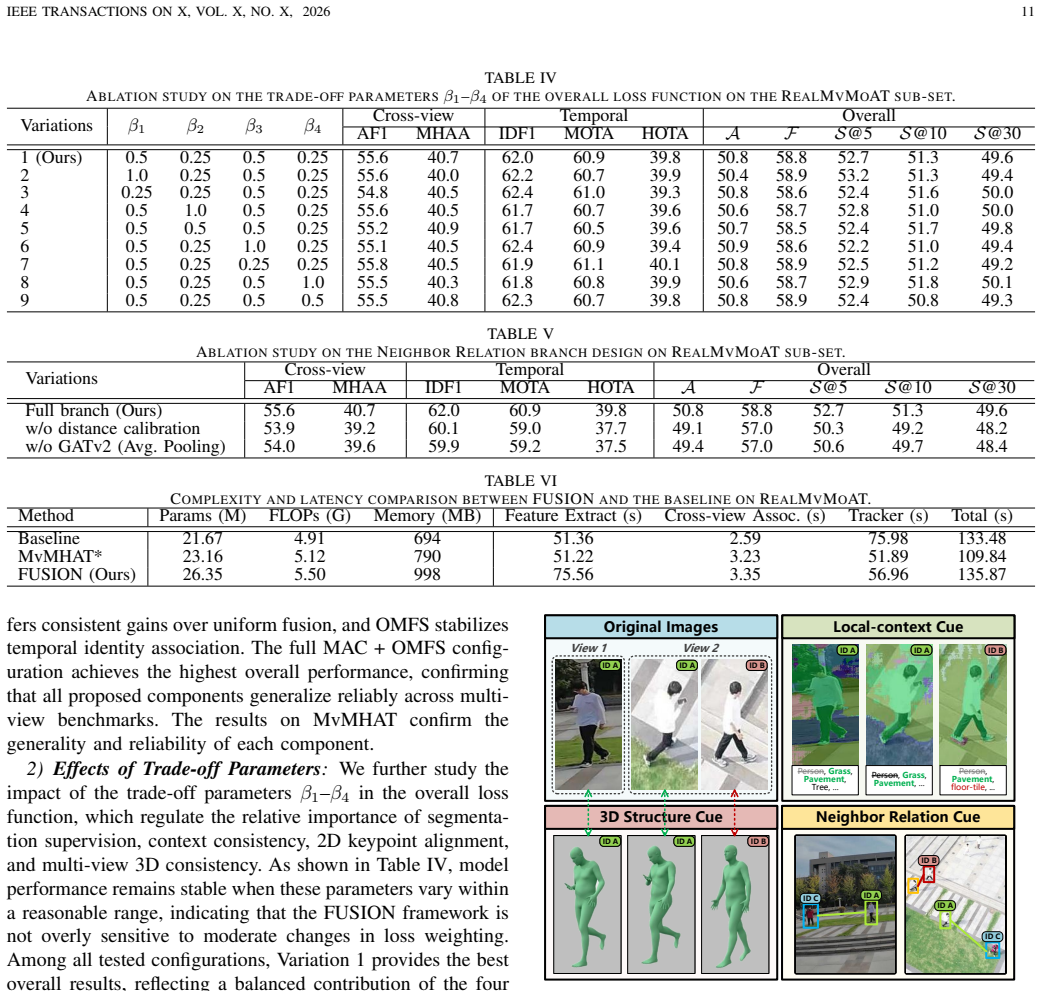
- [§IV.C.5, Eqs. (14)–(17), Table III] The 'adaptive' fusion, which is central to the paper's framing, contributes very little in the reported numbers: '+ MAC w/o Adaptive Fusion' (uniform averaging) reaches 54.3 AF1 vs. 55.2 for adaptive fusion, and on the temporal metrics the two are within ~0.3 of each other. Moreover, the frame-level shared-weight design (Eqs. 14–15) — one weight vector α_t for all pedestrians and all views at time t, predicted from a mean-pooled descriptor — is asserted as an adequacy choice but never tested against per-instance or per-pair adaptive weighting, which is the more natural design for cue reliability that varies across individuals (occluded vs. unoccluded). If adaptivity is not where the gain lives, the abstract/intro claims about 'adaptively fusing' cues should be tempered, or a stronger adaptive variant should be evaluated.
- [§IV.C.3, §V.A] Validity of the 3D cue under top-down aerial views is assumed, not demonstrated. A large fraction of RealMvMoAT views are top-down or near-top, where SMPL pose/shape estimation from a single crop is severely ill-posed and ViTPose keypoint pseudo-labels (Eq. 23) are themselves unreliable. The paper treats pose/shape as 'viewpoint-invariant' cues (§IV.C.3) but provides no quantitative validation of the branch's output quality — e.g., PCK or reprojection error against manually annotated keypoints on a small held-out subset, stratified by viewpoint (top-down vs. oblique vs. ground). Since this branch drives most of the improvement, some direct evidence that it carries real geometric signal rather than acting as a regularized extra embedding is load-bearing for the central claim.
- [§V.A–C, Tables II–III] Experimental protocol details needed for reproducibility of the central tables. (a) §III.C states all RealMvMoAT experiments use Detector mode, but it is not stated whether all methods in Table II consume identical detector outputs (YOLOv8 vs. Detectron2 per method, or a shared detection set); association numbers are sensitive to this. (b) The 'RealMvMoAT sub-set' used for Tables III–V is never defined (which scenes/groups, how many frames), yet the full model scores differ substantially between Table II (AF1 65.7) and Table III (55.5), and the baseline differs (51.7 vs. 45.9) — the subset must be specified and released for the ablations to be checkable. (c) For the public-benchmark results (Tables VII–IX, supplementary), training data provenance should be stated: is FUSION trained per benchmark, and does MvMHAT* get the same treatment?
minor comments (6)
- [Eq. (17)] The Normalization operator Norm_m applied to cue similarities before fusion is named but never defined (min-max? z-score? learned?). Please specify, since it interacts with the softmax weights α.
- [Eq. (18)] The memory bank is initialized to '0' at t = 0; presumably an empty set ∅ is meant. Also, the sensitivity to memory length L = 100 is not studied anywhere, despite L being a free parameter of OMFS.
- [Table VI] Table VI: the baseline's tracker time (75.98 s) is much larger than FUSION's (56.96 s), and the text attributes this to 'cleaner trajectories.' This is a post-hoc explanation; a supporting statistic (e.g., tracklet fragmentation count) would make it credible. Also report per-frame latency rather than only a 500-frame total.
- [Abstract, §III, Table I] Typographical: 'contains504.9K frames', '5 UA V views' (abstract and §I); 'star-structed' should be 'star-structured' (Fig. 3); inconsistent citation formatting in [31], [54], [55]; MMP-MvMHAT is attributed to [9] in Table I but to [51] (MMPTrack) in §V.A — please reconcile.
- [§III.C] The STMA metric (S@N) is described only verbally; a formal definition (or precise pointer to its source) would help, as it is nonstandard.
- [§V.D.5] Fig. 6 (adaptive weight visualization) is relegated to supplementary material, yet it is the only direct evidence that α_t responds to scene conditions; given Major Comment 2, consider moving it into the main text.
Circularity Check
No significant circularity: empirical multi-cue tracker and new benchmark; claims are held-out performance, not inputs renamed as predictions.
full rationale
FUSION’s load-bearing claims are architectural (MAC multi-cue similarity fusion; OMFS identity memory) and empirical (SOTA on RealMvMoAT and six public sets). Nothing in the derivation chain defines the reported metrics in terms of the quantities being “predicted.” Adaptive weights α_t = Softmax(ψ(F̄_t)) are produced from frame features and applied to cue cosine similarities; they are not algebraically forced to reproduce a fitted constant as the result. Training reuses MvMHAT*-style symmetric/transitive/pseudo-label losses and Hungarian-derived assignment targets—standard self-supervision for this task, not a self-definitional loop. External teachers (ViTPose, MaskCLIP+, RSC-Net init) create a possible fairness confound versus pure self-supervised baselines, but that is a comparison/correctness issue, not circularity: the paper does not claim those teachers are derived from the SOTA margin, and ablations still compare branches under the same training setup. RealMvMoAT uses a scene-level train/test split with no location/subject overlap. No uniqueness theorem, ansatz-as-theorem, or fitted-input-called-prediction pattern appears. Score 0 is the honest finding.
Assumptions & free parameters
free parameters (5)
- loss trade-offs β1,β2,β3,β4 =
0.5, 0.25, 0.5, 0.25
- context area threshold τ_area =
0.02
- neighbor graph size N and distance-calibration (λ, τ_height, γ) =
N=4; λ,τ_height,γ not fully numeric in main text
- OMFS memory length L =
L=100
- optimization hyperparameters =
lr=1e-5, 15 epochs, 224×224 crops
assumptions (5)
- domain assumption Cross-view identity can be recovered primarily from appearance plus auxiliary cues without explicit metric camera calibration or 3D scene reconstruction at inference.
- domain assumption Self-supervised symmetric/transitive consistency and Hungarian pseudo-labels sufficiently supervise multi-view assignment (MvMHAT* paradigm).
- domain assumption SMPL pose/shape parameters are a useful stable identity cue across synchronized views, including aerial viewpoints.
- ad hoc to paper Frame-level cue fusion weights shared across all pedestrians and views at time t are an adequate adaptive policy.
- standard math Standard cosine similarity, Hungarian matching, and DeepSORT cascade association are valid decoding layers for reporting AF1/IDF1/MOTA/HOTA.
invented entities (3)
-
MAC (Multi-cue Adaptive Combination) module
-
OMFS (Online Multi-view Feature Synchronization) memory
-
RealMvMoAT benchmark
independent evidence
Cite this review
Pith. "Pith review of Beyond Appearance: A Multi-cue Framework and Large-scale Benchmark for Pedestrian Association and Tracking on Mobile Aerial-Ground Platforms." pith.science (2026). https://pith.science/paper/E6FW747F
@misc{pith2026260723803,
  author       = {Pith},
  title        = {Pith review of: Beyond Appearance: A Multi-cue Framework and Large-scale Benchmark for Pedestrian Association and Tracking on Mobile Aerial-Ground Platforms},
  year         = {2026},
  howpublished = {\url{https://pith.science/paper/E6FW747F}},
  note         = {Machine review of arXiv:2607.23803}
}
read the original abstract
Multi-view Multi-object Association and Tracking (MvMoAT) associates objects across camera views and tracks them over time, supporting identity persistence and forensic trajectory reconstruction in multi-platform cooperative perception. Unlike conventional multiple object tracking, MvMoAT faces frequent viewpoint shifts that distort appearance and undermine cross-view association and temporal tracking. We propose FUSION, a viewpoint-robust Feature Unification framework for multi-view aSsociation and IdentificatiON. Its Multi-cue Adaptive Combination (MAC) module adaptively integrates viewpoint-invariant cues with appearance features to improve cross-view association, while Online Multi-view Feature Synchronization (OMFS) aggregates pedestrian features across historical and cross-view frames for temporally consistent tracking. We also introduce RealMvMoAT, a large-scale benchmark featuring substantial inter- and intra-camera viewpoint variation. It contains 504.9K frames from 7 cameras (5 UAV and 2 ground views) across 10 scenes, with over 7.3M identity-labeled bounding boxes. All cameras exhibit random and substantial motion. To the best of our knowledge, RealMvMoAT is the largest MvMoAT dataset to date. Its scale, viewpoint diversity, complex platform motion, and realistic trajectories provide a comprehensive resource for future research. Experiments on RealMvMoAT and six public benchmarks show that FUSION achieves state-of-the-art performance.
Figures


Figures from the paper (2 more)

Reference graph
Works this paper leans on
-
[1]
Secap: self- calibrating and adaptive prompts for cross-view person re-identification in aerial-ground networks,
S. Wang, Y . Wang, R. Wu, B. Jiao, W. Wang, and P. Wang, “Secap: self- calibrating and adaptive prompts for cross-view person re-identification in aerial-ground networks,” inProc. IEEE Conf. Comp. Vis. Patt. Recogn., 2025, pp. 22 119–22 128
2025
-
[2]
Generalizable person re-identification from a 3d perspective: Address- ing unpredictable viewpoint changes,
B. Jiao, L. Liu, L. Gao, D. O. Wu, G. Lin, P. Wang, and Y . Zhang, “Generalizable person re-identification from a 3d perspective: Address- ing unpredictable viewpoint changes,”IEEE Trans. Inf. Forensics Secur., 2025
2025
-
[3]
Posture-aware robust person re-identification via optimal transport calibration,
R. Lu, Y . Sun, C. Peng, and Y . Zheng, “Posture-aware robust person re-identification via optimal transport calibration,”IEEE Trans. Inf. Forensics Secur., 2025
2025
-
[4]
Famnet: Joint learning of feature, affinity and multi-dimensional assignment for online multiple object tracking,
P. Chu and H. Ling, “Famnet: Joint learning of feature, affinity and multi-dimensional assignment for online multiple object tracking,” in Proc. IEEE Int. Conf. Comp. Vis., 2019, pp. 6172–6181
2019
-
[5]
Deep affinity network for multiple object tracking,
S. Sun, N. Akhtar, H. Song, A. Mian, and M. Shah, “Deep affinity network for multiple object tracking,”IEEE Trans. Pattern Anal. Mach. Intell., vol. 43, no. 1, pp. 104–119, 2019
2019
-
[6]
Robust privacy-preserving motion detection and object tracking in encrypted streaming video,
X. Tian, P. Zheng, and J. Huang, “Robust privacy-preserving motion detection and object tracking in encrypted streaming video,”IEEE Trans. Inf. Forensics Secur., vol. 16, pp. 5381–5396, 2021
2021
-
[7]
The p- destre: A fully annotated dataset for pedestrian detection, tracking, and short/long-term re-identification from aerial devices,
S. A. Kumar, E. Yaghoubi, A. Das, B. Harish, and H. Proenc ¸a, “The p- destre: A fully annotated dataset for pedestrian detection, tracking, and short/long-term re-identification from aerial devices,”IEEE Trans. Inf. Forensics Secur., vol. 16, pp. 1696–1708, 2020
2020
-
[8]
Self-supervised multi-view multi-human association and tracking,
Y . Gan, R. Han, L. Yin, W. Feng, and S. Wang, “Self-supervised multi-view multi-human association and tracking,” inACM Int. Conf. Multimedia, 2021, pp. 282–290
2021
Show all 64 references
-
[9]
Unveiling the power of self-supervision for multi-view multi-human association and tracking,
W. Feng, F. Wang, R. Han, Y . Gan, Z. Qian, J. Hou, and S. Wang, “Unveiling the power of self-supervision for multi-view multi-human association and tracking,”IEEE Trans. Pattern Anal. Mach. Intell., vol. 47, no. 1, pp. 351–368, 2025
2025
-
[10]
Divotrack: A novel dataset and baseline method for cross- view multi-object tracking in diverse open scenes,
S. Hao, P. Liu, Y . Zhan, K. Jin, Z. Liu, M. Song, J.-N. Hwang, and G. Wang, “Divotrack: A novel dataset and baseline method for cross- view multi-object tracking in diverse open scenes,”Int. J. Comput. Vision, vol. 132, no. 4, pp. 1075–1090, 2024
2024
-
[11]
Benchmark- ing the complementary-view multi-human association and tracking,
R. Han, W. Feng, F. Wang, Z. Qian, H. Yan, and S. Wang, “Benchmark- ing the complementary-view multi-human association and tracking,” International Journal of Computer Vision, vol. 132, no. 1, pp. 118–136, 2024
2024
-
[12]
Robust multi-drone multi-target tracking to resolve target occlusion: A benchmark,
Z. Liu, Y . Shang, T. Li, G. Chen, Y . Wang, Q. Hu, and P. Zhu, “Robust multi-drone multi-target tracking to resolve target occlusion: A benchmark,”IEEE Trans. Multimedia, vol. 25, pp. 1462–1476, 2023
2023
-
[13]
Neural mech- anisms of context effects on face recognition: automatic binding and context shift decrements,
S. M. Hayes, E. Baena, T.-K. Truong, and R. Cabeza, “Neural mech- anisms of context effects on face recognition: automatic binding and context shift decrements,”Journal of cognitive neuroscience, vol. 22, no. 11, pp. 2541–2554, 2010
2010
-
[14]
Unaware person recognition from the body when face identification fails,
A. Rice, P. J. Phillips, V . Natu, X. An, and A. J. O’Toole, “Unaware person recognition from the body when face identification fails,”Psy- chological Science, vol. 24, no. 11, pp. 2235–2243, 2013
2013
-
[15]
Separated and overlapping neural coding of face and body identity,
C. Foster, M. Zhao, T. Bolkart, M. J. Black, A. Bartels, and I. B ¨ulthoff, “Separated and overlapping neural coding of face and body identity,” Human Brain Mapping, vol. 42, no. 13, pp. 4242–4260, 2021. IEEE TRANSACTIONS ON X, VOL. X, NO. X, 2026 13
2021
-
[16]
Visual perception of biological motion and a model for its analysis,
G. Johansson, “Visual perception of biological motion and a model for its analysis,”Perception & psychophysics, vol. 14, no. 2, pp. 201–211, 1973
1973
-
[17]
Learning multi-attention context graph for group-based re-identification,
Y . Yan, J. Qin, B. Ni, J. Chen, L. Liu, F. Zhu, W.-S. Zheng, X. Yang, and L. Shao, “Learning multi-attention context graph for group-based re-identification,”IEEE Trans. Pattern Anal. Mach. Intell., vol. 45, no. 6, pp. 7001–7018, 2020
2020
-
[18]
3-d personvlad: Learning deep global representations for video-based person reidentification,
L. Wu, Y . Wang, L. Shao, and M. Wang, “3-d personvlad: Learning deep global representations for video-based person reidentification,”IEEE Trans. Neural Netw. & Learn. Syst., vol. 30, no. 11, pp. 3347–3359, 2019
2019
-
[19]
A strong baseline and batch normalization neck for deep person re-identification,
H. Luo, W. Jiang, Y . Gu, F. Liu, X. Liao, S. Lai, and J. Gu, “A strong baseline and batch normalization neck for deep person re-identification,” IEEE Trans. Multimedia, vol. 22, no. 10, pp. 2597–2609, 2020
2020
-
[20]
Beyond part models: Person retrieval with refined part pooling (and a strong convolutional baseline),
Y . Sun, L. Zheng, Y . Yang, Q. Tian, and S. Wang, “Beyond part models: Person retrieval with refined part pooling (and a strong convolutional baseline),” inProc. Eur. Conf. Comp. Vis., 2018, p. 501–518
2018
-
[21]
Learning discriminative features with multiple granularities for person re-identification,
G. Wang, Y . Yuan, X. Chen, J. Li, and X. Zhou, “Learning discriminative features with multiple granularities for person re-identification,” inACM Int. Conf. Multimedia, 2018, p. 274–282
2018
-
[22]
Deep metric learning for person re-identification,
D. Yi, Z. Lei, S. Liao, and S. Z. Li, “Deep metric learning for person re-identification,” inProc. Int. Conf. Patt. Recogn., 2014, pp. 34–39
2014
-
[23]
In defense of the triplet loss for person re-identification,
A. Hermans, L. Beyer, and B. Leibe, “In defense of the triplet loss for person re-identification,”arXiv preprint arXiv:1703.07737, 2017
2017 arXiv
-
[24]
Beyond triplet loss: A deep quadruplet network for person re-identification,
W. Chen, X. Chen, J. Zhang, and K. Huang, “Beyond triplet loss: A deep quadruplet network for person re-identification,” inProc. IEEE Conf. Comp. Vis. Patt. Recogn., 2017, pp. 1320–1329
2017
-
[25]
Long-term cloth-changing person re-identification,
X. Qian, W. Wang, L. Zhang, F. Zhu, Y . Fu, T. Xiang, Y .-G. Jiang, and X. Xue, “Long-term cloth-changing person re-identification,” inProc. Asian Conf. Comp. Vis., 2020
2020
-
[26]
Dynamically transformed instance normalization network for generalizable person re-identification,
B. Jiao, L. Liu, L. Gao, G. Lin, L. Yang, S. Zhang, P. Wang, and Y . Zhang, “Dynamically transformed instance normalization network for generalizable person re-identification,” inProc. Eur. Conf. Comp. Vis., 2022
2022
-
[27]
Enhanc- ing visible-infrared person re-identification with modality-and instance- aware adaptation learning,
R. Wu, B. Jiao, M. Liu, S. Wang, W. Wang, and P. Wang, “Enhanc- ing visible-infrared person re-identification with modality-and instance- aware adaptation learning,”IEEE Trans. Circuits Syst. Video Technol., 2025
2025
-
[28]
Vehicle re-identification in aerial imagery: Dataset and approach,
P. Wang, B. Jiao, L. Yang, Y . Yang, S. Zhang, W. Wei, and Y . Zhang, “Vehicle re-identification in aerial imagery: Dataset and approach,” in Proc. IEEE Int. Conf. Comp. Vis., 2019, pp. 460–469
2019
-
[29]
Large-scale vehicle re-identification in urban surveillance videos,
X. Liu, W. Liu, H. Ma, and H. Fu, “Large-scale vehicle re-identification in urban surveillance videos,” inProc. IEEE Int. Conf. Multimedia Expo, 2016, pp. 1–6
2016
-
[30]
Toward re-identifying any animal,
B. Jiao, L. Liu, L. Gao, R. Wu, G. Lin, P. Wang, and Y . Zhang, “Toward re-identifying any animal,” inProc. Advances in Neural Inf. Process. Syst., 2023
2023
-
[31]
Simple online and realtime tracking,
A. Bewley, Z. Ge, L. Ott, F. Ramos, and B. Upcroft, “Simple online and realtime tracking,” inProc. IEEE Int. Conf. Image Process.Ieee, 2016, pp. 3464–3468
2016
-
[32]
Strongsort: Make deepsort great again,
Y . Du, Z. Zhao, Y . Song, Y . Zhao, F. Su, T. Gong, and H. Meng, “Strongsort: Make deepsort great again,”IEEE Trans. Multimedia, vol. 25, pp. 8725–8737, 2023
2023
-
[33]
Multiple object tracking with correlation learning,
Q. Wang, Y . Zheng, P. Pan, and Y . Xu, “Multiple object tracking with correlation learning,” inProc. IEEE Conf. Comp. Vis. Patt. Recogn., 2021, pp. 3876–3886
2021
-
[34]
Multi-object tracking: Decoupling features to solve the contradictory dilemma of feature requirements,
Y . Jin, F. Gao, J. Yu, J. Wang, and F. Shuang, “Multi-object tracking: Decoupling features to solve the contradictory dilemma of feature requirements,”IEEE Trans. Circuits Syst. Video Technol., vol. 33, no. 9, pp. 5117–5132, 2023
2023
-
[35]
Tracking objects as points,
X. Zhou, V . Koltun, and P. Kr ¨ahenb¨uhl, “Tracking objects as points,” in Proc. Eur. Conf. Comp. Vis.Springer, 2020, pp. 474–490
2020
-
[36]
Retinatrack: Online single stage joint detection and tracking,
Z. Lu, V . Rathod, R. V otel, and J. Huang, “Retinatrack: Online single stage joint detection and tracking,” inProc. IEEE Conf. Comp. Vis. Patt. Recogn., 2020, pp. 14 668–14 678
2020
-
[37]
3d multi-object tracking: A baseline and new evaluation metrics,
X. Weng, J. Wang, D. Held, and K. Kitani, “3d multi-object tracking: A baseline and new evaluation metrics,” in2020 IEEE/RSJ International Conference on Intelligent Robots and Systems (IROS). IEEE, 2020, pp. 10 359–10 366
2020
-
[38]
Complementary-view multiple human tracking,
R. Han, W. Feng, J. Zhao, Z. Niu, Y . Zhang, L. Wan, and S. Wang, “Complementary-view multiple human tracking,” inProc. Conf. AAAI, vol. 34, no. 07, 2020, pp. 10 917–10 924
2020
-
[39]
Temporal-spatial feature interac- tion network for multi-drone multi-object tracking,
H. Wu, H. Sun, K. Ji, and G. Kuang, “Temporal-spatial feature interac- tion network for multi-drone multi-object tracking,”IEEE Trans. Circuits Syst. Video Technol., vol. 35, no. 2, pp. 1165–1179, 2025
2025
-
[40]
Multi-view multi- human association with deep assignment network,
R. Han, Y . Wang, H. Yan, W. Feng, and S. Wang, “Multi-view multi- human association with deep assignment network,”IEEE Trans. Image Process., vol. 31, pp. 1830–1840, 2022
2022
-
[41]
Learning from syn- chronization: Self-supervised uncalibrated multi-view person association in challenging scenes,
K. Chen, V . Srivastav, D. Mutter, and N. Padoy, “Learning from syn- chronization: Self-supervised uncalibrated multi-view person association in challenging scenes,” inProc. IEEE Conf. Comp. Vis. Patt. Recogn., 2025, pp. 24 419–24 428
2025
-
[42]
Multi-view people tracking via hierarchical trajectory composition,
Y . Xu, X. Liu, Y . Liu, and S.-C. Zhu, “Multi-view people tracking via hierarchical trajectory composition,” inProc. IEEE Conf. Comp. Vis. Patt. Recogn., 2016, pp. 4256–4265
2016
-
[43]
Multicamera people tracking with a probabilistic occupancy map,
F. Fleuret, J. Berclaz, R. Lengagne, and P. Fua, “Multicamera people tracking with a probabilistic occupancy map,”IEEE Trans. Pattern Anal. Mach. Intell., vol. 30, no. 2, pp. 267–282, 2008
2008
-
[44]
Wildtrack: A multi-camera hd dataset for dense unscripted pedestrian detection,
T. Chavdarova, P. Baqu ´e, S. Bouquet, A. Maksai, C. Jose, T. Bagaut- dinov, L. Lettry, P. Fua, L. Van Gool, and F. Fleuret, “Wildtrack: A multi-camera hd dataset for dense unscripted pedestrian detection,” in Proc. IEEE Conf. Comp. Vis. Patt. Recogn., 2018, pp. 5030–5039
2018
-
[45]
Mobilenetv2: Inverted residuals and linear bottlenecks,
M. Sandler, A. Howard, M. Zhu, A. Zhmoginov, and L.-C. Chen, “Mobilenetv2: Inverted residuals and linear bottlenecks,” inProceedings of the IEEE conference on computer vision and pattern recognition, 2018, pp. 4510–4520
2018
-
[46]
3d human pose, shape and texture from low-resolution images and videos,
X. Xu, H. Chen, F. Moreno-Noguer, L. A. Jeni, and F. De la Torre, “3d human pose, shape and texture from low-resolution images and videos,” IEEE Trans. Pattern Anal. Mach. Intell., vol. 44, no. 9, pp. 4490–4504, 2021
2021
-
[47]
How attentive are graph attention networks?
S. Brody, U. Alon, and E. Yahav, “How attentive are graph attention networks?”arXiv preprint arXiv:2105.14491, 2021
2021 arXiv
-
[48]
Invariant visual representation by single neurons in the human brain,
R. Q. Quiroga, L. Reddy, G. Kreiman, C. Koch, and I. Fried, “Invariant visual representation by single neurons in the human brain,”Nature, vol. 435, no. 7045, pp. 1102–1107, 2005
2005
-
[49]
Simple online and realtime tracking with a deep association metric,
N. Wojke, A. Bewley, and D. Paulus, “Simple online and realtime tracking with a deep association metric,” inProc. IEEE Int. Conf. Image Process.IEEE, 2017, pp. 3645–3649
2017
-
[50]
Vitpose: Simple vision transformer baselines for human pose estimation,
Y . Xu, J. Zhang, Q. Zhang, and D. Tao, “Vitpose: Simple vision transformer baselines for human pose estimation,”Proc. Advances in Neural Inf. Process. Syst., vol. 35, pp. 38 571–38 584, 2022
2022
-
[51]
Mmptrack: Large-scale densely annotated multi-camera multiple people tracking benchmark,
X. Han, Q. You, C. Wang, Z. Zhang, P. Chu, H. Hu, J. Wang, and Z. Liu, “Mmptrack: Large-scale densely annotated multi-camera multiple people tracking benchmark,” inProc. IEEE Wint. Conf. on Appl. of Comp. Vis., 2023, pp. 4849–4858
2023
-
[52]
Lifting multi- view detection and tracking to the bird’s eye view,
T. Teepe, P. Wolters, J. Gilg, F. Herzog, and G. Rigoll, “Lifting multi- view detection and tracking to the bird’s eye view,” inProc. IEEE Conf. Comp. Vis. Patt. Recogn., 2024, pp. 667–676
2024
-
[53]
Enhanced multi-view pedestrian detection using probabilistic occupancy volume,
R. Alturki, A. Hilton, and J.-Y . Guillemaut, “Enhanced multi-view pedestrian detection using probabilistic occupancy volume,” inProc. IEEE Conf. Comp. Vis. Patt. Recogn., 2025, pp. 3377–3386
2025
-
[54]
Ultralytics yolov8,
G. Jocher, A. Chaurasia, and J. Qiu, “Ultralytics yolov8,” 2023. [Online]. Available: https://github.com/ultralytics/ultralytics
2023
-
[55]
Detectron2,
Y . Wu, A. Kirillov, F. Massa, W.-Y . Lo, and R. Girshick, “Detectron2,” https://github.com/facebookresearch/detectron2, 2019
2019
-
[56]
Vitpose++: Vision transformer for generic body pose estimation,
Y . Xu, J. Zhang, Q. Zhang, and D. Tao, “Vitpose++: Vision transformer for generic body pose estimation,”IEEE Trans. Pattern Anal. Mach. Intell., vol. 46, no. 2, pp. 1212–1230, 2023
2023
-
[57]
Extract free dense labels from clip,
C. Zhou, C. C. Loy, and B. Dai, “Extract free dense labels from clip,” inProc. Eur. Conf. Comp. Vis.Springer, 2022, pp. 696–712
2022
-
[58]
Hota: A higher order metric for evaluating multi-object tracking,
J. Luiten, A. Osep, P. Dendorfer, P. Torr, A. Geiger, L. Leal-Taix ´e, and B. Leibe, “Hota: A higher order metric for evaluating multi-object tracking,”Int. J. Comput. Vision, vol. 129, pp. 548–578, 2021
2021
-
[59]
An image is worth 16x16 words: Transformers for image recognition at scale,
A. Dosovitskiy, L. Beyer, A. Kolesnikov, D. Weissenborn, X. Zhai, T. Unterthiner, M. Dehghani, M. Minderer, G. Heigold, S. Gellyet al., “An image is worth 16x16 words: Transformers for image recognition at scale,”arXiv preprint arXiv:2010.11929, 2020
2010 arXiv
-
[60]
End-to-end recovery of human shape and pose,
A. Kanazawa, M. J. Black, D. W. Jacobs, and J. Malik, “End-to-end recovery of human shape and pose,” inProc. IEEE Conf. Comp. Vis. Patt. Recogn., 2018, pp. 7122–7131
2018
-
[61]
Tracking without bells and whistles,
P. Bergmann, T. Meinhardt, and L. Leal-Taix ´e, “Tracking without bells and whistles,” inProc. IEEE Int. Conf. Comp. Vis., 2019, pp. 941–951
2019
-
[62]
Track to detect and segment: An online multi-object tracker,
J. Wu, J. Cao, L. Song, Y . Wang, M. Yang, and J. Yuan, “Track to detect and segment: An online multi-object tracker,” inProc. IEEE Conf. Comp. Vis. Patt. Recogn., 2021, pp. 12 352–12 361
2021
-
[63]
Track- former: Multi-object tracking with transformers,
T. Meinhardt, A. Kirillov, L. Leal-Taixe, and C. Feichtenhofer, “Track- former: Multi-object tracking with transformers,” inProc. IEEE Conf. Comp. Vis. Patt. Recogn., 2022, pp. 8844–8854
2022
-
[64]
Self-supervised multi-object tracking with cross-input consistency,
F. Bastani, S. He, and S. Madden, “Self-supervised multi-object tracking with cross-input consistency,”Proc. Advances in Neural Inf. Process. Syst., vol. 34, pp. 13 695–13 706, 2021
2021
Reviewed July 30, 2026 · model on record in the stance chip above.
Discussion (0). Continue with ORCID to comment.