REVIEW 3 major objections 9 minor 169 references
Endpoint Replay: Compressing the Recency Buffer in Deep Reinforcement Learning
T0 review · 3 major / 9 minor · reviewed 2026-07-31 · grok-4.5
Pith's one-line read A deep RL agent can match a million-transition replay buffer with 10–50× less storage by keeping only chained n-step endpoints and updating them with expectile Sarsa.
desk verdict Clean failure-mode diagnosis plus a simple two-buffer fix that actually matches large-buffer Atari/Pinball at 10–50× less storage; theory is honest about its deterministic limit. read the letter →
The pith
A machine-rendered reading of the paper's core claim, the machinery that carries it, and where it could break.
The reading
What carries the argument
Endpoint Replay: a small recency buffer plus a coreset of chained n-step transitions updated by n-step Expectile Sarsa. The chain anchors every bootstrap state and action; the expectile loss (τ > 0.5) counteracts multi-step pessimism from older policies.
What would settle it
In a controlled control setting, replace a large buffer with an equal-sized coreset of isolated one-step transitions versus chained n-step endpoints; if bootstrap-target error keeps rising and return collapses only for the isolated coreset, the unanchored-target diagnosis is confirmed.
Extended reading notes
Core claim
Naive coresets of isolated transitions create unanchored bootstrap targets—states and actions that are never updated—so value estimates drift and control performance collapses. Storing instead the endpoints of chained n-step sequences keeps every bootstrap target inside the buffer, and pairing those updates with an n-step expectile Sarsa loss removes the pessimistic bias of older multi-step returns. With that construction, a buffer one-tenth to one-fiftieth the usual size matches a standard million-transition recency buffer.
Load-bearing premise
The proof that policy iteration reaches the optimal policy holds only when the environment is deterministic; with high reward noise the expectile can chase lucky outcomes instead of better actions.
Editorial extensions
If this is right
- Production DQN-style agents can cut replay memory by 10–50× while retaining large-buffer learning curves.
- Any coreset or prototype selection that stores isolated transitions is at risk of the same unanchored-bootstrap failure.
- n-step expectile operators are sound Bellman operators and induce an ordered family of value functions indexed by n.
- Under deterministic dynamics, greedifying on n-step expectile values converges to the ordinary optimal policy.
Reading between the lines
- The same anchoring idea could be applied inside prioritized or generative replay, not only uniform FIFO coresets.
- Decaying τ toward 0.5 over training would give a practical way to retain early multi-step optimism while recovering mean returns in noisier domains.
- If unanchored targets are the dominant failure mode, distance-based prototype selection without chaining should systematically underperform Endpoint Replay even when coverage looks good.
Editorial analysis
A structured set of objections, weighed in public.
Referee Report
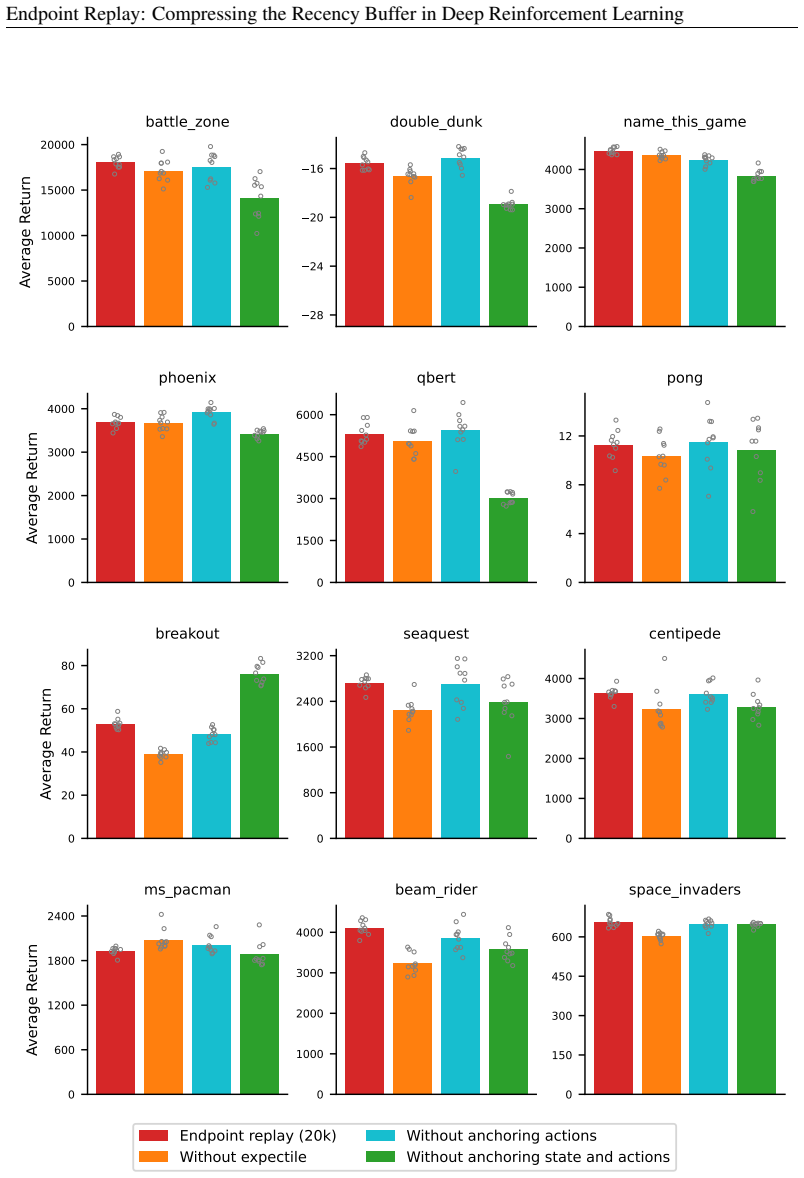
Summary. The paper asks whether the standard 1M-transition FIFO replay buffer in DQN-style algorithms can be compressed 10–50× without performance loss. It identifies a failure mode of naive coreset compression: isolated transitions yield "unanchored" bootstrap targets whose state-action values are never directly updated, and demonstrates this in controlled prediction (Fig. 1) and control (Fig. 2) experiments. The proposed fix, Endpoint Replay, keeps a small recency buffer plus a coreset of chained n-step transitions (so every bootstrap endpoint is itself updated), trained with an n-step Expectile Sarsa update (τ=0.7) to counteract the pessimistic bias of n-step targets from stale policies. Theory: the n-step expectile Bellman operator is a γⁿ-contraction (Thm 1), n-step expectile values are ordered in n (Thm 2), policy iteration converges under a monotonic-greedification assumption (Thm 3), and to the optimal policy under deterministic dynamics (Cor. 1); Prop. 1 shows expectile greedification can strictly reduce expected return. Empirically, Endpoint Replay matches a 10–50× larger recency buffer in Pinball (100 seeds) and 12 Atari games (10 seeds, sign tests), beating equal-sized buffers, reservoir coresets, and MeDQN; ablations attribute gains to state anchoring and the expectile loss.
Significance. If the results hold, this is a practically useful contribution: an order-of-magnitude reduction in replay memory with maintained performance matters for deployment and for scaling studies, and the "unanchored bootstrap target" diagnosis is a clean, previously unrecognized conceptual point backed by direct error measurements rather than only return curves. Strengths worth naming: publicly released code; unusually careful experimental hygiene for the area (100-seed Pinball runs with bootstrap CIs, two-stage tuning for the MeDQN baseline, sign tests, per-game breakdowns); controlled experiments that measure bootstrap-target error directly; and honest theory, including a counterexample (Prop. 1) against the authors' own update. The n-step expectile operator analysis (contraction for n≥1, ordering in n) is, to my knowledge, new. The main risks are a prose/pseudocode inconsistency about what the coreset actually contains, an untested robustness boundary for the expectile under stochastic dynamics, and a gap in the policy-iteration convergence proof.
major comments (3)
- [§3.3 vs. Algorithm 1 (App. 8), lines 11–17] The prose describes a stride-n chain: the lag buffer fills with n transitions, one n-step summary is emitted, and 'the lag buffer would simply reset' (and resets after k steps on termination), giving D_c = {(s_0,...s_n),(s_n,...s_2n),...} as in §3.1. The pseudocode instead pops only the FIRST transition from D_lag after emitting a summary and never resets: this implements a stride-1 sliding window in which every evicted transition generates an overlapping n-step summary. The two versions differ materially. Under stride-1, a 90k coreset covers ~90k environment steps of history, not ~900k, so the abstract's claim of 'an effective memory horizon comparable to a standard large buffer' no longer follows; anchoring also becomes trivial (every state is a start state) rather than a consequence of chaining. Additionally, line 14 computes g with constant γ^i and ignores the stored per-transition (
- [§3.2 and §5 (Table 3, Figs. 4c/d, 7, 8)] The mechanism attribution for the expectile is underdetermined by the evidence. The paper itself states the failure mode: with stochastic dynamics the expectile 'can chase environment stochasticity rather than ... actions that result in higher expected return' (§3.2), Corollary 1 gives optimality only under deterministic dynamics, and Proposition 1 constructs a case where expectile greedification strictly lowers expected return. Yet the headline benchmark deliberately injects stochasticity: sticky actions with repeat probability 0.25 in all 12 games (Table 3), and Ms. Pac-Man selected for 'high variance induced by unpredictable ghost movements'. The No-Expectile ablation is run only at this fixed noise level, so it cannot distinguish 'expectile corrects stale-policy pessimism' from 'expectile is generic optimism that happens to help here'. τ=0.7 is used everywhere with no reported sweep,
- [App. 7.3, Theorem 3 (and Corollary 1)] The proof of Theorem 3 establishes monotone, bounded improvement of V^{(n)}_{τ,π_t}, hence convergence to a fixed point of the greedification operator — but the conclusion that the limit is the OPTIMAL expectile policy ('will stop at some π*_τ that has the largest V') does not follow. In classical policy iteration the fixed-point argument gives V = max_{π'} T_{π'}V because improvement maximizes over policies; here greedification produces a single π′ satisfying Definition 2, so a fixed point only satisfies T_{π'}V_π = V_π for that particular π′, which need not be globally optimal without an additional argument that every suboptimal policy admits a strictly improving monotonic expectile greedy successor. Relatedly, convergence of π_t itself (rather than of the values) is asserted, and Assumption 1 is acknowledged to be unverified for the ε-greedy policy the algorithm actually uses — so the
minor comments (9)
- [App. 14, Figure 10] Caption says '100k buffer setting' but the legend and content are the 20k (50×) setting; also the caption says 'ablations' while showing baselines.
- [§3.1, Figure 1] Caption states 'Average over 100 seeds' while the text describes 10 datasets; the light lines are described as 10 random seeds. Please reconcile.
- [§5 / App. 12] Min–max normalization mapping the worst seed to 0 and best seed to 1 per game is sensitive to single-seed outliers and discards effect magnitude; consider reporting IQM with stratified bootstrap CIs (rliable-style) alongside, at least in the supplement.
- [App. 13] The sign test treats 120 game–seed pairs as independent; pairs within a game share game-level effects, which can inflate significance. Aggregating per game first (12 pairs) or a hierarchical test would be more conservative.
- [§5] MeDQN is excluded from Atari because it failed in Pinball, but its Pinball failure is attributed to invalid random states in a constrained domain — a domain-specific reason. The contribution claim 'outperforms MeDQN' therefore rests on a single, unfavorable setting; either soften the claim or include one Atari data point.
- [Abstract / Fig. 3d] The abstract says the method 'matches the performance of traditional large buffers'; in the 50× setting it does not quite reach the large baseline (5/12 games at parity). Qualify the claim by compression level.
- [§3.3 / §5] The 7:1 minibatch mix and n=10 are described as 'found effective' with no sensitivity results; even a coarse sweep in Pinball would help practitioners.
- [App. 7.2, Theorem 2] The ordering V^{(n)} ≥ V^{(a·n)} is stated for τ ≥ 1/2; a one-line remark on whether the ordering reverses for τ < 1/2 would complete the picture.
- [Typos] §5 'We preformed'; §4 'boostrap'; App. 7.1 'analagously'; §3.1 'a nearby states t'; Broader Impact 'bare little resemblance' (→ 'bear'). §2 'from early learn' (→ 'early learning').
Circularity Check
No significant circularity: theory is self-contained contraction/policy-iteration analysis; empirical claims are scored on external environment returns against independent baselines.
full rationale
The paper's load-bearing claims do not reduce to their inputs by construction. The n-step expectile action-values are introduced as a fixed-point definition Q^{(n)}_{τ,π}=e_τ(G^{(n)}(Q^{(n)}_{τ,π})), which is the standard Bellman-style recursion; existence and uniqueness follow from an explicit γ^n-contraction proof (Theorem 1) that does not bake in target performance. Ordering (Theorem 2) and policy-iteration convergence (Theorem 3, Corollary 1) are derived from monotonicity/subadditivity of expectiles under stated assumptions (including deterministic dynamics for optimality). None of these steps fit a parameter to data and rename the fit a prediction, import a uniqueness theorem from overlapping authors, or smuggle an ansatz via self-citation. Empirically, Endpoint Replay is evaluated on held-out Pinball and Atari returns against large-buffer DDQN, equal-sized recency buffers, reservoir coresets, and MeDQN; ablations isolate anchoring and the expectile loss on the same external metrics. Self-citations (e.g., Panahi et al. 2024, Patterson et al. 2024, Lo et al. 2024) supply environment or methodology context and are not load-bearing for the compression or soundness claims. The known limitation that optimality holds only under deterministic dynamics is a correctness/scope issue, not circularity. Score 0 is therefore appropriate.
Assumptions & free parameters
free parameters (5)
- expectile level τ =
0.7
- chain length n =
10
- recency/coreset split and minibatch mix =
90-10 capacities; 28:4 batch mix
- Pinball learning rate =
0.002
- MeDDQN regularization weight λ =
2
assumptions (5)
- domain assumption Environment is an MDP with bounded rewards; episodic γ set to 0 at termination (White 2017).
- standard math n-step expectile Bellman operator is a γ^n-contraction in sup norm, hence has a unique fixed point (Theorem 1).
- ad hoc to paper Policy class is compact and closed under a monotonic expectile greedification operator (Assumption 1 / Definition 2).
- domain assumption Deterministic transitions and rewards for Corollary 1 (expectile PI recovers the optimal expected-return policy).
- domain assumption Double DQN / Adam / Dopamine-style Atari protocol is a valid performance yardstick for buffer compression.
invented entities (3)
-
Unanchored bootstrap targets
independent evidence
-
n-step expectile action-values Q^{(n)}_{τ,π}
-
Endpoint Replay (recency + lag + chained n-step coreset)
independent evidence
Cite this review
Pith. "Pith review of Endpoint Replay: Compressing the Recency Buffer in Deep Reinforcement Learning." pith.science (2026). https://pith.science/paper/N4A3H3FD
@misc{pith2026260725123,
  author       = {Pith},
  title        = {Pith review of: Endpoint Replay: Compressing the Recency Buffer in Deep Reinforcement Learning},
  year         = {2026},
  howpublished = {\url{https://pith.science/paper/N4A3H3FD}},
  note         = {Machine review of arXiv:2607.25123}
}
abstract
Experience replay remains one of the most practical and useful algorithmic tools in the deep reinforcement learning (DRL) toolbox. Aside from the limited success of prioritized replay and specialized approaches for large asynchronous systems, most DRL algorithms make use of a large, uniformly sampled recency buffer---even the size, one million, remains unchanged. Could we store less data, reduce redundancy, or more effectively chain experience together to speed up value propagation and still retain the performance of large buffers? In this paper, we investigate a simple compression approach that stores representative transitions derived from the end-points of a chain of connected $n$-step sequences. By curating these end-points in a smaller recency buffer, our method maintains an effective memory horizon comparable to a standard large buffer while requiring an order of magnitude less storage. Through empirical evaluation, we demonstrate that this approach prevents the systematic bias inherent in naive compression strategies and matches the performance of traditional large buffers in the Pinball environment and the Atari 2600 benchmark.
Figures


Figures from the paper (9 more)




Reference graph
Works this paper leans on
-
[2]
Neural computation , volume=
Risk-sensitive reinforcement learning , author=. Neural computation , volume=. 2014 , publisher=
2014
-
[3]
Advances in Neural Information Processing Systems , volume=
The nature of temporal difference errors in multi-step distributional reinforcement learning , author=. Advances in Neural Information Processing Systems , volume=
-
[5]
K-percent Evaluation for Lifelong RL , author=
-
[6]
International Conference on Learning Representations , year=
Distributed Distributional Deterministic Policy Gradients , author=. International Conference on Learning Representations , year=
-
[7]
Advances in Neural Information Processing Systems , volume=
State chrono representation for enhancing generalization in reinforcement learning , author=. Advances in Neural Information Processing Systems , volume=
-
[8]
arXiv preprint arXiv:2507.09087 , year=
Deep reinforcement learning with gradient eligibility traces , author=. arXiv preprint arXiv:2507.09087 , year=
-
[9]
Proceedings of the AAAI conference on artificial intelligence , volume=
Using hindsight to anchor past knowledge in continual learning , author=. Proceedings of the AAAI conference on artificial intelligence , volume=
-
[10]
ArXiv , year=
The Laplacian in RL: Learning Representations with Efficient Approximations , author=. ArXiv , year=
Show all 169 references
-
[11]
International Conference on Machine Learning , year=
Towards Sustainable Learning: Coresets for Data-efficient Deep Learning , author=. International Conference on Machine Learning , year=
-
[12]
IEEE Transactions on Signal Processing , year=
Analyzing Sparse Dictionaries for Online Learning With Kernels , author=. IEEE Transactions on Signal Processing , year=
-
[13]
Journal of Machine Learning Research , volume=
Empirical design in reinforcement learning , author=. Journal of Machine Learning Research , volume=
-
[14]
The Thirteenth International Conference on Learning Representations , year=
Prioritized Generative Replay , author=. The Thirteenth International Conference on Learning Representations , year=
-
[15]
International Conference on Machine Learning , pages=
Large Batch Experience Replay , author=. International Conference on Machine Learning , pages=. 2022 , organization=
2022
-
[16]
Proceedings of the Thirty-Fourth International Joint Conference on Artificial Intelligence , pages=
Efficient diversity-based experience replay for deep reinforcement learning , author=. Proceedings of the Thirty-Fourth International Joint Conference on Artificial Intelligence , pages=
-
[17]
IEEE Transactions on Signal Processing , year=
The kernel recursive least-squares algorithm , author=. IEEE Transactions on Signal Processing , year=
-
[18]
AAAI Conference on Artificial Intelligence , year=
Deep Reinforcement Learning with Double Q-Learning , author=. AAAI Conference on Artificial Intelligence , year=
-
[19]
2022 , journaltitle =
A Generalized Projected Bellman Error for Off-Policy Value Estimation in Reinforcement Learning , author =. 2022 , journaltitle =
2022
-
[20]
nature , volume=
Human-level control through deep reinforcement learning , author=. nature , volume=. 2015 , publisher=
2015
-
[21]
Proceedings of the Ninth National Conference on Artificial Intelligence - Volume 2 , pages =
Lin, Long-Ji , title =. Proceedings of the Ninth National Conference on Artificial Intelligence - Volume 2 , pages =. 1991 , publisher =
1991
-
[23]
and Barto, Andrew G
Sutton, Richard S. and Barto, Andrew G. , publisher=. Reinforcement Learning:. 1998 , address=
1998
-
[24]
R. S. Sutton and D. McAllester and S. Singh and Y. Mansour. Policy Gradient Methods for Reinforcement Learning with Function Approximation. Advances in Neural Information Processing Systems 12. 2000
2000
-
[25]
R. J. Williams. Simple Statistical Gradient-Following Algorithms for Connectionist Reinforcement Learning. Machine Learning. 1992
1992
-
[26]
International Conference on Learning Representations , year=
Offline Reinforcement Learning with Implicit Q-Learning , author=. International Conference on Learning Representations , year=
-
[27]
, title =
Indyk, Piotr and Mahabadi, Sepideh and Mahdian, Mohammad and Mirrokni, Vahab S. , title =. Proceedings of the 33rd ACM SIGMOD-SIGACT-SIGART Symposium on Principles of Database Systems , pages =. 2014 , publisher =
2014
-
[28]
Journal of Machine Learning Research (JMLR) , volume =
Temporal Abstraction in Reinforcement Learning with the Successor Representation , author =. Journal of Machine Learning Research (JMLR) , volume =
-
[29]
International Conference on Machine Learning (ICML) , year =
Deep Laplacian-based Options for Temporally-Extended Exploration , author =. International Conference on Machine Learning (ICML) , year =
-
[30]
International Conference on Learning Representations (ICLR) , year =
Proper Laplacian Representation Learning , author =. International Conference on Learning Representations (ICLR) , year =
-
[31]
3rd International Conference on Learning Representations (ICLR) , year=
Adam: A Method for Stochastic Optimization , author=. 3rd International Conference on Learning Representations (ICLR) , year=
-
[32]
Sutton , title =
Shangtong Zhang and Richard S. Sutton , title =. Deep Reinforcement Learning Symposium, NIPS 2017 , volume =
2017
-
[33]
The Reinforcement Learning Journal , volume=
Investigating the Interplay of Prioritized Replay and Generalization , author=. The Reinforcement Learning Journal , volume=
-
[34]
Advances in Neural Information Processing Systems , volume=
Synthetic experience replay , author=. Advances in Neural Information Processing Systems , volume=
-
[35]
International Conference on Machine Learning , pages=
Adapting kernel representations online using submodular maximization , author=. International Conference on Machine Learning , pages=. 2017 , organization=
2017
-
[36]
Advances in neural information processing systems , volume=
Double Q-learning , author=. Advances in neural information processing systems , volume=
-
[37]
International Conference on Machine Learning , pages=
Unifying task specification in reinforcement learning , author=. International Conference on Machine Learning , pages=. 2017 , organization=
2017
-
[38]
arXiv preprint arXiv:1912.01603 , year=
Dream to control: Learning behaviors by latent imagination , author=. arXiv preprint arXiv:1912.01603 , year=
1912 arXiv
-
[39]
arXiv preprint arXiv:1903.00374 , year=
Model-based reinforcement learning for atari , author=. arXiv preprint arXiv:1903.00374 , year=
1903 arXiv
-
[40]
Medical Imaging with Deep Learning , pages =
Selective experience replay compression using coresets for lifelong deep reinforcement learning in medical imaging , author =. Medical Imaging with Deep Learning , pages =. 2024 , volume =
2024
-
[41]
Proceedings of the 40th International Conference on Machine Learning , pages =
Prototype-Sample Relation Distillation: Towards Replay-Free Continual Learning , author =. Proceedings of the 40th International Conference on Machine Learning , pages =. 2023 , volume =
2023
-
[42]
The big world hypothesis and its ramifications for artificial intelligence , author=
-
[43]
Artificial intelligence , volume=
Between MDPs and semi-MDPs: A framework for temporal abstraction in reinforcement learning , author=. Artificial intelligence , volume=. 1999 , publisher=
1999
-
[44]
Artificial Intelligence , volume=
Reward-respecting subtasks for model-based reinforcement learning , author=. Artificial Intelligence , volume=. 2023 , publisher=
2023
-
[45]
Journal of Machine Learning Research , volume=
Goal-space planning with subgoal models , author=. Journal of Machine Learning Research , volume=
-
[46]
Journal of Artificial Intelligence Research , volume=
Revisiting the arcade learning environment: Evaluation protocols and open problems for general agents , author=. Journal of Artificial Intelligence Research , volume=
-
[47]
Proceedings of the AAAI conference on artificial intelligence , volume=
Deep reinforcement learning with double q-learning , author=. Proceedings of the AAAI conference on artificial intelligence , volume=
-
[48]
Machine learning , volume=
Convergence results for single-step on-policy reinforcement-learning algorithms , author=. Machine learning , volume=. 2000 , publisher=
2000
-
[49]
and Naddaf, Yavar and Veness, Joel and Bowling, Michael , journal =
Bellemare, Marc G. and Naddaf, Yavar and Veness, Joel and Bowling, Michael , journal =. The
-
[50]
International Conference on Machine Learning , pages=
Atari-5: Distilling the arcade learning environment down to five games , author=. International Conference on Machine Learning , pages=. 2023 , organization=
2023
-
[51]
Proceedings of the AAAI conference on artificial intelligence , volume=
Rainbow: Combining improvements in deep reinforcement learning , author=. Proceedings of the AAAI conference on artificial intelligence , volume=
-
[52]
International Conference on Machine Learning , pages=
Revisiting rainbow: Promoting more insightful and inclusive deep reinforcement learning research , author=. International Conference on Machine Learning , pages=. 2021 , organization=
2021
-
[53]
Proceedings of the 27th International Joint Conference on Artificial Intelligence , pages=
Organizing experience: a deeper look at replay mechanisms for sample-based planning in continuous state domains , author=. Proceedings of the 27th International Joint Conference on Artificial Intelligence , pages=
-
[54]
Proceedings of the 37th International Conference on Machine Learning , pages =
Coresets for Data-efficient Training of Machine Learning Models , author =. Proceedings of the 37th International Conference on Machine Learning , pages =. 2020 , volume =
2020
-
[55]
Experience Selection in Deep Reinforcement Learning for Control , journal =
Tim de Bruin and Jens Kober and Karl Tuyls and Robert Babu. Experience Selection in Deep Reinforcement Learning for Control , journal =. 2018 , volume =
2018
-
[56]
Fedorov, Valerii , year =
-
[57]
International conference on machine learning , pages=
Revisiting fundamentals of experience replay , author=. International conference on machine learning , pages=. 2020 , organization=
2020
-
[58]
International Conference on Learning Representations , year=
Distributed Prioritized Experience Replay , author=. International Conference on Learning Representations , year=
-
[59]
Proceedings of the 40th International Conference on Machine Learning , pages =
Towards Sustainable Learning: Coresets for Data-efficient Deep Learning , author =. Proceedings of the 40th International Conference on Machine Learning , pages =. 2023 , editor =
2023
-
[60]
Proceedings of the Twenty-Seventh International Joint Conference on Artificial Intelligence,
Organizing Experience: a Deeper Look at Replay Mechanisms for Sample-Based Planning in Continuous State Domains , author =. Proceedings of the Twenty-Seventh International Joint Conference on Artificial Intelligence,. 2018 , month =
2018
-
[61]
No More Pesky Hyperparameters: Offline Hyperparameter Tuning for
Han Wang and Archit Sakhadeo and Adam M White and James M Bell and Vincent Liu and Xutong Zhao and Puer Liu and Tadashi Kozuno and Alona Fyshe and Martha White , journal=. No More Pesky Hyperparameters: Offline Hyperparameter Tuning for
-
[62]
2013 , journal=
Playing Atari with Deep Reinforcement Learning , author=. 2013 , journal=
2013
-
[63]
International Conference on Learning Representations (ICLR) , year=
Prioritized Experience Replay , author=. International Conference on Learning Representations (ICLR) , year=
-
[64]
Reinforcement Learning Conference , year =
Investigating the Interplay of Prioritized Replay and Generalization , author=. Reinforcement Learning Conference , year =
-
[65]
Reachability-Aware
Wang, Kaixin and Zhou, Kuangqi and Feng, Jiashi and Hooi, Bryan and Wang, Xinchao , booktitle =. Reachability-Aware. 2023 , volume =
2023
-
[66]
Advances in neural information processing systems , volume=
Safe and efficient off-policy reinforcement learning , author=. Advances in neural information processing systems , volume=
-
[67]
A Method for Evaluating Hyperparameter Sensitivity in Reinforcement Learning , volume =
Adkins, Jacob and Bowling, Michael and White, Adam , booktitle =. A Method for Evaluating Hyperparameter Sensitivity in Reinforcement Learning , volume =
-
[69]
Medical Imaging with Deep Learning , pages=
Selective experience replay compression using coresets for lifelong deep reinforcement learning in medical imaging , author=. Medical Imaging with Deep Learning , pages=. 2024 , organization=
2024
-
[70]
SIAM Journal on Computing , volume=
Bisimulation Metrics for Continuous Markov Decision Processes , author=. SIAM Journal on Computing , volume=. 2011 , publisher=
2011
-
[71]
A Kernel Perspective on Behavioural Metrics for Markov Decision Processes , author=
-
[72]
Advances in Neural Information Processing Systems , volume=
MICo: Improved representations via sampling-based state similarity for Markov decision processes , author=. Advances in Neural Information Processing Systems , volume=
-
[73]
International conference on machine learning , pages=
Asynchronous methods for deep reinforcement learning , author=. International conference on machine learning , pages=. 2016 , organization=
2016
-
[74]
International Conference on Machine Learning , pages=
Trajectory-aware eligibility traces for off-policy reinforcement learning , author=. International Conference on Machine Learning , pages=. 2023 , organization=
2023
-
[75]
Machine learning , volume=
Self-improving reactive agents based on reinforcement learning, planning and teaching , author=. Machine learning , volume=. 1992 , publisher=
1992
-
[76]
arXiv preprint arXiv:2509.15032 , year=
Sample Efficient Experience Replay in Non-stationary Environments , author=. arXiv preprint arXiv:2509.15032 , year=
-
[77]
Transactions on Machine Learning Research , volume=
Uncertainty-Based Experience Replay for Task-Agnostic Continual Reinforcement Learning , author=. Transactions on Machine Learning Research , volume=
-
[78]
Advances in Neural Information Processing Systems , volume=
Continual Learning with Deep Generative Replay , author=. Advances in Neural Information Processing Systems , volume=
-
[81]
Proceedings of the AAAI conference on artificial intelligence , volume=
Selective experience replay for lifelong learning , author=. Proceedings of the AAAI conference on artificial intelligence , volume=
-
[82]
2023 IEEE/CVF International Conference on Computer Vision (ICCV) , pages=
Prototype Reminiscence and Augmented Asymmetric Knowledge Aggregation for Non-Exemplar Class-Incremental Learning , author=. 2023 IEEE/CVF International Conference on Computer Vision (ICCV) , pages=. 2023 , organization=
2023
-
[83]
Advances in Neural Information Processing Systems , volume=
Experience Replay for Continual Learning , author=. Advances in Neural Information Processing Systems , volume=
-
[84]
Proceedings of the 28th International Joint Conference on Artificial Intelligence , pages=
Experience replay optimization , author=. Proceedings of the 28th International Joint Conference on Artificial Intelligence , pages=
-
[85]
Frontiers in neurorobotics , volume=
Map-based experience replay: a memory-efficient solution to catastrophic forgetting in reinforcement learning , author=. Frontiers in neurorobotics , volume=
-
[86]
Advances in Neural Information Processing Systems , volume=
Sample-Efficient Deep Reinforcement Learning via Episodic Backward Update , author=. Advances in Neural Information Processing Systems , volume=
-
[87]
Proceedings of the National Academy of Sciences of the United States of America , volume=
Prioritized experience replays on a hippocampal predictive map for learning , author=. Proceedings of the National Academy of Sciences of the United States of America , volume=
-
[88]
Proceedings of the AAAI Conference on Artificial Intelligence , volume=
Attentive Experience Replay , author=. Proceedings of the AAAI Conference on Artificial Intelligence , volume=
-
[89]
Transactions on Machine Learning Research , year=
Introspective Experience Replay: Look Back When Surprised , author=. Transactions on Machine Learning Research , year=
-
[90]
International Conference on Learning Representations , year=
Topological Experience Replay , author=. International Conference on Learning Representations , year=
-
[91]
Applied Intelligence , volume=
Revisiting experience replayable conditions , author=. Applied Intelligence , volume=. 2024 , publisher=
2024
-
[92]
arXiv preprint arXiv:2102.03261 , year=
Revisiting prioritized experience replay: A value perspective , author=. arXiv preprint arXiv:2102.03261 , year=
-
[93]
The Eleventh International Conference on Learning Representations , year =
Sample-Efficient Reinforcement Learning by Breaking the Replay Ratio Barrier , author=. The Eleventh International Conference on Learning Representations , year =
-
[94]
The Twelfth International Conference on Learning Representations , year=
Revisiting plasticity in visual reinforcement learning: Data, modules and training stages , author=. The Twelfth International Conference on Learning Representations , year=
-
[95]
International Conference on Machine Learning , pages=
A Forget-and-Grow Strategy for Deep Reinforcement Learning Scaling in Continuous Control , author=. International Conference on Machine Learning , pages=. 2025 , organization=
2025
-
[96]
arXiv preprint arXiv:2512.01034 , year=
Addressing the Plasticity-Stability Dilemma in Reinforcement Learning , author=. arXiv preprint arXiv:2512.01034 , year=
-
[97]
Transactions on Machine Learning Research , issn=
Memory-efficient Reinforcement Learning with Value-based Knowledge Consolidation , author=. Transactions on Machine Learning Research , issn=
-
[98]
Advances in Neural Information Processing Systems , volume=
Deep policy gradient methods without batch updates, target networks, or replay buffers , author=. Advances in Neural Information Processing Systems , volume=
-
[99]
Advances in Neural Information Processing Systems , volume=
Hindsight Experience Replay , author=. Advances in Neural Information Processing Systems , volume=
-
[100]
International Conference on Machine Learning , pages=
Universal Value Function Approximators , author=. International Conference on Machine Learning , pages=. 2015 , organization=
2015
-
[101]
, booktitle=
Peng, Jing and Williams, Ronald J. , booktitle=. Efficient learning and planning within the. 1993 , organization=
1993
-
[102]
Advances in Neural Information Processing Systems , volume=
When to use parametric models in reinforcement learning? , author=. Advances in Neural Information Processing Systems , volume=
-
[103]
International Conference on Learning Representations , year=
Reinforcement Learning with Unsupervised Auxiliary Tasks , author=. International Conference on Learning Representations , year=
-
[104]
Advances in neural information processing systems , volume=
Memory-based reinforcement learning: Efficient computation with prioritized sweeping , author=. Advances in neural information processing systems , volume=
-
[105]
Learning for Dynamics and Control Conference , pages=
Experience replay with likelihood-free importance weights , author=. Learning for Dynamics and Control Conference , pages=. 2022 , organization=
2022
-
[106]
Nature , volume=
Outracing champion Gran Turismo drivers with deep reinforcement learning , author=. Nature , volume=. 2022 , publisher=
2022
-
[108]
PLoS One , volume=
Dual experience replay enhanced deep deterministic policy gradient for efficient continuous data sampling , author=. PLoS One , volume=. 2025 , publisher=
2025
-
[109]
Proceedings of the AAAI conference on artificial intelligence , volume=
Deep q-learning from demonstrations , author=. Proceedings of the AAAI conference on artificial intelligence , volume=
-
[110]
the Multidisciplinary Symposium on Reinforcement Learning, Montreal, Canada , year=
Skill chaining: Skill discovery in continuous domains , author=. the Multidisciplinary Symposium on Reinforcement Learning, Montreal, Canada , year=
-
[111]
and da Silva, Bruno Castro , booktitle=
Maheshwari, Mansi and Raisbeck, John C. and da Silva, Bruno Castro , booktitle=
-
[112]
Permanent and Transient Representations for Continual Reinforcement Learning , author=
-
[113]
International conference on machine learning , pages=
The primacy bias in deep reinforcement learning , author=. International conference on machine learning , pages=. 2022 , organization=
2022
-
[114]
Proceedings of the 1st Reinforcement Learning Conference (RLC) , year=
An Analysis of Action-Value Temporal-Difference Methods That Learn State Values , author=. Proceedings of the 1st Reinforcement Learning Conference (RLC) , year=
-
[115]
International Conference on Machine Learning , pages=
VA-learning as a more efficient alternative to Q-learning , author=. International Conference on Machine Learning , pages=. 2023 , organization=
2023
-
[116]
Atari-5: Distilling the arcade learning environment down to five games
Matthew Aitchison, Penny Sweetser, and Marcus Hutter. Atari-5: Distilling the arcade learning environment down to five games. In International Conference on Machine Learning, pp.\ 421--438. PMLR, 2023
2023
-
[117]
Permanent and transient representations for continual reinforcement learning, 2026
Nishanth Anand and Doina Precup. Permanent and transient representations for continual reinforcement learning, 2026
2026
-
[118]
Hindsight experience replay
Marcin Andrychowicz, Filip Wolski, Alex Ray, Jonas Schneider, Rachel Fong, Peter Welinder, Bob McGrew, Josh Tobin, Pieter Abbeel, and Wojciech Zaremba. Hindsight experience replay. In Advances in Neural Information Processing Systems, volume 30, 2017
2017
-
[119]
Bellemare, Yavar Naddaf, Joel Veness, and Michael Bowling
Marc G. Bellemare, Yavar Naddaf, Joel Veness, and Michael Bowling. The Arcade Learning Environment : An evaluation platform for general agents. Journal of Artificial Intelligence Research, 47: 0 253--279, 2013
2013
-
[120]
On tiny episodic memories in continual learning
Arslan Chaudhry, Marcus Rohrbach, Mohamed Elhoseiny, Thalaiyasingam Ajanthan, Puneet K Dokania, Philip HS Torr, and Marc'Aurelio Ranzato. On tiny episodic memories in continual learning. arXiv preprint arXiv:1902.10486, 2019
1902 arXiv
-
[121]
Using hindsight to anchor past knowledge in continual learning
Arslan Chaudhry, Albert Gordo, Puneet Dokania, Philip Torr, and David Lopez-Paz. Using hindsight to anchor past knowledge in continual learning. In Proceedings of the AAAI conference on artificial intelligence, volume 35, pp.\ 6993--7001, 2021
2021
-
[122]
Bootstrapping expectiles in reinforcement learning
Pierre Clavier, Emmanuel Rachelson, Erwan Le Pennec, and Matthieu Geist. Bootstrapping expectiles in reinforcement learning. arXiv preprint arXiv:2406.04081, 2024
2024 arXiv
-
[123]
Sample-efficient reinforcement learning by breaking the replay ratio barrier
Pierluca D'Oro, Max Schwarzer, Evgenii Nikishin, Pierre-Luc Bacon, Marc G Bellemare, and Aaron Courville. Sample-efficient reinforcement learning by breaking the replay ratio barrier. The Eleventh International Conference on Learning Representations, 2022
2022
-
[124]
Rupam Mahmood
Mohamed Elsayed, Gautham Vasan, and A. Rupam Mahmood. Streaming deep reinforcement learning finally works. arXiv preprint arXiv:2410.14606, 2024
2024 arXiv
-
[125]
Revisiting fundamentals of experience replay
William Fedus, Prajit Ramachandran, Rishabh Agarwal, Yoshua Bengio, Hugo Larochelle, Mark Rowland, and Will Dabney. Revisiting fundamentals of experience replay. In International conference on machine learning, pp.\ 3061--3071. PMLR, 2020
2020
-
[126]
Etgl-ddpg: a deep deterministic policy gradient algorithm for sparse reward continuous control
Ehsan Futuhi, Shayan Karimi, Chao Gao, and Martin M \"u ller. Etgl-ddpg: a deep deterministic policy gradient algorithm for sparse reward continuous control. arXiv preprint arXiv:2410.05225, 2024
2024
-
[127]
Double q-learning
Hado Hasselt. Double q-learning. Advances in neural information processing systems, 23, 2010
2010
-
[128]
Rainbow: Combining improvements in deep reinforcement learning
Matteo Hessel, Joseph Modayil, Hado Van Hasselt, Tom Schaul, Georg Ostrovski, Will Dabney, Dan Horgan, Bilal Piot, Mohammad Azar, and David Silver. Rainbow: Combining improvements in deep reinforcement learning. In Proceedings of the AAAI conference on artificial intelligence,...
2018
-
[129]
Deep q-learning from demonstrations
Todd Hester, Matej Vecerik, Olivier Pietquin, Marc Lanctot, Tom Schaul, Bilal Piot, Dan Horgan, John Quan, Andrew Sendonaris, Ian Osband, et al. Deep q-learning from demonstrations. In Proceedings of the AAAI conference on artificial intelligence, volume 32, 2018
2018
-
[130]
Topological experience replay
Zhang-Wei Hong, Tao Chen, Yen-Chen Lin, Joni Pajarinen, and Pulkit Agrawal. Topological experience replay. In International Conference on Learning Representations, 2022
2022
-
[131]
Prioritized experience replays on a hippocampal predictive map for learning
Hideyoshi Igata, Yuji Ikegaya, and Takuya Sasaki. Prioritized experience replays on a hippocampal predictive map for learning. Proceedings of the National Academy of Sciences of the United States of America, 118 0 (1): 0 e2011266118, 2021
2021
-
[132]
Selective experience replay for lifelong learning
David Isele and Akansel Cosgun. Selective experience replay for lifelong learning. In Proceedings of the AAAI conference on artificial intelligence, volume 32, 2018
2018
-
[133]
Reinforcement learning with unsupervised auxiliary tasks
Max Jaderberg, Volodymyr Mnih, Wojciech Marian Czarnecki, Tom Schaul, Joel Z Leibo, David Silver, and Koray Kavukcuoglu. Reinforcement learning with unsupervised auxiliary tasks. In International Conference on Learning Representations, 2017
2017
-
[134]
A forget-and-grow strategy for deep reinforcement learning scaling in continuous control
Zilin Kang, Chenyuan Hu, Yu Luo, Zhecheng Yuan, Ruijie Zheng, and Huazhe Xu. A forget-and-grow strategy for deep reinforcement learning scaling in continuous control. In International Conference on Machine Learning, pp.\ 28921--28942. PMLR, 2025
2025
-
[135]
Adam: A method for stochastic optimization
Diederik P Kingma and Jimmy Ba. Adam: A method for stochastic optimization. In 3rd International Conference on Learning Representations (ICLR), 2015
2015
-
[136]
Skill chaining: Skill discovery in continuous domains
George Konidaris and Andrew Barto. Skill chaining: Skill discovery in continuous domains. In the Multidisciplinary Symposium on Reinforcement Learning, Montreal, Canada, 2009
2009
-
[137]
Offline reinforcement learning with implicit q-learning
Ilya Kostrikov, Ashvin Nair, and Sergey Levine. Offline reinforcement learning with implicit q-learning. In International Conference on Learning Representations, 2022
2022
-
[138]
Introspective experience replay: Look back when surprised
Ramnath Kumar and Dheeraj Mysore Nagaraj. Introspective experience replay: Look back when surprised. Transactions on Machine Learning Research, 2022
2022
-
[139]
Memory-efficient reinforcement learning with value-based knowledge consolidation
Qingfeng Lan, Yangchen Pan, Jun Luo, and A Rupam Mahmood. Memory-efficient reinforcement learning with value-based knowledge consolidation. Transactions on Machine Learning Research, 2022. ISSN 2835-8856
2022
-
[140]
Sample-efficient deep reinforcement learning via episodic backward update
Su Young Lee, Choi Sungik, and Sae-Young Chung. Sample-efficient deep reinforcement learning via episodic backward update. Advances in Neural Information Processing Systems, 32, 2019
2019
-
[141]
Programming robots using reinforcement learning and teaching
Long-Ji Lin. Programming robots using reinforcement learning and teaching. In Proceedings of the Ninth National Conference on Artificial Intelligence - Volume 2, AAAI'91, pp.\ 781–786. AAAI Press, 1991
1991
-
[142]
Goal-space planning with subgoal models
Chunlok Lo, Kevin Roice, Parham Mohammad Panahi, Scott M Jordan, Adam White, Gabor Mihucz, Farzane Aminmansour, and Martha White. Goal-space planning with subgoal models. Journal of Machine Learning Research, 25 0 (330): 0 1--57, 2024
2024
-
[143]
Synthetic experience replay
Cong Lu, Philip Ball, Yee Whye Teh, and Jack Parker-Holder. Synthetic experience replay. Advances in Neural Information Processing Systems, 36: 0 46323--46344, 2023
2023
-
[144]
Actor-critic algorithm for dynamic expectile and cvar
Yudong Luo and Erick Delage. Actor-critic algorithm for dynamic expectile and cvar. arXiv preprint arXiv:2605.07857, 2026
2026 arXiv
-
[145]
Revisiting the arcade learning environment: Evaluation protocols and open problems for general agents
Marlos C Machado, Marc G Bellemare, Erik Talvitie, Joel Veness, Matthew Hausknecht, and Michael Bowling. Revisiting the arcade learning environment: Evaluation protocols and open problems for general agents. Journal of Artificial Intelligence Research, 61: 0 523--562, 2018
2018
-
[146]
Raisbeck, and Bruno Castro da Silva
Mansi Maheshwari, John C. Raisbeck, and Bruno Castro da Silva. AltNet : Alternating network resets for plasticity. In Proceedings of the Fourth Conference on Lifelong Learning Agents (CoLLAs), Workshop Track, 2025
2025
-
[147]
Coresets for data-efficient training of machine learning models
Baharan Mirzasoleiman, Jeff Bilmes, and Jure Leskovec. Coresets for data-efficient training of machine learning models. In Proceedings of the 37th International Conference on Machine Learning, volume 119, pp.\ 6950--6960. Proceedings of Machine Learning Research, PMLR, 2020
2020
-
[148]
Playing atari with deep reinforcement learning
Volodymyr Mnih, Koray Kavukcuoglu, David Silver, Alex Graves, Ioannis Antonoglou, Daan Wierstra, and Martin Riedmiller. Playing atari with deep reinforcement learning. NIPS Deep Learning Workshop 2013, 2013
2013
-
[149]
Human-level control through deep reinforcement learning
Volodymyr Mnih, Koray Kavukcuoglu, David Silver, Andrei A Rusu, Joel Veness, Marc G Bellemare, Alex Graves, Martin Riedmiller, Andreas K Fidjeland, Georg Ostrovski, et al. Human-level control through deep reinforcement learning. nature, 518 0 (7540): 0 529--533, 2015
2015
-
[150]
Asynchronous methods for deep reinforcement learning
Volodymyr Mnih, Adria Puigdomenech Badia, Mehdi Mirza, Alex Graves, Timothy Lillicrap, Tim Harley, David Silver, and Koray Kavukcuoglu. Asynchronous methods for deep reinforcement learning. In International conference on machine learning, pp.\ 1928--1937. PMLR, 2016
1928
-
[151]
Dual experience replay enhanced deep deterministic policy gradient for efficient continuous data sampling
Teh Noranis Mohd Aris, Ningning Chen, Norwati Mustapha, and Maslina Zolkepli. Dual experience replay enhanced deep deterministic policy gradient for efficient continuous data sampling. PLoS One, 20 0 (11): 0 e0334411, 2025
2025
-
[152]
Memory-based reinforcement learning: Efficient computation with prioritized sweeping
Andrew Moore and Christopher Atkeson. Memory-based reinforcement learning: Efficient computation with prioritized sweeping. Advances in neural information processing systems, 5, 1992
1992
-
[153]
Safe and efficient off-policy reinforcement learning
R \'e mi Munos, Tom Stepleton, Anna Harutyunyan, and Marc Bellemare. Safe and efficient off-policy reinforcement learning. Advances in neural information processing systems, 29, 2016
2016
-
[154]
Organizing experience: a deeper look at replay mechanisms for sample-based planning in continuous state domains
Yangchen Pan, Muhammad Zaheer, Adam White, Andrew Patterson, and Martha White. Organizing experience: a deeper look at replay mechanisms for sample-based planning in continuous state domains. In Proceedings of the 27th International Joint Conference on Artificial Intelligence,...
2018
-
[155]
Investigating the interplay of prioritized replay and generalization
Parham Mohammad Panahi, Andrew Patterson, Martha White, and Adam White. Investigating the interplay of prioritized replay and generalization. The Reinforcement Learning Journal, 1, 2024
2024
-
[156]
Empirical design in reinforcement learning
Andrew Patterson, Samuel Neumann, Martha White, and Adam White. Empirical design in reinforcement learning. Journal of Machine Learning Research, 25 0 (318): 0 1--63, 2024
2024
-
[157]
Williams
Jing Peng and Ronald J. Williams. Efficient learning and planning within the Dyna framework. In Proceedings of 1993 International Conference on Neural Networks (ICNN-93), volume 1, pp.\ 168--174. IEEE, 1993
1993
-
[158]
Experience replay for continual learning
David Rolnick, Arun Ahuja, Jonathan Schwarz, Timothy Lillicrap, and Gregory Wayne. Experience replay for continual learning. Advances in Neural Information Processing Systems, 32, 2019
2019
-
[159]
Universal value function approximators
Tom Schaul, Daniel Horgan, Karol Gregor, and David Silver. Universal value function approximators. In International Conference on Machine Learning, pp.\ 1312--1320. PMLR, 2015
2015
-
[160]
Prioritized experience replay
Tom Schaul, John Quan, Ioannis Antonoglou, and David Silver. Prioritized experience replay. In International Conference on Learning Representations (ICLR), 2016. Poster
2016
-
[161]
Risk-sensitive reinforcement learning
Yun Shen, Michael J Tobia, Tobias Sommer, and Klaus Obermayer. Risk-sensitive reinforcement learning. Neural computation, 26 0 (7): 0 1298--1328, 2014
2014
-
[162]
Experience replay with likelihood-free importance weights
Samarth Sinha, Jiaming Song, Animesh Garg, and Stefano Ermon. Experience replay with likelihood-free importance weights. In Learning for Dynamics and Control Conference, pp.\ 110--123. PMLR, 2022
2022
-
[163]
Attentive experience replay
Peiquan Sun, Wengang Zhou, and Houqiang Li. Attentive experience replay. In Proceedings of the AAAI Conference on Artificial Intelligence, volume 34, pp.\ 5900--5907, 2020
2020
-
[164]
The nature of temporal difference errors in multi-step distributional reinforcement learning
Yunhao Tang, R \'e mi Munos, Mark Rowland, Bernardo Avila Pires, Will Dabney, and Marc Bellemare. The nature of temporal difference errors in multi-step distributional reinforcement learning. Advances in Neural Information Processing Systems, 35: 0 30265--30276, 2022
2022
-
[165]
Va-learning as a more efficient alternative to q-learning
Yunhao Tang, R \'e mi Munos, Mark Rowland, and Michal Valko. Va-learning as a more efficient alternative to q-learning. In International Conference on Machine Learning, pp.\ 33739--33757. PMLR, 2023
2023
-
[166]
Deep reinforcement learning with double q-learning
Hado Van Hasselt, Arthur Guez, and David Silver. Deep reinforcement learning with double q-learning. In Proceedings of the AAAI conference on artificial intelligence, volume 30, 2016
2016
-
[167]
When to use parametric models in reinforcement learning? Advances in Neural Information Processing Systems, 32, 2019
Hado P Van Hasselt, Matteo Hessel, and John Aslanides. When to use parametric models in reinforcement learning? Advances in Neural Information Processing Systems, 32, 2019
2019
-
[168]
Alireza Azimi, Jincheng He, Farzaneh Shahriar, Colin Bellinger, Martha White, and A
Gautham Vasan, Mohamed Elsayed, S. Alireza Azimi, Jincheng He, Farzaneh Shahriar, Colin Bellinger, Martha White, and A. Rupam Mahmood. Deep policy gradient methods without batch updates, target networks, or replay buffers. In Advances in Neural Information Processing Systems, ...
2024
-
[169]
Prioritized generative replay
Renhao Wang, Kevin Frans, Pieter Abbeel, Sergey Levine, and Alexei A Efros. Prioritized generative replay. In The Thirteenth International Conference on Learning Representations, 2025
2025
-
[170]
Unifying task specification in reinforcement learning
Martha White. Unifying task specification in reinforcement learning. In International Conference on Machine Learning, pp.\ 3742--3750. PMLR, 2017
2017
-
[171]
Outracing champion gran turismo drivers with deep reinforcement learning
Peter R Wurman, Samuel Barrett, Kenta Kawamoto, James MacGlashan, Kaushik Subramanian, Thomas J Walsh, Roberto Capobianco, Alisa Devlic, Franziska Eckert, Florian Fuchs, et al. Outracing champion gran turismo drivers with deep reinforcement learning. Nature, 602 0 (7896): 0 22...
2022
-
[172]
The in-sample softmax for offline reinforcement learning
Chenjun Xiao, Han Wang, Yangchen Pan, Adam White, and Martha White. The in-sample softmax for offline reinforcement learning. arXiv preprint arXiv:2302.14372, 2023
2023 arXiv
-
[173]
Augmenting replay in world models for continual reinforcement learning
Luke Yang, Levin Kuhlmann, and Gideon Kowadlo. Augmenting replay in world models for continual reinforcement learning. arXiv preprint arXiv:2401.16650, 2024
2024 arXiv
-
[174]
Shangtong Zhang and Richard S. Sutton. A deeper look at experience replay. Deep Reinforcement Learning Symposium, NIPS 2017, abs/1712.01275, 2017
2017 arXiv
-
[175]
Jacobs, and Vishwa Sanjay Parekh
Guangyao Zheng, Samson Zhou, Vladimir Braverman, Michael A. Jacobs, and Vishwa Sanjay Parekh. Selective experience replay compression using coresets for lifelong deep reinforcement learning in medical imaging. In Medical Imaging with Deep Learning, volume 227, pp.\ 1751--1764....
2024
-
[176]
Selective experience replay compression using coresets for lifelong deep reinforcement learning in medical imaging
Guangyao Zheng, Samson Zhou, Vladimir Braverman, Michael A Jacobs, and Vishwa Sanjay Parekh. Selective experience replay compression using coresets for lifelong deep reinforcement learning in medical imaging. In Medical Imaging with Deep Learning, pp.\ 1751--1764. PMLR, 2024 b
2024
Reviewed July 31, 2026 · model on record in the stance chip above.
Discussion (0). Sign in to comment.