REVIEW 4 major objections 6 minor 84 references
Ultra-broadband and time-resolved depolarized dynamic light scattering for probing molecular dynamics in supercooled liquids and glasses
T0 review · 4 major / 6 minor · reviewed 2026-08-01 · deepseek-v4-flash
Pith's one-line read By correcting for coherence and partial-heterodyne effects, four different light-scattering experiments can be merged into a single continuous electric-field autocorrelation function spanning more than twenty time decades, and multispeckle
desk verdict Useful DDLS tutorial with a real new correction formula, but Eq. (25) is algebraically wrong as printed and the fiber-data transformation is not reproducible as written. read the letter →
The pith
A machine-rendered reading of the paper's core claim, the machinery that carries it, and where it could break.
The reading
What carries the argument
The load-bearing identity is the generalized Siegert relation for partially heterodyne detection: g2(Δt) = 1 + ΛC² g1(Δt)² + 2ΛC(C−1)g1(Δt). Here Λ is the coherence factor, and C = ⟨Is⟩/⟨I⟩ is the fraction of detected intensity that comes from the dynamically fluctuating sample scattering. For the camera, C is extracted from the long-time plateau of the speckle-averaged correlation function (Eq. 24); for the fiber, C is obtained by solving a quadratic equation (Eq. 25) that uses the short-time plateau λ = 0.88, which represents the amplitude lost to fast, unresolved vibrational dynamics and is measured from the high-frequency TFPI/DM spectra. These two routes make the PCS data commensurable
What would settle it
Measure λ directly at a low temperature such as 176 K using tandem Fabry-Perot or Raman spectroscopy, and check whether the fiber-derived g1 still overlaps the camera-derived g1 when Eq. 25 is solved with the measured λ; a clear discrepancy in the overlap region would falsify the extrapolation.
Extended reading notes
Core claim
The paper's central claim is that the intensity autocorrelation functions obtained from fiber-optical photon correlation spectroscopy, multispeckle photon correlation imaging, tandem Fabry-Perot interferometry, and double-monochromator spectroscopy can be converted into mutually consistent electric-field autocorrelation functions g1(Δt) after accounting for two optical effects: the coherence factor Λ (loss of speckle contrast due to finite detector resolution) and the heterodyne parameter C (static stray light mixed with the sample-scattered light). With Λ measured from dilute latex-sphere suspensions and C determined separately for camera data from the long-time plateau and for fiber data f
Load-bearing premise
The fiber-optic data correction relies on the short-time plateau λ = 0.88, measured from 300 to 500 K, being temperature-independent and valid at cryogenic temperatures near 176 K; if λ actually varies with temperature, the reconstructed g1 from the fiber data would be distorted and the overlap with the camera data would break down.
Editorial extensions
If this is right
- Continuous DDLS datasets can be built spanning more than 20 time decades, from sub-picoseconds to beyond 10^5 seconds, covering the entire relaxation range of supercooled liquids except for a small gap around 10–100 MHz.
- The overlap between camera and fiber data serves as a cross-validation of the correction procedures; after merging, the camera data provide the superior signal-to-noise ratio at long lag times.
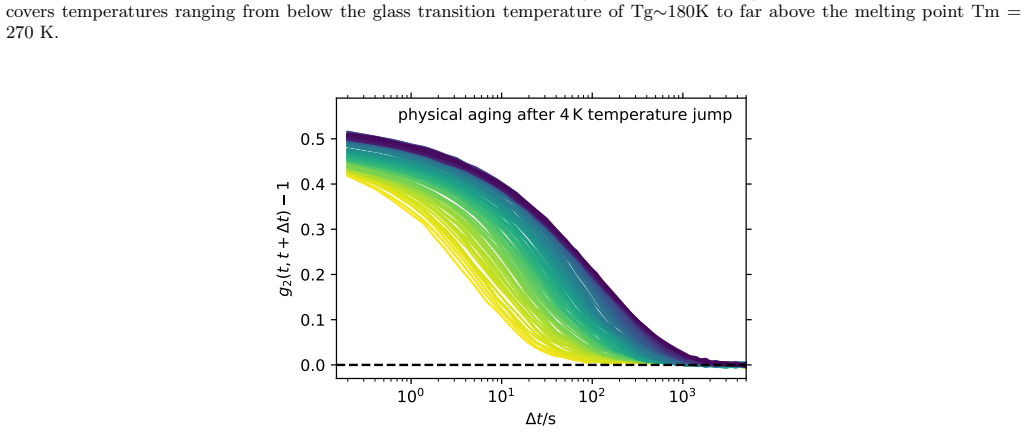
- Multispeckle detection yields time-resolved intensity autocorrelation functions without temporal averaging, enabling quantitative analysis of the slowing dynamics during physical aging of molecular glasses.
- The framework allows direct and quantitative comparison of DDLS results with broadband dielectric spectroscopy, helping to disentangle Debye, structural, and secondary relaxation processes.
Reading between the lines
- If the temperature independence of λ is confirmed at cryogenic temperatures, the same correction routine could be applied to other weakly scattering liquids without requiring a separate high-frequency measurement for every temperature.
- The formalism for combining fiber and camera data should transfer directly to other scattering geometries and sample classes—such as ionic liquids, polymer melts, or colloids—potentially extending ultra-broadband dynamic light scattering beyond molecular glass formers.
- The time-resolved aging correlations could be used to extract the material time of aging glasses directly from light scattering, linking equilibrium and non-equilibrium dynamics in a way that is currently only sketched in the literature.
Signed reviews
Editorial analysis
A structured set of objections, weighed in public.
Referee Report
Summary. The manuscript presents a detailed experimental tutorial on depolarized dynamic light scattering (DDLS) for supercooled molecular liquids and glasses. It describes a combined setup comprising fiber-optical photon correlation spectroscopy, multispeckle photon correlation imaging, and high-frequency tandem Fabry-Perot / double-monochromator spectroscopy. The central methodological claim is that after correcting for the coherence factor and partial heterodyning, the different detection schemes yield mutually consistent electric-field autocorrelation functions, enabling construction of continuous ultra-broadband DDLS datasets spanning more than 20 time decades. A second claim is that multispeckle detection provides time-resolved two-time correlation functions without temporal averaging, extending DDLS to non-equilibrium aging glasses. The data treatment is illustrated with diethyl phthalate and 1-phenyl-1-propanol, including a demonstration of overlap between camera, fiber, and TFPI/Raman data at 178 K.
Significance. If the data-treatment framework is correct, the paper would be a valuable methodological reference: it would establish a unified experimental route from sub-picosecond vibrational dynamics to structural relaxation near and below the glass transition, and it would extend DDLS to non-stationary systems. The experimental engineering described—cryogenic stability, vibration suppression, optimized multispeckle optics—is substantial and credible, and the time-resolved aging measurements are a genuine capability that conventional single-speckle PCS cannot provide. However, the central quantitative claim rests on heterodyne-correction formulas that are not internally consistent as written, so the manuscript cannot currently be used as a reproducible recipe.
major comments (4)
- [Sec. III.C.2, Eq. (25)] Equation (25) does not follow from Eq. (15). Substituting g1 = λ into Eq. (15) with x = g2^0 − 1 gives Λλ(λ+2)C^2 − 2ΛλC − x = 0, whose solution is C = [1 ± sqrt(1 + (λ+2)x/(Λλ))]/(λ+2). This differs from Eq. (25) in both the denominator (λ+2 vs. 2−λ) and the radicand. For the values quoted in the text (λ=0.88, Λ=0.98, g2^0 ≈ 1.6–1.8), the printed radicand is negative when g2^0 is used as defined in Eq. (14), so no real C exists. The formula only makes numerical sense if g2^0 is reinterpreted as the contrast g2^0 − 1 and if the sign of the linear term in Eq. (15) is changed to +2ΛC(1−C)g1. As printed, the fiber-data transformation—a load-bearing step in the broadband construction—is not reproducible. Please correct the equation, state the convention for g2^0, and re-derive the solution.
- [Sec. III.C, Eqs. (15) and (23)] There is an unresolved inconsistency between the general Siegert relation and the multispeckle long-time plateau. Equation (15) has no constant term and predicts g2 → 1 as g1 → 0, yet Sec. III.C.1 derives g∞_2 = 1 + Λ(1−C)^2 for the multispeckle scheme. The manuscript does not state explicitly how camera data are transformed into g1: if Eq. (15) is applied directly, the long-time plateau is discarded; if a background Λ(1−C)^2 is first subtracted, that step is not described. Because the claimed mutual consistency of camera and fiber data in Figs. 5 and 8 depends on this transformation, the camera-side procedure must be specified explicitly, ideally as a complete expression for g2(Δt) in terms of g1, C, and Λ that reproduces both the short-time and long-time limits.
- [Sec. III.E, Figs. 7 and 8] The fiber correction uses λ = 0.88(1), obtained from KWW fits of TFPI/DM data between 300 K and 500 K, and extrapolates it to 176 K. This extrapolation is justified only by the statement that the plateau is 'virtually temperature independent' in the measured range. λ enters Eq. (25) and therefore controls C_fiber; an erroneous λ would rescale and distort the reconstructed g1 and could break the claimed overlap. The overlap in Fig. 8 is the only low-temperature validation, but the paper does not quantify how sensitive the overlap is to λ (or to its uncertainty of ±0.01, let alone to a plausible low-temperature variation). Please add a sensitivity analysis or an independent low-temperature constraint on λ.
- [Sec. III.C.2] The selection of the heterodyne branch for the fiber data is made by assuming C_fiber ≥ C_camera and choosing the C+ solution. This inequality is physically plausible but is an assumption, not a measurement, and the two solutions of Eq. (25) differ significantly. Since the branch choice directly determines the fiber heterodyne correction and hence the central cross-technique consistency claim, the assumption should be tested (e.g., by deliberately varying the heterodyne fraction through aperture or sample-cell changes) or at minimum stated as an explicit limitation with an estimate of the resulting uncertainty in g1.
minor comments (6)
- [Eq. (14) vs. Eq. (25)] The symbol g2^0 is defined in Eq. (14) as the actual short-time limit of g2, but in Eq. (25) it appears to denote the contrast g2^0 − 1. Use a distinct symbol (e.g., h0 or g2^0 − 1) to avoid ambiguity.
- [Sec. I] The phrase 'we discuss, how' in the abstract and introduction contains an unnecessary comma and slightly awkward syntax; please rephrase.
- [Sec. III.D] The abbreviation 'KWW' is used without definition; write out Kohlrausch-Williams-Watts at first use.
- [Sec. III.C] The text says heterodyne contributions 'manifest through an increased long-time plateau' in multispeckle data, but Eq. (15) predicts no such plateau. This should be reconciled, at least by an explanatory sentence, because it is confusing when reading the two formulas side by side.
- [Fig. 5 caption] The caption states the data are obtained 'by applying the extended Siegert relation [Eq. (15)]', but for the camera data the plateau issue in Eq. (15) makes this ambiguous. Update the caption after the transformation procedure is clarified.
- [Sec. III.E / Fig. 9] The temperature range listed in the abstract and conclusions says 'more than 20 orders of magnitude in time'; the figure axis shows about 10^−14 s to 10^5 s, which is 19 decades. If Raman-band extension to higher frequencies is included, state the effective range explicitly so the claim is unambiguous.
Circularity Check
No significant circularity; the cross-technique consistency check is not a parameter fit, though Eq. (25) is a non-circular reproducibility concern.
full rationale
I find no step in which a claimed prediction is equivalent to its inputs by construction. The consistency between fiber, camera, and TFPI/DM data is not a fit target: Lambda_fiber and Lambda_camera are set by latex-sphere calibrations; C_camera is extracted from the multispeckle long-time plateau via Eq. (24); lambda is obtained from high-frequency TFPI/DM data and extrapolated; and C_fiber is solved from the fiber short-time amplitude via Eq. (25), with C_camera used only to select the sign, not to tune the magnitude. The overlap in Fig. 8 is therefore an independent cross-check rather than a parameter fit. The paper relies on its own earlier work for the generalized Siegert relation (Ref. 73), but it also cites external Ref. 74, and the relation is stated explicitly, so the self-citation is not load-bearing. I note a non-circular reproducibility defect: as printed, Eq. (25) does not follow from Eq. (15) with g1(Delta_t0)=lambda; inserting the stated lambda=0.88, Lambda=0.98 and g0_2>1 can make the printed radicand negative. This is a correctness/manuscript-reproducibility issue, not a circular-equivalence issue, and should not raise the circularity score.
Assumptions & free parameters
free parameters (6)
- Coherence factor fiber Λ_fiber =
0.98
- Coherence factor camera Λ_camera =
0.62
- Fast-amplitude factor λ = 1 - A_fast =
0.88(1)
- Heterodyne fraction for camera C_camera =
0.97
- Heterodyne fraction for fiber C_fiber =
≈1
- Speckle statistics parameter m =
2
assumptions (6)
- domain assumption Scattered and heterodyne fields E_s and E_h are statistically independent complex Gaussian random variables
- ad hoc to paper The coherence factor Λ is identical for the fluctuating and static heterodyne fields
- domain assumption For molecular rotations, the translational intermediate scattering function F(q,t) ≈ 1 over rotational timescales
- ad hoc to paper λ is temperature-independent from 500 K down to 176 K
- domain assumption The long-time plateau of multispeckle g2 is reached within the measurement window
- domain assumption Sample dynamics are stationary and ergodic for equilibrium t-averaged data
Cite this review
Pith. "Pith review of Ultra-broadband and time-resolved depolarized dynamic light scattering for probing molecular dynamics in supercooled liquids and glasses." pith.science (2026). https://pith.science/paper/UKXUQXVY
@misc{pith2026260725506,
  author       = {Pith},
  title        = {Pith review of: Ultra-broadband and time-resolved depolarized dynamic light scattering for probing molecular dynamics in supercooled liquids and glasses},
  year         = {2026},
  howpublished = {\url{https://pith.science/paper/UKXUQXVY}},
  note         = {Machine review of arXiv:2607.25506}
}
read the original abstract
Dynamic light scattering (DLS) is a versatile technique for probing microscopic dynamics in soft condensed matter. However, applying DLS to supercooled molecular liquids and glasses demands exceptional experimental performance due to weak depolarized scattering, slow relaxation near the glass transition, and the need for quantitative comparison with complementary spectroscopic techniques. In this tutorial we discuss, how a depolarized dynamic light scattering (DDLS) setup can be tailored to meet these challenges. By combining conventional fiber-optical photon correlation spectroscopy, and multispeckle photon correlation imaging with high-frequency DDLS, such a setup allows to capture rotational dynamics across more than 20 orders of magnitude in time. We detail the experimental design required for high signal-to-noise ratios and long-term optical stability, alongside the treatment of coherence and partial heterodyning effects. As we demonstrate, after proper treatment the different detection schemes yield the same electric-field autocorrelation function, enabling the construction of continuous, ultra-broadband DDLS datasets. Furthermore, multispeckle detection enables time-resolved correlation measurements without temporal averaging, extending DDLS to non-equilibrium systems such as aging molecular glasses. This methodology establishes a unified experimental framework for quantitative investigations of equilibrium and non-equilibrium molecular reorientation dynamics over an exceptionally broad time range.
Figures


Figures from the paper (7 more)


Reference graph
Works this paper leans on
-
[1]
Approach for multi-speckle data To quantitatively relate the long-time plateau of the multispeckle intensity autocorrelation function to the hetero- dyne parameterC, we consider the influence of static heterodyne light on the speckle-averaged intensity correlations. For this purpose, the electric field detected on the camera sensor is decomposed into a fl...
-
[2]
Approach for fiber-optical data For data obtained by monitoring the scattered intensity using an optical fiber, the degree of heterodyning can be determined from the value of the short-time limitg 0 2 of the intensity autocorrelation function, which is reduced compared to the homodyne scenario. However, this procedure requires knowledge of the amplitudeA ...
-
[3]
Pecora,Dynamic Light Scattering: Applications of Photon Correlation Spectroscopy(Springer Science & Business Media, 1985)
R. Pecora,Dynamic Light Scattering: Applications of Photon Correlation Spectroscopy(Springer Science & Business Media, 1985)
1985
-
[4]
B. J. Berne and R. Pecora,Dynamic light scattering: with applications to chemistry, biology, and physics(Courier Corpo- ration, 2000)
2000
-
[5]
Petzold and E
N. Petzold and E. R¨ ossler, Light scattering study on the glass former o-terphenyl, J. Chem. Phys.133(2010)
2010
-
[6]
Schmidtke, N
B. Schmidtke, N. Petzold, R. Kahlau, M. Hofmann, and E. R¨ ossler, From boiling point to glass transition temperature: Transport coefficients in molecular liquids follow three-parameter scaling, Phys. Rev. E86, 041507 (2012)
2012
-
[7]
Schmidtke, N
B. Schmidtke, N. Petzold, R. Kahlau, and E. R¨ ossler, Reorientational dynamics in molecular liquids as revealed by dynamic light scattering: From boiling point to glass transition temperature, J. Chem. Phys.139(2013)
2013
-
[8]
Schmidtke, N
B. Schmidtke, N. Petzold, B. Potzschner, H. Weingartner, and E. Rossler, Relaxation stretching, fast dynamics, and activation energy: A comparison of molecular and ionic liquids as revealed by depolarized light scattering, J. Phys. Chem. B118, 7108 (2014)
2014
Show all 84 references
-
[9]
Gabriel, F
J. Gabriel, F. Pabst, A. Helbling, T. B¨ ohmer, and T. Blochowicz, Depolarized dynamic light scattering and dielectric spectroscopy: Two perspectives on molecular reorientation in supercooled liquids, inThe scaling of relaxation processes (Springer, 2018) pp. 203–245
2018
-
[10]
E. A. R¨ ossler and M. Becher, Relaxation spectra of molecular glass formers probed by tandem fabry–perot interferometry and photon correlation spectroscopy: A critical re-assessment, J. Chem. Phys.163(2025)
2025
-
[11]
B¨ ohmer, F
T. B¨ ohmer, F. Pabst, J. P. Gabriel, R. Zeißler, and T. Blochowicz, On the spectral shape of the structural relaxation in supercooled liquids, J. Chem. Phys.162(2025)
2025
-
[12]
Pecora, Dynamic light scattering measurement of nanometer particles in liquids, J
R. Pecora, Dynamic light scattering measurement of nanometer particles in liquids, J. Nanopart. Res.2, 123 (2000)
2000
-
[13]
P. A. Hassan, S. Rana, and G. Verma, Making sense of brownian motion: colloid characterization by dynamic light scattering, Langmuir31, 3 (2015)
2015
-
[14]
Patterson, Light scattering from bulk polymers, Annu
G. Patterson, Light scattering from bulk polymers, Annu. Rev. Mater. Sci.13, 219 (1983)
1983
-
[15]
J. R. Stevens, Dynamic light scattering in solid polymers, Crit. Rev. Solid State Mater. Sci.12, 297 (1984)
1984
-
[16]
Fytas and A
G. Fytas and A. Patkowski, Dynamic light scattering from polymers in solution and in bulk, Dyn. Light Scattering (1993)
1993
-
[17]
Chu, Light scattering studies of polymer solutions and melts, Polym
B. Chu, Light scattering studies of polymer solutions and melts, Polym. J.17, 225 (1985)
1985
-
[18]
Stetefeld, S
J. Stetefeld, S. A. McKenna, and T. R. Patel, Dynamic light scattering: a practical guide and applications in biomedical sciences, Biophys. Rev.8, 409 (2016)
2016
-
[19]
Menon and D
N. Menon and D. J. Durian, Diffusing-wave spectroscopy of dynamics in a three-dimensional granular flow, Sci275, 1920 (1997)
1920
-
[20]
C. Mayo, M. Kunzner, M. Sperl, and J. P. Gabriel, Observing the glass and jamming transitions of dense granular material in microgravity, Phys. Rev. Lett.135, 178203 (2025)
2025
-
[21]
Blochowicz, E
T. Blochowicz, E. Ismajli, and J. P. Gabriel, Jamming and flow in granular matter: A physics lab course experiment, arXiv preprint arXiv:2603.26857 (2026)
2026
-
[22]
Norisuye, Q
T. Norisuye, Q. Tran-Cong-Miyata, and M. Shibayama, Dynamic inhomogeneities in polymer gels investigated by dynamic light scattering, Macromolecules37, 2944 (2004)
2004
-
[23]
Geissler, Dynamic light scattering in gels and solutions, Period
E. Geissler, Dynamic light scattering in gels and solutions, Period. Polytech., Chem. Eng.66, 525 (2022). 19
2022
-
[24]
M. C. Blanco, D. Leisner, C. V´ azquez, and M. A. L´ opez-Quintela, Dynamic light scattering in transient reversible gels, Langmuir16, 8585 (2000)
2000
-
[25]
Pabst, J
F. Pabst, J. Kraus, M. Reynolds, J. Mattsson, and T. Blochowicz, Preserving fast ion dynamics while introducing mechan- ical rigidity in gelatin-based ionogels, Soft Matter19, 1418 (2023)
2023
-
[26]
Durian, D
D. Durian, D. Weitz, and D. Pine, Multiple light-scattering probes of foam structure and dynamics, Sci252, 686 (1991)
1991
-
[27]
Weitz, J
D. Weitz, J. Zhu, D. Durian, H. Gang, and D. Pine, Diffusing-wave spectroscopy: The technique and some applications, Phys. Scripta1993, 610 (1993)
1993
-
[28]
Siegert,On the fluctuations in signals returned by many independently moving scatterers(Radiation Laboratory, Mas- sachusetts Institute of Technology, 1943) p
A. Siegert,On the fluctuations in signals returned by many independently moving scatterers(Radiation Laboratory, Mas- sachusetts Institute of Technology, 1943) p. 12
1943
-
[29]
Berne and R
B. Berne and R. Pecora,Dynamic Light Scattering(Wiley, New York, 1976)
1976
-
[30]
R. Mock, B. Hillebrands, and R. Sandercock, Construction and performance of a brillouin scattering set-up using a triple- pass tandem fabry-perot interferometer, Journal of Physics E: Scientific Instruments20, 656 (1987)
1987
-
[31]
R. R. Jones, D. C. Hooper, L. Zhang, D. Wolverson, and V. K. Valev, Raman techniques: fundamentals and frontiers, Nanoscale Res. Lett.14, 231 (2019)
2019
-
[32]
a. Li, W. Du, X. Chen, H. Cummins, and N. Tao, Testing mode-coupling predictions forαandβrelaxation in ca 0.4 k 0.6 (no 3) 1.4 near the liquid-glass transition by light scattering, Phys. Rev. A45, 3867 (1992)
1992
-
[33]
Cummins, G
H. Cummins, G. Li, W. Du, R. M. Pick, and C. Dreyfus, Origin of depolarized light scattering in supercooled liquids: Orientational fluctuation versus induced scattering mechanisms, Phys. Rev. E53, 896 (1996)
1996
-
[34]
Wiedersich, N
J. Wiedersich, N. Surovtsev, and E. R¨ ossler, A comprehensive light scattering study of the glass former toluene, J. Chem. Phys.113, 1143 (2000)
2000
-
[35]
Wiedersich, N
J. Wiedersich, N. Surovtsev, V. Novikov, E. R¨ ossler, and A. Sokolov, Light scattering spectra of fast relaxation in silica and ca 0.4 k 0.6 (no 3) 1.4 glasses, Phys. Rev. B64, 064207 (2001)
2001
-
[36]
Sokolov, J
A. Sokolov, J. Hurst, and D. Quitmann, Dynamics of supercooled water: Mode-coupling theory approach, Phys. Rev. B 51, 12865 (1995)
1995
-
[37]
Surovtsev, J
N. Surovtsev, J. Wiedersich, V. Novikov, E. R¨ ossler, and A. Sokolov, Light-scattering spectra of fast relaxation in glasses, Phys. Rev. B58, 14888 (1998)
1998
-
[38]
Petzold, B
N. Petzold, B. Schmidtke, R. Kahlau, D. Bock, R. Meier, B. Micko, D. Kruk, and E. R¨ ossler, Evolution of the dynamic susceptibility in molecular glass formers: Results from light scattering, dielectric spectroscopy, and nmr, J. Chem. Phys. 138(2013)
2013
-
[39]
E. A. R¨ ossler and M. Becher, Glass spectrum, excess wing phenomenon, and master curves in molecular glass formers: A multi-method approach, J. Chem. Phys.160(2024)
2024
-
[40]
Gabriel, F
J. Gabriel, F. Pabst, and T. Blochowicz, Debye process andβ-relaxation in 1-propanol probed by dielectric spectroscopy and depolarized dynamic light scattering, J. Phys. Chem. B121, 8847 (2017)
2017
-
[41]
B¨ ohmer, J
T. B¨ ohmer, J. P. Gabriel, T. Richter, F. Pabst, and T. Blochowicz, Influence of molecular architecture on the dynamics of h-bonded supramolecular structures in phenyl-propanols, J. Phys. Chem. B123, 10959 (2019)
2019
-
[42]
Pabst, J
F. Pabst, J. Gabriel, and T. Blochowicz, Mesoscale aggregates and dynamic asymmetry in ionic liquids: Evidence from depolarized dynamic light scattering, J. Phys. Chem. Lett.10, 2130 (2019)
2019
-
[43]
J. P. Gabriel, P. Zourchang, F. Pabst, A. Helbling, P. Weigl, T. B¨ ohmer, and T. Blochowicz, Intermolecular cross- correlations in the dielectric response of glycerol, Phys. Chem. Chem. Phys.22, 11644 (2020)
2020
-
[44]
Pabst, A
F. Pabst, A. Helbling, J. Gabriel, P. Weigl, and T. Blochowicz, Dipole-dipole correlations and the debye process in the dielectric response of nonassociating glass forming liquids, Phys. Rev. E102, 010606 (2020)
2020
-
[45]
Pabst, J
F. Pabst, J. P. Gabriel, T. B¨ ohmer, P. Weigl, A. Helbling, T. Richter, P. Zourchang, T. Walther, and T. Blochowicz, Generic structural relaxation in supercooled liquids, J. Phys. Chem. Lett.12, 3685 (2021)
2021
-
[46]
B¨ ohmer, J
T. B¨ ohmer, J. P. Gabriel, R. Zeißler, T. Richter, and T. Blochowicz, Glassy dynamics in polyalcohols: Intermolecular simplicity vs. intramolecular complexity, Phys. Chem. Chem. Phys.24, 18272 (2022)
2022
-
[47]
B¨ ohmer, T
T. B¨ ohmer, T. Richter, J. P. Gabriel, R. Zeißler, P. Weigl, F. Pabst, and T. Blochowicz, Revealing complex relaxation behavior of monohydroxy alcohols in a series of octanol isomers, J. Chem. Phys.159(2023)
2023
-
[48]
B¨ ohmer, F
T. B¨ ohmer, F. Pabst, J. P. Gabriel, and T. Blochowicz, Dipolar order controls dielectric response of glass-forming liquids, Phys. Rev. Lett.132, 206101 (2024)
2024
-
[49]
Zeißler, F
R. Zeißler, F. Pabst, and T. Blochowicz, A fresh perspective on water dynamics in aqueous lithium chloride solutions, Chem. Phys. Lett. , 142602 (2025)
2025
-
[50]
Viasnoff, F
V. Viasnoff, F. Lequeux, and D. Pine, Multispeckle diffusing-wave spectroscopy: A tool to study slow relaxation and time-dependent dynamics, Rev. Sci. Instrum.73, 2336 (2002)
2002
-
[52]
Cipelletti, H
L. Cipelletti, H. Bissig, V. Trappe, P. Ballesta, and S. Mazoyer, Time-resolved correlation: a new tool for studying temporally heterogeneous dynamics, J. Phys.: Condens. Matter15, S257 (2003)
2003
-
[53]
Cipelletti, L
L. Cipelletti, L. Ramos, S. Manley, E. Pitard, D. A. Weitz, E. E. Pashkovski, and M. Johansson, Universal non-diffusive slow dynamics in aging soft matter, Faraday Discuss.123, 237 (2003)
2003
-
[54]
Ramos and L
L. Ramos and L. Cipelletti, Ultraslow dynamics and stress relaxation in the aging of a soft glassy system, Phys. Rev. Lett. 87, 245503 (2001)
2001
-
[55]
Cipelletti, S
L. Cipelletti, S. Manley, R. C. Ball, and D. A. Weitz, Universal aging features in the restructuring of fractal colloidal gels, Phys. Rev. Lett.84, 2275 (2000). 20
2000
-
[56]
Mayer, H
P. Mayer, H. Bissig, L. Berthier, L. Cipelletti, J. P. Garrahan, P. Sollich, and V. Trappe, Heterogeneous dynamics of coarsening systems, Phys. Rev. Lett.93, 115701 (2004)
2004
-
[57]
A. Duri, H. Bissig, V. Trappe, and L. Cipelletti, Time-resolved-correlation measurements of temporally heterogeneous dynamics, Phys. Rev. E72, 051401 (2005)
2005
-
[58]
H¨ ohler, S
R. H¨ ohler, S. Cohen-Addad, and D. J. Durian, Multiple light scattering as a probe of foams and emulsions, Curr. Opin. Colloid Interface Sci.19, 242 (2014)
2014
-
[59]
A. Duri, D. A. Sessoms, V. Trappe, and L. Cipelletti, Resolving long-range spatial correlations in jammed colloidal systems using photon correlation imaging, Phys. Rev. Lett.102, 085702 (2009)
2009
-
[60]
B¨ ohmer, J
T. B¨ ohmer, J. P. Gabriel, L. Costigliola, J.-N. Kociok, T. Hecksher, J. C. Dyre, and T. Blochowicz, Time reversibility during the ageing of materials, Nat. Phys.20, 637 (2024)
2024
-
[61]
Cipelletti and D
L. Cipelletti and D. Weitz, Ultralow-angle dynamic light scattering with a charge coupled device camera based multispeckle, multitau correlator, Rev. Sci. Instrum.70, 3214 (1999)
1999
-
[62]
Bissig, S
H. Bissig, S. Romer, L. Cipelletti, V. Trappe, and P. Schurtenberger, Intermittent dynamics and hyper-aging in dense colloidal gels, PhysChemComm6, 21 (2003)
2003
-
[63]
Gabriel,Depolarisierte dynamische Lichtstreuung an Monohydroxy-Alkoholen, Ph.D
J. Gabriel,Depolarisierte dynamische Lichtstreuung an Monohydroxy-Alkoholen, Ph.D. thesis, Dissertation, Darmstadt, Technische Universit¨ at Darmstadt, 2018 (2018)
2018
-
[64]
Cavagna, Supercooled liquids for pedestrians, Phys
A. Cavagna, Supercooled liquids for pedestrians, Phys. Rep.476, 51 (2009)
2009
-
[65]
Hecksher, N
T. Hecksher, N. B. Olsen, K. Niss, and J. C. Dyre, Physical aging of molecular glasses studied by a device allowing for rapid thermal equilibration, J. Chem. Phys.133, 10.1063/1.3487646 (2010)
2010 doi
-
[66]
Jakobsen, A
B. Jakobsen, A. T. Holmes, T. Rasmussen, H. Schneider, A. Pettersson, A. Hiess, and K. Niss, Huginn: A peltier-based sub-cryostat for neutron scattering, J. Neutron Res.21, 47 (2019)
2019
-
[67]
A. P. Y. Wong and P. Wiltzius, Dynamic light scattering with a CCD camera, Rev. Sci. Instrum.64, 2547 (1993)
1993
-
[68]
Kirsch, V
S. Kirsch, V. Frenz, W. Sch¨ artl, E. Bartsch, and H. Sillescu, Multispeckle autocorrelation spectroscopy and its application to the investigation of ultraslow dynamical processes, J. Chem. Phys.104, 1758 (1996)
1996
-
[69]
A. Duri, D. A. Sessoms, V. Trappe, and L. Cipelletti, Resolving long-range spatial correlations in jammed colloidal systems¡? format?¿ using photon correlation imaging, Phys. Rev. Lett.102, 085702 (2009)
2009
-
[70]
S. Aime, L. Ramos, and L. Cipelletti, Microscopic dynamics and failure precursors of a gel under mechanical load, Proc. Natl. Acad. Sci.115, 3587 (2018)
2018
-
[71]
J. Ju, L. Cipelletti, S. Zoellner, T. Narita, and C. Creton, Multispeckle diffusing wave spectroscopy as a tool to study heterogeneous mechanical behavior in soft solids, J. Rheol.66, 1269 (2022)
2022
-
[72]
Aime and L
S. Aime and L. Cipelletti, Probing shear-induced rearrangements in fourier space. i. dynamic light scattering, Soft Matter 15, 200 (2019)
2019
-
[73]
S. Aime, D. Truzzolillo, D. J. Pine, L. Ramos, and L. Cipelletti, A unified state diagram for the yielding transition of soft colloids, Nat. Phys.19, 1673 (2023)
2023
-
[74]
J. W. Goodman, Statistical properties of laser speckle patterns, inLaser speckle and related phenomena(Springer, 1975) pp. 9–75
1975
-
[75]
Pabst, J
F. Pabst, J. Gabriel, P. Weigl, and T. Blochowicz, Molecular dynamics of supercooled ionic liquids studied by light scattering and dielectric spectroscopy, Chem. Phys.494, 103 (2017)
2017
-
[76]
L. G. B. Bremer, L. Deriemaeker, R. Finsy, E. Gelade, and J. G. H. Joosten, Fiber optic dynamic light scattering, neither homodyne nor heterodyne, Langmuir9, 2008 (1993)
2008
-
[77]
J.-Z. Xue, D. J. Pine, S. T. Milner, X.-l. Wu, and P. M. Chaikin, Nonergodicity and light scattering from polymer gels, Phys. Rev. A46, 6550 (1992)
1992
-
[78]
J. G. Joosten, J. L. McCarthy, and P. N. Pusey, Dynamic and static light scattering by aqueous polyacrylamide gels, Macromolecules24, 6690 (1991)
1991
-
[79]
Isserlis, On a formula for the product-moment coefficient of any order of a normal frequency distribution in any number of variables, Biometrika12, 134 (1918)
L. Isserlis, On a formula for the product-moment coefficient of any order of a normal frequency distribution in any number of variables, Biometrika12, 134 (1918)
1918
-
[80]
We note that in a prior publication [73], we only discussedC − as a possible solution
-
[81]
Lunkenheimer, U
P. Lunkenheimer, U. Schneider, R. Brand, and A. Loid, Glassy dynamics, Contemp. Phys.41, 15 (2000)
2000
-
[82]
Kremer and A
F. Kremer and A. Sch¨ onhals,Broadband dielectric spectroscopy(Springer Science & Business Media, 2002)
2002
-
[83]
Lunkenheimer and A
P. Lunkenheimer and A. Loidl, Glassy dynamics: From millihertz to terahertz, inThe scaling of relaxation processes (Springer, 2018) pp. 23–59
2018
-
[84]
O. S. Narayanaswamy, A model of structural relaxation in glass, J. Am. Ceram. Soc.54, 491 (1971)
1971
-
[85]
J. C. Dyre, Narayanaswamy’s 1971 aging theory and material time, J. Chem. Phys.143, 114507 (2015)
1971
Reviewed August 1, 2026 · model on record in the stance chip above.
Discussion (0). Continue with ORCID to comment.