REVIEW 4 major objections 5 minor 24 references
R-SLPR: Region-based Small-to-Large Point-cloud Registration with Contrastive Learning
T0 review · 4 major / 5 minor · reviewed 2026-08-01 · deepseek-v4-flash
Pith's one-line read R-SLPR turns small-to-large point-cloud registration into a region-matching task, reaching translation MAE 0.009.
desk verdict Plausible and useful approach to a real small-to-large registration gap, but the self-scored proposal selection and missing controls make the headline gains unproven. read the letter →
The pith
A machine-rendered reading of the paper's core claim, the machinery that carries it, and where it could break.
The reading
What carries the argument
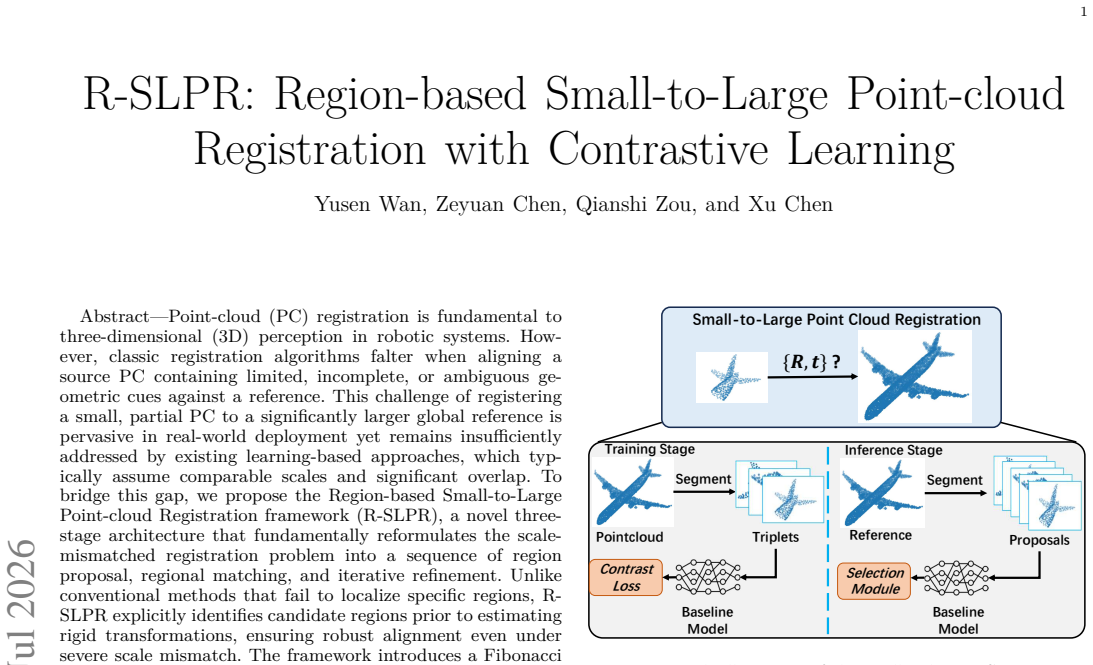
The load-bearing components are (1) Fibonacci Grid Segmentation (FGS), a deterministic lattice of anchors on the unit sphere whose spacing uses the golden ratio to give uniform directional coverage, used to slice the reference into proposals; (2) a contrastive learning loss that shapes regional feature embeddings so the source embeds close to its true region and far from irrelevant regions; and (3) Cascade Anchor Selection and Refinement (CASR), an iterative algorithm that scores each proposal by the average distance between the transformed source and the baseline model's predicted correspondences (Eq. 10), selects the best transform, and updates anchors with an exponential moving average (E
What would settle it
Run R-SLPR on a symmetric object (e.g., a cylinder or sphere) where two different regions produce nearly identical local geometry; if the CASR selection picks the wrong side as often as random, the self-consistency score is not load-bearing. Alternatively, replace Eq. (10) with an oracle selector that knows the ground-truth region; if accuracy does not improve, the reported gains cannot be attributed to the selection mechanism.
Extended reading notes
Core claim
The central claim is that explicitly identifying candidate regions before estimating rigid transformations resolves the scale mismatch in small-to-large registration. The paper introduces a three-stage pipeline: Fibonacci Grid Segmentation (FGS) creates directionally uniform anchors on the unit sphere and uses nearest-neighbor search to carve the reference into overlapping proposals; a patch-level contrastive loss pulls feature embeddings of corresponding source–reference regions together and pushes embeddings of distant regions apart; and Cascade Anchor Selection and Refinement (CASR) registers the source against every proposal, picks the transform with the smallest average alignment distan
Load-bearing premise
The whole refinement loop trusts that the average distance between the transformed source and the network's predicted correspondences is a reliable score for picking the correct region; if a wrong proposal can achieve a small residual by matching to a geometrically similar surface, the anchor drifts and the final alignment collapses.
Editorial extensions
If this is right
- Because the framework wraps a baseline registration network, any correspondence-based method such as RPMNet can be lifted into the small-to-large setting without redesigning the network.
- Translation accuracy improves because the method aligns the source to a localized region rather than to the global centroid, which is inherently mismatched in scale-asymmetric pairs.
- The approach generalizes to unseen object categories and to noise, as demonstrated on ModelNet40 and on the ISOPR manufacturing dataset.
- The framework can serve as a practical recipe for CAD-to-scan alignment and workpiece localization in manufacturing, where partial scans must be matched to full reference models.
Reading between the lines
- If the region-selection score is reliable, the same propose–match–refine loop could be applied hierarchically—first coarse regions, then fine ones—to reduce the number of proposals and cut inference cost without losing accuracy.
- The self-consistency selection in Eq. (10) uses the same network that estimates transforms, so on geometrically ambiguous or symmetric parts a learned confidence estimator might be a more robust selector; this is an extension the paper does not test.
- The pipeline could naturally extend to sequential registration in robotics, where a small live scan must localize within a pre-built map; the anchor-update mechanism resembles a particle-filter-like search over directions.
- A testable prediction follows from the paper's claim: replacing FGS with random or farthest-point anchors should degrade accuracy, and the ablation in the paper already suggests the Fibonacci grid is not just a convenience but a contributor to the gains.
Signed reviews
Editorial analysis
A structured set of objections, weighed in public.
Referee Report
Summary. The paper proposes R-SLPR, a three-stage method for registering a small partial point cloud against a much larger reference point cloud. The method consists of a deterministic Fibonacci Grid Segmentation (FGS) to generate overlapping regional proposals, a contrastive learning objective on patch-level features, and a Cascade Anchor Selection and Refinement (CASR) algorithm that iteratively scores proposals and updates anchor directions. The method is evaluated on ModelNet40 under clean, unseen, noise, and noise+unseen settings at two cardinality ratios, and on the ISOPR industrial dataset. The authors report state-of-the-art accuracy, e.g., position MAE 0.009 and rotation MAE 1.104° on ModelNet40 clean at sampling ratio 0.2.
Significance. If the reported numbers are reproducible and the CASR selection mechanism is validated, the paper would address a genuinely under-served problem—small-to-large point-cloud registration—and the propose-match-refine decomposition is a reasonable architectural contribution. The evaluation uses external ground-truth transforms, so the headline metrics are not fitted to the test objective. The deterministic FGS anchor generation is simple and reproducible, and the paper tests on two datasets. However, the central SOTA claim is currently unverifiable: no error bars are reported, no code/data/trained models are provided, the closest partial-to-global baselines are not compared, and the CASR selection metric is an unvalidated self-consistency score. The paper also contains internal contradictions in its own benchmark tables and ablation reporting.
major comments (4)
- [Algorithm 1, Eq. (10)] The proposal-selection score d_k^n is a self-consistency residual computed with correspondences q̂_i produced by the same network that estimates (R_k^n, t_k^n). A wrong proposal containing a locally congruent surface patch can be aligned with small residual even if the global region is incorrect. The paper provides no oracle-selection baseline, no random-proposal control, and no region-hit-rate statistics to show that CASR actually identifies the true region. Because CASR is the core novelty separating R-SLPR from running the baseline on a single proposal, this unvalidated selection mechanism is load-bearing for the claimed gains.
- [Table I, Section V-C] The claim that R-SLPR 'consistently outperforms prior approaches' is contradicted by the authors' own table. At sampling rate 0.3 clean, MCLNet achieves MAE-r 1.186° while R-SLPR achieves 1.268°. At sampling rate 0.2 clean, the rotation-MAE advantage over MCLNet is 1.104 vs 1.132—a 0.028° difference that may be within run-to-run variability, yet no error bars or significance tests are reported. The abstract's headline 'rotation MAE 1.104' also omits the 1.268 value from Table I. These discrepancies must be reconciled before the SOTA claim can be accepted.
- [Section V-D, Table V] The ablation text promises comparisons with random anchor sampling, farthest-point sampling, and varying CASR iteration counts, but Table V reports only four configurations: baseline, +FG, +FG+CASR, and +FG+CASR+CL. The promised random/FPS controls are absent, so the claim that FGS is superior to alternative anchor-generation schemes is unsupported. The effect of the CASR iteration count on accuracy is also not shown, even though the text says it was investigated.
- [Section II and V-B] The related work section cites Chen et al. [10] on full-to-partial registration and PGPNet [11] as partial-global methods, but neither is included in the experimental comparison. Since the paper's central claim is superiority on small-to-large/partial-to-global registration, omitting the closest prior baselines makes the comparison incomplete. Furthermore, no code, data, or trained models are provided; for a claim that rests on very small margins (e.g., 0.028° rotation MAE), this level of reproducibility is insufficient.
minor comments (5)
- [Eq. (11), Algorithm 1 line 16] The EMA update is written with (1−λ)a_k^n + γa_k^b in Eq. (11) but with (1−η)a_k^n + ηa_k^b in Algorithm 1. Please unify the notation and clearly define the hyperparameter.
- [Table VI] The table caption says the experimental setting is 'Noise & Unseen', but the rows are labeled 'Clean' and 'Noisy'. Please clarify which setting was actually used for the ISOPR experiments.
- [Section V-B] The text defines γ = I/J as the cardinality ratio, but the tables and headers use 'Sampling Rate'. Please align the terminology.
- [Reference [18]] Reference [18] is cited as 'MFGNet: Multibranch feature generation networks for few-shot remote sensing scene classification', but the text describes MFGNet as a point-cloud registration method with a keypoint selection module. The citation appears to be mismatched; please verify.
- [Abstract/Conclusion] Units should be stated consistently: rotation errors are in degrees, translation errors are dimensionless (normalized coordinates). The abstract and conclusion should make this explicit.
Circularity Check
CASR selection metric (Eq. 10) is a self-consistency score: the 'best region' is chosen by the residual of the baseline's own SVD fit to its own correspondences; the central external benchmark keeps the score moderate.
-
fitted input called prediction
[Section IV-C, Algorithm 1 lines 11-12, Eqs. (10)-(11)]
"For each transform {Rk n, tk n}, we calculate the average distance between the transformed source PC and the corresponding coordinates: dk n = 1 I ∑ I i=1 ∥ Rk nsi + tk n− ˆqi∥2 (10) where si is a point in S and ˆqi is the corresponding coordinate used in aligning S and proposal Pn to calculate each transform {Rk n, tk n}."
By Sec. III-B, {Rk n, tk n} is obtained by SVD on the same ˆqi used in Eq. (10), so dk n is exactly the fitting residual of the baseline model for proposal n. Selecting argmin d therefore chooses the proposal that the network can fit to its own predicted correspondences, not necessarily the truly corresponding region. A wrong proposal with a locally congruent surface patch can produce a small residual, so the 'region quality' score is tautologically defined in terms of the model's own output. The paper presents this self-consistency distance as evaluating proposal quality and uses it to claim SOTA gains over RPMNet, but provides no oracle-selection or random-proposal control.
full rationale
The headline accuracy numbers (MAE-t 0.009, MAE-r 1.104°) are measured against external ground-truth transforms on ModelNet40 and ISOPR, so the central SOTA claim is not itself a fitted prediction. The main circularity concern is the CASR proposal-selection step: Eq. (10) scores a proposal by the average distance from the transformed source to ˆqi, but ˆqi are the correspondences from which the same baseline computes {R,t} via SVD. Hence the score is a self-consistency residual, not an independent correctness measure, and the region selection could be an artifact of the model fitting itself to a locally plausible but globally wrong proposal. The paper does not ablate against oracle selection or random proposals, and the qualitative note about uninformative regions inflating RMSE is the only acknowledgment of failure cases. The self-citation [12] for the ISOPR dataset is minor and the dataset carries external ground truth, so it does not materially add circularity. Overall, the final evaluation is external and the method is not a pure tautology, but the load-bearing selection mechanism is partially circular, yielding a score of 3.
Assumptions & free parameters
free parameters (6)
- alpha (contrastive margin)
- lambda (loss balance)
- eta/gamma (EMA step)
- N (number of anchors)
- k (patch size)
- K (CASR iterations)
assumptions (6)
- domain assumption The FGS dot-product segmentation, using top-k points by projection onto Fibonacci anchor directions, produces proposals that cover the reference and contain the true overlap region.
- domain assumption The triplet training distribution (S = random FGS proposal, Q = nearest proposal, Ir = farthest proposal) is representative of the inference distribution (S = arbitrary local fragment, Q = full reference).
- domain assumption The model's own self-consistency residual (Eq. 10) is a reliable selection score for the true corresponding region in CASR.
- standard math SVD-based rigid transform recovery from predicted correspondences is valid.
- standard math Fibonacci sphere sampling gives directionally uniform anchors for point-cloud surfaces.
- domain assumption The source point cloud S is a subset of the reference Q up to the applied ground-truth transform, so every source point has a true correspondence in Q.
Cite this review
Pith. "Pith review of R-SLPR: Region-based Small-to-Large Point-cloud Registration with Contrastive Learning." pith.science (2026). https://pith.science/paper/EXCAB7R3
@misc{pith2026260726583,
  author       = {Pith},
  title        = {Pith review of: R-SLPR: Region-based Small-to-Large Point-cloud Registration with Contrastive Learning},
  year         = {2026},
  howpublished = {\url{https://pith.science/paper/EXCAB7R3}},
  note         = {Machine review of arXiv:2607.26583}
}
read the original abstract
Point-cloud (PC) registration is fundamental to three-dimensional (3D) perception in robotic systems. However, classic registration algorithms falter when aligning a source PC containing limited, incomplete, or ambiguous geometric cues against a reference. This challenge of registering a small, partial PC to a significantly larger global reference is pervasive in real-world deployment yet remains insufficiently addressed by existing learning-based approaches, which typically assume comparable scales and significant overlap. To bridge this gap, we propose the Region-based Small-to-Large Point-cloud Registra- tion framework (R-SLPR), a novel three-stage architecture that fundamentally reformulates the scale-mismatched registration problem into a sequence of region proposal, regional matching, and iterative refinement. Unlike conventional methods that fail to localize specific regions, R-SLPR explicitly identifies candidate regions prior to estimating rigid transformations, ensuring robust alignment even under severe scale mismatch. The framework introduces a Fibonacci Grid Segmentation method coupled with a contrastive learning objective to effectively generate and match local geometric patches. Building on this, a novel Cascade Anchor Selection and Refinement algorithm iteratively aligns the source with the target region to maximize precision. Extensive evaluation on ModelNet40 demonstrates that R-SLPR establishes a new state-of-the-art accuracy standard, outperforming prior approaches and significantly reducing position and rotation Mean Absolute Error (MAE) to 0.009 and 1.104, respectively.
Figures


Figures from the paper (2 more)


Reference graph
Works this paper leans on
-
[10]
F. Chen, Q. Du, J. Zhao, et al, “A generalized full-to-partial registration framework of 3d point sets for computer-aided or- thopedic surgery,” IEEE Trans. on Biomed. Eng., vol. 71, no. 3, pp. 1010-1021, March 2023, doi: 10.1109/TBME.2023.3325355
arXiv 2023
-
[11]
PGPNet: A Novel Iterative Partial- Global-Partial Point Cloud Registration Method,
Y. Feng, Q. Bi, & Z. Lin, “PGPNet: A Novel Iterative Partial- Global-Partial Point Cloud Registration Method,” In Int. Conf. Artif. Intell. Comput. Eng. (ICAICE), November 2024, pp. 146- 152
2024
-
[1]
H. Chen, Y. Huang, Q. Xie, et al, “Multiscale feature line extraction from raw point clouds based on local surface vari- ation and anisotropic contraction,” IEEE Trans. Autom. Sci. Eng., vol. 19, no. 2, pp. 1003-1016, February 2021, doi: 10.1109/TASE.2021.3053006
arXiv 2021
-
[2]
A feature extraction approach over workpiece point clouds for robotic welding
Y. Zhang, Y. Geng, X. Tian, et al, “A feature extraction approach over workpiece point clouds for robotic welding. ” IEEE Trans. Autom. Sci. Eng., vol. 22, pp. 75-84, January 2024, doi: 10.1109/TASE.2023.3345868
arXiv 2024
-
[3]
Low-latency visual-based high- quality 3-D reconstruction using point cloud optimization,
P. Chi, Z. Wang, H. Liao, et al, “Low-latency visual-based high- quality 3-D reconstruction using point cloud optimization,” IEEE Sensors J., vol. 23, no. 17, pp. 20055-20065, Spectember. 2023, doi: 10.1109/JSEN.2023.3297232
arXiv 2023
-
[4]
A method for registration of 3-D shapes,
P. J. Besl and N. D. McKay, “A method for registration of 3-D shapes,” IEEE Transactions on Pattern Analysis and Machine Intelligence, vol. 14, no. 2, pp. 239–256, Feb. 1992
1992
-
[5]
Fast point feature histograms (FPFH) for 3D registration,
R. B. Rusu, N. Blodow, and M. Beetz, “Fast point feature histograms (FPFH) for 3D registration,” in Proc. IEEE Int. Conf. Robotics and Automation (ICRA), 2009, pp. 3212–3217
2009
-
[6]
RPM-net: Robust point matching using learned features,
Z. J. Yew, & H. L. Gim, “RPM-net: Robust point matching using learned features,” in Proc. IEEE Conf. Comput. Vis. Pattern Recognit. (CVPR), June 2020, pp. 11824-11833
2020
Show all 24 references
-
[7]
Pointnetlk: Robust efficient point cloud registration using pointnet,
Y. Aoki, H. Goforth, R. A. Srivatsan, & S. Lucey, “Pointnetlk: Robust efficient point cloud registration using pointnet,” in Proc. IEEE Conf. Comput. Vis. Pattern Recognit. (CVPR), June 2019, pp. 7163-7172
2019
-
[8]
Using multi-level consistency learning for partial-to-partial point cloud registration,
B. Tan, H. Qin, X. Zhang, et al, “Using multi-level consistency learning for partial-to-partial point cloud registration,” IEEE Trans. Vis. Comput. Graph., vol. 30, no. 8, pp. 4881-4894, August 2023, doi: 10.1109/TVCG.2023.3280171
2023
-
[9]
Vision meets robotics: The KITTI dataset,
A. Geiger, P. Lenz, C. Stiller, and R. Urtasun, “Vision meets robotics: The KITTI dataset,” The International Journal of Robotics Research, vol. 32, no. 11, pp. 1231–1237, Sep. 2013
2013
-
[12]
iLSPR: A Learning-based Scene Point- cloud Registration method for robotic spatial awareness in intelligent manufacturing,
Y. Wan, & X. Chen, “iLSPR: A Learning-based Scene Point- cloud Registration method for robotic spatial awareness in intelligent manufacturing,” Robot. Comput.-Integr. Manuf., vol. 99, pp. 103204, June 2026, doi: 10.1016/j.rcim.2025.103204
2026
-
[13]
Fast r-cnn,
R. Girshick, “Fast r-cnn,” In Proc. IEEE Int. Conf. Comput. Vis. (ICCV), December 2015, pp. 1440-1448
2015
-
[14]
Cascade R-CNN: High quality object detection and instance segmentation,
Z. Cai, & N. Vasconcelos (2019). “Cascade R-CNN: High quality object detection and instance segmentation,” IEEE Trans. Pattern Anal. Mach. Intell., vol. 43, no. 5, pp. 1483-1498, May 2021, doi: 10.1109/TPAMI.2019.2956516
2019
-
[15]
Facenet: A unified embedding for face recognition and clustering,
F. Schroff, D. Kalenichenko, & J. Philbin, “Facenet: A unified embedding for face recognition and clustering,” in Proc. IEEE Conf. Comput. Vis. Pattern Recognit. (CVPR), June 2015, pp. 815-823
2015
-
[16]
Small_GICP: Efficient and Parallel Algorithms for Point Cloud Registration,
K. Koide, “Small_GICP: Efficient and Parallel Algorithms for Point Cloud Registration,” J. Open Source Softw., vol. 9, no. 100, pp. 6948, 2024
2024
-
[17]
Deep closest point: Learning representations for point cloud registration,
Y. Wang, & J. M. Solomon, “Deep closest point: Learning representations for point cloud registration,” In Proc. IEEE Int. Conf. Comput. Vis. (ICCV), November 2019, pp. 3523-3532
2019
-
[18]
MFGNet: Multibranch feature generation networks for few-shot remote sensing scene classification,
X. Zhang, X. Fan, P. Chen, et al, “MFGNet: Multibranch feature generation networks for few-shot remote sensing scene classification,” IEEE Trans. Geosci. Remote. Sens., vol. 61, pp. 1-13, May 2023, doi: 10.1109/TGRS.2023.3275754
2023
-
[19]
Deep weighted consensus dense correspondence confidence maps for 3D shape registration,
D. Ginzburg, & D. Raviv, “Deep weighted consensus dense correspondence confidence maps for 3D shape registration,” In IEEE Int. Conf. Image Process. (ICIP), October 2022, pp. 71- 75
2022
-
[20]
Dynamic graph cnn for learning on point clouds,
Y. Wang, Y. Sun, Z. Liu, et al, “Dynamic graph cnn for learning on point clouds,” ACM Trans. Graph., vol. 38, no. 5, pp. 1-12, October 2019, doi:10.1145/3326362
2019 doi
-
[21]
Pointnetlk revisited
X. Li, J. K. Pontes, & S. Lucey, “Pointnetlk revisited”, in Proc. IEEE Conf. Comput. Vis. Pattern Recognit. (CVPR), June 2021, pp. 12763-12772
2021
-
[22]
RORNet: Partial- to-partial registration network with reliable overlapping representations,
Y. Wu, Y. Zhang, W. Ma, et al, “RORNet: Partial- to-partial registration network with reliable overlapping representations,” IEEE Trans. Neural Netw. Learn. Syst. vol. 35, no. 11, pp. 15453-15466, November 2024, doi: 10.1109/TNNLS.2023.3286943
2024
-
[23]
3D Shapenets: A Deep Representation for Volumetric Shapes,
Z. Wu, S. Song, A. Khosla, et al, “3D Shapenets: A Deep Representation for Volumetric Shapes,” in Proc. IEEE Conf. Comput. Vis. Pattern Recognit. (CVPR), June 2015, pp. 1912- 1920
2015
-
[24]
Measurement of areas on a sphere using Fibonacci and latitude–longitude lattices,
Á. González, “Measurement of areas on a sphere using Fibonacci and latitude–longitude lattices,” Math. Geosci., vol. 42, no. 1,pp. 49-64, 2010
2010
Reviewed August 1, 2026 · model on record in the stance chip above.
Discussion (0). Continue with ORCID to comment.