REVIEW 5 minor 146 references
The full shape of Lyman-alpha forest correlations from the survey's second data release measures the Alcock-Paczyński distance ratio at z=2.33 to 1%, the tightest high-redshift expansion anchor from large-scale structure.
Reviewed by Pith at T0; open to challenge. T0 means a machine referee read the full paper against a public rubric. the ladder, T0–T4 →
T0 review · deepseek-v4-flash
2026-08-03 01:38 UTC pith:YB5XX33J
load-bearing objection Solid 1% AP measurement at z=2.33; SSM absorbs most of the FGPA worry, but an explicit systematic on φ_s would be a cleaner choice.
DESI DR2 Results IV: Alcock-Paczy\'nski Measurements from the Lyman Alpha Forest and Cosmological Constraints
The pith
A machine-rendered reading of the paper's core claim, the machinery that carries it, and where it could break.
Core claim
The central claim is that the anisotropy of Lyman-alpha correlations at z_eff=2.33 carries an Alcock-Paczyński signal that can be measured from the broadband, smooth part of the correlation function rather than only from the BAO peak. Combining the Lyman-alpha auto-correlation and the Lyman-alpha-quasar cross-correlation, the paper measures the broadband AP parameter phi_s = 1.007±0.011, corresponding to D_M/D_H = 4.578±0.052; adding the BAO-peak AP constraint gives a full-shape result D_M/D_H = 4.572±0.046, a 1.0% measurement. The joint full-shape and BAO fit gives D_M/r_d = 39.32±0.33 and D_H/r_d = 8.600±0.066 at z_eff=2.33. The paper argues that systematics from small-scale non-linearitie
What carries the argument
The central machinery is a template for the 2D correlation function split into a BAO peak component and a smooth broadband component, each with its own Alcock-Paczyński scale parameters (phi_p, alpha_p and phi_s, alpha_s). The AP parameter phi = q_perp/q_parallel equals the true D_M/D_H divided by the fiducial value, isolating the anisotropic stretch that occurs when the wrong cosmology maps angles and redshifts to distances. Redshift-space distortions—the apparent anisotropy from peculiar velocities—are separated from AP because the Lyman-alpha forest has a large RSD parameter beta_F≈1.2, making the AP response shape distinctly different. A new small-scale marginalization method treats the
Load-bearing premise
The measurement stands or falls on the assumption that the smooth part of the Lyman-alpha correlations, after the chosen scale cuts and small-scale marginalization, is modeled well enough that any residual confusion between the cosmic-stretch anisotropy and velocity-induced anisotropy is below one-third of the statistical error.
What would settle it
Replace the linear-theory template with an emulator trained on hydrodynamical simulations and refit the same DR2 correlation functions; if the full-shape D_M/D_H moves by more than about 0.4%—one-third of the quoted uncertainty—the claim that systematics are controlled fails.
If this is right
- The 1% AP constraint at z=2.33 is the tightest distance-ratio measurement at z>1 from large-scale structure, exceeding the survey's original precision requirements with only three years of data.
- Combined with BAO, the distances D_M/r_d and D_H/r_d at z_eff=2.33 are determined at 0.84% and 0.77%, providing a high-redshift anchor for the expansion history.
- In flat ΛCDM, the Lyman-alpha forest alone gives Omega_m=0.325±0.018, and with a baryon density prior gives H0=66.5±1.3 km/s/Mpc, independent of CMB anisotropies.
- Adding the Lyman-alpha full-shape data reduces the DESI-vs-CMB tension from 2.4 sigma to 2.2 sigma and lowers the preference for evolving dark energy from 3.2 sigma to 2.7 sigma (DESI+CMB) and from about 3.4 sigma to 3.1 sigma (with supernovae).
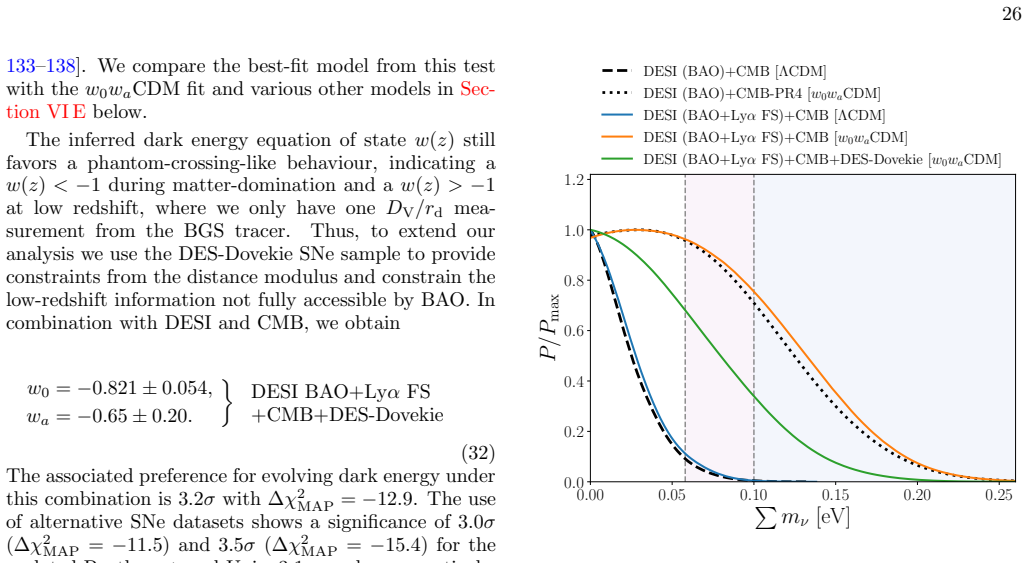
- In ΛCDM, the joint DESI+CMB analysis yields an upper limit on the sum of neutrino masses of <0.0592 eV at 95%, essentially touching the lower bound from neutrino oscillation experiments in the normal ordering.
Where Pith is reading between the lines
- The clean separation between AP and redshift-space distortions in this analysis relies on the large beta_F of the Lyman-alpha forest; below the current 1% precision, a forward-model approach calibrated to hydrodynamical simulations will likely be needed to avoid the systematic floor the paper itself acknowledges.
- The new small-scale marginalization method is transferable: any analysis of absorption spectra with anisotropic distortion matrices from continuum fitting could adopt it to prevent small-scale leakage from contaminating large-scale anisotropic signals.
- Because the measurement sits deep in the matter-dominated era, it acts as a geometric anchor for models that alter the pre-recombination sound horizon, such as early dark energy or modified gravity, making it a sharper discriminant for those models than low-redshift BAO alone.
- If the same pipeline is applied to the next data release with roughly twice the sample, the 1% constraint should shrink toward 0.7%; a deviation from ΛCDM at that level would be far more informative than the current two-sigma tensions.
Editorial analysis
A structured set of objections, weighed in public.
Referee Report
Summary. This paper presents Alcock–Paczyński measurements from the full shape of DESI DR2 Lyα‑forest auto‑ and cross‑correlations. Using a template split into a BAO peak and a smooth component, it extracts the broadband AP parameter φs = 1.007 ± 0.011, and combines it with the BAO AP parameter to obtain DM/DH(zeff=2.33) = 4.572 ± 0.046 (1.0%). Combined with the isotropic BAO scale, the analysis yields DM/rd = 39.32 ± 0.33 and DH/rd = 8.600 ± 0.066. Under ΛCDM, LyαFS+BBN gives H0 = 66.5 ± 1.3 km s⁻¹ Mpc⁻¹ and Ωm = 0.325 ± 0.018; combining with DESI BAO reduces the DESI–CMB discrepancy from 2.4σ to 2.2σ and the w0wa preference from 3.2σ to 2.7σ (DESI+CMB). The paper introduces a new small‑scale marginalization (SSM) technique to remove continuum‑fitting leakage and a UVB‑fluctuation model; the UVB bias is measured at bγ = 0.143 ± 0.047, consistent with theoretical expectations.
Significance. If correct, the 1% AP constraint at z>2 is the tightest large‑scale‑structure anchor of the distance ratio at z>1 and a substantial improvement over BAO‑only constraints. The paper’s strengths are the blinded analysis, validation on two independent mock suites (AbacusSummit four variants and CoLoRe 2LPT), multiple data splits, and the good fit quality (PTE = 0.20). The small‑scale marginalization method is an interesting and generally applicable contribution, and the UVB‑bias measurement provides a non‑trivial cross‑check of the model. The cosmological implications—reduced preference for evolving dark energy, a high‑redshift H0 constraint, and updated neutrino‑mass and curvature limits—are important for the current DESI tension landscape.
minor comments (5)
- [§IV C, §V A] The decision to quote no extra systematic on φs is the most consequential judgment call in the paper. The SSM argument is strong: marginalizing over every small‑scale bin in the undistorted model space removes sensitivity to the small‑scale model, and §IV B shows that removing the non‑linear correction entirely does not shift the result. Still, the paper should state explicitly that the reported φs uncertainty is statistical‑only and that the decision not to add a systematic is a modeling assumption, and should note what a full‑hydrodynamical validation would add given that both mock suites share the FGPA approximation.
- [§V B, Eqs. (22)–(23)] The BAO systematic Δφp = 0.8% is chosen to match the observed mock bias while the central value is not shifted. This is defensible given that EFT predictions and mocks disagree on the sign, but the text should be more explicit that this is an empirical uncertainty added in quadrature, not a bias correction applied to the measurement. A sentence clarifying this would prevent readers from interpreting the central values as already bias‑corrected.
- [§III C, Eqs. (16)–(17)] The symbol S is used for both the full parameter prior covariance and the diagonal prior on the marginalized template amplitudes (later set to S_ii = 100). Please distinguish the two, e.g., S_θ and S_η, to avoid ambiguity in the algebraic marginalization step.
- [Fig. 4 caption] The caption contains a minor redundancy: “the constraints from the cross‑correlations in orange (orange)” repeats “orange”. Please remove the duplicate.
- [Appendix A] In the description of Figure 14, the sentence “By the fifth r⊥ bin shown in brown (0 < r⊥ < 4 h⁻¹ Mpc)” appears to have a typo in the transverse range; the fifth bin should not be the same range as the first. Please correct the transverse interval.
Circularity Check
No significant circularity: the Lyα AP measurement is an empirical full-shape fit, with companion-paper self-citations serving as validation, mocks, or fixed priors rather than as the source of the claimed constraint.
full rationale
The derivation chain is self-contained as a measurement. The data (Lyα auto- and cross-correlations) are fitted with a template model whose scale parameters (φ_s, φ_p, α_p) are free parameters; the resulting distances are obtained by multiplying the fitted ratios by the fiducial Planck values, which is an arbitrary coordinate convention rather than an input that determines the result. No parameter is defined in terms of the target distance ratios: φ_s is fitted from the smooth-component anisotropy, φ_p from the BAO peak, and α_p from the isotropic BAO scale, and these are then combined. The fixed small-scale non-linearity parameters come from a companion paper [29] that uses disjoint 1D power-spectrum data, and the paper explicitly tests that freeing them does not change the result. The UVB bias parameter b_Γ is measured and then compared to an external prediction (~0.13), not used as an input. The fiducial cosmology appears in the template and coordinates, but mocks with different fiducial cosmologies are used to check that this choice does not bias the broadband AP constraint. Self-citations to companion papers [27,28,29] are validation or technical-support references, not uniqueness theorems or ansatz definitions that force the result. The decision not to add a systematic on φ_s is based on mock recovery of known truth, which is empirical validation rather than circular reasoning; whether FGPA mocks are realistic enough for that decision is a robustness/correctness concern, not a circularity of the derivation. The BAO systematic is added as a quadrature uncertainty rather than subtracted as a fitted shift, so it does not feed back into the central claim in a definitional way. Overall, the paper's headline AP and distance constraints are fits to the data with external calibration checks, not restatements of its inputs.
Axiom & Free-Parameter Ledger
free parameters (13)
- alpha_s (isotropic smooth-component scale) =
1.044 ± 0.036
- beta_F (Lyα RSD parameter) =
1.193 +0.083/-0.12
- b_F (Lyα bias) =
-0.167 +0.010/-0.015
- b_Q (quasar bias) =
3.49 ± 0.22
- f (growth rate) =
1.43 +0.17/-0.20
- sigma_z (quasar redshift error) =
4.8 ± 1.6 Mpc/h
- b_HCD, beta_HCD, L_HCD (HCD contamination) =
b_HCD > -0.027; beta_HCD 0.498±0.089; L_HCD 4.9±1.8 Mpc/h
- Metal biases (b_SiII lines, b_CIV) =
e.g., b_CIV = -19.80 ± 5.1 (×10^3)
- a_noise (sky noise amplitude) =
2.24 ± 0.2 (×10^4)
- xi_TP^0 (transverse proximity effect amplitude) =
< 0.24
- Delta r_parallel (systematic redshift shift) =
0.34 ± 0.26 Mpc/h
- b_gamma (UV background fluctuation bias) =
0.143 ± 0.046
- q1, q2, kv, av, bv, kp (small-scale non-linear coefficients) =
0.303, 0.267, 0.576, 0.443, 1.66, 11.062
axioms (9)
- domain assumption Lyα flux overdensity is a biased tracer of matter with linear bias and RSD (Eqs. 7-8).
- domain assumption Contaminant model (metals, HCDs, sky noise, transverse proximity, UVB) covers all significant astrophysical systematics.
- domain assumption Fiducial Planck ΛCDM used for coordinate conversion and P_fid does not bias AP; scale parameters absorb the coordinate mismatch.
- domain assumption Scale cuts r_min=30/40 Mpc/h plus small-scale marginalization remove sensitivity to non-linear small scales.
- domain assumption Covariance matrix from HEALPix subregion resampling plus smoothing is accurate.
- ad hoc to paper Fixed small-scale non-linear coefficients from companion paper [29] are applicable to the 3D correlations.
- ad hoc to paper UVB fluctuation model parameters b'_a=-2/3 and lambda0=300 Mpc/h are correct.
- ad hoc to paper BAO systematic uncertainty (Delta_alpha_p=0.15%, Delta_phi_p=0.8%) is adequate.
- domain assumption ΛCDM and CPL parametrization assumed for cosmological interpretations.
read the original abstract
We present Alcock-Paczy\'nski (AP) measurements from the full shape of Lyman-$\alpha$ (Ly$\alpha$) forest correlation functions measured from the second data release (DR2) of the Dark Energy Spectroscopic Instrument (DESI). Our measurements include information from the Ly$\alpha$ forest auto-correlation and its cross-correlation with quasars. We constrain the AP effect with $1\%$ precision at an effective redshift $z_\mathrm{eff}=2.33$, which is twice as tight as the Baryon Acoustic Oscillation (BAO) constraint from the same data. When using the joint Ly$\alpha$ AP and BAO results, we measure the ratios $D_\text{H}(z_\mathrm{eff})/r_\text{d}=8.600 \pm 0.066$ and $D_\text{M}(z_\mathrm{eff})/r_\text{d}=39.32 \pm 0.33$, where $D_\text{M}$ is the transverse comoving distance, $D_\text{H}$ is the Hubble distance, and $r_\text{d}$ is the sound horizon at the drag epoch. Assuming $\Lambda$CDM, Ly$\alpha$ forest measurements combined with a nucleosynthesis prior produce a constraint on the Hubble constant $H_0=66.5\pm1.3\,\mathrm{km\,s^{-1}\,Mpc^{-1}}$. The Ly$\alpha$ AP result corresponds to a matter fraction constraint $\Omega_\text{m}=0.325\pm0.018$ in $\Lambda$CDM, which is $1.4\sigma$ higher than DESI BAO. This impacts the DESI results relative to the Cosmic Microwave Background (CMB), slightly reducing their discrepancy from $2.4\sigma$ to $2.2\sigma$. We present updated constraints on extended models using the joint DESI DR2 BAO and Ly$\alpha$ forest full shape data, together with external data sets. When considering a time-evolving dark energy equation of state parametrized by $w_0$ and $w_a$, we find it is preferred over $\Lambda$CDM at $2.7\sigma$ for the combination of DESI and CMB data, and at $3.2\sigma$ when also including supernovae. With the new Ly$\alpha$ AP measurement, DESI provides its most precise anchor for the expansion history at $z > 1$ in the matter-dominated Universe.
Figures




Reference graph
Works this paper leans on
-
[1]
Dark energy The unknown nature of dark energy, as well as the cur- rent trends in cosmology, make the search for constrain- ing the equation of state of dark energy and its redshift dependence of particular interest. We model the equa- tion of state relating the pressure and the energy density of dark energy,P=wρc 2, with the Chevallier-Polarski- Linder (...
-
[2]
Neutrino masses We also present updated constraints on the sum of neu- trino masses. With the analysis of DR2 BAO, DESI al- ready placed tight constraints on the sum of neutrino masses, assuming ΛCDM with three degenerate neutrino species and the standard physical prior that P mν > 0 eV. In combination with CMB data fromPlanckPR4 and CMB lensing reconstru...
-
[3]
Curvature Cosmological distance measurements also allow us to test deviations from flatness within ΛCDM. The spatial curvature density parameter, ΩK, can affect the measure- ments of Ωm across the redshift tracers, and even impact measurements of neutrino masses, relaxing the neutrino mass bounds (see [141, 142], for instance). While cosmo- logical data h...
-
[4]
A. G. Adame, J. Aguilar, S. Ahlen, S. Alam, D. M. Alexander,et al., J. Cosmology Astropart. Phys.2025, 021 (2025), arXiv:2404.03002 [astro-ph.CO]
Pith/arXiv arXiv 2025
-
[5]
M. Abdul Karim, J. Aguilar, S. Ahlen, S. Alam, L. Allen,et al., Phys. Rev. D112, 083515 (2025), arXiv:2503.14738 [astro-ph.CO]
Pith/arXiv arXiv 2025
-
[6]
M. Levi, C. Bebek, T. Beers, R. Blum, R. Cahn, et al., arXiv e-prints , arXiv:1308.0847 (2013), arXiv:1308.0847 [astro-ph.CO]
Pith/arXiv arXiv 2013
-
[7]
DESI Collaboration, A. Aghamousa, J. Aguilar, S. Ahlen, S. Alam,et al., arXiv e-prints , arXiv:1611.00036 (2016), arXiv:1611.00036 [astro- ph.IM]
Pith/arXiv arXiv 2016
-
[8]
DESI Collaboration, B. Abareshi, J. Aguilar, S. Ahlen, S. Alam,et al., AJ164, 207 (2022), arXiv:2205.10939 [astro-ph.IM]
Pith/arXiv arXiv 2022
-
[9]
A. Slosar, V. Irˇ siˇ c, D. Kirkby, S. Bailey, N. G. Busca, et al., J. Cosmology Astropart. Phys.2013, 026 (2013), arXiv:1301.3459 [astro-ph.CO]
Pith/arXiv arXiv 2013
-
[10]
N. G. Busca, T. Delubac, J. Rich, S. Bailey, A. Font- Ribera,et al., A&A552, A96 (2013), arXiv:1211.2616
Pith/arXiv arXiv 2013
-
[11]
A. Cuceu, J. Farr, P. Lemos, and A. Font-Ribera, J. Cosmology Astropart. Phys.2019, 044 (2019), arXiv:1906.11628 [astro-ph.CO]
Pith/arXiv arXiv 2019
-
[12]
M. McQuinn and M. White, MNRAS415, 2257 (2011), arXiv:1102.1752 [astro-ph.CO]
Pith/arXiv arXiv 2011
-
[13]
K. S. Dawson, D. J. Schlegel, C. P. Ahn, S. F. Anderson, ´E. Aubourg,et al., AJ145, 10 (2013), arXiv:1208.0022 [astro-ph.CO]
Pith/arXiv arXiv 2013
-
[15]
A. Cuceu, A. Font-Ribera, S. Nadathur, B. Joachimi, and P. Martini, Phys. Rev. Lett.130, 191003 (2023), arXiv:2209.13942 [astro-ph.CO]
Pith/arXiv arXiv 2023
-
[16]
K. S. Dawson, J.-P. Kneib, W. J. Percival, S. Alam, F. D. Albareti,et al., AJ151, 44 (2016), arXiv:1508.04473 [astro-ph.CO]
Pith/arXiv arXiv 2016
-
[17]
H. du Mas des Bourboux, J. Rich, A. Font-Ribera, V. de Sainte Agathe, J. Farr,et al., ApJ901, 153 (2020), arXiv:2007.08995 [astro-ph.CO]
Pith/arXiv arXiv 2020
-
[18]
A. G. Adame, J. Aguilar, S. Ahlen, S. Alam, D. M. Alexander,et al., J. Cosmology Astropart. Phys.2025, 124 (2025), arXiv:2404.03001 [astro-ph.CO]
Pith/arXiv arXiv 2025
-
[19]
DESI Collaboration, A. G. Adame, J. Aguilar, S. Ahlen, S. Alam,et al., AJ167, 62 (2024), arXiv:2306.06307 [astro-ph.CO]
Pith/arXiv arXiv 2024
-
[20]
C. Poppett, P. Jelinsky, J. Guy, J. Edelstein, S. Jelin- sky,et al., inGround-based and Airborne Instrumenta- tion for Astronomy VIII, Society of Photo-Optical In- 31 strumentation Engineers (SPIE) Conference Series, Vol. 11447, edited by C. J. Evans, J. J. Bryant, and K. Moto- hara (2020) p. 1144711, arXiv:2101.11564 [astro-ph.IM]
Pith/arXiv arXiv 2020
- [21]
-
[22]
Alcock and B
C. Alcock and B. Paczynski, Nature281, 358 (1979)
1979
-
[23]
DESI Collaboration, A. Aghamousa, J. Aguilar, S. Ahlen, S. Alam,et al., arXiv e-prints , arXiv:1611.00037 (2016), arXiv:1611.00037 [astro- ph.IM]
Pith/arXiv arXiv 2016
-
[24]
Poppett, L
C. Poppett, L. Tyas, J. Aguilar, C. Bebek, D. Bramall, et al., AJ168, 245 (2024)
2024
-
[25]
DESI Collaboration, M. Abdul Karim, A. G. Adame, D. Aguado, J. Aguilar,et al., AJ171, 285 (2026), arXiv:2503.14745 [astro-ph.CO]
Pith/arXiv arXiv 2026
-
[26]
T. N. Miller, P. Doel, G. Gutierrez, R. Besuner, D. Brooks,et al., AJ168, 95 (2024), arXiv:2306.06310 [astro-ph.IM]
Pith/arXiv arXiv 2024
-
[27]
J. Guy, S. Bailey, A. Kremin, S. Alam, D. M. Alexan- der,et al., AJ165, 144 (2023), arXiv:2209.14482 [astro- ph.IM]
Pith/arXiv arXiv 2023
-
[28]
E. F. Schlafly, D. Kirkby, D. J. Schlegel, A. D. Myers, A. Raichoor,et al., AJ166, 259 (2023), arXiv:2306.06309 [astro-ph.CO]
Pith/arXiv arXiv 2023
-
[29]
J. Chaves-Montero, A. Font-Ribera, J. Aguilar, S. Ahlen, E. Armengaud,et al., arXiv e-prints (2026), arXiv:2607.27413 [astro-ph.CO]
Pith/arXiv arXiv 2026
-
[30]
A. Anand, J. Guy, S. Bailey, J. Moustakas, J. Aguilar, et al., AJ168, 124 (2024), arXiv:2405.19288 [astro- ph.CO]
Pith/arXiv arXiv 2024
-
[31]
A. G. Adame, J. Aguilar, S. Ahlen, S. Alam, D. M. Alexander,et al., J. Cosmology Astropart. Phys.2025, 017 (2025), arXiv:2411.12020 [astro-ph.CO]
Pith/arXiv arXiv 2025
-
[32]
M. Herbold, A. Cuceu, P. Martini, H. K. Herrera- Alcantar, J. Guy,et al., arXiv e-prints (2026), arXiv:2607.27411 [astro-ph.CO]
Pith/arXiv arXiv 2026
-
[33]
M. F. Ruiz-Herrera Bernal, S. Avila, A. Font-Ribera, H. K. Herrera-Alcantar, D. Alonso,et al., arXiv e-prints (2026), arXiv:2607.27412 [astro-ph.CO]
Pith/arXiv arXiv 2026
-
[34]
D. Green, D. Kirkby, J. Aguilar, S. Ahlen, D. M. Alexander,et al., J. Cosmology Astropart. Phys.2025, 087 (2025), arXiv:2505.01596 [astro-ph.IM]
Pith/arXiv arXiv 2025
-
[35]
C. Hahn, M. J. Wilson, O. Ruiz-Macias, S. Cole, D. H. Weinberg,et al., AJ165, 253 (2023), arXiv:2208.08512 [astro-ph.CO]
Pith/arXiv arXiv 2023
-
[36]
Bailey et al., in preparation (2024)
2024
-
[37]
E. Chaussidon, C. Y` eche, N. Palanque-Delabrouille, D. M. Alexander, J. Yang,et al., ApJ944, 107 (2023), arXiv:2208.08511 [astro-ph.CO]
Pith/arXiv arXiv 2023
-
[38]
N. Busca and C. Balland, arXiv e-prints , arXiv:1808.09955 (2018), arXiv:1808.09955 [astro- ph.IM]
Pith/arXiv arXiv 2018
-
[39]
M.-F. Ho, S. Bird, and R. Garnett, MNRAS507, 704 (2021), arXiv:2103.10964 [astro-ph.GA]
Pith/arXiv arXiv 2021
-
[40]
A. Brodzeller, M. Wolfson, D. M. Santos, M. Ho, T. Tan,et al., Phys. Rev. D112, 083510 (2025), arXiv:2503.14740 [astro-ph.CO]
Pith/arXiv arXiv 2025
-
[41]
A. Raichoor, J. Moustakas, J. A. Newman, T. Karim, S. Ahlen,et al., AJ165, 126 (2023), arXiv:2208.08513 [astro-ph.CO]
Pith/arXiv arXiv 2023
-
[42]
A. M. Wolfe, E. Gawiser, and J. X. Prochaska, ARA&A 43, 861 (2005), arXiv:astro-ph/0509481 [astro-ph]
Pith/arXiv arXiv 2005
-
[43]
B. Wang, J. Zou, Z. Cai, J. X. Prochaska, Z. Sun,et al., ApJS259, 28 (2022)
2022
-
[44]
A. Cuceu, H. K. Herrera-Alcantar, C. Gordon, P. Mar- tini, J. Guy,et al., J. Cosmology Astropart. Phys.2025, 148 (2025), arXiv:2404.03004 [astro-ph.CO]
Pith/arXiv arXiv 2025
-
[45]
L. Casas, H. K. Herrera-Alcantar, J. Chaves-Montero, A. Cuceu, A. Font-Ribera,et al., Phys. Rev. D113, 023520 (2026), arXiv:2503.14741 [astro-ph.IM]
Pith/arXiv arXiv 2026
-
[46]
J. E. Bautista, N. G. Busca, J. Guy, J. Rich, M. Blomqvist,et al., A&A603, A12 (2017), arXiv:1702.00176
Pith/arXiv arXiv 2017
-
[47]
C. Ram ´ ırez-P´ erez, I. P´ erez-R` afols, A. Font-Ribera, M. A. Karim, E. Armengaud,et al., MNRAS528, 6666 (2024), arXiv:2306.06312 [astro-ph.CO]
Pith/arXiv arXiv 2024
-
[48]
A. Cuceu, A. Font-Ribera, B. Joachimi, and S. Na- dathur, MNRAS506, 5439 (2021), arXiv:2103.14075 [astro-ph.CO]
Pith/arXiv arXiv 2021
-
[49]
Lewis, arXiv e-prints (2019), arXiv:1910.13970 [astro-ph.IM]
A. Lewis, arXiv e-prints (2019), arXiv:1910.13970 [astro-ph.IM]
Pith/arXiv arXiv 2019
-
[50]
J. Chaves-Montero, L. Cabayol-Garcia, M. Lokken, A. Font-Ribera, J. Aguilar,et al., Astron.Astrophys. 694, 10.1051/0004-6361/202452039 (2025)
-
[51]
A. G. Adame, J. Aguilar, S. Ahlen, S. Alam, D. M. Alexander,et al., J. Cosmology Astropart. Phys.2025, 008 (2025), arXiv:2411.12021 [astro-ph.CO]
Pith/arXiv arXiv 2025
-
[52]
A. G. Adame, J. Aguilar, S. Ahlen, S. Alam, D. M. Alexander,et al., J. Cosmology Astropart. Phys.2025, 028 (2025), arXiv:2411.12022 [astro-ph.CO]
Pith/arXiv arXiv 2025
-
[53]
A. Cuceu, A. Font-Ribera, P. Martini, B. Joachimi, S. Nadathur,et al., MNRAS523, 3773 (2023), arXiv:2209.12931 [astro-ph.CO]
Pith/arXiv arXiv 2023
-
[54]
C. Ravoux, M.-L. Abdul-Karim, J.-M. Le Goff, E. Ar- mengaud, J. N. Aguilar,et al., J. Cosmology As- tropart. Phys.2025, 079 (2025), arXiv:2505.09493 [astro-ph.CO]
arXiv 2025
-
[55]
J. Chaves-Montero, A. Font-Ribera, P. McDonald, E. Armengaud, D. Chebat,et al., J. Cosmology As- tropart. Phys.2026, 040 (2026), arXiv:2601.21432 [astro-ph.CO]
Pith/arXiv arXiv 2026
-
[56]
A. Arinyo-i-Prats, J. Miralda-Escud´ e, M. Viel, and R. Cen, J. Cosmology Astropart. Phys.2015, 017 (2015), arXiv:1506.04519 [astro-ph.CO]
Pith/arXiv arXiv 2015
-
[57]
J. J. Givans, A. Font-Ribera, A. Slosar, L. Seeyave, C. Pedersen,et al., J. Cosmology Astropart. Phys. 2022, 070 (2022), arXiv:2205.00962 [astro-ph.CO]
Pith/arXiv arXiv 2022
-
[58]
N. G. Kara¸ caylı, P. Martini, J. Aguilar, S. Ahlen, E. Ar- mengaud,et al., J. Cosmology Astropart. Phys.2025, 004 (2025), arXiv:2505.07974 [astro-ph.CO]
Pith/arXiv arXiv 2025
-
[59]
S. Morrison, D. Som, M. M. Pieri, I. P´ erez- R` afols, and M. Blomqvist, MNRAS532, 32 (2024), arXiv:2309.06813 [astro-ph.CO]
Pith/arXiv arXiv 2024
-
[60]
J. Guy, S. G. A. Gontcho, E. Armengaud, A. Brodzeller, A. Cuceu,et al., J. Cosmology Astropart. Phys.2025, 140 (2025), arXiv:2404.03003 [astro-ph.CO]
Pith/arXiv arXiv 2025
-
[61]
A. Font-Ribera, E. Arnau, J. Miralda-Escud´ e, E. Rollinde, J. Brinkmann,et al., J. Cosmology Astropart. Phys.5, 018 (2013), arXiv:1303.1937
Pith/arXiv arXiv 2013
-
[62]
A. Font-Ribera, J. Miralda-Escud´ e, E. Arnau, B. Carithers, K.-G. Lee,et al., J. Cosmology As- tropart. Phys.2012, 059 (2012), arXiv:1209.4596 [astro-ph.CO]
Pith/arXiv arXiv 2012
-
[63]
M. M. Pieri, M. J. Mortonson, S. Frank, N. Crighton, D. H. Weinberg,et al., MNRAS441, 1718 (2014), arXiv:1309.6768 [astro-ph.CO]
Pith/arXiv arXiv 2014
-
[64]
A. Pontzen, Phys. Rev. D89, 083010 (2014), arXiv:1402.0506 [astro-ph.CO]
Pith/arXiv arXiv 2014
-
[65]
S. Gontcho A Gontcho, J. Miralda-Escud´ e, and N. G. Busca, MNRAS442, 187 (2014), arXiv:1404.7425 [astro-ph.CO]
Pith/arXiv arXiv 2014
-
[66]
M. Blomqvist, D. Kirkby, J. E. Bautista, A. Arinyo- i-Prats, N. G. Busca,et al., J. Cosmology As- tropart. Phys.2015, 034 (2015), arXiv:1504.06656 [astro-ph.CO]
Pith/arXiv arXiv 2015
-
[67]
M. Abdul Karim, J. Aguilar, S. Ahlen, C. Allende Pri- eto, O. Alves,et al., Phys. Rev. D112, 083514 (2025), arXiv:2503.14739 [astro-ph.CO]. 32
Pith/arXiv arXiv 2025
- [68]
-
[69]
R. A. C. Croft, D. H. Weinberg, N. Katz, and L. Hern- quist, ApJ495, 44 (1998), arXiv:astro-ph/9708018 [astro-ph]
Pith/arXiv arXiv 1998
-
[70]
N. A. Maksimova, L. H. Garrison, D. J. Eisenstein, B. Hadzhiyska, S. Bose, and T. P. Satterthwaite, MN- RAS508, 4017 (2021), arXiv:2110.11398 [astro-ph.CO]
Pith/arXiv arXiv 2021
-
[71]
N. Padmanabhan, X. Xu, D. J. Eisenstein, R. Scalzo, A. J. Cuesta,et al., MNRAS427, 2132 (2012), arXiv:1202.0090 [astro-ph.CO]
Pith/arXiv arXiv 2012
-
[72]
B. Hadzhiyskaet al., Mon. Not. Roy. Astron. Soc.524, 1008 (2023), arXiv:2305.08899 [astro-ph.CO]
Pith/arXiv arXiv 2023
-
[73]
C. Ram ´ ırez-P´ erez, J. Sanchez, D. Alonso, and A. Font- Ribera, J. Cosmology Astropart. Phys.2022, 002 (2022), arXiv:2111.05069 [astro-ph.CO]
Pith/arXiv arXiv 2022
-
[74]
J. Farr, A. Font-Ribera, H. du Mas des Bourboux, A. Mu˜ noz-Guti´ errez, F. J. S´ anchez,et al., J. Cosmology Astropart. Phys.2020, 068 (2020), arXiv:1912.02763 [astro-ph.CO]
Pith/arXiv arXiv 2020
-
[75]
P. Martini, A. Cuceu, L. Ennesser, A. Brodzeller, J. Aguilar,et al., J. Cosmology Astropart. Phys.2025, 137 (2025), arXiv:2405.09737 [astro-ph.CO]
Pith/arXiv arXiv 2025
-
[76]
L. H. Garrison, D. J. Eisenstein, D. Ferrer, N. A. Mak- simova, and P. A. Pinto, MNRAS508, 575 (2021), arXiv:2110.11392 [astro-ph.CO]
Pith/arXiv arXiv 2021
-
[77]
R. de Belsunce, S.-F. Chen, M. M. Ivanov, C. Ravoux, S. Chabanier,et al., Phys. Rev. D111, 063524 (2025), arXiv:2412.06892 [astro-ph.CO]
Pith/arXiv arXiv 2025
-
[78]
B. Hadzhiyska, R. de Belsunce, A. Cuceu, J. Guy, M. M. Ivanov,et al., MNRAS540, 1960 (2025), arXiv:2503.13442 [astro-ph.CO]
Pith/arXiv arXiv 1960
-
[79]
R. de Belsunce, M. M. Ivanov, J. M. Sullivan, S.- F. Chen, and K. Akitsu, arXiv e-prints (2026), arXiv:2606.26234 [astro-ph.CO]
Pith/arXiv arXiv 2026
-
[80]
H. K. Herrera-Alcantar, A. Mu˜ noz-Guti´ errez, T. Tan, A. X. Gonz´ alez-Morales, A. Font-Ribera,et al., J. Cosmology Astropart. Phys.2025, 141 (2025), arXiv:2401.00303 [astro-ph.CO]
Pith/arXiv arXiv 2025
-
[81]
R. de Belsunce, O. H. E. Philcox, V. Irˇ siˇ c, P. McDonald, J. Guy, and N. Palanque-Delabrouille, MNRAS533, 3756 (2024), arXiv:2403.08241 [astro-ph.CO]
Pith/arXiv arXiv 2024
discussion (0)
Sign in with ORCID, Apple, or X to comment. Anyone can read and Pith papers without signing in.