REVIEW 3 major objections 4 minor 33 references
The Riemann Problem for a 3x3 Generalized Chaplygin Gas System with Variable Pressure
T0 review · 3 major / 4 minor · reviewed 2026-08-05 · deepseek-v4-flash
Pith's one-line read This paper claims that the isolated overcompressive delta shock in a 3×3 generalized Chaplygin gas is a genuine zero-viscosity limit of self-similar Dafermos viscous profiles, and that a complete Riemann classification holds for all 0<alpha
desk verdict A substantial 3x3 Chaplygin Riemann paper with a real classification caveat and a genuine gap in the viscous-profile proof: the Corner Lemma step asserts C^1 dependence in ε that it does not supply. read the letter →
The pith
A machine-rendered reading of the paper's core claim, the machinery that carries it, and where it could break.
The reading
What carries the argument
The load-bearing construction is the Dafermos self-similar viscous regularization, rewritten as a singularly perturbed ODE whose singular point is resolved by a spherical blow-up on S^3. In the blow-up, the reduced problem separates into three explicit orbit pieces: left and right outer orbits approaching the blown-up boundary, and a middle orbit on the boundary given by the ellipse y^2+lambda^2 z^2=a^2 together with the invariant relation D h - Gamma y=0. The quantities D and Gamma are invariant combinations of the Rankine-Hugoniot data, and the parameter lambda is fixed by the scalar matching condition k_L-k_R=-2πD/lambda^3, whose derivative is nonzero. A ramified coordinate b=beta^n conve
What would settle it
Use the explicitly smooth cases alpha=1/2 or alpha=1 with Riemann data satisfying the strict speed inequality and solve the Dafermos profile ODEs numerically. The theorem predicts that for every small positive epsilon a heteroclinic profile exists and that, after blow-down, the density spike grows like 1/epsilon with weight w(t)=t(c[rho]-[rho u]) while the wave speed tends to c. A direct computation showing no such profile, or a different spike scaling, would refute the main claim.
Extended reading notes
Core claim
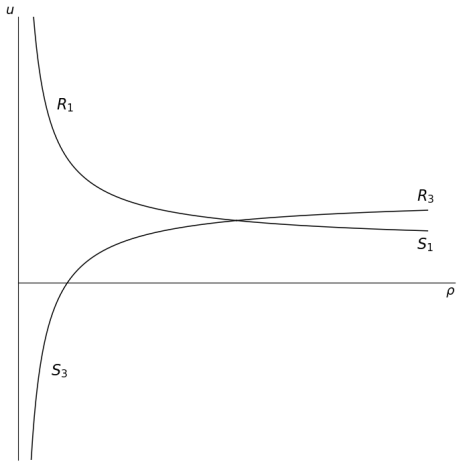
The paper claims that the Riemann problem for the system with pressure p(rho,v)=-A(v)/rho^alpha has a complete classification: for 0<alpha<1 the admissible patterns are combinations of shocks, rarefactions, contact discontinuities, and overcompressive singular waves, while for alpha=1 there is a sharp dichotomy between three contact discontinuities and one overcompressive delta shock. The singular solutions satisfy the conservation laws distributionally, and their generalized Rankine-Hugoniot aggregates coincide exactly with those obtained from the shadow-wave construction. The new result is the existence of self-similar Dafermos viscous profiles: under the strict overcompressive speed condi
Load-bearing premise
The main theorem rests on the very specific pressure coefficient A(v)=(1-v)^{-p} with 0<p≤alpha and alpha rational, plus the requirement that the singular wave speed lie strictly between the signal speeds of the left and right states; if A is a general smooth function or the inequality is only weak, the proof does not apply.
Editorial extensions
If this is right
- For overcompressive Riemann data satisfying the strict speed inequality, the isolated delta shock is a genuine zero-viscosity limit of smooth self-similar viscous profiles, not merely a formal distributional object.
- The Dirac-delta and shadow-wave descriptions produce the same aggregate quantities—mass rate, propagation speed, and transported value—so any admissibility or stability result proved for one transfers to the other.
- Dafermos maximum entropy dissipation ranks competing wave patterns in the computed examples, though the Lax-Friedrichs simulations sometimes select the classical pattern instead, leaving the relation between the two selection criteria open.
- In the fully linearly degenerate case alpha=1, the Riemann problem has a complete two-case classification: either three contact discontinuities or a single overcompressive delta shock, determined by one inequality.
- The rational-weighted corner blow-up plus scalar matching condition gives a reusable template for constructing viscous profiles for singular shocks in other 3×3 conservation-law systems with transported coefficients.
Reading between the lines
- The rationality restriction on alpha is likely technical rather than physical; since the pressure term is flat at the corner for irrational exponents, an analogous persistence argument might be obtained with quasianalytic or flat-coordinate tools, extending the profile theorem to all 0<alpha≤1.
- The paper leaves open regions where no classical, overcompressive singular, or composite wave is admissible; a natural next step is to introduce undercompressive shadow waves into the classification and test them against the entropy criterion.
- The disagreement between Dafermos entropy selection and Lax-Friedrichs numerics suggests that the numerical scheme's own numerical viscosity may be doing the selection; a profile-resolving scheme that tracks the Dafermos regularization directly would clarify which criterion is physically operative.
Editorial analysis
A structured set of objections, weighed in public.
Referee Report
Summary. The paper studies the Riemann problem for a 3x3 generalized Chaplygin gas system with pressure p(ρ,v)=-A(v)/ρ^α, 0<α≤1. It derives classical wave curves (shocks, rarefactions, contact discontinuities), constructs δ-shock solutions in the distributional sense and compares them with Nedeljkov's shadow-wave construction, and proposes a classification of Riemann solutions for 0<α<1 and α=1. It also investigates admissibility via the Dafermos entropy dissipation criterion with numerical examples, and, for the isolated overcompressive δ-shock, develops a Dafermos regularization and spherical blow-up analysis aimed at proving existence of self-similar viscous profiles for sufficiently small viscosity. The main advertised results are a complete classification of Riemann solutions and the realization of the isolated overcompressive δ-shock as the zero-viscosity limit of Dafermos viscous profiles.
Significance. If the central claims were fully established, this would be a substantial contribution: it would provide one of the first rigorous self-similar Dafermos profile constructions for a 3x3 system with singular shocks, and it would add a detailed comparison between distributional δ-shocks and shadow waves in a variable-pressure setting. The paper is commendably explicit about many of its standing assumptions: the viscous-profile construction is restricted to A(v)=(1-v)^{-p}, 0<p≤α, v<1, and α∈Q∩(0,1], and the entropy-dissipation analysis is presented as computational for representative cases. The derivation of the generalized Rankine-Hugoniot conditions, the shadow-wave matching, and the blow-up setup are detailed and, in outline, internally consistent. However, two load-bearing issues prevent acceptance in the current form: the advertised complete classification is contradicted by the paper's own Section 5, and the positive-ε persistence argument in Proposition 12/Theorem 17 relies on a parameter-dependent Corner Lemma step that is not proved.
major comments (3)
- [§5, Region 5 (Case 1 and Case 2)] The paper's claimed complete classification is contradicted by its own numerical section. In §5, Region 5, the text states that for ρ>ρ_L and right states outside the overcompressive region, no classical, SDW, R1+SDW, or SDW+R3 solution is admissible, and that undercompressive shadow waves are a likely candidate. This directly contradicts §4.1, which asserts that the only nontrivial wave combinations involving an overcompressive singular shock are R1+SDW, SDW+R3, and the isolated singular shock, and it contradicts the abstract's promise of a complete classification. No undercompressive solution is constructed, analyzed, or even defined. Thus the classification is incomplete for an open set of Riemann data, and the statement in the Introduction and Conclusion that the Riemann solutions are completely classified for 0<α≤1 must be revised or accompanied by an actual undercompressive-wave an
- [§7.7.6–7.7.9, Proposition 12] The proof of Proposition 12 asserts that the matching function G(λ,ε) is C^1 by 'the C^1 convergence supplied by Corollary 13', but this step is not justified. Lemma 12 (Schecter's Corner Lemma) is a single-vector-field statement, while the weighted corner system (7.292) has invariant leaves zβ^n=δ; for any fixed δ>0, the flow lies on a leaf that does not intersect the corner manifolds P±⊂{z=0,β=0}. Corollary 13 gives C^1 convergence only as z→0 along the singular leaf δ=0. It does not imply that the composed entry-to-middle and middle-to-exit transition maps are C^1 in δ near δ=0, nor that G(λ,ε) is C^1 in ε at ε=0. Without this parameter-dependent regularity, the implicit function theorem cannot yield heteroclinic orbits for 0<ε<ε0. This gap is load-bearing for Theorem 17.
- [§4.2 and abstract] The Dafermos entropy-dissipation analysis is purely computational and the paper itself acknowledges that a complete analytical comparison is intractable and that the numerical Lax-Friedrichs simulations select the classical wave pattern even where the entropy criterion favors singular waves (end of §4.2). In light of this, the abstract's wording that the criterion 'selects the physically relevant solution' overstates the available evidence. This is not a fatal technical error, but the claims in the abstract and conclusion should be aligned with the actual content: representative numerical examples, not a validated selection principle.
minor comments (4)
- [§7.7.8, Proposition 10] The transversality proof states that the tangent vectors of the lifted unstable manifold converge to span{Z_L,Y_L,H_L,X_L} and concludes transversality to W^s(P+). The argument is plausible, but the text does not explicitly show that the limiting four-dimensional subspace has trivial intersection with T_{p+}P+ ⊕ E^s_+; the reader must reconstruct the normal-form eigenvalues from Proposition 9. A short explicit spanning test would improve clarity.
- [§4.2, Eq. (4.55)] The formula D_SDW = c[η]-[q] - (1/2)c^2 k_1 is central to the entropy comparisons, but the derivation of the concentrated entropy E_δ(t)=(1/2)c^2 k_1 t is only stated. Please include the computation or a precise reference, since the sign of the concentrated contribution is essential for the numerical conclusions.
- [§5] The nine regions are described verbally rather than by a single theorem with the corresponding inequalities. Since the paper promises a classification, the region boundaries and the admissible-wave statements should be collected in a formal statement (e.g., a theorem or proposition) with the inequalities derived in §4.1. As written, the region descriptions read as numerical observations rather than proved classification results.
- [§7.7.6, Lemma 8] There are small textual repetitions and typos, e.g., 'with W=W_L, ξ=c, with W=W_L, ξ=c' and 'invariant under the reduced the entry region system'. A careful proofreading pass is needed.
Circularity Check
No significant circularity: the singular solutions are verified directly against the PDE, the shadow-wave comparison is an independent algebraic consistency check, and the viscous-profile theorem rests on an external Corner Lemma and a separate dynamical-systems construction; self-citations are methodological, not load-bearing.
full rationale
The central claims do not reduce to their inputs. The delta-shock solution (Section 3) is obtained by postulating a measure-valued ansatz and then requiring that it satisfy (3.4)-(3.6); the generalized Rankine-Hugoniot conditions (3.7) are a derived consequence, not an input. The shadow-wave construction (3.8)-(3.10) independently produces the same aggregate quantities (k1,k2,k3) and speed equation (3.11), and the identification with the delta shock is an algebraic check in Section 3. No fitted parameter is renamed as a prediction; the entropy-dissipation comparison (Section 4.2) is explicitly computational and notes an unresolved discrepancy with the numerics. The viscous-profile proof uses standard tools: Fenichel theory, spherical blow-up, and Schecter's Corner Lemma (Lemma 12, quoted from [28, Theorem 5.1]), all external to the paper. The self-citations [5,32] are cited only as methodological precedents ('This analysis follows the general philosophy of Schecter [28]... It also builds on our previous work on Dafermos regularizations and singular shock profiles for related systems [5,32]'), not as the source of the existence theorem. The theorem's input c and v_delta are taken from the independently derived Section 3 singular solution, but the proof does not assume the existence of the heteroclinic orbit; it constructs it via Propositions 1-3, normal hyperbolicity, transversality, and the implicit function theorem. The main weakness is a technical gap flagged by the reviewer: Proposition 12 asserts that G(lambda,epsilon) is C^1 near (lambda_*,0) 'by the C^1 convergence supplied by Corollary 13', but Corollary 13 (from the single-vector-field Corner Lemma) does not by itself establish C^1 dependence of the matching map on epsilon at epsilon=0. This is an omitted proof / correctness risk, not circularity, because it does not assume the conclusion. The paper also honestly restricts itself to alpha in Q intersect (0,1] (Remark 4) and leaves the entropy/numerics discrepancy open, further indicating that it is not smuggling conclusions into premises.
Assumptions & free parameters
free parameters (1)
- p in A(v)=(1-v)^(-p) =
0.146 in numerical examples; in profile theorems, any 0<p<=alpha
assumptions (6)
- standard math Peano existence theorem and asymptotic-autonomous ODE convergence tools, including Poincare-Bendixson and Bendixson-Dulac.
- standard math Fenichel theory and Schecter's Corner Lemma are invoked as black boxes.
- domain assumption Physical solutions have positive density rho>0, and A(v) is strictly positive, later smooth.
- domain assumption The pressure of the singular density layer contributes zero in the distributional limit because rho_epsilon=O(epsilon^-1) and v_epsilon=O(1) make A(v)/rho^alpha tend to zero.
- ad hoc to paper Restriction to A(v)=(1-v)^(-p), 0<p<=alpha, v<1, and alpha in Q intersect (0,1] in the viscous-profile theorems.
- domain assumption The strict overcompressive condition lambda_3(U_R)<c<lambda_1(U_L) is assumed in Lemma 3 and Theorem 17.
Cite this review
Pith. "Pith review of The Riemann Problem for a 3x3 Generalized Chaplygin Gas System with Variable Pressure." pith.science (2026). https://pith.science/paper/VGYEANQZ
@misc{pith2026260801580,
  author       = {Pith},
  title        = {Pith review of: The Riemann Problem for a 3x3 Generalized Chaplygin Gas System with Variable Pressure},
  year         = {2026},
  howpublished = {\url{https://pith.science/paper/VGYEANQZ}},
  note         = {Machine review of arXiv:2608.01580}
}
abstract
We consider the Riemann problem for a 3x3 system of conservation laws with generalized Chaplygin pressure $p(\rho,v)=-\frac{A(v)}{\rho^\alpha}$, $0<\alpha\leq 1$, where the pressure depends on an additional transported variable. We analyze the system's wave structure and classify the Riemann solutions. Whenever classical solutions consisting of shocks, rarefaction waves, and contact discontinuities fail to exist, singular solutions arise. We verify that these satisfy the conservation laws in the distributional sense within the classical Dirac delta framework, and compare them with Nedeljkov's shadow-wave construction, giving two complementary descriptions of the same singular solution. We further study admissibility via the Dafermos maximum entropy dissipation principle, with several examples showing how it selects the physically relevant solution. Lax-Friedrichs simulations illustrate the Riemann wave patterns and provide a comparison with the analytical results. To construct viscous profiles for the isolated overcompressive $\delta$-shock, we assume $\alpha\in\mathbb{Q}\cap(0,1]$ and apply the Dafermos regularization together with a spherical blow-up. Working in three directional charts, we construct the reduced singular concatenation consisting of the left outer orbit, the middle orbit on the blown-up boundary, and the right outer orbit. We then prove that, for sufficiently small positive viscosity, this singular concatenation perturbs to a heteroclinic orbit. Consequently, the isolated overcompressive $\delta$-shock is realized as the zero-viscosity limit of a family of self-similar Dafermos viscous profiles.
Figures


Figures from the paper (5 more)


Reference graph
Works this paper leans on
-
[1]
Generalized Chaplygin Gas, Accelerated Expansion and Dark-Energy-Matter Unification
M. C. Bento, O. Bertolami, and A. A. Sen. “Generalized Chaplygin Gas, Accelerated Expansion and Dark-Energy-Matter Unification”. In:Physical Review D66.4 (2002), p. 043507.doi:10.1103/ PhysRevD.66.043507
work page 2002
-
[2]
Gui-Qiang Chen and Hailiang Liu. “Formation of Delta-Shocks and Vacuum States in the Vanish- ing Pressure Limit of Solutions to the Euler Equations for Isentropic Fluids”. In:SIAM Journal on Mathematical Analysis34.4 (2003), pp. 925–938.doi:10.1137/S0036141001399350. eprint:https: //doi.org/10.1137/S0036141001399350.url:https://doi.org/10.1137/S0036141001399350
-
[3]
Existence and Uniqueness of the Global L1 Solution of the Euler Equations for Chaplygin Gas
Tingting Chen, Aifang Qu, and Zhen Wang. “Existence and Uniqueness of the Global L1 Solution of the Euler Equations for Chaplygin Gas”. In:Acta Mathematica Scientia41.3 (2021), pp. 941–958.doi: 10.1007/s10473-021-0319-6.url:https://doi.org/10.1007/s10473-021-0319-6
work page doi:10.1007/s10473-021-0319-6.url:https://doi.org/10.1007/s10473-021-0319-6 2021
-
[4]
Riemann Problem for the Isentropic Chaplygin Gas Cargo–LeRoux Model
Hongjun Cheng. “Riemann Problem for the Isentropic Chaplygin Gas Cargo–LeRoux Model”. In: Journal of Mathematical Physics60.8 (2019), p. 081507.doi:10.1063/1.5108701
-
[5]
Josh Culver, Aubrey Ayres, Evan Halloran, Ryan Lin, Emily Peng, and Charis Tsikkou. “An Analysis of the Riemann Problem for a 2×2 System of Keyfitz–Kranzer Type Conservation Laws Using Shadow Waves and Dafermos Regularization”. In:Physica D: Nonlinear Phenomena490 (2026), p. 135154.doi: 10.1016/j.physd.2026.135154
-
[6]
Dafermos.Hyperbolic Conservation Laws in Continuum Physics
Constantine M. Dafermos.Hyperbolic Conservation Laws in Continuum Physics. 4th ed. Vol. 325. Grundlehren der mathematischen Wissenschaften. Berlin: Springer, 2016.doi:10.1007/978-3-662- 49451-6
-
[7]
The Entropy Rate Admissibility Criterion for Solutions of Hyperbolic Conservation Laws
Constantine M. Dafermos. “The Entropy Rate Admissibility Criterion for Solutions of Hyperbolic Conservation Laws”. In:Journal of Differential Equations14.2 (1973), pp. 202–212.doi:10.1016/ 0022-0396(73)90043-0
work page 1973
-
[8]
Dynamics of propagation and interaction ofδ-shock waves in conservation law systems
V. G. Danilov and V. M. Shelkovich. “Dynamics of propagation and interaction ofδ-shock waves in conservation law systems”. In:Journal of Differential Equations211.2 (2005), pp. 333–381.issn: 0022-0396.doi:https://doi.org/10.1016/j.jde.2004.12.011. 76
Show all 33 references
-
[9]
Shadow waves for pressureless gas balance laws
D. A. E. Daw and M. Nedeljkov. “Shadow waves for pressureless gas balance laws”. In:Applied Math- ematics Letters57 (2016), pp. 54–59.issn: 0893-9659.doi:https://doi.org/10.1016/j.aml.2016. 01.004.url:https://www.sciencedirect.com/science/article/pii/S0893965916300167
2016 doi
-
[10]
An analysis of a 2×2 Keyfitz–Kranzer type balance system with varying generalized Chaplygin gas
J. Frew, N. Keyser, E. Kim, G. Paddock, C. Toumbleston, S. Wilson, and C. Tsikkou. “An analysis of a 2×2 Keyfitz–Kranzer type balance system with varying generalized Chaplygin gas”. In:Physics of Fluids36.9 (Sept. 2024), p. 096132.issn: 1070-6631.doi:10.1063/5.0231413. eprint:...
2024 doi
-
[11]
Solutions in the Large for Nonlinear Hyperbolic Systems of Equations
James Glimm. “Solutions in the Large for Nonlinear Hyperbolic Systems of Equations”. In:Communi- cations on Pure and Applied Mathematics18.4 (1965), pp. 697–715.doi:10.1002/cpa.3160180408
1965 doi
-
[12]
The Chaplygin Gas as a Model for Dark Energy
V. Gorini, A. Y. Kamenshchik, U. Moschella, and V. Pasquier. “The Chaplygin Gas as a Model for Dark Energy”. In:Proceedings of the MG10 Meeting(2004). arXiv:gr-qc/0403062
2004 arXiv
-
[13]
The entropy rate admissibility criterion in gas dynamics
L. Hsiao. “The entropy rate admissibility criterion in gas dynamics”. In:Journal of Differential Equa- tions38.2 (1980), pp. 226–238.doi:10.1016/0022-0396(80)90006-6
1980 doi
-
[14]
Viscous singular shock profiles for a system of conservation laws modeling two-phase flow
T. H. Hsu. “Viscous singular shock profiles for a system of conservation laws modeling two-phase flow”. In:Journal of Differential Equations261.4 (2016), pp. 2300–2333.doi:https://doi.org/10.1016/ j.jde.2016.04.034
2016
-
[15]
Nonlinear Hyperbolic Problems
B. L. Keyfitz and H. C. Kranzer. “Nonlinear Hyperbolic Problems”. In: Berlin: Springer, 1989. Chap. A viscosity approximation to a system of conservation laws with no classical Riemann solution, pp. 185– 197
1989
-
[16]
Spaces of Weighted Measures for Conservation Laws with Singular Shock Solutions
B. L. Keyfitz and H. C. Kranzer. “Spaces of Weighted Measures for Conservation Laws with Singular Shock Solutions”. In:Journal of Differential Equations118.2 (1995), pp. 420–451.doi:https://doi. org/10.1006/jdeq.1995.1080
1995
-
[17]
Conserving the Wrong Variables in Gas Dynamics: A Riemann Solution with Singular Shocks
B. L. Keyfitz and C. Tsikkou. “Conserving the Wrong Variables in Gas Dynamics: A Riemann Solution with Singular Shocks”. In:Quarterly of Applied Mathematics70.3 (2012), pp. 407–436.doi:https: //doi.org/10.1090/S0033-569X-2012-01317-1
2012 doi
-
[18]
Solution of a Riemann Problem for a 2×2 System of Conservation Laws Possessing No Classical Weak Solution
D. J. Korchinski. “Solution of a Riemann Problem for a 2×2 System of Conservation Laws Possessing No Classical Weak Solution”. PhD thesis. Adelphi University, 1977
1977
-
[19]
Nonlinear Evolution Equations that Change Type
H. C. Kranzer and B. L. Keyfitz. “Nonlinear Evolution Equations that Change Type”. In: New York: Springer, 1990. Chap. A strictly hyperbolic system of conservation laws admitting singular shocks, pp. 107–125
1990
-
[20]
The Riemann Problem for the Generalized Chaplygin Gas with a Potential
Davor Kumozec and Marko Nedeljkov. “The Riemann Problem for the Generalized Chaplygin Gas with a Potential”. In:Zeitschrift f¨ ur Angewandte Mathematik und Physik75.2 (2024), p. 60.doi: 10.1007/s00033-024-02211-0
2024 doi
-
[21]
Hyperbolic Systems of Conservation Laws II
Peter D. Lax. “Hyperbolic Systems of Conservation Laws II”. In:Communications on Pure and Applied Mathematics10.4 (1957), pp. 537–566.doi:10.1002/cpa.3160100406
1957 doi
-
[22]
R. J. LeVeque.Numerical methods for conservation laws. Birkh¨ auser Basel, 2012, pp. 95–135.isbn: 978-3-0348-8629-1
2012
-
[23]
Delta-shocks for a 2×2 balance system of Keyfitz–Kranzer type with varying Chaplygin gas
S. Li. “Delta-shocks for a 2×2 balance system of Keyfitz–Kranzer type with varying Chaplygin gas”. In:Physics of Fluids35.7 (2023).doi:https://doi.org/10.1063/5.0156662
2023 doi
-
[24]
Admissibility of a solution to generalized Chaplygin gas
M. Nedeljkov. “Admissibility of a solution to generalized Chaplygin gas”. In:Theoretical and Applied Mechanics46.1 (2019), pp. 89–96.doi:10.2298/TAM190116002N
2019 doi
-
[25]
On the uniqueness of solution to generalized Chaplygin gas
M. Nedeljkov and S. Ruˇ ziˇ ci´ c. “On the uniqueness of solution to generalized Chaplygin gas”. In:Discrete and Continuous Dynamical Systems37.8 (2017), pp. 4439–4460.issn: 1078-0947.doi:10.3934/dcds. 2017190
2017 doi
-
[26]
Shadow Waves: Entropies and Interactions for Delta and Singular Shocks
Marko Nedeljkov. “Shadow Waves: Entropies and Interactions for Delta and Singular Shocks”. In: Archive for Rational Mechanics and Analysis197.2 (2010), pp. 489–537.doi:10.1007/s00205-009- 0281-2. 77
2010 doi
-
[27]
The Riemann problem for the Chaplygin gas dy- namics with a single-point heating source
Yicheng Pang, Changjin Xu, and Liuyang Shao. “The Riemann problem for the Chaplygin gas dy- namics with a single-point heating source”. In:Physics of Fluids36.3 (Mar. 2024), p. 036126.issn: 1070-6631.doi:10.1063/5.0201935. eprint:https://pubs.aip.org/aip/pof/article-pdf/doi/ 1...
2024 doi
-
[28]
Existence of Dafermos profiles for singular shocks
S. Schecter. “Existence of Dafermos profiles for singular shocks”. In:J. Differential Equations205.1 (2004)
2004
-
[29]
The Riemann problem admittingδ,δ ′-shocks, and vacuum states (the vanishing viscosity approach)
V. M. Shelkovich. “The Riemann problem admittingδ,δ ′-shocks, and vacuum states (the vanishing viscosity approach)”. In:Journal of Differential Equations199.1 (2004), pp. 59–114.doi:10.1016/j. jde.2003.11.004
2004 doi
-
[30]
Delta-Shock Waves as Limits of Vanishing Viscosity for Hyperbolic Systems of Conservation Laws
D.C. Tan, T. Zhang, T. Chang, and Y.X. Zheng. “Delta-Shock Waves as Limits of Vanishing Viscosity for Hyperbolic Systems of Conservation Laws”. In:Journal of Differential Equations112.1 (1994), pp. 1–32.issn: 0022-0396.doi:https://doi.org/10.1006/jdeq.1994.1093.url:https://www...
1994
-
[31]
Toro.Riemann Solvers and Numerical Methods for Fluid Dynamics
Eleuterio F. Toro.Riemann Solvers and Numerical Methods for Fluid Dynamics. 3rd ed. Springer, 2009
2009
-
[32]
Singular shocks in a chromatography model
C. Tsikkou. “Singular shocks in a chromatography model”. In:J. Mathematical Analysis and Applica- tions439.2 (2016), pp. 766–797
2016
-
[33]
Concentration in the flux approximation limit of Riemann solutions to the extended Chap- lygin gas equations with Coulomb-like friction
Q. Zhang. “Concentration in the flux approximation limit of Riemann solutions to the extended Chap- lygin gas equations with Coulomb-like friction”. In:Journal of Mathematical Physics(2017).doi: https://doi.org/10.1063/1.5085233. 78
2017 doi
Reviewed August 5, 2026 · model on record in the stance chip above.
Discussion (0). Sign in to comment.