REVIEW 3 major objections 3 minor 89 references
Pollux UV & FUV polarimeters: first lab results
T0 review · 3 major / 3 minor · reviewed 2026-08-04 · deepseek-v4-flash
Pith's one-line read This paper reports that the Pollux vacuum-ultraviolet spectropolarimeter test bench is now operational in both its MUV-NUV and FUV configurations, with first end-to-end polarimetric measurements and a validated FUV mirror analyser, opening
desk verdict A solid, honest first-light status report for a UV spectropolarimeter test bench; the bench works, but the 10^-3 precision claim is not yet supported. read the letter →
The pith
A machine-rendered reading of the paper's core claim, the machinery that carries it, and where it could break.
The reading
What carries the argument
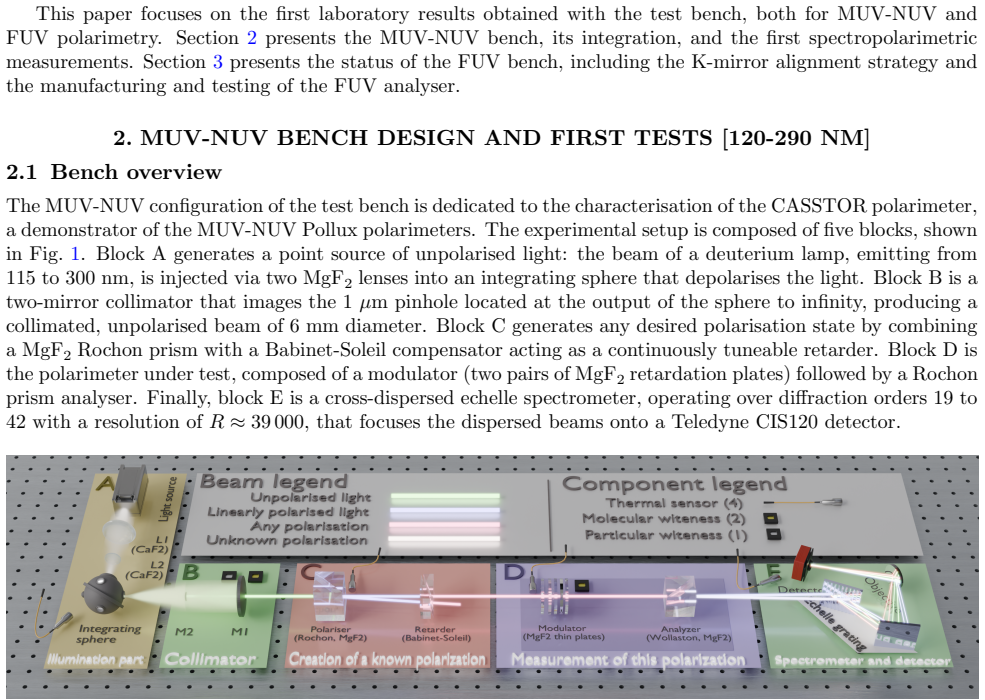
The central object is the two-configuration vacuum-ultraviolet test bench itself. In the MUV-NUV path, the key chain is: an integrating sphere that is assumed to fully depolarise the deuterium lamp beam, a Rochon prism plus a Babinet-Soleil compensator to synthesise arbitrary polarisation states, the CASSTOR modulator (two pairs of MgF2 retardation plates) followed by a Rochon analyser, and a cross-dispersed echelle spectrometer. In the FUV path, the central components are a windowless deuterium discharge source, a rotating K-mirror (a three-mirror assembly whose rotation changes polarisation without birefringent materials), and a multilayer analyser made of MgF2 over B4C on BK7. The Mueller
What would settle it
Directly measure the polarisation state of the integrating sphere's output—for instance by rotating the Rochon prism without the compensator and comparing the two output intensities—and check whether any residual polarisation exceeds the 10^-3 target; non-zero residuals would invalidate the unpolarised reference and require re-validation of the bench.
Extended reading notes
Core claim
The authors report that their vacuum-ultraviolet test bench has passed its first integrated laboratory tests. In the MUV-NUV configuration, the full optical chain was assembled: a first polarised deuterium-lamp spectrum was recorded, the polarisation-generation subsystem matched Mueller-matrix predictions across spectral orders, and a six-angle modulation/demodulation cycle recovered input Stokes vectors from created polarisation states. In the FUV configuration, a windowless deuterium plasma source was characterised and selected over nitrogen, a K-mirror alignment strategy was implemented, and a mirror-based analyser was manufactured and tested, showing a polarisation extinction ratio of 10
Load-bearing premise
The load-bearing premise is that the integrating sphere in the light-source block fully depolarises the deuterium beam; if the sphere or collimator leaves any residual polarisation, the 'unpolarised' reference and the theoretical Stokes vectors used to validate the whole chain are systematically wrong.
Editorial extensions
If this is right
- The MUV-NUV bench can now generate, modulate, and demodulate polarisation states end-to-end, so the next step is a dedicated campaign to measure polarimetric precision.
- The FUV analyser's measured 10:1 extinction at 120 nm is sufficient to attempt first FUV polarimetric measurements once the K-mirror and analyser are integrated inside the vacuum chamber.
- Because deuterium feeds both the MUV-NUV lamp and the windowless FUV source, the two bench configurations can be cross-calibrated against each other.
- The roughly balanced grating efficiency for the two orthogonal polarisations means the spectrometer does not introduce a large polarisation bias, simplifying data reduction.
- Demonstrating bench operation raises the laboratory readiness of UV spectropolarimetry and prepares the ground for a future implementation on the Habitable Worlds Observatory.
Reading between the lines
- Inference: if the bench reaches its 10^-3 precision target, similar all-reflective FUV polarimeters could be validated in a standard vacuum laboratory rather than only at synchrotron facilities, lowering the cost of future instrument development.
- Inference: the two-source K-mirror alignment method, which decouples four alignment degrees of freedom, is reusable for any reflective polarimeter that must stay aligned while sealed inside a vacuum chamber.
- Inference: the integrating-sphere depolarisation assumption could be tested independently by placing a known analyser directly after the source block; if residual polarisation is found, an extra depolarising element or a calibration measurement would correct the reference.
- Inference: the order-by-order Stokes reconstruction errors visible on the Poincaré sphere suggest where the future precision campaign should look first, such as checking S/P beam separation per order and its wavelength dependence.
Signed reviews
Editorial analysis
A structured set of objections, weighed in public.
Referee Report
Summary. This paper reports first laboratory results from a dedicated vacuum-ultraviolet test bench for the Pollux spectropolarimeter proposed for HWO. In the MUV-NUV configuration (120-290 nm), the full optical chain is integrated: a polarized deuterium spectrum is obtained, the polarization-generation subsystem (Rochon prism + Babinet-Soleil compensator) is validated against Mueller-matrix intensity predictions, and a first end-to-end polarimetric measurement is made by recovering Stokes vectors at several spectral orders. In the FUV configuration (98-120 nm), a windowless deuterium source is characterized, a K-mirror modulator alignment scheme is implemented, and a MgF2/B4C mirror analyser is manufactured and tested, giving a polarization extinction ratio of 10 at 120 nm. The authors conclude that the bench is operational and paves the way for characterizing the polarimetric precision of the Pollux polarimeters, targeting 10^-3.
Significance. If the reported results hold, the paper represents a meaningful step toward raising the TRL of UV spectropolarimetry for HWO. The strengths are the construction and integration of a difficult VUV bench, the use of standard Mueller-matrix predictions as a validation tool (with no ad hoc fit to the claimed result), the detailed K-mirror alignment strategy adapted from MICADO, and the first measurement of a custom reflective FUV analyser. The paper is appropriately cautious in calling these 'first lab results' and in flagging the need for further synchrotron measurements. The main risk is the uncalibrated input polarization of the integrating-sphere source, which directly enters the theoretical Stokes vectors used for validation; the paper needs to close this gap before the bench can credibly claim readiness for 10^-3 polarimetric precision.
major comments (3)
- [Sec. 2.1, Figs. 4 and 6] The validation of polarization creation and end-to-end demodulation assumes that the integrating sphere in Block A produces fully depolarized light ('an integrating sphere that depolarises the light'). No measurement, null test, or quantitative upper limit is provided for residual polarization from the sphere or from the two-mirror collimator in Block B. Since the bench target is 10^-3, any residual input DoP—whether from a non-Lambertian coating, a specular reflection inside the sphere, or polarization-dependent mirror reflectivity—biases every 'theoretical' Stokes vector and can be partially absorbed into the inferred instrument response. Please add a direct test of the sphere output (e.g., a rotating Rochron or polarizer as a null test) and report a bound on the input degree of polarization, or re-analyse the validation with an unknown source term.
- [Sec. 2.4, Fig. 6] One diffraction order shows 'significant depolarisation', with the arrow pointing from the surface of the Poincaré sphere toward the centre, attributed tentatively to 'insufficient separation between the S and P beams'. This outlier is not quantified, and its presence weakens the claim that the complete measurement chain is validated. Please provide a per-order table of measured versus theoretical Stokes parameters, explain the outlier (e.g., order overlap, incomplete prism separation, extraction artifact), or justify its exclusion. The impact of this order on the inferred polarimetric precision must be stated.
- [Secs. 2.3-2.4, Figs. 4-6] The validation plots show no error bars, no uncertainty estimates, and no goodness-of-fit metric. Statements such as 'good agreement' and 'validate our polarisation creation method' are not quantitatively supported. For a bench whose purpose is to measure 10^-3 polarimetric precision, the authors should report per-order residuals, photon-noise-limited uncertainties, and a metric such as RMS Stokes error or reduced chi-square. This is necessary to substantiate the readiness claim.
minor comments (3)
- [Throughout] Use consistent SI formatting: '1µm', '200µm', and '10−6 mbar' should be '1 μm', '200 μm', and '10^-6 mbar'. Also '1.6×10⁻⁵' would be clearer as '1.6x10^-5'.
- [References] References [2] and [3] are incomplete ('et al., G.' and 'et al., M. L. G.'); reference [4] has no publication venue or year details. These should be completed for reproducibility.
- [Sec. 3.4, Fig. 12] The analyser extinction ratio is reported at a single wavelength, 120 nm, which the abstract correctly qualifies. The planned synchrotron campaign should be described in terms of wavelength coverage and the precision with which the extinction ratio will be determined across the FUV range.
Circularity Check
No significant circularity: the lab validations compare independent measurements against Mueller-matrix models; the depolarisation assumption is a systematic-error caveat, not a circular derivation.
full rationale
The paper's MUV-NUV validation compares measured order intensities and recovered Stokes vectors with theoretical Mueller-matrix predictions. The compensator's zero-retardance position is stated to have been calibrated beforehand (Sec. 2.3), and no parameter is fitted to the validation data itself; the comparison is a genuine end-to-end consistency check between an independently generated polarization state and the polarimeter demodulation chain. The FUV analyser extinction ratio is measured on a reflectometer and compared with design predictions, with a synchrotron campaign planned for confirmation—an acknowledged limitation, not a circular reliance. The main caveat is the Sec. 2.1 assumption that the integrating sphere fully depolarises the input light; if residual polarisation exists, the theoretical reference states would be biased. That is a missing systematic-error calibration, not a circularity, because the claimed bench operation is not defined in terms of that assumption and the agreement is not obtained by fitting the source polarisation. Self-citations to prior Pollux design and test-bench architecture are contextual background and are not load-bearing for the first lab results presented here.
Assumptions & free parameters
free parameters (1)
- Babinet-Soleil zero-retardance wedge position =
not provided in paper
assumptions (5)
- standard math Mueller matrix formalism correctly describes the polarization optics in the bench.
- domain assumption The integrating sphere fully depolarises the input beam from the deuterium lamp.
- domain assumption The deuterium lamp and gas flow are stable over the measurement timescales.
- domain assumption The K-mirror alignment method adapted from MICADO is valid for this mirror.
- domain assumption Thin-film theory predictions for the B4C/MgF2 analyser coating are correct at FUV wavelengths.
Cite this review
Pith. "Pith review of Pollux UV & FUV polarimeters: first lab results." pith.science (2026). https://pith.science/paper/65PSALUH
@misc{pith2026260802118,
  author       = {Pith},
  title        = {Pith review of: Pollux UV & FUV polarimeters: first lab results},
  year         = {2026},
  howpublished = {\url{https://pith.science/paper/65PSALUH}},
  note         = {Machine review of arXiv:2608.02118}
}
abstract
Pollux is a high-resolution spectropolarimeter proposed by a European consortium for the Habitable Worlds Observatory (HWO). Its design covers a broad spectral range from the far-ultraviolet (FUV) to the near-infrared (97-1\,750 nm), with polarimetric channels relying on \ch{MgF2} birefringent optics in the mid- and near-UV (MUV-NUV), and on an innovative all-reflective polarimeter in the FUV, where no birefringent material is available. To validate these polarimeters, whose required polarimetric precision is $10^{-3}$, a dedicated vacuum ultraviolet test bench has been developed, with two configurations: one for the MUV-NUV range (120-290 nm) and one for the FUV range (98-120 nm). We present the first laboratory results obtained with this bench. On the MUV-NUV configuration, the full optical chain has been integrated: a first polarised spectrum of the deuterium lamp was acquired, the polarisation generation subsystem was validated against Mueller matrix predictions, and a first end-to-end polarimetric measurement was performed. On the FUV configuration, the windowless deuterium plasma source has been characterised, the alignment strategy of the K-mirror modulator has been implemented, and the mirror-based analyser has been manufactured and tested, showing a polarisation extinction ratio of 10 at 120 nm. These results demonstrate the operation of the bench and pave the way for the characterisation of the polarimetric precision of the Pollux polarimeters, increasing the Technology Readiness Level of UV spectropolarimetry for HWO.
Figures


Figures from the paper (9 more)


Reference graph
Works this paper leans on
-
[1]
Born, Max and Wolf, Emil and Bhatia, A. B. , date =. Principles of optics: electromagnetic theory of propagation, interference, and diffraction of light , isbn =
-
[2]
and Young, Garam and Lam, Wai Sze Tiffany , date =
Chipman, Russell A. and Young, Garam and Lam, Wai Sze Tiffany , date =. Polarized light and optical systems , isbn =
-
[3]
Optimum modulation and demodulation matrices for solar polarimetry , volume =
Del Toro Iniesta, Jose Carlos and Collados, Manuel , urldate =. Optimum modulation and demodulation matrices for solar polarimetry , volume =. doi:10.1364/AO.39.001637 , pages =
-
[4]
Spectropolarimètres spatiaux haute résolution pour un grand domaine ultra-violet : conceptions et tests , url =
-
[5]
Spectropolarimétrie stellaire
Pertenais, Martin , date =. Spectropolarimétrie stellaire
-
[6]
and Leighton, Robert B
Feynman, Richard P. and Leighton, Robert B. and Sands, Matthew L. and Feynman, Richard P. , date =. Mainly electromagnetism and matter , isbn =
-
[7]
The Polstar UV Spectropolarimetry Mission
Ignace, Richard and Scowen, Paul , urldate =. The Polstar. doi:10.48550/arXiv.2409.15714 , abstract =. 2409.15714 [astro-ph] , keywords =
-
[8]
and Andretta, V
Peter, Hardi and Abbo, L. and Andretta, V. and Auchère, F. and Bemporad, A. and Berrilli, F. and Bommier, V. and Braukhane, A. and Casini, R. and Curdt, W. and Davila, J. and Dittus, H. and Fineschi, S. and Fludra, A. and Gandorfer, A. and Griffin, D. and Inhester, B. and Lagg, A. and Degl’Innocenti, E. Landi and Maiwald, V. and Sainz, R. Manso and Pillet...
Show all 89 references
-
[9]
Folsom, C. P. and Ignace, R. and Erba, C. and Casini, R. and Del Pino Alemán, T. and Gayley, K. and Hobbs, K. and Manso Sainz, R. and Neiner, C. and Petit, V. and Shultz, M. E. and Wade, G. A. , urldate =. Ultraviolet spectropolarimetry: investigating stellar magnetic field di...
-
[10]
Westerveld, W. B. and Becker, K. and Zetner, P. W. and Corr, J. J. and. Production and measurement of circular polarization in the. doi:10.1364/AO.24.002256 , pages =
-
[11]
and Bunch, Bryan H
Hellemans, Alexander and Bunch, Bryan H. and Bunch, Bryan H. , date =. The timetables of science: a chronology of the most important people and events in the history of science , isbn =
-
[12]
Donati, J. F. , urldate =
-
[13]
and Aurière, M
Mouillet, D. and Aurière, M. and. Spectro-polarimetry at Telescope B. Lyot , url =
-
[14]
Martyn, D. F. , urldate =. Polarization of Solar Radio-frequency Emissions , volume =. doi:10.1038/158308b0 , abstract =
-
[15]
and Roberts, J
Radhakrishnan, V. and Roberts, J. A. , urldate =. Polarization and Angular Extent of the 960-Megacycle Radiation from Jupiter. , volume =. doi:10.1086/108330 , abstract =
-
[16]
and Shakeshaft, J
Wielebinski, R. and Shakeshaft, J. R. and Pauliny-Toth, I. I. K. , urldate =. A search for a linearly polarized component of the galactic radio emission at 408 Mc/s , volume =
-
[17]
, urldate =
Hale, George E. , urldate =. On the Probable Existence of a Magnetic Field in Sun-Spots , volume =. doi:10.1086/141602 , pages =
- [18]
-
[20]
and Pérez-Marín, Antonio P
Larruquert, Juan I. and Pérez-Marín, Antonio P. and García-Cortés, Sergio and Rodríguez-de Marcos, Luis and Aznárez, José A. and Méndez, José A. , urldate =. Self-consistent optical constants of. doi:10.1364/JOSAA.28.002340 , pages =
-
[21]
doi:10.48550/arXiv.2507.03956 , shorttitle =
Neiner, Coralie and Lapeyrere, Vincent and Pechevis, Eitan and Catala, Claude and Segret, Boris and Lacreu, Feliu and Jain, Rashika and Reess, Jean-Michel and Esteve, Frederic and Chevrier, Charles-Antoine and Gal, Jean-Luc Le and Doumic, Laurent and Saada, Adrien and Gal, Mae...
- [22]
-
[23]
Space Telescopes and Instrumentation 2024: Ultraviolet to Gamma Ray , author =
Optical design options for Pollux:. Space Telescopes and Instrumentation 2024: Ultraviolet to Gamma Ray , author =. doi:10.1117/12.3020175 , shorttitle =. 2410.01491 [astro-ph] , keywords =
2024 arXiv
-
[24]
, urldate =
Landstreet, J.D. , urldate =. Observing and Modelling Stellar Magnetic Fields: 1. Basic Physics and Simple Models , volume =. doi:10.1051/eas/0939001 , shorttitle =
- [25]
- [26]
-
[27]
New Frontiers in the Study of Magnetic Massive Stars with the Habitable Worlds Observatory , url =
David-Uraz, Alexandre and Petit, Véronique and Neiner, Coralie and Bouret, Jean-Claude and Nazé, Yaël and Erba, Christiana and Garcia, Miriam and Gayley, Kenneth and Ignace, Richard and Krtička, Jiři and Sana, Hugues and St-Louis, Nicole and ud-Doula, Asif , urldate =. New Fro...
-
[28]
, urldate =
Coffeen, David L. , urldate =. Polarization and scattering characteristics in the atmospheres of Earth, Venus, and Jupiter , volume =. doi:10.1364/JOSA.69.001051 , pages =
-
[29]
and Helderman, F
Aben, I. and Helderman, F. and Stam, D. M. and Stammes, P. , urldate =. Spectral fine‐structure in the polarisation of skylight , volume =. doi:10.1029/1999GL900025 , abstract =
-
[30]
Polarization of skylight in the O\_2A band: effects of aerosol properties , volume =
Boesche, Eyk and Stammes, Piet and Preusker, Réne and Bennartz, Ralf and Knap, Wouter and Fischer, Juergen , urldate =. Polarization of skylight in the O\_2A band: effects of aerosol properties , volume =. doi:10.1364/AO.47.003467 , shorttitle =
-
[32]
and Charlot, S
Marin, F. and Charlot, S. and González, B. Agís and Sluse, D. and Hutsemékers, D. and Labiano, A. and Grosset, L. and Neiner, C. and Bouret, J. -C. , urldate =. The role of Active Galactic Nuclei in galaxy evolution: insights from space ultraviolet spectropolarimetry , rights ...
-
[33]
and Heron, Philip J
Crameri, Fabio and Shephard, Grace E. and Heron, Philip J. , urldate =. The misuse of colour in science communication , volume =. doi:10.1038/s41467-020-19160-7 , abstract =
-
[34]
Tsuzuki, Toshihiro and Ishikawa, Ryohko and Kano, Ryouhei and Narukage, Noriyuki and Song, Donguk and Yoshida, Masaki and Uraguchi, Fumihiro and Okamoto, Takenori J. and. Optical design of the Chromospheric. Space Telescopes and Instrumentation 2020: Ultraviolet to Gamma Ray ,...
2020 doi
-
[35]
and Tomczyk, Steven and Hegwer, Steven , urldate =
Socas-Navarro, Hector and Elmore, David and Pietarila, Anna and Darnell, Anthony and Lites, Bruce W. and Tomczyk, Steven and Hegwer, Steven , urldate =. Spinor: Visible and Infrared Spectro-Polarimetry at the National Solar Observatory , volume =. doi:10.1007/s11207-006-0020-x...
-
[36]
Contamination Effects on
Tveekrem, J , date =. Contamination Effects on
-
[37]
and Larruquert, Juan I
Garoli, Denis and Rodriguez De Marcos, Luis V. and Larruquert, Juan I. and Corso, Alain J. and Proietti Zaccaria, Remo and Pelizzo, Maria G. , urldate =. Mirrors for Space Telescopes: Degradation Issues , volume =. doi:10.3390/app10217538 , shorttitle =
-
[38]
and Leviton, Douglas B
Tveekrem, June L. and Leviton, Douglas B. and Fleetwood, Charles M. and Feinberg, Lee D. , editor =. Contamination-induced degradation of optics exposed to the Hubble Space Telescope interior , url =. doi:10.1117/12.258316 , eventtitle =
-
[39]
Muscari, J. A. , editor =. Absorption Spectra Of Typical Space Materials In The Vacuum Ultraviolet , url =. doi:10.1117/12.965723 , abstract =
-
[40]
The Pollux European instrument concept for
Neiner, Coralie and Bouret, Jean-Claude and Fossati, Luca and Mignant, David le and Muslimov, Eduard and Castro, Ana Ines Gomez de and Marin, Frédéric , urldate =. The Pollux European instrument concept for. doi:10.48550/arXiv.2602.09828 , shorttitle =. 2602.09828 [astro-ph.IM...
-
[41]
Moos, H. W. , urldate =. Overview of the Far Ultraviolet Spectroscopic Explorer Mission , volume =. doi:10.1086/312795 , abstract =. astro-ph/0005529 , keywords =
-
[42]
Observations of the Lyman-\ α\ Universe , volume =
Ouchi, Masami and Ono, Yoshiaki and Shibuya, Takatoshi , urldate =. Observations of the Lyman-\ α\ Universe , volume =. doi:10.1146/annurev-astro-032620-021859 , abstract =. 2012.07960 [astro-ph.GA] , keywords =
2012 arXiv
-
[43]
doi:10.1088/2041-8205/738/1/L11 , pages =
Trujillo Bueno, Javier and Štěpán, Jiří and Casini, Roberto , urldate =. doi:10.1088/2041-8205/738/1/L11 , pages =
-
[44]
and Bueno, J
Kano, R. and Bueno, J. Trujillo and Winebarger, A. and Auchère, F. and Narukage, N. and Ishikawa, R. and Kobayashi, K. and Bando, T. and Katsukawa, Y. and Kubo, M. and Ishikawa, S. and Giono, G. and Hara, H. and Suematsu, Y. and Shimizu, T. and Sakao, T. and Tsuneta, S. and Ic...
-
[45]
Savage, B. D. and Sembach, K. R. and Wakker, B. P. and Richter, P. and Meade, M. and Jenkins, E. B. and Shull, J. M. and Moos, H. W. and Sonneborn, G. , urldate =. Distribution and Kinematics of O. doi:10.1086/346229 , shorttitle =
-
[46]
The Lyman Alpha Forest in the Spectra of
Rauch, Michael , urldate =. The Lyman Alpha Forest in the Spectra of. doi:10.1146/annurev.astro.36.1.267 , abstract =. astro-ph/9806286 , keywords =
-
[47]
and Des Etangs, A
Vidal-Madjar, A. and Des Etangs, A. Lecavelier and Désert, J.-M. and Ballester, G. E. and Ferlet, R. and Hébrard, G. and Mayor, M. , urldate =. An extended upper atmosphere around the extrasolar planet. doi:10.1038/nature01448 , pages =
-
[48]
Sur une propriete sur la lumiere reflechie , volume =
Malus, Etienne-Louis , date =. Sur une propriete sur la lumiere reflechie , volume =
-
[49]
K-mirror prototype for
-
[50]
Djupvik, A. A. and Andersen, J. , date =. The Nordic Optical Telescope , pages =
-
[51]
and Delabre, B
Buzzoni, B. and Delabre, B. and Dekker, H. and D'Odorico, S. and Enard, D. and Focardi, P. and Gustafsson, B. and Nees, W. and Paureau, J. and Reiss, R. , date =. The
-
[52]
and Taubenberger, S
Patat, F. and Taubenberger, S. , date =. Characterisation of the. doi:10.1051/0004-6361/201016566 , pages =
-
[53]
and Fricke, K
Appenzeller, I. and Fricke, K. and Fürtig, W. and Gässler, W. and Häfner, R. and Harke, R. and Hess, H.-J. and Hummel, W. and Jürgens, P. and Kudritzki, R.-P. and Mantel, K.-H. and Meisl, W. and Muschielok, B. and Nicklas, H. and Rupprecht, G. and Seifert, W. and Stahl, O. and...
-
[54]
and Credner, T
Jockers, K. and Credner, T. and Bonev, T. and Kiselev, V. N. and Korsun, P. and Kulyk, I. and Rosenbush, V. and Andrienko, A. and Karpov, N. and Sergeev, A. and Tarady, V. , date =. Exploration of the solar system with the two-channel focal reducer
-
[55]
and Catala, C
Donati, J.-F. and Catala, C. and Landstreet, J. D. and Petit, P. , date =
-
[56]
, editor =
Cabanac, R. , editor =. Telescope Bernard Lyot beyond Narval: Neo-Narval and
-
[57]
and Kochukhov, O
Snik, F. and Kochukhov, O. and Piskunov, N. and Rodenhuis, M. and Jeffers, S. and Keller, C. and Dolgopolov, A. and Stempels, E. and Makaganiuk, V. and Valenti, J. and Johns-Krull, C. , date =. The
-
[58]
Strassmeier, K. G. and Ilyin, I. and Järvinen, A. and Weber, M. and Woche, M. and Barnes, S. I. and. doi:10.1002/asna.201512172 , pages =
-
[59]
Potter, S. B. and Buckley, D. A. H. and O'Donoghue, D. and Romero-Colmenero, E. and O'Connor, J. and Fourie, P. and Evans, G. and Sass, C. and Crause, L. and Still, M. and Butters, O. W. and Norton, A. J. and Mukai, K. , date =. Polarized. doi:10.1111/j.1365-2966.2009.15944.x ...
2009
-
[60]
and Vigan, A
Beuzit, J.-L. and Vigan, A. and Mouillet, D. and Dohlen, K. and Gratton, R. and Boccaletti, A. and Sauvage, J.-F. and. doi:10.1051/0004-6361/201935251 , pages =
-
[61]
Schmid, H. M. and Bazzon, A. and Roelfsema, R. and Mouillet, D. and Milli, J. and Menard, F. and. doi:10.1051/0004-6361/201833620 , pages =
-
[62]
Abbott, T. M. C. and Aspin, C. and Bezawada, N. and Bridger, A. and Dipper, N. and Ettedgui, A. and Hippler, S. and. Proc. doi:10.1117/12.395528 , pages =
-
[63]
Dorn, R. J. and Bristow, P. and Smoker, J. V. and. doi:10.1051/0004-6361/202245217 , pages =
-
[64]
and Kouach, D
Donati, J.-F. and Kouach, D. and Moutou, C. and Doyon, R. and Delfosse, X. and Artigau, E. and. doi:10.1093/mnras/staa2569 , pages =
-
[65]
and Kouach, D
Baratchart, S. and Kouach, D. and Lacombe, M. and Carrié, E. and Challita, Z. and Olchewsky, F. and Vallée, P. and Saint-Antoine, J. and Dupieux, M. and Le Men, C. and Micheau, Y. and Donati, J.-F. and Moutou, C. and Doyon, R. , date =. Proc. doi:10.1117/12.2629347 , pages =
-
[67]
and Catala, C
Donati, J.-F. and Catala, C. and Wade, G. A. and Gallou, G. and Delaigue, G. and Rabou, P. , date =. A dedicated polarimeter for the. doi:10.1051/aas:1999442 , pages =
-
[68]
, date =
Aurière, M. , date =. Stellar polarimetry with
-
[69]
and Bando, T
Kano, R. and Bando, T. and Narukage, N. and Ishikawa, R. and Tsuneta, S. and Katsukawa, Y. and. Chromospheric Lyman-Alpha. Proc. doi:10.1117/12.925991 , pages =
-
[70]
and McKenzie, D
Narukage, N. and McKenzie, D. E. and Ishikawa, R. and Trujillo Bueno, J. and De Pontieu, B. and. Chromospheric. Proc. doi:10.1117/12.2232245 , pages =
-
[71]
Polarization-dependent vacuum-ultraviolet reflectometry using elliptically polarized synchrotron radiation , volume =
Gottwald, Alexander and Bridou, Françoise and Cuniot-Ponsard, Mireille and Desvignes, Jean-Michel and Kroth, Simone and Kroth, Udo and Paustian, Wolfgang and Richter, Mathias and Schöppe, Hendrik and Thornagel, Reiner , urldate =. Polarization-dependent vacuum-ultraviolet refl...
-
[72]
Performance analysis of a spectropolarimeter employing a continuous phase variation , volume =
Vasilescu, Bogdan and Piron, Pierre and Loicq, Jérôme , urldate =. Performance analysis of a spectropolarimeter employing a continuous phase variation , volume =. doi:10.1364/OE.487335 , abstract =
-
[73]
, date =
Palik, Edward D. , date =. Handbook of optical constants of solids
-
[74]
, date =
Palik, Edward D. , date =. Handbook of Optical Constants of Solids , isbn =
-
[75]
, urldate =
Louedec, K. , urldate =. Atmospheric effects in astroparticle physics experiments and the challenge of ever greater precision in measurements , volume =. doi:10.1016/j.astropartphys.2014.05.011 , abstract =. 1403.2977 [astro-ph.IM] , keywords =
2014 arXiv
-
[76]
From Herschel to Gaia: 3-meter class
Bougoin, Michel and Lavenac, Jérôme , editor =. From Herschel to Gaia: 3-meter class. doi:10.1117/12.893704 , shorttitle =
-
[78]
Larruquert, J. I. and Méndez, J. A. and Aznárez, J. A. , urldate =. Optical constants of aluminum films in the extreme ultraviolet interval of 82–77 nm , volume =. doi:10.1364/AO.35.005692 , pages =
-
[79]
Larruquert, J. I. and Rodríguez-de Marcos, L. V. and Méndez, J. A. and Martin, P. J. and Bendavid, A. , urldate =. High reflectance ta-C coatings in the extreme ultraviolet , volume =. doi:10.1364/OE.21.027537 , pages =
-
[80]
and Donati, J.-F
Semel, M. and Donati, J.-F. and Rees, D. E. , urldate =. Zeeman-Doppler imaging of active stars
-
[81]
Sparks, William and Germer, Thomas A. and. Compact and robust method for full Stokes spectropolarimetry , volume =. doi:10.1364/AO.51.005495 , pages =
-
[82]
and Code, Arthur D
Nordsieck, Kenneth H. and Code, Arthur D. and Anderson, C. M. and Meade, M. R. and Babler, B. and Michalski, Donald E. and Pfeifer, R. H. and Jones, T. E. , editor =. Exploring ultraviolet astronomical polarimetry: results from the Wisconsin Ultraviolet Photo-Polarimeter Exper...
-
[83]
and Bueno, J
Kano, R. and Bueno, J. Trujillo and Winebarger, A. and Auchère, F. and Narukage, N. and Ishikawa, R. and Kobayashi, K. and Bando, T. and Katsukawa, Y. and Kubo, M. and Ishikawa, S. and Giono, G. and Hara, H. and Suematsu, Y. and Shimizu, T. and Sakao, T. and Tsuneta, S. and Ic...
-
[84]
doi:10.1201/9781351129121 , year =
Polarized Light and Optical Systems , publisher =. doi:10.1201/9781351129121 , year =
-
[85]
doi:10.1017/9781108769914 , year =
Principles of Optics , publisher =. doi:10.1017/9781108769914 , year =
-
[86]
doi:10.1117/12.2536094 , year =
Far ultra-violet polarimeter by reflection for Pollux (LUVOIR) , journal =. doi:10.1117/12.2536094 , year =
-
[87]
doi:10.1364/josaa.29.000117 , year =
Self-consistent optical constants of sputter-deposited B_4C thin films , journal =. doi:10.1364/josaa.29.000117 , year =
-
[88]
doi:10.1016/j.optcom.2009.11.062 , year =
Experimental determination of optical constants of MgF2 and [...] , journal =. doi:10.1016/j.optcom.2009.11.062 , year =
2009 doi
-
[89]
Space Telescopes and Instrumentation 2024 , publisher =
Design of a. Space Telescopes and Instrumentation 2024 , publisher =. doi:10.1117/12.3017994 , pages =
2024 doi
-
[90]
2026 , eprint=
The Pollux European instrument concept for HWO [...] , author=. 2026 , eprint=
2026
-
[91]
Lou et al
John Z. Lou et al. , title =. Optical Modeling and Performance Predictions XIV , publisher =. 2024 , doi =
2024
-
[92]
K-mirror prototype for MICADO-SCAO module of the E-ELT , author=
-
[93]
2026 , doi=
Pollux test bench: from NUV to FUV polarimetric measurements , author=. 2026 , doi=
2026
Reviewed August 4, 2026 · model on record in the stance chip above.
Discussion (0). Continue with ORCID to comment.