REVIEW 4 major objections 4 minor 148 references
Inflow-driven galaxy evolution - I. Revealing the physics of the fundamental metallicity relation
T0 review · 4 major / 4 minor · reviewed 2026-08-06 · deepseek-v4-flash
Pith's one-line read This paper argues that the fundamental metallicity relation is not a fundamental law but a projection of a simpler ratio, and it derives the closed-form gas-flow solution that shows why.
desk verdict A clean analytic core, an honest paper, and a load-bearing assumption about eta(z) that should decide how much of the FMR interpretation you buy. read the letter →
The pith
A machine-rendered reading of the paper's core claim, the machinery that carries it, and where it could break.
The reading
What carries the argument
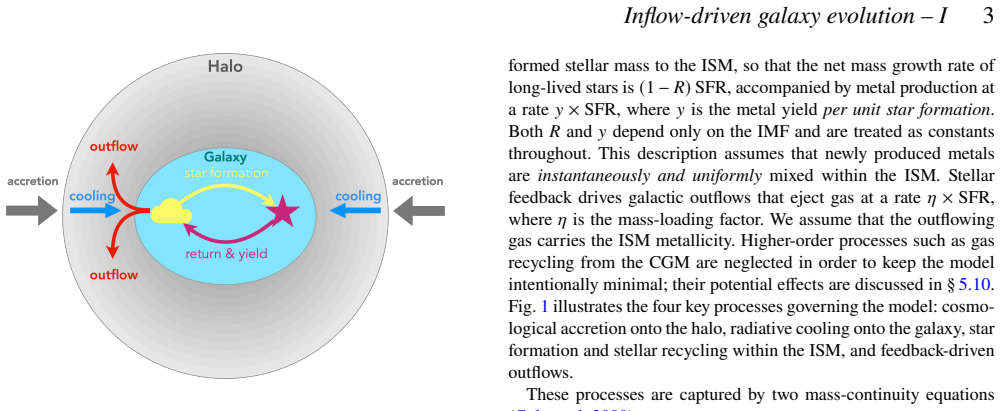
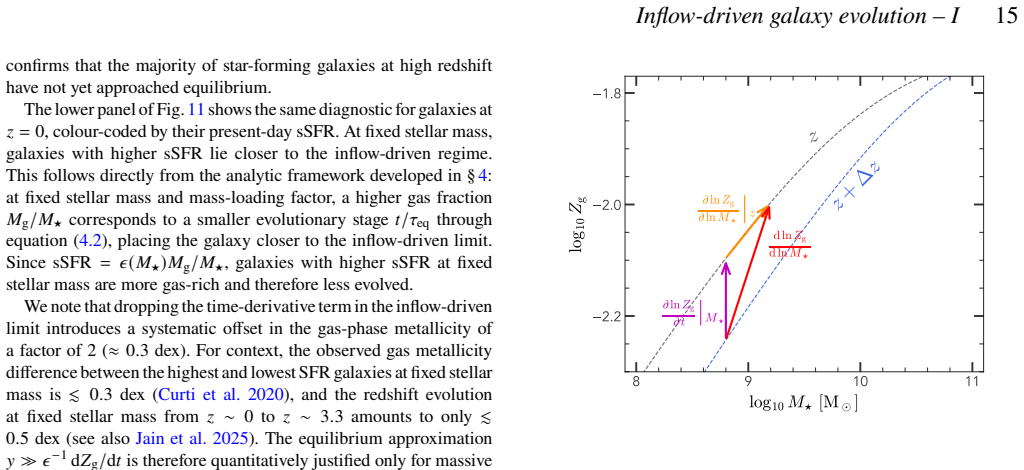
The machinery is a pair of mass-continuity equations, (2.1) and (2.2), governing the galaxy's gas reservoir and its metal content under inflow $\Phi$, star formation at efficiency $\epsilon \equiv {\rm SFR}/M_{\rm g}$, and outflows at mass-loading factor $\eta$. The central object is the equilibrium timescale $\tau_{\rm eq} = 1/[(1-R+\eta)\epsilon]$, the characteristic time for star formation plus outflows to balance inflow, whose ratio to the evolution time $t$ places every galaxy on a continuum between the inflow-driven regime ($t \ll \tau_{\rm eq}$), where $Z_{\rm g} = (y/(1-R))\,M_\star/M_{\rm g}$ exactly, and equilibrium ($t \gg \tau_{\rm eq}$), where $Z_{\rm g} \to y/(1-R+\eta)$. The closed-form system in equations (4.1)–(4.2) expresses that transition through two functions of $t/\tau_{\rm eq}$, $K_1$ and $K_2$, which tie $Z_{\rm g}$, $M_{\rm g}/M_\star$, and $\eta$ together so that any two determine the third; the calibrated cosmological model then shows that the observed FMR surface is the projection of this universal curve once $\epsilon$ and $\eta$ are given their realistic power-law dependences.
What would settle it
Measure the gas fraction $M_{\rm g}/M_\star$ and the star formation rate for a large sample of $z \approx 2$–$3$ star-forming galaxies: the inflow-driven claim predicts $M_{\rm g}/M_\star \gg (1-R+\eta)/(1-R)$ for the bulk of the population, with metallicity tracking $M_\star/M_{\rm g}$. If high-redshift galaxies instead show gas fractions close to the equilibrium expectation, or if direct wind observations at $z > 1.5$ show $\eta$ rising with redshift, the claim that the star-forming population is predominantly inflow-driven — and with it the attribution of metal-enrichment evolution to $\epsilon$ — collapses.
Extended reading notes
Core claim
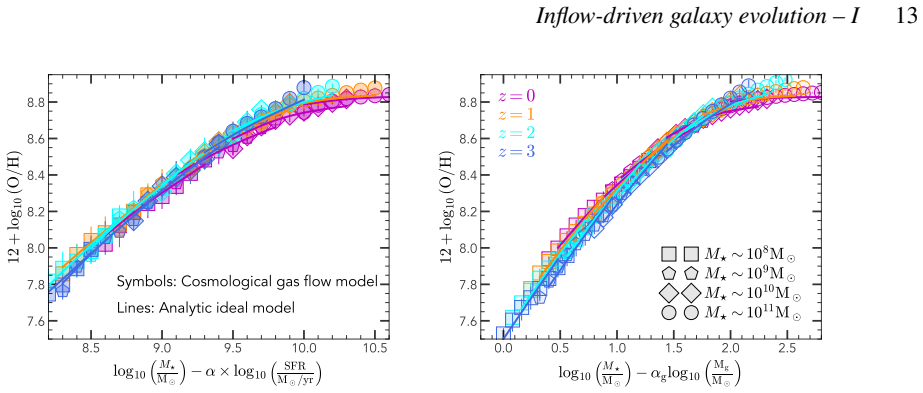
The paper's central claim is that the FMR emerges from the transition between two regimes of gas-flow physics, and that its observed parameterisation encodes only the mass and redshift dependence of the star formation efficiency, $\epsilon$, and the mass-loading factor, $\eta$. In the calibrated cosmological gas flow model, galaxies collapse onto one universal sequence of $Z_{\rm g}$ against $M_\star$/SFR when $\epsilon$ and $\eta$ are constants; reintroducing their realistic power-law dependences generates exactly the offsets among mass bins and epochs that the FMR parameter $\alpha$ is then used to absorb. The gaseous FMR, $Z_{\rm g} = (y/(1-R))\,M_\star/M_{\rm g}$, is claimed to be the more fundamental relation because it holds independent of $\epsilon$ in the inflow-driven limit, with the approach to equilibrium governed by gas fraction and $\eta$ alone. The analytic solution of the ideal constant-inflow model (equations 4.1–4.2) provides closed-form functions $K_1(t/\tau_{\rm eq})$ and $K_2(t/\tau_{\rm eq})$ that relate $Z_{\rm g}$, $M_{\rm g}/M_\star$, and $\eta$, and it reproduces the full cosmological calculation, so measured metallicities and gas fractions can be turned into inferences about outflows and star formation efficiency.
Load-bearing premise
The load-bearing premise, invoked in Section 5.7 to break the degeneracy between star formation efficiency and outflow strength, is that the mass-loading factor $\eta$ does not evolve with redshift; if outflows at fixed stellar mass were substantially stronger at high redshift, an equilibrium model with $\eta(z)$ could reproduce the same redshift evolution of the mass–metallicity relation without galaxies being inflow-driven at all.
Editorial extensions
If this is right
- The gFMR ($Z_{\rm g}$ versus $M_\star/M_{\rm g}$) is the primary relation; the standard FMR is its projection into SFR-space, so gas mass measurements should replace or augment SFR in future metallicity scaling studies.
- The FMR parameter $\alpha$ is not universal: it is bracketed between the single-epoch collapse value $\alpha_m \approx 0.75$ and the redshift-invariance value $\alpha_z \approx 0.45$ for the fiducial model, with the observed $\alpha \approx 0.55$ lying between and encoding the mass and redshift slopes of $\epsilon$ and $\eta$.
- Semi-analytic models with high mass-loading factors push galaxies into equilibrium and predict a nearly non-evolving mass–metallicity relation; lowering $\eta$ and $\epsilon$ lengthens $\tau_{\rm eq}$, keeps galaxies inflow-driven, and produces both the observed MZR evolution and a redshift-invariant FMR from one mechanism.
- The gas-to-stellar metallicity difference should decline monotonically from about 0.18 dex in low-mass, high-sSFR galaxies to zero in massive systems, a trend the paper matches to integral-field survey measurements.
- The model's fiducial calibration predicts $\epsilon \propto (1+z)^{1.1}$, a direct prediction for gas and SFR surveys at $z \approx 1$–$3$ that would confirm or rule out the inflow-driven attribution of MZR evolution.
Reading between the lines
- The closed-form system also inverts into a redshift test the authors do not run: with gas masses measured at $z \approx 1$–$3$, $K_1$–$K_2$ would yield the mass-loading factor directly at each epoch, providing a stacking-based check of the constant-$\eta$ premise from existing CO and dust-continuum surveys.
- Because the inflow rate cancels out of every relation among $M_\star$, SFR, $M_{\rm g}$, and $Z_{\rm g}$ in the inflow-driven limit, the model implies that metallicity encodes the timing and duration of enrichment, not the rate of gas accretion; a testable corollary is that metallicity scatter should track variations in star-formation histories rather than scatter in halo accretion rates.
- The bracketing of $\alpha$ between $\alpha_m \approx 0.75$ and $\alpha_z \approx 0.45$ suggests a consistency check the paper leaves implicit: measuring $\alpha$ locally together with the mass slope of $\epsilon$ would predict the redshift slope of $\epsilon$, independently verifiable from gas-depletion timescales.
- If the gFMR is the primary relation, its near-epoch-invariance should persist even where the standard FMR breaks down at $z \gtrsim 4$; that gives JWST abundance programs a sharper target — test whether $Z_{\rm g}$–$M_\star/M_{\rm g}$ stays universal when $Z_{\rm g}$–$M_\star$/SFR does not.
Editorial analysis
A structured set of objections, weighed in public.
Referee Report
Summary. The paper proposes a gas-flow model based on the baryon mass-continuity equations to explain the fundamental metallicity relation (FMR). It argues that the FMR is not a fundamental symmetry but arises from the transition between an inflow-driven regime and an equilibrium regime, and that the gaseous FMR (gFMR), relating Z_g to M_star/M_g, is more fundamental than the standard FMR. The authors construct a cosmological gas flow model calibrated to the mass–metallicity relation (MZR), the star-forming main sequence (SFMS), and the stellar–halo mass relation, and claim the FMR and gFMR emerge as predictions. They also derive closed-form analytic expressions (Eqs. 4.1–4.3) relating Z_g, M_g/M_star, and the mass-loading factor η, and discuss implications for previous models, degeneracies, and high-redshift extrapolations.
Significance. The analytic K1–K2 framework in Sections 4 and Appendix F is a clear and potentially useful contribution: it provides closed-form relations that interpolate between the inflow-driven and equilibrium regimes and offers a route to infer η from gas fraction and metallicity. The generalization to differential mass and metal loading (Section 5.4) is also valuable. The paper makes explicit, falsifiable predictions, including the maximum gas-to-stellar metallicity difference of about 0.18 dex (Section 5.6) and the sensitivity of high-redshift FMR offsets to the local calibration slope (Section 5.5). These strengths are substantial. However, the central empirical claim that the evolving MZR requires the inflow-driven regime is contingent on the assumption that η does not evolve with redshift, and the claim that the FMR is a non-trivial prediction is weakened by the fact that the model is calibrated to the MZR and SFMS, which jointly define the median FMR locus. The manuscript is worth publication after these load-bearing points are addressed.
major comments (4)
- [§3.1, Fig. 4] The FMR is presented as a non-trivial prediction because it was not a calibration target, but the model is calibrated to the median MZR and median SFMS at each redshift (§2.2.5). Together these two relations already specify, at each z, the median SFR and Z_g for every M_star, i.e. a one-dimensional locus in (M_star, SFR, Z_g) space. The median FMR surface is therefore largely inherited from the calibration data. What is genuinely predictive is the residual-level anti-correlation (e.g., galaxies with higher SFR at fixed M_star being more metal-poor) and whether a single α=0.55 aligns the redshift-dependent loci. Please state this distinction explicitly and show the residual-level prediction (for example, the model's FMR scatter after fitting only the median MZR and SFMS), rather than presenting the median surface itself as an emergent, non-trivial prediction.
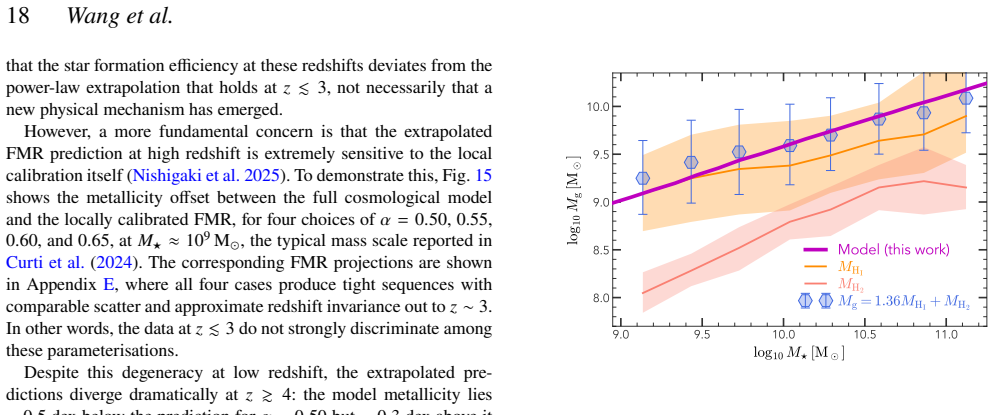
- [§5.7, Eq. (5.15)] The degeneracy between the star formation efficiency ε(t) and the mass-loading factor η(t) is acknowledged, and the paper breaks it by assuming η has no redshift dependence. This assumption is load-bearing for the central conclusion that the evolving MZR requires the inflow-driven regime. Equation (5.15) shows that any assumed η(t) yields a unique ε(t) that reproduces the same SFR(t) and Z_g(t); an equilibrium model with η(M_star, z) can therefore reproduce the observed MZR evolution without requiring galaxies to be predominantly inflow-driven. The cited empirical support (to z~1.5) and the unpublished Wang et al. (2026, in prep.) do not establish η(z)=const at z~2–3, and the z=0 gas-mass comparison in Fig. 16 does not constrain η(z) at high redshift. The argument in §5.9 that equilibrium plus stochastic accretion cannot produce a tight, redshift-invariant FMR is an argument by elimination. Please either (i) provide direct or indirect constraints on η(z) at z~2–3, (ii) demonstrate that the central conclusions are robust to plausible η(z) variations within the z≲1.5 constraints, or (iii) explicitly qualify the inflow-driven interpretation as conditional on non-evolving η.
- [§3.2, Fig. 5] The gFMR is defined and displayed using α_g=0.85, yet the claimed fundamental inflow-driven relation is Z_g = y/(1−R) × M_star/M_g, which corresponds to α_g=1. The paper never derives α_g=0.85 from the K1–K2 system or from an independent fit, and the reader is left to wonder whether α_g=1 would actually collapse the model points. If α_g=1 does not produce a tight collapse across mass and redshift, then the gFMR, as operationally defined, is itself an empirical projection whose 'more fundamental' status needs qualification. Please show the α_g=1 projection, or derive the empirical α_g from the equilibrium contribution of η(M_star) in Eqs. (4.1)–(4.2), and discuss why the gFMR parameter is not unity.
- [§2.2.5, Table 1] The calibration is performed by manual tuning with no reported uncertainties or residuals, yet several quantitative conclusions are drawn from the fiducial parameter values: α_m≈0.75, α_z≈0.45, the bracketing in Eq. (4.7), and the inference of ε_z=1.1. Because the five parameters that 'directly affect the main results' (ε_0, ε_m, ε_z, η_0, η_m) are not accompanied by error bars, the reader cannot assess whether the agreement with the observed α≈0.55 is meaningful or a product of tuning. Please add a sensitivity analysis for these parameters, at minimum varying ε_m, ε_z, and η_m within observationally motivated ranges, and show how the predicted FMR/gFMR properties and the inferred ε_z depend on those choices.
minor comments (4)
- [Fig. 4] The label 'FMRfitting' in the upper panel should read 'FMR fitting'.
- [References] Jain et al. (2025) is listed as an arXiv paper only; since it is the primary calibration dataset for the MZR and SFMS, please provide the publication status or DOI when available.
- [§2.2.5] Please define more precisely what 'fitting' means in the manual calibration: Fig. 3 shows model lines and data, but no residuals, scatter statistics, or goodness-of-fit are reported, making it hard to gauge the quality of the simultaneous fit.
- [Appendix D] The Eddington-bias demonstration would be more convincing if the adopted Gaussian scatters (σ_M=0.2 dex, σ_SFR=0.4 dex) were justified with explicit observational references, since the resulting slope depends directly on these choices.
Circularity Check
Core K1–K2 derivation is self-contained, but the central inflow-driven interpretation leans on an eta(z)=const assumption supported beyond z~1.5 only by an in-prep self-citation, and the FMR 'prediction' is partly a postdiction of the calibrated MZR and SFMS.
-
self citation load bearing
[Section 5.7, 'Degeneracy between star formation efficiency and mass-loading factor'; reference list: 'Wang K., et al., 2026, in prep.']
"We break the degeneracy by assuming that the mass-loading factor does not evolve with redshift, following the observational evidence from z∼0 to z∼1.5 (Heckman et al. 2015; Chisholm et al. 2017; Schroetter et al. 2019, 2024). This assumption is supported empirically by Wang et al. (2026), who use gas mass and metallicity observations at z∼0–1 to constrain the mass-loading factor directly and find that it evolves little over the past ∼8 Gyr."
Equation (5.15) in the same section shows that for any assumed η(t), a corresponding ε(t) reproduces the same SFR(t) and Zg(t); the inference that galaxies are inflow-driven and that the FMR shape encodes ε(M*, z) rather than η(z) is obtained only after imposing η(z)=const. The external wind data cited reach z∼1.5, while the model is applied to z∼3; the additional support offered for the constancy is an unpublished (in prep.) paper by the present first author. The premise is therefore load-bearing and its extension beyond the verified window rests on a self-citation rather than on independent evidence. This is a self-referential support chain for the central interpretation, not an equation-level circularity.
full rationale
The analytic backbone of the paper (equations 2.1–2.19 and the K1–K2 system of equations 4.1–4.3) is derived from the mass-continuity equations and is self-contained: the inflow-driven scalings and the closed-form expressions do not assume the FMR or gFMR they are used to explain. The cosmological model is calibrated to the MZR, SFMS, and SHMR, and the FMR is then exhibited as an emergent relation; because the model also determines off-median correlations, this is not a pure fit, although it is a postdiction rather than an independent prediction. The paper is transparent about the ε–η degeneracy and states the η(z)=const assumption explicitly. The main circularity-adjacent issue is that the load-bearing assumption used to break that degeneracy is supported beyond z~1.5 only by a self-cited in-prep paper (Wang et al. 2026), and the conclusion that the FMR is inflow-driven would lose its empirical footing if η evolved with redshift. This warrants a moderate score of 4 rather than a higher one, because no central equation reduces to its inputs by construction.
Assumptions & free parameters
free parameters (12)
- lambda0 =
0.35
- lambda_m1 =
-0.60
- lambda_m2 =
0.20
- lambda_z =
0.20
- epsilon0 =
0.38 Gyr^-1
- epsilon_m =
0.33
- epsilon_z =
1.1
- eta0 =
0.22
- eta_m =
-0.30
- y =
0.012
- c =
12
- alpha_g =
0.85
assumptions (7)
- domain assumption Instantaneous and uniform mixing of newly produced metals in the ISM
- domain assumption Gas accretion is smooth and deterministic, with no stochasticity or mergers
- domain assumption Gas ejected from the galaxy is permanently removed; no recycling from the CGM
- domain assumption The mass-loading factor eta does not evolve with redshift
- domain assumption Star formation efficiency and mass-loading factor follow power laws in stellar mass and redshift (Eqs 2.23 and 2.26)
- domain assumption Halo mass growth follows the Wechsler et al. (2002) formula with concentration c=12
- domain assumption The one-zone mass-continuity equations (2.1) and (2.2) fully describe the baryon cycle
Cite this review
Pith. "Pith review of Inflow-driven galaxy evolution - I. Revealing the physics of the fundamental metallicity relation." pith.science (2026). https://pith.science/paper/SF7IC5T5
@misc{pith2026260804784,
  author       = {Pith},
  title        = {Pith review of: Inflow-driven galaxy evolution - I. Revealing the physics of the fundamental metallicity relation},
  year         = {2026},
  howpublished = {\url{https://pith.science/paper/SF7IC5T5}},
  note         = {Machine review of arXiv:2608.04784}
}
abstract
We present a unified physical framework for the fundamental metallicity relation (FMR), based on the mass-continuity equations. The FMR is not merely the anti-correlation between star formation rate (SFR) and gas metallicity ($Z_{\rm g}$) at fixed stellar mass ($M_\star$); it is a redshift-invariant surface in the $(M_\star,{\rm SFR},Z_{\rm g})$ space. We construct a minimal cosmological gas flow model, calibrated to reproduce the mass-metallicity relation, star-forming main sequence, and stellar-to-halo mass relation at $z=0-3$, and show that the FMR emerges as a prediction of the calibrated physics. Through controlled experiments that progressively simplify the model, we reveal that in a universe where both the star formation efficiency ($\epsilon$) and mass-loading factor ($\eta$) are constants, the FMR reduces to a universal scaling between $Z_{\rm g}$ and $M_\star/$SFR, whose shape traces the transition from inflow-driven regime to equilibrium. The specific parameterisation of the observed FMR is not a fundamental symmetry but a contingent consequence of how $\epsilon$ and $\eta$ depend on stellar mass and redshift. We show that the gaseous FMR (gFMR), defined in the $(M_\star,M_{\rm g},Z_{\rm g})$ space, is more fundamental than the standard FMR: in the inflow-driven limit, $Z_{\rm g}$ is proportional to $M_\star/M_{\rm g}$, and the approach to equilibrium is governed by $M_\star/M_{\rm g}$ and $\eta$ alone. We derive an analytic solution for an idealised version of the model that provides closed-form expressions relating $Z_{\rm g}$, $M_{\rm g}/M_\star$, and $\eta$, and show this framework accurately reproduces the cosmological gas flow model. By establishing the physical origin of the FMR and its connection to the more fundamental gFMR, we provide the theoretical foundation to turn metallicity scaling relations into precision probes of the baryon cycle over cosmic history.
Figures


Figures from the paper (13 more)







Reference graph
Works this paper leans on
-
[8]
Boardman N. F., Wild V., Scholte D., Wang K., Vale Asari N., Saintonge A., 2026, @doi [arXiv] 10.48550/arXiv.2606.13124
-
[52]
Jain S., et al., 2025, @doi [arXiv] 10.48550/arXiv.2508.18369
-
[78]
Cambridge University Press, Cambridge ; New York
Mo H., Van den Bosch F., White S., 2010, Galaxy Formation and Evolution. Cambridge University Press, Cambridge ; New York
2010
-
[92]
Rodriguez-Gomez V., et al., 2016, @doi [ ] 10.1093/mnras/stw456 , 458, 2371
-
[117]
Wang K., et al., 2026, in prep
2026
-
[131]
Zu Y., 2020, @doi [ ] 10.1093/mnras/staa1457 , 496, 111
-
[134]
Inflow-driven galaxy evolution - III , author =
-
[135]
doi:10.1093/mnras/stu2233 , urldate =
The Metallicity of Galactic Winds , author =. doi:10.1093/mnras/stu2233 , urldate =
Show all 148 references
-
[136]
Semi-Analytic Spectral Fitting: Simultaneously Modelling the Mass Accumulation and Chemical Evolution in
Zhou, Shuang and Merrifield, Michael and. Semi-Analytic Spectral Fitting: Simultaneously Modelling the Mass Accumulation and Chemical Evolution in. doi:10.1093/mnras/stac1279 , urldate =
- [137]
-
[138]
, year = 2026, month = mar, volume =
Bose, Sownak and Deason, Alis J. , year = 2026, month = mar, volume =. A Galactic Tug-of-War: How (Not) to Simultaneously Fit the. doi:10.1093/mnras/stag198 , urldate =
2026 doi
-
[139]
doi:10.48550/arXiv.2512.12983 , urldate =
Nishigaki, Moka and Nakajima, Kimihiko and Ouchi, Masami and Behroozi, Peter and Nakane, Minami and Takeda, Yui and Umeda, Hiroya and Yajima, Hidenobu and Yanagisawa, Hiroto , year = 2025, month = dec, journal =. doi:10.48550/arXiv.2512.12983 , urldate =
2025 doi
-
[140]
, volume =
On a Formula for Correcting Statistics for the Effects of a Known Error of Observation , author =. , volume =. doi:10.1093/mnras/73.5.359 , urldate =
-
[141]
doi:10.1093/mnras/staa1457 , urldate =
Zu, Ying , year = 2020, month = jul, journal =. doi:10.1093/mnras/staa1457 , urldate =. arXiv , file =:1808.10501 , pages =
2020 arXiv
-
[142]
and Andrews, Brett H
Weinberg, David H. and Andrews, Brett H. and Freudenburg, Jenna , year = 2017, month = mar, journal =. Equilibrium and. doi:10.3847/1538-4357/837/2/183 , urldate =
2017 doi
-
[143]
, volume =
The Evolution of the Dust and Gas Content in Galaxies , author =. , volume =. doi:10.1051/0004-6361/201322835 , urldate =
-
[144]
, volume =
Constraining Galaxy Formation and Cosmology with the Conditional Luminosity Function of Galaxies , author =. , volume =. doi:10.1046/j.1365-8711.2003.06254.x , urldate =
2003
-
[145]
Wechsler, Risa H and Tinker, Jeremy L , year = 2018, month = sep, journal =. The. doi:10.1146/annurev-astro-081817-051756 , file =
2018 doi
-
[146]
Wang, Kai and Peng, Yingjie , year = 2025, month = feb, journal =. Testing. doi:10.3847/1538-4357/adaf1a , urldate =
2025 doi
-
[147]
Whitaker, Katherine E. and. The. , volume =. doi:10.1088/2041-8205/754/2/L29 , urldate =
-
[148]
and Martini, Paul , year = 2013, month = mar, journal =
Andrews, Brett H. and Martini, Paul , year = 2013, month = mar, journal =. The. doi:10.1088/0004-637X/765/2/140 , urldate =
2013 doi
-
[149]
, volume =
Toy Models for Galaxy Formation versus Simulations , author =. , volume =. doi:10.1093/mnras/stt1338 , urldate =
-
[151]
Galaxy Assembly, Stellar Feedback and Metal Enrichment: The View from the
Hirschmann, Michaela and De Lucia, Gabriella and Fontanot, Fabio , year = 2016, month = sep, journal =. Galaxy Assembly, Stellar Feedback and Metal Enrichment: The View from the. doi:10.1093/mnras/stw1318 , urldate =
2016 doi
-
[152]
, volume =
The Metal Enrichment of Elliptical Galaxies in Hierarchical Galaxy Formation Models , author =. , volume =. doi:10.1111/j.1745-3933.2005.00078.x , urldate =
2005
-
[153]
Boardman, N. F. and Wild, V. and Scholte, D. and Wang, K. and Vale Asari, N. and Saintonge, A. , year = 2026, month = jun, publisher =. Beyond the. arXiv , doi =
2026
-
[154]
and Stevens, Adam R
Croton, Darren J. and Stevens, Adam R. H. and Tonini, Chiara and Garel, Thibault and Bernyk, Maksym and Bibiano, Antonio and Hodkinson, Luke and Mutch, Simon J. and Poole, Gregory B. and Shattow, Genevieve M. , year = 2016, month = feb, journal =. Semi-. doi:10.3847/0067-0049/...
2016 doi
-
[155]
The Mass-Metallicity Relations for Gas and Stars in Star-Forming Galaxies: Strong Outflow versus Variable
Lian, Jianhui and Thomas, Daniel and Maraston, Claudia and Goddard, Daniel and Comparat, Johan and. The Mass-Metallicity Relations for Gas and Stars in Star-Forming Galaxies: Strong Outflow versus Variable. , volume =. doi:10.1093/mnras/stx2829 , urldate =
-
[156]
, year = 2018, month = sep, journal =
D'Eugenio, Francesco and Colless, Matthew and Groves, Brent and Bian, Fuyan and Barone, Tania M. , year = 2018, month = sep, journal =. The Gas-Phase Metallicities of Star-Forming Galaxies in Aperture-Matched. doi:10.1093/mnras/sty1424 , urldate =
2018 doi
-
[157]
and Ly, Chun and Brinchmann, Jarle and Dav
Salim, Samir and Lee, Janice C. and Ly, Chun and Brinchmann, Jarle and Dav. A. , volume =. doi:10.1088/0004-637X/797/2/126 , urldate =
-
[158]
, volume =
The Atomic Gas Sequence and Mass-Metallicity Relation from Dwarfs to Massive Galaxies , author =. , volume =. doi:10.1093/mnras/stae2477 , urldate =
-
[159]
, volume =
The Role of Atomic Hydrogen in Regulating the Scatter of the Mass-Metallicity Relation , author =. , volume =. doi:10.1093/mnras/stx2452 , urldate =
-
[160]
Li, Haixin and Wang, Enci and Lyu, Cheqiu and Chen, Yangyao and Wang, Huiyuan and Chen, Zeyu and Yu, Haoran and Jia, Cheng and Ma, Chengyu , year = 2025, month = may, journal =. Central. doi:10.3847/1538-4357/adbf94 , urldate =
2025 doi
-
[161]
and D'Eugenio, Francesco and Piotrowska, Joanna M
Looser, Tobias J. and D'Eugenio, Francesco and Piotrowska, Joanna M. and Belfiore, Francesco and Maiolino, Roberto and Cappellari, Michele and Baker, William M. and Tacchella, Sandro , year = 2024, month = aug, journal =. The Stellar Fundamental Metallicity Relation: The Corre...
2024 doi
-
[162]
, volume =
Molecular Gas as the Driver of Fundamental Galactic Relations , author =. , volume =. doi:10.1093/mnras/stv2121 , urldate =
-
[163]
, volume =
Galaxy Metallicities Depend Primarily on Stellar Mass and Molecular Gas Mass , author =. , volume =. doi:10.1051/0004-6361/201527918 , urldate =
-
[164]
A Primer on Hierarchical Galaxy Formation: The Semi-Analytical Approach , shorttitle =
Baugh, C M , year = 2006, month = dec, journal =. A Primer on Hierarchical Galaxy Formation: The Semi-Analytical Approach , shorttitle =. doi:10.1088/0034-4885/69/12/R02 , urldate =
2006 doi
-
[165]
, year = 2022, month = aug, journal =
Chowdhury, Aditya and Kanekar, Nissim and Chengalur, Jayaram N. , year = 2022, month = aug, journal =. Atomic. doi:10.3847/2041-8213/ac8150 , urldate =
2022 doi
-
[166]
Saintonge, Am. The. , volume =. doi:10.1146/annurev-astro-021022-043545 , urldate =
-
[168]
, volume =
H2-Based Star Formation Laws in Hierarchical Models of Galaxy Formation , author =. , volume =. doi:10.1093/mnras/stx889 , urldate =
- [169]
-
[170]
and Sukhbold, Tuguldur and Weinberg, David H
Griffith, Emily J. and Sukhbold, Tuguldur and Weinberg, David H. and Johnson, Jennifer A. and Johnson, James W. and Vincenzo, Fiorenzo , year = 2021, month = nov, journal =. The. doi:10.3847/1538-4357/ac1bac , urldate =
2021 doi
-
[171]
Blitz, Leo and Rosolowsky, Erik , year = 2006, month = oct, journal =. The. doi:10.1086/505417 , urldate =
2006 doi
-
[172]
Galaxy Formation and Evolution , author =
-
[173]
A Two-Phase Model of Galaxy Formation:
Mo, Houjun and Chen, Yangyao and Wang, Huiyuan , year = 2024, month = aug, journal =. A Two-Phase Model of Galaxy Formation:. doi:10.1093/mnras/stae1727 , urldate =
2024 doi
-
[174]
and Gao, Liang and Bett, Philip and Cole, Shaun and Navarro, Julio F
Neto, Angelo F. and Gao, Liang and Bett, Philip and Cole, Shaun and Navarro, Julio F. and Frenk, Carlos S. and White, Simon D. M. and Springel, Volker and Jenkins, Adrian , year = 2007, month = nov, journal =. The Statistics of. doi:10.1111/j.1365-2966.2007.12381.x , urldate =
2007
-
[175]
, volume =
The Mass Profile and Accretion History of Cold Dark Matter Haloes , author =. , volume =. doi:10.1093/mnras/stt526 , urldate =
-
[176]
First Results from the
Nelson, Dylan and Pillepich, Annalisa and Springel, Volker and Pakmor, R. First Results from the. , volume =. doi:10.1093/mnras/stz2306 , urldate =
-
[177]
and Alavi, Anahita and Colbert, James and Henry, Alaina L
Wang, Xin and Li, Zihao and Cai, Zheng and Shi, Dong Dong and Fan, Xiaohui and Zheng, Xian Zhong and Bian, Fuyan and Teplitz, Harry I. and Alavi, Anahita and Colbert, James and Henry, Alaina L. and Malkan, Matthew A. , year = 2022, month = feb, journal =. The. doi:10.3847/1538...
2022 doi
-
[178]
and Pasquali, A
Gallazzi, Anna R. and Pasquali, A. and Zibetti, S. and Barbera, F. La , year = 2021, month = apr, journal =. Galaxy Evolution across Environments as Probed by the Ages, Stellar Metallicities, and [. doi:10.1093/mnras/stab265 , urldate =
2021 doi
-
[180]
Li, Mingyu and Cai, Zheng and Bian, Fuyan and Lin, Xiaojing and Li, Zihao and Wu, Yunjing and Sun, Fengwu and Zhang, Shiwu and. The. , volume =. doi:10.3847/2041-8213/acf470 , urldate =
-
[181]
, volume =
The Competing Effects of Recent and Long-Term Star Formation Histories on Oxygen, Nitrogen, and Stellar Metallicities , author =. , volume =. doi:10.1093/mnras/staf830 , urldate =
-
[182]
and Theuns, Tom and Schaye, Joop and Furlong, Michelle and Bower, Richard G
Lagos, Claudia del P. and Theuns, Tom and Schaye, Joop and Furlong, Michelle and Bower, Richard G. and Schaller, Matthieu and Crain, Robert A. and Trayford, James W. and Matthee, Jorryt , year = 2016, month = jul, journal =. The. doi:10.1093/mnras/stw717 , urldate =
2016 doi
-
[183]
and Malkan, Matthew A
He, Xianlong and Wang, Xin and Jones, Tucker and Treu, Tommaso and Glazebrook, K. and Malkan, Matthew A. and Vulcani, Benedetta and Metha, Benjamin and Brada. Early. , volume =. doi:10.3847/2041-8213/ad12cd , urldate =
-
[184]
and Torrey, Paul and Ellison, Sara L
Garcia, Alex M. and Torrey, Paul and Ellison, Sara L. and Grasha, Kathryn and Chen, Qian-Hui and Hemler, Z. S. and Zimmerman, Dhruv T. and Wright, Ruby J. and Zovaro, Henry R. M. and Nelson, Erica J. and Sanders, Ryan L. and Kewley, Lisa J. and Hernquist, Lars , year = 2025, m...
2025 doi
-
[185]
Potential-Driven
Jia, Cheng and Wang, Enci and Lyu, Cheqiu and Ma, Chengyu and Song, Jie and Chen, Yangyao and Wang, Kai and Yu, Haoran and Chen, Zeyu and Wang, Jinyang and Wang, Yifan and Kong, Xu , year = 2025, month = jun, journal =. Potential-Driven. doi:10.3847/2041-8213/addfd9 , urldate =
2025 doi
-
[186]
, volume =
Breaking the Hierarchy of Galaxy Formation , author =. , volume =. doi:10.1111/j.1365-2966.2006.10519.x , urldate =
2006
-
[187]
Nature , volume =
Cold Streams in Early Massive Hot Haloes as the Main Mode of Galaxy Formation , author =. Nature , volume =. doi:10.1038/nature07648 , urldate =
-
[188]
Galaxy Metallicity Scaling Relations in the
De Rossi, Mar. Galaxy Metallicity Scaling Relations in the. , volume =. doi:10.1093/mnras/stx2158 , urldate =
-
[189]
White, S. D. M. and Rees, M. J. , year = 1978, month = jul, journal =. Core Condensation in Heavy Halos: A Two-Stage Theory for Galaxy Formation and Clustering , shorttitle =. doi:10.1093/mnras/183.3.341 , urldate =
1978 doi
-
[190]
and Schaye, Joop and Frenk, Carlos S
Bower, Richard G. and Schaye, Joop and Frenk, Carlos S. and Theuns, Tom and Schaller, Matthieu and Crain, Robert A. and McAlpine, Stuart , year = 2017, month = feb, journal =. The Dark Nemesis of Galaxy Formation: Why Hot Haloes Trigger Black Hole Growth and Bring Star Formati...
2017 doi
-
[191]
Mapping Stellar Content to Dark Matter Haloes Using Galaxy Clustering and Galaxy-Galaxy Lensing in the
Zu, Ying and Mandelbaum, Rachel , year = 2015, month = dec, journal =. Mapping Stellar Content to Dark Matter Haloes Using Galaxy Clustering and Galaxy-Galaxy Lensing in the. doi:10.1093/mnras/stv2062 , urldate =
2015 doi
-
[192]
and Somerville, Rachel S
Moster, Benjamin P. and Somerville, Rachel S. and Maulbetsch, Christian and. Constraints on the. , volume =. doi:10.1088/0004-637X/710/2/903 , urldate =
-
[193]
Yang, Xiaohu and Mo, H. J. and. Evolution of the. , volume =. doi:10.1088/0004-637X/752/1/41 , urldate =
-
[194]
and Schaller, Matthieu and Bower, Richard and Theuns, Tom , year = 2017, month = feb, journal =
Matthee, Jorryt and Schaye, Joop and Crain, Robert A. and Schaller, Matthieu and Bower, Richard and Theuns, Tom , year = 2017, month = feb, journal =. The Origin of Scatter in the Stellar Mass--Halo Mass Relation of Central Galaxies in the. doi:10.1093/mnras/stw2884 , urldate =
2017 doi
-
[195]
and Evans, Neal J
Kennicutt, Robert C. and Evans, Neal J. , year = 2012, journal =. Star. doi:10.1146/annurev-astro-081811-125610 , urldate =
2012 doi
-
[196]
Rupke, David S. N. and Kewley, Lisa J. and Chien, L.-H. , year = 2010, month = nov, journal =. Gas-Phase. doi:10.1088/0004-637X/723/2/1255 , urldate =
2010 doi
-
[197]
Torrey, Paul and Cox, T. J. and Kewley, Lisa and Hernquist, Lars , year = 2012, month = feb, journal =. The. doi:10.1088/0004-637X/746/1/108 , urldate =
2012 doi
-
[198]
, volume =
The Stellar Accretion Origin of Stellar Population Gradients in Massive Galaxies at Large Radii , author =. , volume =. doi:10.1093/mnras/stv274 , urldate =
-
[199]
Constraints on Galactic Outflows from the Metallicity-Stellar Mass-
Lin, Yuanye and Zu, Ying , year = 2023, month = may, journal =. Constraints on Galactic Outflows from the Metallicity-Stellar Mass-. doi:10.1093/mnras/stad502 , urldate =
2023 doi
-
[200]
and Ellison, Sara L
Kewley, Lisa J. and Ellison, Sara L. , year = 2008, month = jul, journal =. Metallicity. doi:10.1086/587500 , urldate =
2008 doi
-
[201]
The Evolution of the Galaxy Stellar Mass Function and Star Formation Rates in the
Chaikin, Evgenii and Schaye, Joop and Schaller, Matthieu and Ploeckinger, Sylvia and. The Evolution of the Galaxy Stellar Mass Function and Star Formation Rates in the. doi:10.48550/arXiv.2509.07960 , urldate =
-
[202]
Baugh, C. M. and Lacey, C. G. and Frenk, C. S. and Granato, G. L. and Silva, L. and Bressan, A. and Benson, A. J. and Cole, S. , year = 2005, month = jan, journal =. Can the Faint Submillimetre Galaxies Be Explained in the. doi:10.1111/j.1365-2966.2004.08553.x , urldate =
2005
-
[203]
and Matteucci, F
Vincenzo, F. and Matteucci, F. and Belfiore, F. and Maiolino, R. , year = 2016, month = feb, journal =. Modern Yields per Stellar Generation: The Effect of the. doi:10.1093/mnras/stv2598 , urldate =
2016 doi
-
[205]
, volume =
An Efficient and Robust Method to Estimate Halo Concentration Based on the Method of Moments , author =. , volume =. doi:10.1093/mnras/stad3927 , urldate =
-
[206]
Pandya, Viraj and Fielding, Drummond B. and. Characterizing Mass, Momentum, Energy, and Metal Outflow Rates of Multiphase Galactic Winds in the. , volume =. doi:10.1093/mnras/stab2714 , urldate =
- [207]
- [208]
- [209]
-
[210]
Galactic
Chabrier, Gilles , year = 2003, month = jul, journal =. Galactic. doi:10.1086/376392 , urldate =
2003 doi
-
[211]
, volume =
A Fundamental Relation between the Metallicity, Gas Content and Stellar Mass of Local Galaxies , author =. , volume =. doi:10.1093/mnras/stt817 , urldate =
-
[212]
, volume =
Similar Star Formation Rate and Metallicity Variability Time-Scales Drive the Fundamental Metallicity Relation , author =. , volume =. doi:10.1093/mnrasl/sly031 , urldate =
-
[213]
The Gas-Phase Metallicity of Central and Satellite Galaxies in the
Pasquali, Anna and Gallazzi, Anna and. The Gas-Phase Metallicity of Central and Satellite Galaxies in the. , volume =. doi:10.1111/j.1365-2966.2012.21454.x , urldate =
2012
-
[214]
Environmental
Wang, Kai and Wang, Xin and Chen, Yangyao , year = 2023, month = jul, journal =. Environmental. doi:10.3847/1538-4357/acd633 , urldate =
2023 doi
-
[215]
, volume =
The Origin of the Enhanced Metallicity of Satellite Galaxies , author =. , volume =. doi:10.1093/mnras/stw2329 , urldate =
-
[216]
and Gott, III, J
Gunn, James E. and Gott, III, J. Richard , year = 1972, month = aug, journal =. On the. doi:10.1086/151605 , urldate =
1972 doi
-
[217]
and Kova
Peng, Ying-jie and Lilly, Simon J. and Kova. Mass and. , volume =. doi:10.1088/0004-637X/721/1/193 , urldate =
-
[218]
Nature , volume =
Strangulation as the Primary Mechanism for Shutting down Star Formation in Galaxies , author =. Nature , volume =. doi:10.1038/nature14439 , urldate =
-
[219]
and Renzini, Alvio and Carollo, Marcella , year = 2012, month = sep, journal =
Peng, Ying-jie and Lilly, Simon J. and Renzini, Alvio and Carollo, Marcella , year = 2012, month = sep, journal =. doi:10.1088/0004-637X/757/1/4 , urldate =
2012 doi
-
[220]
Larson, R. B. and Tinsley, B. M. and Caldwell, C. N. , year = 1980, month = may, journal =. The Evolution of Disk Galaxies and the Origin of. doi:10.1086/157917 , urldate =
1980 doi
-
[221]
Revisiting the
Ma, Chengyu and Wang, Kai and Wang, Enci and Peng, Yingjie and Jiang, Haochen and Yu, Haoran and Jia, Cheng and Chen, Zeyu and Li, Haixin and Kong, Xu , year = 2024, month = aug, journal =. Revisiting the. doi:10.3847/2041-8213/ad675f , urldate =
2024 doi
-
[222]
, volume =
More Fundamental than the Fundamental Metallicity Relation. , volume =. doi:10.1051/0004-6361/202348423 , urldate =
-
[223]
and Schaye, Joop and Bower, Richard G
Mitchell, Peter D. and Schaye, Joop and Bower, Richard G. , year = 2020, month = oct, journal =. Galactic Inflow and Wind Recycling Rates in the. doi:10.1093/mnras/staa2252 , urldate =
2020 doi
-
[224]
, volume =
Feedback from Supermassive Black Holes Transforms Centrals into Passive Galaxies by Ejecting Circumgalactic Gas , author =. , volume =. doi:10.1093/mnras/stz3124 , urldate =
-
[225]
, volume =
The Stellar Mass Assembly of Galaxies in the. , volume =. doi:10.1093/mnras/stw456 , urldate =. 1511.08804 , pages =
-
[226]
, volume =
Merger Rates in Hierarchical Models of Galaxy Formation , author =. , volume =. doi:10.1093/mnras/262.3.627 , urldate =
-
[228]
, volume =
How Do Galaxies Get Their Gas? , author =. , volume =. doi:10.1111/j.1365-2966.2005.09451.x , urldate =
2005
-
[229]
The Origin of the Galaxy Size-stellar Metallicity Relation -
Wang, Kai , year = 2026, month = feb, journal =. The Origin of the Galaxy Size-stellar Metallicity Relation -. doi:10.1093/mnras/staf2113 , urldate =
2026 doi
-
[230]
and Ellis, Richard S
Leethochawalit, Nicha and Kirby, Evan N. and Ellis, Richard S. and Moran, Sean M. and Treu, Tommaso , year = 2019, month = nov, journal =. Evolution of the. doi:10.3847/1538-4357/ab4809 , urldate =
2019 doi
-
[231]
and Kere
Muratov, Alexander L. and Kere. Gusty, Gaseous Flows of. , volume =. doi:10.1093/mnras/stv2126 , urldate =
-
[233]
, author =
A Recipe for Galaxy Formation. , author =. , volume =. doi:10.1093/mnras/271.4.781 , urldate =
-
[234]
, author =
The Formation and Evolution of Galaxies within Merging Dark Matter Haloes. , author =. , volume =. doi:10.1093/mnras/264.1.201 , urldate =
-
[235]
, volume =
Hierarchical Galaxy Formation , author =. , volume =. doi:10.1046/j.1365-8711.2000.03879.x , urldate =
2000
-
[236]
, volume =
A Unified Multiwavelength Model of Galaxy Formation , author =. , volume =. doi:10.1093/mnras/stw1888 , urldate =
-
[237]
Henriques, Bruno M. B. and White, Simon D. M. and Thomas, Peter A. and Angulo, Raul and Guo, Qi and Lemson, Gerard and Springel, Volker and Overzier, Roderik , year = 2015, month = aug, journal =. Galaxy Formation in the. doi:10.1093/mnras/stv705 , urldate =
2015 doi
-
[238]
, volume =
The Mass and Momentum Outflow Rates of Photoionized Galactic Outflows , author =. , volume =. doi:10.1093/mnras/stx1164 , urldate =
-
[239]
and Alexandroff, Rachel M
Heckman, Timothy M. and Alexandroff, Rachel M. and Borthakur, Sanchayeeta and Overzier, Roderik and Leitherer, Claus , year = 2015, month = aug, journal =. The. doi:10.1088/0004-637X/809/2/147 , urldate =
2015 doi
-
[240]
and Schaye, Joop and Bower, Richard G
Mitchell, Peter D. and Schaye, Joop and Bower, Richard G. and Crain, Robert A. , year = 2020, month = may, journal =. Galactic Outflow Rates in the. doi:10.1093/mnras/staa938 , urldate =
2020 doi
-
[241]
and Benson, Andrew , year = 2015, month = aug, journal =
Lu, Yu and Blanc, Guillermo A. and Benson, Andrew , year = 2015, month = aug, journal =. An. doi:10.1088/0004-637X/808/2/129 , urldate =
2015 doi
-
[242]
Jabran and Dima, Gabriel I
Zahid, H. Jabran and Dima, Gabriel I. and Kudritzki, Rolf-Peter and Kewley, Lisa J. and Geller, Margaret J. and Hwang, Ho Seong and Silverman, John D. and Kashino, Daichi , year = 2014, month = aug, journal =. The. doi:10.1088/0004-637X/791/2/130 , urldate =
2014 doi
-
[243]
The Equilibrium View on Dust and Metals in Galaxies:
Feldmann, Robert , year = 2015, month = may, journal =. The Equilibrium View on Dust and Metals in Galaxies:. doi:10.1093/mnras/stv552 , urldate =
2015 doi
-
[244]
, volume =
Inflow and Outflow Properties, Not Total Gas Fractions, Drive the Evolution of the Mass-Metallicity Relation , author =. , volume =. doi:10.1093/mnrasl/slae036 , urldate =
-
[246]
, year = 2022, month = dec, journal =
Chowdhury, Aditya and Kanekar, Nissim and Chengalur, Jayaram N. , year = 2022, month = dec, journal =. Atomic. doi:10.3847/2041-8213/ac9d8a , urldate =
2022 doi
-
[247]
Renzini, Alvio and Peng, Ying-jie , year = 2015, month = mar, journal =. An. doi:10.1088/2041-8205/801/2/L29 , urldate =
2015 doi
-
[248]
Speagle, J. S. and Steinhardt, C. L. and Capak, P. L. and Silverman, J. D. , year = 2014, month = oct, journal =. A. doi:10.1088/0067-0049/214/2/15 , urldate =
2014 doi
-
[249]
, volume =
Catinella, Barbara and Saintonge, Am. , volume =. doi:10.1093/mnras/sty089 , urldate =
-
[250]
Tacconi, L. J. and Genzel, R. and Saintonge, A. and Combes, F. and. , volume =. doi:10.3847/1538-4357/aaa4b4 , urldate =
-
[251]
, year = 1998, journal =
Kennicutt, Robert C. , year = 1998, journal =. Star. doi:10.1146/annurev.astro.36.1.189 , urldate =
1998 doi
-
[252]
, volume =
Equilibrium Model Constraints on Baryon Cycling across Cosmic Time , author =. , volume =. doi:10.1093/mnras/stv1387 , urldate =
-
[253]
Lu, Yu and Benson, Andrew and Wetzel, Andrew and Mao, Yao-Yuan and Tonnesen, Stephanie and Peter, Annika H. G. and. The. , volume =. doi:10.3847/1538-4357/aa845e , urldate =
-
[254]
The Evolution of the Mass-Metallicity Relation and Its Scatter in
Torrey, Paul and Vogelsberger, Mark and Marinacci, Federico and Pakmor, R. The Evolution of the Mass-Metallicity Relation and Its Scatter in. , volume =. doi:10.1093/mnras/stz243 , urldate =
-
[255]
Galaxies in the
Guo, Quan and. Galaxies in the. , volume =. doi:10.1093/mnras/stw1525 , urldate =
-
[256]
Lessons from Cosmic History: The Case for a Linear Star Formation -
Feldmann, Robert , year = 2013, month = aug, journal =. Lessons from Cosmic History: The Case for a Linear Star Formation -. doi:10.1093/mnras/stt851 , urldate =
2013 doi
-
[257]
Bouch. The. , volume =. doi:10.1088/0004-637X/718/2/1001 , urldate =
-
[258]
, volume =
Curti, Mirko and Maiolino, Roberto and. , volume =. doi:10.1051/0004-6361/202346698 , urldate =
-
[259]
and Shapley, Alice E
Sanders, Ryan L. and Shapley, Alice E. and Jones, Tucker and Reddy, Naveen A. and Kriek, Mariska and Siana, Brian and Coil, Alison L. and Mobasher, Bahram and Shivaei, Irene and Dav. The. , volume =. doi:10.3847/1538-4357/abf4c1 , urldate =
-
[260]
and Patton, David R
Ellison, Sara L. and Patton, David R. and Simard, Luc and McConnachie, Alan W. , year = 2008, month = jan, journal =. Clues to the. doi:10.1086/527296 , urldate =
2008 doi
-
[261]
and Nagao, T
Maiolino, R. and Nagao, T. and Grazian, A. and Cocchia, F. and Marconi, A. and Mannucci, F. and Cimatti, A. and Pipino, A. and Ballero, S. and Calura, F. and Chiappini, C. and Fontana, A. and Granato, G. L. and Matteucci, F. and Pastorini, G. and Pentericci, L. and Risaliti, G...
2008 doi
-
[262]
and Heckman, Timothy M
Tremonti, Christy A. and Heckman, Timothy M. and Kauffmann, Guinevere and Brinchmann, Jarle and Charlot, St. The. , volume =. doi:10.1086/423264 , urldate =
-
[263]
and Henriques, Bruno M
Yates, Robert M. and Henriques, Bruno M. B. and Fu, Jian and Kauffmann, Guinevere and Thomas, Peter A. and Guo, Qi and White, Simon D. M. and Schady, Patricia , year = 2021, month = may, journal =. L-. doi:10.1093/mnras/stab741 , urldate =
2021 doi
-
[264]
, volume =
The Origin and Evolution of the Galaxy Mass-Metallicity Relation , author =. , volume =. doi:10.1093/mnras/stv2659 , urldate =
-
[265]
, volume =
The Physics of the Fundamental Metallicity Relation , author =. , volume =. doi:10.1093/mnras/stt083 , urldate =
-
[266]
, volume =
Gas Accretion Regulates the Scatter of the Mass-Metallicity Relation , author =. , volume =. doi:10.1093/mnras/staa2556 , urldate =
-
[267]
, year = 2021, month = apr, journal =
Wang, Enci and Lilly, Simon J. , year = 2021, month = apr, journal =. Gas-Phase. doi:10.3847/1538-4357/abe413 , urldate =
2021 doi
-
[268]
, volume =
On the Origin of the Fundamental Metallicity Relation and the Scatter in Galaxy Scaling Relations , author =. , volume =. doi:10.1093/mnras/stu1142 , urldate =
-
[269]
, volume =
An Analytic Model for the Evolution of the Stellar, Gas and Metal Content of Galaxies , author =. , volume =. doi:10.1111/j.1365-2966.2011.20148.x , urldate =
2011
-
[270]
Physical
Somerville, Rachel S and Dave, Romeel , year = 2015, month = aug, journal =. Physical. doi:10.1146/annurev-astro-082812-140951 , langid =
2015 doi
-
[271]
From Haloes to
Peng, Ying-jie and Maiolino, Roberto , year = 2014, month = oct, journal =. From Haloes to. doi:10.1093/mnras/stu1288 , urldate =
2014 doi
-
[272]
and Hearin, Andrew P
Behroozi, Peter and Wechsler, Risa H. and Hearin, Andrew P. and Conroy, Charlie , year = 2019, month = sep, journal =. doi:10.1093/mnras/stz1182 , urldate =
2019 doi
-
[273]
and Khostovan, Ali Ahmad and Jones, Tucker and Shapley, Alice E
Jain, Shweta and Sanders, Ryan L. and Khostovan, Ali Ahmad and Jones, Tucker and Shapley, Alice E. and Reddy, Naveen A. and Garcia, Alex M. and Torrey, Paul and Coil, Alison , year = 2025, month = aug, doi =. A. arXiv , urldate =
2025
-
[274]
, volume =
The Origin of the Galaxy Mass-Metallicity Relation and Implications for Galactic Outflows , author =. , volume =. doi:10.1111/j.1365-2966.2008.12991.x , urldate =
2008
-
[275]
, volume =
Star Formation in Semi-Analytic Galaxy Formation Models with Multiphase Gas , author =. , volume =. doi:10.1093/mnras/stv1877 , urldate =
-
[276]
and Somerville, Rachel S
Lu, Yu and Wechsler, Risa H. and Somerville, Rachel S. and Croton, Darren and Porter, Lauren and Primack, Joel and Behroozi, Peter S. and Ferguson, Henry C. and Koo, David C. and Guo, Yicheng and Safarzadeh, Mohammadtaher and Finlator, Kristian and Castellano, Marco and White,...
2014 doi
-
[278]
The Mass-Metallicity and the Fundamental Metallicity Relation Revisited on a Fully
Curti, Mirko and Mannucci, Filippo and Cresci, Giovanni and Maiolino, Roberto , year = 2020, month = jan, journal =. The Mass-Metallicity and the Fundamental Metallicity Relation Revisited on a Fully. doi:10.1093/mnras/stz2910 , urldate =
2020 doi
-
[279]
and Johnson, Benjamin D
Tacchella, Sandro and Bose, Sownak and Conroy, Charlie and Eisenstein, Daniel J. and Johnson, Benjamin D. , year = 2018, month = dec, journal =. A. doi:10.3847/1538-4357/aae8e0 , urldate =
2018 doi
-
[280]
and Lagos, Claudia del P
Wright, Ruby J. and Lagos, Claudia del P. and Power, Chris and Mitchell, Peter D. , year = 2020, month = oct, journal =. The Impact of Stellar and. doi:10.1093/mnras/staa2359 , urldate =
2020 doi
-
[281]
and Carollo, C
Lilly, Simon J. and Carollo, C. Marcella and Pipino, Antonio and Renzini, Alvio and Peng, Yingjie , year =. , volume =. doi:10.1088/0004-637X/772/2/119 , urldate =
-
[282]
and Bullock, James S
Wechsler, Risa H. and Bullock, James S. and Primack, Joel R. and Kravtsov, Andrey V. and Dekel, Avishai , year =. Concentrations of. , volume =. doi:10.1086/338765 , urldate =
-
[283]
The Merger Rates and Mass Assembly Histories of Dark Matter Haloes in the Two
Fakhouri, Onsi and Ma, Chung-Pei and. The Merger Rates and Mass Assembly Histories of Dark Matter Haloes in the Two. 2010 , month = aug, journal =. doi:10.1111/j.1365-2966.2010.16859.x , urldate =
2010
Reviewed August 6, 2026 · model on record in the stance chip above.
Discussion (0). Sign in to comment.