REVIEW 2 major objections 5 minor 17 references
Correlation-based Modeling of Seismic Newtonian Noise in Half-Space and Full-Space Media
T0 review · 2 major / 5 minor · reviewed 2026-08-15 · deepseek-v4-flash
Pith's one-line read A Cartesian numerical framework reproduces the analytical gravitoelastic correlation tensors for Rayleigh waves and body waves in half-space and full-space media, with mean total errors from 6.17e-4 to 1.31e-2.
desk verdict A solid, useful synthesis of gravitoelastic correlation tensors for Newtonian-noise modeling, held back mainly by missing code/data and one hand-waved boundary term. read the letter →
The pith
A machine-rendered reading of the paper's core claim, the machinery that carries it, and where it could break.
The reading
What carries the argument
The central object is the gravitoelastic correlation tensor, the cross-spectral tensor linking the Newtonian acceleration perturbation at the test mass to the seismic displacement at a seismometer. The argument runs on two integral representations: a bulk-surface integral over the two-point displacement correlation tensor, and a derivative-free kernel-contraction form obtained by moving the derivative onto the Newtonian kernel, which produces a principal-value volume integral plus a local term $(4\pi/3)G\rho_0 C_{ij}(\mathbf{r}_0,\mathbf{r})$. The numerical engine is a Cartesian midpoint grid with even cell counts and depth alignment, while the analytical benchmarks come from angular Bessel identities that convert azimuthal averages into $J_0$, $J_1$, and $J_2$ combinations, and a diffuse-field equipartition prescription fixes the P/SV power fractions in mixed-wave models.
What would settle it
Evaluate the surface term at infinity in the derivative-free representation for a propagating P/SV half-space field at the paper's nominal parameters; a nonzero result means the analytical body-wave closed forms are incomplete, and the reported numerical agreement would not certify the framework against the true gravitoelastic response.
Extended reading notes
Core claim
The central claim is that one Cartesian midpoint-grid integration framework reproduces the analytical gravitoelastic correlation tensors $c_{ij}(\mathbf{r},\omega)=\langle\delta a_i(\mathbf{r}_0,\omega)\,\xi_j^*(\mathbf{r},\omega)\rangle$ for Rayleigh waves and for body waves in homogeneous half-space and full-space media, for test masses above and below ground and with or without a spherical source-exclusion cavity. The validation compares all nine tensor components over spatial maps and reports mean total Frobenius errors between $6.17\times10^{-4}$ and $1.31\times10^{-2}$, with peak-normalized map discrepancies below roughly nine percent in the worst case. On this evidence, the framework is a validated tool for Newtonian-noise cancellation studies and sensor-array design in future low-frequency gravitational-wave detectors.
Load-bearing premise
The analytical half-space body-wave benchmarks are derived only after dropping a surface integral at infinity, and the paper does not prove that this term vanishes for propagating body waves.
Editorial extensions
If this is right
- With a validated correlation tensor, Newtonian-noise cancellation studies can compute sensor-array correlations directly on a Cartesian grid, avoiding full time-domain wavefield simulations for benchmark design.
- The same framework covers above-ground, underground, and spherical-cavity test-mass geometries, so one code can be applied across the configurations of a proposed detector site.
- Because all nine tensor components are validated, off-diagonal correlations are available for multi-axis and arbitrary-arm-orientation array optimization, not just scalar noise power.
- The frequency and cavity-radius sweeps delimit the regimes where the small-cavity principal-value approximation is reliable, telling users how small the cavity must be for the simple analytical model to apply.
Reading between the lines
- Beyond the paper, the per-component error curves suggest a practical grid-design recipe: coarser horizontal grids may suffice once the xx and yy residuals dominate, while zz-sensitive configurations need finer vertical sampling.
- The same Cartesian integrator could be fed with displacement correlation tensors computed for heterogeneous or topographic models, with the homogeneous benchmarks in this paper serving as a regression suite for such extensions.
- If the surface-at-infinity term in the half-space derivation turns out not to vanish, the analytical body-wave benchmarks would need revision, but the numerical framework itself would remain testable against a corrected reference.
Signed reviews
Editorial analysis
A structured set of objections, weighed in public.
Referee Report
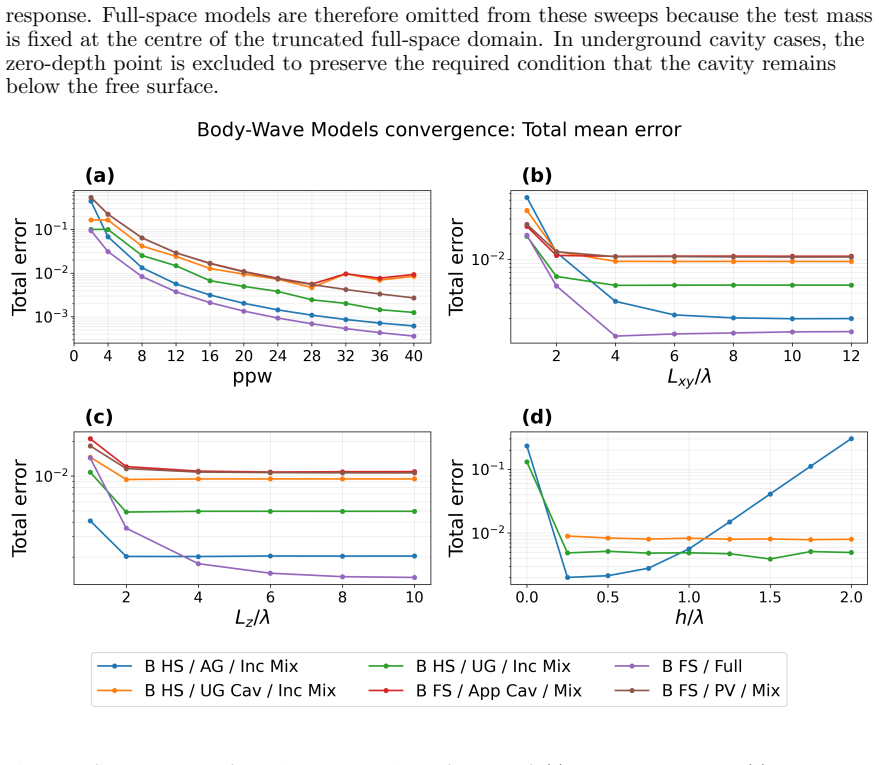
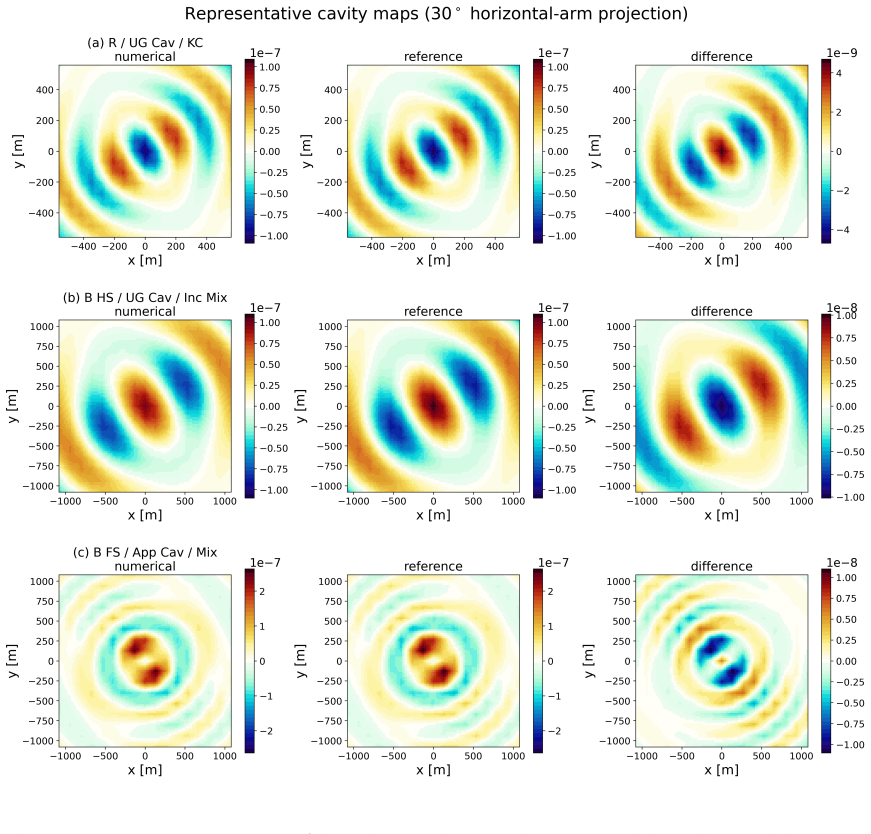
Summary. The paper develops a Cartesian midpoint-grid numerical framework for computing gravitoelastic correlation tensors (cross-correlations between Newtonian acceleration at a test mass and seismic displacement at sensor positions) for Rayleigh waves and body waves in half-space and full-space homogeneous isotropic media. It derives closed-form analytical benchmarks, including a universal angular-averaged tensor, mode-specific displacement and acceleration profiles, incoherent P-SV mixtures, and leading-order spherical-cavity corrections. The numerical framework is then validated against these closed forms across all nine tensor components, with convergence studies over resolution, domain size, test-mass position, frequency, and cavity radius, and with spatial map comparisons. The central claim is that the numerical framework reproduces the analytical tensors with mean total errors between about 6e-4 and 1.3e-2, thereby providing a unified tool for Newtonian-noise modeling and sensor-array design.
Significance. If the validation is sound, this paper provides a useful, systematically benchmarked numerical tool for Newtonian-noise estimation in future gravitational-wave detectors such as the Einstein Telescope. The strengths are the thoroughness of the convergence studies (all nine tensor components, multiple geometries, frequency and cavity-radius sweeps), the well-defined normalized error metrics, and the explicit use of equipartition-based diffuse-field fractions that are not fitted to the numerical results. The paper also clearly separates exact full-space models from principal-value and approximate-cavity references, and it identifies regimes where finite-cavity and truncation errors matter. The main limitations are that no code or data are made publicly available, and two technical points in the derivation and in the scope of the cavity formula need clarification before the validation claims can be fully accepted.
major comments (2)
- [Sec. 2.2.2 and Sec. 3.3.2] Equation (14) is obtained from Eq. (12) by dropping the boundary integral at infinity, justified only 'if the contribution at infinity vanishes.' For the half-space body-wave benchmarks used in Section 5, the correlation tensor C_αj(r',r) is not evanescent: the depth profiles in Eqs. (58)-(61) contain propagating factors e^{±ik_z z'}, and after the angular average the Bessel functions J_n(κΔρ) decay only as (κΔρ)^{-1/2}. The manuscript never verifies that the S∞ term in Eq. (12) vanishes, yet Section 3.3.2 refers to Eq. (40) as the 'exact interior relation' without qualification. Please add a demonstration that the boundary integral vanishes (for example, using |J_n(κΔρ)| ≤ C(κΔρ)^{-1/2} to bound the hemisphere boundary integral by a constant times R^{-1/2} → 0), or state explicitly the additional assumption needed and restrict the exactness claim to the cases where the condition is established.
- [Sec. 3.4 and Sec. 5.2.3] Equation (41) is presented as the leading-order cavity-corrected closed form for both the kernel-contraction and bulk-surface models, but the text states that it 'is valid for Rayleigh waves and the full-space medium.' The numerical validation, however, applies Eq. (41) as the reference for half-space body-wave cavity configurations (e.g., the 'half-space body-wave cavity model' in Fig. 4 and the small-radius plateaus in Fig. 5). If the stated restriction is correct, those validation results are not meaningful; if the restriction is not intended, the sentence should be revised. Please clarify the domain of validity of Eq. (41) and ensure that the validation is consistent with that domain.
minor comments (5)
- [Data and code availability] The statement that code and data are available 'upon request' rather than in a permanent repository limits reproducibility of the reported convergence numbers; please consider releasing the code or providing a detailed description of the data products.
- [Sec. 5.2.1] Please specify which integral formulation (bulk-surface or kernel-contraction) the reported mean-total-error ranges refer to, since both formulations are claimed to be verified and the reader cannot tell whether the ranges cover one or both.
- [Appendix B] The grid discretization does not describe how the spherical cavity boundary is handled on the Cartesian grid (for example, whether cells whose centers lie inside the sphere are excluded with a staircase approximation); please specify this, since the discussion of non-monotonic convergence cites the 'Cartesian representation of the spherical cavity boundary' as a source of error.
- [Appendix D.2.2] The acceleration transfer functions B_pot(z0) and B_vert(z0) are listed without derivation; please provide a derivation or a precise reference to the standard half-space potential solutions from which they follow.
- [Eq. (24)] The projection formula contains c_xy + c_yx; if the gravitoelastic tensor is symmetric, this should be noted and the expansion written as 2c_xy, otherwise the asymmetry should be explained.
Circularity Check
No significant circularity: the numerical validation is a benchmark of the same physical model, and the diffuse-field weights are fixed by equipartition rather than fitted to the target result.
full rationale
After walking the derivation chain, I find no circular step in the sense used here. The numerical integrals in Sec. 5 evaluate the same displacement-correlation tensors that enter the closed forms, but that is the intended benchmark structure: the closed forms are obtained by analytic angular and solid-angle reduction (Eqs. 30, 35, 83), while the numerical code tests quadrature and grid convergence on a different route (Eqs. 7, 13, 21). The diffuse-field fractions p_HS = 0.150 and p_FS = 0.081 are fixed by the equipartition prescription in App. E, and the paper states explicitly that they are 'not selected by minimizing the numerical error,' so no fitted parameter is being renamed as a prediction. The reliance on [6] for Rayleigh profiles, full-space kernels, and principal-value multipliers is a self-citation, but it is not load-bearing in a circular way: those formulas are published standard results, the paper rederives the master equations independently in App. D, and the validation target is the numerical framework's consistency with those formulas rather than a claim that the formulas follow from the framework. The unverified S_infinity condition in the passage from Eq. (12) to Eq. (14) is a genuine correctness concern for half-space body waves, but it is not a circularity: the bulk-surface formulation and the direct acceleration profiles provide independent content, and a failure of that condition would be an error, not a tautology.
Assumptions & free parameters
assumptions (6)
- domain assumption Horizontal isotropy of the seismic wavefield, represented by uniform azimuthal averaging in Eq. (29)
- domain assumption Homogeneous isotropic elastic medium with a flat free surface
- domain assumption Equipartition of diffuse elastic wavefields sets the P/SV and P/S fractions
- domain assumption Small-cavity leading-order asymptotic approximation O(a^2/lambda^2)
- standard math Kernel derivative distributional identity Eq. (11)
- domain assumption Vanishing of the boundary-at-infinity integral in Eq. (12)
Cite this review
Pith. "Pith review of Correlation-based Modeling of Seismic Newtonian Noise in Half-Space and Full-Space Media." pith.science (2026). https://pith.science/paper/3QAD7AON
@misc{pith2026260805117,
  author       = {Pith},
  title        = {Pith review of: Correlation-based Modeling of Seismic Newtonian Noise in Half-Space and Full-Space Media},
  year         = {2026},
  howpublished = {\url{https://pith.science/paper/3QAD7AON}},
  note         = {Machine review of arXiv:2608.05117}
}
read the original abstract
Seismic Newtonian noise, arising from fluctuating gravitational forces on detector test masses due to ambient seismic activity, represents a fundamental sensitivity limit for low-frequency gravitational-wave observatories such as the Einstein Telescope. Effective mitigation of Newtonian noise requires detailed knowledge of the statistical correlations between the Newtonian acceleration perturbation at the test mass and the seismic displacement field measured by surrounding sensor arrays. In this work, the gravitoelastic correlation tensors (the cross-correlations between the Newtonian acceleration perturbation and the seismic displacement field) are derived and numerically validated for Rayleigh waves and body waves in half-space and full-space media, considering test masses located above and below ground, with and without a spherical cavity. The analytical solutions provide exact and asymptotic benchmarks for validating a Cartesian numerical integration framework, which reproduces the corresponding gravitoelastic tensors across Rayleigh-wave and body-wave models, establishing a unified tool for Newtonian-noise modeling and sensor-array design in future gravitational-wave detectors.
Figures


Figures from the paper (3 more)


Reference graph
Works this paper leans on
-
[1]
Abbott B Pet al.2016Phys. Rev. Lett.116061102
-
[2]
Abbott B Pet al.2017Phys. Rev. Lett.119161101
-
[3]
Akutsu Tet al.2021Prog. Theor. Exp. Phys.202105A101
-
[4]
ET Steering Committee 2020available from European Gravitational Observatory, document number ET-0007B-20URLhttps://apps.et-gw.eu/tds/ql/?c=15418
-
[5]
Evans Met al.2021 A horizon study for Cosmic Explorer: Science, observatories, and community arXiv:2109.09882 (Preprint2109.09882)
arXiv 2021
-
[6]
Relativ.226 updated and expanded review
Harms J 2019Living Rev. Relativ.226 updated and expanded review
-
[7]
Beker M Get al.2011Gen. Relativ. Gravit.43623–656
- [8]
Show all 17 references
-
[9]
Badaracco F, Harms J, Bertolini A, Bulik T, Fiori I, Idzkowski B, Kutynia A, Nikliborc K, Paoletti F, Paoli A, Rei L and Suchinski M 2020Classical and Quantum Gravity37195016 URLhttps://doi.org/10.1088/1361-6382/abab64
-
[10]
Schillings P and Erdmann J 2025Classical and Quantum Gravity42065025 URL https://doi.org/10.1088/1361-6382/adb898
-
[11]
Harms J, Ampuero J P, Barsuglia M, Chassande-Mottin E, Montagner J P, Somala S N and Whiting B F 2015Geophysical Journal International2011416–1425 ISSN 0956-540X URLhttps://doi.org/10.1093/gji/ggv090
-
[12]
Driggers J C, Harms J and Adhikari R X 2012Phys. Rev. D86102001
-
[13]
Quantum Grav.33244001
Coughlin Met al.2016Class. Quantum Grav.33244001
-
[14]
Andric T and Harms J 2020J. Geophys. Res. Solid Earth125e2020JB020401
-
[15]
Aki K and Richards P G 2002Quantitative Seismology2nd ed (Sausalito, CA: University Science Books)
-
[16]
Weaver R L 1982J. Acoust. Soc. Am.711608–1609
-
[17]
Margerin L, Campillo M and Van Tiggelen B A 2000J. Geophys. Res. Solid Earth 1057873–7892 21
Reviewed August 15, 2026 · model on record in the stance chip above.
Discussion (0). Continue with ORCID to comment.