REVIEW 3 major objections 4 minor 15 references
Search2Skill: Skill Distillation Beyond Knowledge Boundaries Via Rubric-Based Reinforcement Learning
T0 review · 3 major / 4 minor · reviewed 2026-08-08 · deepseek-v4-flash
Pith's one-line read Search2Skill claims an LLM agent can push past its parametric knowledge by searching external sources and distilling the evidence into reusable skills, using a rubric-based reinforcement learning objective that jointly optimizes when to…
desk verdict Search2Skill is a genuine new combination—joint RL over when to search, how to search, and how to distill skills—with solid held-out evidence, though the training reward's dependence on a single LLM teacher/judge is the main thing to probe in review. read the letter →
The pith
A machine-rendered reading of the paper's core claim, the machinery that carries it, and where it could break.
The reading
What carries the argument
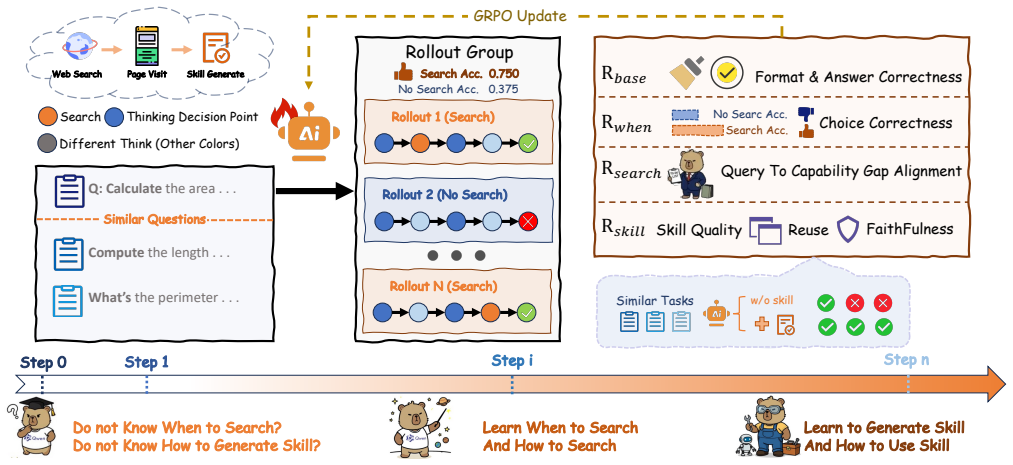
The load-bearing object is the rubric-based reinforcement learning objective, composed of a task reward and three decision rewards. The exploration-necessity reward is a group-contrastive gate: within a batch of rollouts, exploration earns a quality bonus only when searching clearly outperforms direct answering, and direct answering earns a bonus when searching clearly hurts. The search-quality reward is an LLM-judged score of query abstraction and evidence gain, applied as a penalty on the bonus. The skill-generation reward combines a reuse score, measured by executing the skill on similar relabeled questions, with an LLM-judged grounding score that audits the skill's claims against the retrieved evidence. The final reward is a weighted, clipped combination of the task term and the gated quality bonus, trained with GRPO.
What would settle it
Retrain Search2Skill exactly as described but replace the LLM judge's rubric scores with human-annotated ratings on the same dimensions for a random subset of training rollouts; if gains over direct inference shrink or disappear under human-rated rewards, the claim that rubric-RL with this judge drives the improvement is falsified. A simpler check: take a trained policy, disable the reuse-score component of the skill reward, and see whether held-out accuracy still rises; the paper's own ablation already suggests it would not, but only a direct comparison on a fresh domain settles it.
Extended reading notes
Core claim
The central claim is that external search, when supervised by the right reward signal, can be converted into persistent procedural knowledge that pushes an agent's effective capability boundary outward. The paper argues that this conversion requires optimizing three decisions jointly: when to search, how to search, and how to distill, and that a single outcome reward is too coarse for this credit-assignment problem. Its experiments show that a rubric-based reward with three complementary terms fixes the main failure modes of an untrained pipeline, that the distillation step contributes more than simply storing retrieved content, and that the resulting skills are not tied to the collecting model. If this is right, self-evolving agents need not be bounded by their priors: they can acquire expert-domain conventions and standard procedures that their parameters never contained.
Load-bearing premise
The reward signal rests on the assumption that the LLM judge's scores for query quality and skill grounding, together with the reuse score computed on a few relabeled similar questions, correctly measure whether a distilled skill will help on future questions; if those measures are miscalibrated, the policy could learn to produce skills that look good to the judge but do not genuinely generalize.
Editorial extensions
If this is right
- With the trained policy, a 4B model using skills reaches 56.5% on the Science domain, surpassing the unassisted 8B model at 50.0%.
- A skill library mined by the 8B collector improves a 4B executor by +4.1% and a 14B executor by +3.5% over direct inference, so structured skills act as an external capability scaffold.
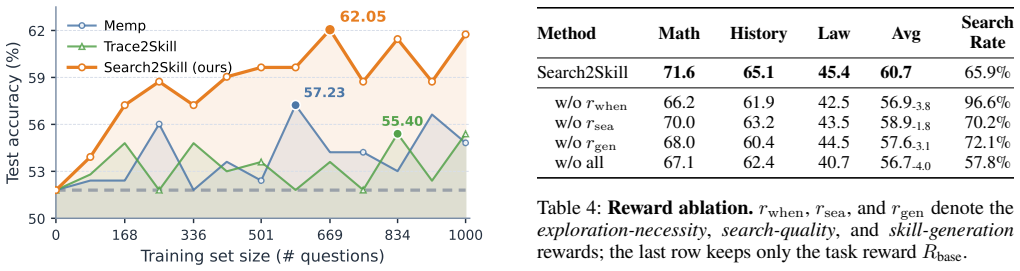
- Removing any of the three rubric rewards degrades accuracy, with the exploration-necessity term most important: without it the search rate surges to 96.6% and accuracy drops by 3.8%.
- RL reduces the average failure share across all five failure patterns from 25.3% to 11.9%, indicating the training fixes the whole pipeline rather than one stage.
- Search2Skill acquires useful skills more efficiently than inward-looking baselines: on MMLU-Pro Philosophy it jumps to 57.2% after 168 questions, while memory-based baselines remain stagnant.
Reading between the lines
- A natural next test is whether the judge-based reward could be replaced by a learned reward model trained on human preference data; the paper does not validate its judge against human raters, so the faithfulness of the rubric scores remains an open empirical question.
- The group-contrastive gating depends on both exploring and direct rollouts being sampled per group; if one strategy quickly dominates, the gate may stop providing signal, so the margin parameter $\tau_0$ likely needs adaptive scheduling in settings with larger search budgets.
- Because skills transfer across model scales, a practical extension is to decouple collection and execution: a small, cheap model mines the library while a larger model consumes it, lowering the cost of self-evolution.
- The skill library is capped at 300 entries with no merging; adding deduplication or hierarchical organization could further compound the reuse gains reported here.
Editorial analysis
A structured set of objections, weighed in public.
Referee Report
Summary. The paper proposes Search2Skill, a framework that lets an LLM agent identify its own capability gaps, search external sources, and distill the retrieved evidence into persistent, reusable skills, trained end-to-end with a rubric-based reinforcement learning objective. The reward decomposes into an exploration-necessity term, a search-quality judge, and a skill-generation judge, gated by group-contrastive accuracy differences. Experiments on eight domains from SuperGPQA, MMLU-Pro, and EvoAgentBench report average accuracy gains over direct inference of 8.3% and 9.3% on Qwen3-4B/8B under a streaming protocol, and 5.1% and 6.6% under a held-out protocol, with additional analyses claiming that skill abstraction rather than raw evidence drives the gains and that the mined skills transfer across model scales.
Significance. If the results hold, Search2Skill is a valuable step toward self-evolving agents that genuinely extend their parametric knowledge boundary rather than only reorganizing internal experience. The paper is unusually detailed in its appendices: full prompt templates for the decision, exploration, and skill-only execution phases, explicit reward formulas, hyperparameters, and streaming standard deviations are all provided. The comparisons are also fairer than is common in this area: EvolveR and the search agent are re-trained under the paper's setup, and the held-out protocol disables search at test time. The main empirical pattern is internally consistent, and the cross-scale transfer result is interesting. However, the central training signal depends on an LLM judge and teacher-relabeled labels whose validity is not established, and a key mechanism claim about abstraction is supported by a confounded comparison. With those points addressed, the paper would merit publication.
major comments (3)
- [Appendix B.2 and Appendix C.2, Eq. (9)] The reuse score s_reuse is computed on K=3 similar questions whose ground-truth answers are relabeled by Qwen3.7-Max, the same model that provides the query-quality and grounding judgments. The paper reports no agreement statistics between these relabeled labels and the original WebInstruct-verified answers, nor any comparison against human annotations or an independent objective. Since s_reuse enters every exploring rollout's reward with weight lambda_c=0.3, a systematically biased teacher can shape the policy gradient toward skills that match the teacher's preferences rather than true correctness. The exact-match held-out evaluation is reassuring, but it validates the final policy, not the reward signal; a biased reward could still produce a policy whose reported gains are fragile or dependent on the particular teacher model. I ask the authors to report label-agreement statistics on a sample of relabeled questions and, ideally, to run an ablation that computes s_reuse against the original labels or an independent teacher.
- [Table 2 and Appendix F] The held-out results, which are the core evidence for intrinsic skill reusability, are reported only as point estimates. Appendix F gives mean ± standard deviation for the streaming protocol on Qwen3-8B, but not for the held-out protocol, the EvoAgentBench results, or the Qwen3-4B runs. Since several held-out differences are modest (for example, Search2Skilltrain versus Memp on Qwen3-4B is +3.1 on average, with per-domain deltas sometimes negative), and LiveCodeBench has only 39 test tasks, the claim that Search2Skill 'consistently outperforms' baselines under the held-out protocol cannot be statistically assessed. I ask for error bars or confidence intervals over the collection splits and decoding seeds for Tables 2, 3, and 5.
- [Held-Out Evaluation, Table 3] The comparison between 'raw retrieved evidence' and 'abstracted skill' is confounded by presentation format. The raw condition stores and injects retrieved snippets, presumably with their original length and noise, while the abstracted condition provides a structured workflow and runnable Python functions. The 4.5% margin could therefore reflect formatting, prompt layout, or code-execution benefits rather than abstraction per se. Because the paper explicitly concludes that 'gains arise from skill abstraction rather than raw retrieved evidence,' this comparison needs a control that presents raw evidence through the same structured prompt and code interface, or otherwise manipulates only the abstraction step.
minor comments (4)
- [Appendix C.1] The sentence 'Let ¯y expand ¯ydirect be the mean accuracies of Gexp and Gdirect' appears to be missing a conjunction; it should read 'Let ¯y_exp and ¯y_direct be the mean accuracies...'.
- [Appendix F] The variance table covers only Qwen3-8B streaming results; the main text should state whether the Qwen3-4B streaming results show similar run-to-run variance, or the corresponding table should be added.
- [Abstract] The GitHub link in the abstract (ATH-MaaS/Marco-DeepResearch) looks like a placeholder or unrelated project URL rather than a code release repository; the authors should provide the actual anonymized repository or remove the link until code is available.
- [Table 1] The per-method delta column (e.g., '+0.7' for Search Agent) is not defined in the caption; it should be explicitly stated as the improvement over Direct Inference.
Circularity Check
No significant circularity: Search2Skill's accuracy gains are measured against external gold labels and held-out splits, not against its own rubric or teacher-judge reward components.
full rationale
The derivation chain supporting the headline accuracy gains is self-contained with respect to the target results. The policy is cold-started from SFT trajectories and then optimized with GRPO using a composite reward (Eq. 5) whose components—Rwhen, Rsearch, Rskill, and Rbase—are all specified in the paper (Appendix C). The reuse score s_reuse is computed by injecting a generated skill into K=3 teacher-relabeled similar questions and measuring pass-rate differences on a frozen copy of the policy's own backbone (Appendix C.2). This is internal supervision: it shapes the policy during training, but the reported streaming and held-out accuracies are obtained on SuperGPQA, MMLU-Pro, and EvoAgentBench with exact-match option extraction and unit tests for LiveCodeBench, while the held-out protocol disables search and reuses the frozen skill library on a disjoint test split. The teacher relabeling by Qwen3.7-Max is a training-signal validity concern (it is not validated against human raters), but it does not make the evaluation circular, because no reported number is computed from the teacher's relabeled labels. The self-citations to UMEM (Ye et al. 2026) for the reuse-score idea and streaming protocol and to Marco DeepResearch (Zhu et al. 2026) for the search environment are descriptive rather than load-bearing: the reuse formula and protocol are fully defined in the paper, and the benchmarks are external. No equation in the paper reduces a reported prediction to its own input, so no circular step can be exhibited.
Assumptions & free parameters
free parameters (7)
- lambda_a = 0.7, lambda_c = 0.3 =
0.7, 0.3
- tau_0 = 0.25 =
0.25
- Query penalty 0.15 per dimension =
0.15, max 0.30
- N = 16 rollout group size =
16
- K = 3 similar questions for skill reuse =
3
- Retrieval hyperparameters gamma = 0.7, top-k = 3, threshold theta = 0.50 =
0.7, 3, 0.50
- Library cap = 300 skills =
300
assumptions (6)
- domain assumption Benchmark answer keys and teacher-relabeled ground truths are correct.
- ad hoc to paper Qwen3.7-Max judge ratings accurately measure query quality and skill grounding.
- domain assumption Semantic embedding similarity with text-embedding-v4 is an adequate retrieval signal for skills.
- domain assumption External web pages returned by Google Search API contain reliable expert knowledge.
- domain assumption SFT trajectories generated by DeepSeek-V3.2 and GLM-5 are correct and representative.
- domain assumption The training domains and public evaluation benchmarks do not overlap in problematic ways.
Cite this review
Pith. "Pith review of Search2Skill: Skill Distillation Beyond Knowledge Boundaries Via Rubric-Based Reinforcement Learning." pith.science (2026). https://pith.science/paper/65ULIVNN
@misc{pith2026260805245,
  author       = {Pith},
  title        = {Pith review of: Search2Skill: Skill Distillation Beyond Knowledge Boundaries Via Rubric-Based Reinforcement Learning},
  year         = {2026},
  howpublished = {\url{https://pith.science/paper/65ULIVNN}},
  note         = {Machine review of arXiv:2608.05245}
}
read the original abstract
Reusable skills, which encapsulate the procedural knowledge required to solve real-world professional tasks, offer LLM-based agents a path toward self-evolution in expert domains. Existing self-evolving skill methods construct skills internally from the model's parametric knowledge or trajectories, and are therefore bounded by what the model already knows. However, the domain conventions and standard procedures underlying professional skills often lie beyond this boundary and are hard to elicit from the agent alone. To address this issue, we therefore propose a novel framework, Search2Skill, that automatically identifies the agent's capability gaps, searches external sources to address them, and distills the retrieved evidence into structured, reusable skills. Specifically, Search2Skill is optimized by a rubric-based reinforcement learning scheme that jointly improves when to search, how to search, and how to generate skills. Experiments on eight expert-level domains from three benchmarks show that Search2Skill consistently outperforms both search-augmented and trajectory-based skill-learning baselines under both streaming and held-out evaluation protocols. Further analyses show that the gains arise from skill abstraction rather than raw retrieved evidence, and that the acquired skills transfer across model scales.
Figures


Figures from the paper (4 more)



Reference graph
Works this paper leans on
-
[1]
Query Abstraction.Whether the query searches for reusable principles, formulas, or workflows, rather than over-fittingtospecificinstancenumbersorsearchingvague broad topics. •0=Instance-Overfitted: query contains specific prob- lem numbers or local variables (e.g. “calculate X when a=3, b=5”), directly fishing for the answer. •1=BroadTopic:queryistoovague...
-
[2]
Evidence Gain.Whether the returned search snippets eliminateconfusionandprovideverifiable,non-redundant evidence. •0=Noisy/Irrelevant:snippetsareempty,noisy,orcom- pletely useless. •1=RedundantBackground:snippetsonlygivecommon background knowledge the agent already knew. •2=Partial Support: snippets provide useful formulas or rules that narrow down the sp...
-
[3]
Explore – use this when uncertain or missing knowl- edge:<EXPLORE>what specific information, knowledge, method, example, workflow, or implementation detail you need to verify</EXPLORE>
-
[4]
Activate a skill:<ACTIVATE_SKILL>skill_name </ACTIVATE_SKILL>. Once you have activated a skill, you can view the knowledge contained within it, or di- rectly utilize the functions included in the skill within <CODE>
-
[5]
Run Python code:<CODE>your python code here</CODE>
-
[7]
Answer – only when confident:<ANSWER>final answer (or option letter like B for multiple choice)</ANSWER>. G.2 Exploration Prompt Oncetheagentemitsan<EXPLORE>taginPrompt1,control transfers to Prompt 2, which scopes the exploration phase. This prompt enforces the search–visit–distill discipline that underlies Search2Skill and produces the JSON skill object ...
- [8]
- [9]
Show all 15 references
-
[10]
skill_name
Generate skill (only after visiting pages): <GENERATE_SKILL>{ "skill_name": "name_with_underscores", "use_when": "when to activate this skill -- describe the problem type or scenario", "workflow": "step-by-step workflow, distilled facts, formulas, constants from page content (...
-
[11]
Activate a skill by outputting <ACTIVATE_SKILL>skill_name</ACTIVATE_SKILL>
-
[12]
Run Python code with <CODE>your python code here</CODE>
-
[13]
rotational constant B cm^-1 moment of inertia diatomic
Answer with <ANSWER>final answer (or option letter like B for multiple choice)</ANSWER>. H Example Trajectory and Skill Examples H.1 A Full Trajectory Example We provide an illustrative example of the Search2Skill loop onachemistryproblem.Inthistrajectory,theagentidentifies am...
-
[14]
urls": [
(snippets too brief -- visit pages) Assistant <PAGE_VISIT> { "urls": ["NIST CCCBDB", "LibreTexts", ...], "goal": "verify the B-I-R relation and units" } </PAGE_VISIT> Tool Page visit results:
-
[15]
skill_name
cccbdb.nist.gov/convertmomint The exact formula relating rotational constant B (in cm^-1) to moment of inertia I is B = h / (8 pi^2 c I) where h is Planck's constant, c the speed of light, and I the moment of inertia. I relates to bond length R and reduced mass mu by I = mu R^...
-
[2023]
Zeng, A.; Lv, X.; Hou, Z.; Du, Z.; Zheng, Q.; Chen, B.; Yin, D.; Ge, C.; Huang, C.; Xie, C.; et al
Do Large Language Models Know What They Don’t Know? InFindings of the Association for Computational Linguistics: ACL 2023, 8653–8665. Zeng, A.; Lv, X.; Hou, Z.; Du, Z.; Zheng, Q.; Chen, B.; Yin, D.; Ge, C.; Huang, C.; Xie, C.; et al. 2026. Glm-5: from vibe coding to agentic en...
2023 arXiv
Reviewed August 8, 2026 · model on record in the stance chip above.
Discussion (0). Continue with ORCID to comment.