REVIEW 3 major objections 5 minor 12 references
Inverse mask design for interference lithography using automatic differentiable wave propagation
T0 review · 3 major / 5 minor · reviewed 2026-08-08 · deepseek-v4-flash
Pith's one-line read A differentiable angular-spectrum model designs interference-lithography masks that reproduce non-periodic targets with half-pixel features and only 0.1% isolated defects in simulation.
desk verdict Solid engineering demonstration with a useful memory-scaling trick, but the headline 0.1% defect rate is under-specified because the binarization threshold is never reported. read the letter →
The pith
A machine-rendered reading of the paper's core claim, the machinery that carries it, and where it could break.
The reading
What carries the argument
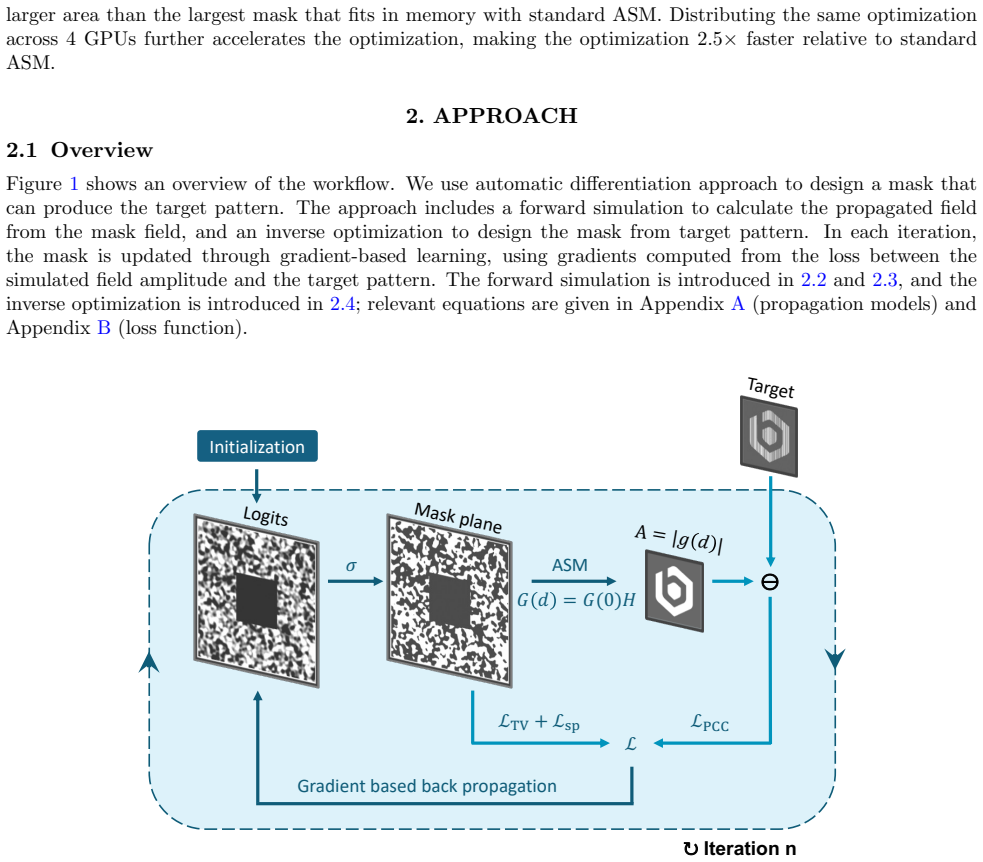
The load-bearing object is the differentiable angular spectrum method (ASM), a scalar diffraction propagator that moves the field from the mask plane to the image plane by Fourier transforming the mask field, multiplying by a band-limited free-space transfer function, and inverse transforming. Because each step is differentiable, the mask logits can be updated by backpropagating a loss composed of a Pearson-correlation term on the field amplitude plus total-variation and sparsity regularizers on the mask. The mask itself is a soft sigmoid of the logits whose temperature is annealed from soft to nearly binary during optimization. For large masks, the shifted ASM divides the mask into $P\times P$ patches, propagates each patch with an offset-dependent transfer function and an anti-aliasing window, and sums the complex fields at the observation plane, reducing peak memory from $O(N^2)$ to $O((N/P)^2)$.
What would settle it
Propagate the optimized mask with a vectorial diffraction solver at the same NA (0.69), wavelength (445 nm), and distance (2 mm) and count defective pixels in the binarized intensity: if the defect fraction rises well above 0.1%, the scalar approximation is the weak point. A direct experimental check would expose a resist with the fabricated mask under the same conditions and compare the developed pattern to the target, which would also pin down the resist threshold the simulation leaves unspecified.
Extended reading notes
Core claim
The central claim is that a binary amplitude mask for interference lithography can be found by optimizing its pixel values against a target aerial image through a fully differentiable scalar diffraction model. The authors report a mask with 800 nm pixel pitch whose simulated field reproduces a target containing 400 nm minimum features—a $2\times$ resolution enhancement relative to the mask pixel pitch—with a Pearson correlation of 0.95 between field amplitude and target, and a binarized aerial image matching the target except for randomly distributed isolated defects covering 0.1% of pixels. They further claim that the same optimization works with the shifted angular spectrum method, which partitions the mask into patches and sums their propagated fields, giving almost identical results (Pearson 0.9998 between the two propagators) while reducing peak memory from 46.8 GB to 12.2 GB for a 3.84 mm mask, and to 6.3 GB with gradient checkpointing. This enables optimizing masks up to 12.8 mm on a side, an order of magnitude larger in area than standard ASM allows.
Load-bearing premise
The claimed pattern quality rests on the assumption that a scalar diffraction model, combined with an unspecified binary intensity threshold for resist development, predicts what a real high-NA exposure records; if vectorial or polarization effects change the field, the printed pattern may not match the simulation.
Editorial extensions
If this is right
- Interference lithography masks can be designed computationally for non-periodic targets rather than only periodic gratings, by treating mask design as a differentiable optimization problem.
- The reported $2\times$ resolution gain implies the mask pixel pitch no longer sets the smallest printable feature in this coherent-diffraction regime.
- Shifted ASM with gradient checkpointing extends mask optimization to areas roughly $10\times$ larger than standard ASM fits in GPU memory, at about twice the runtime.
- Because the propagation model is wavelength-agnostic, the same pipeline applies to EUV illumination at $\lambda = 13.5$ nm by changing the simulation parameters, making the approach a candidate for EUV mask design.
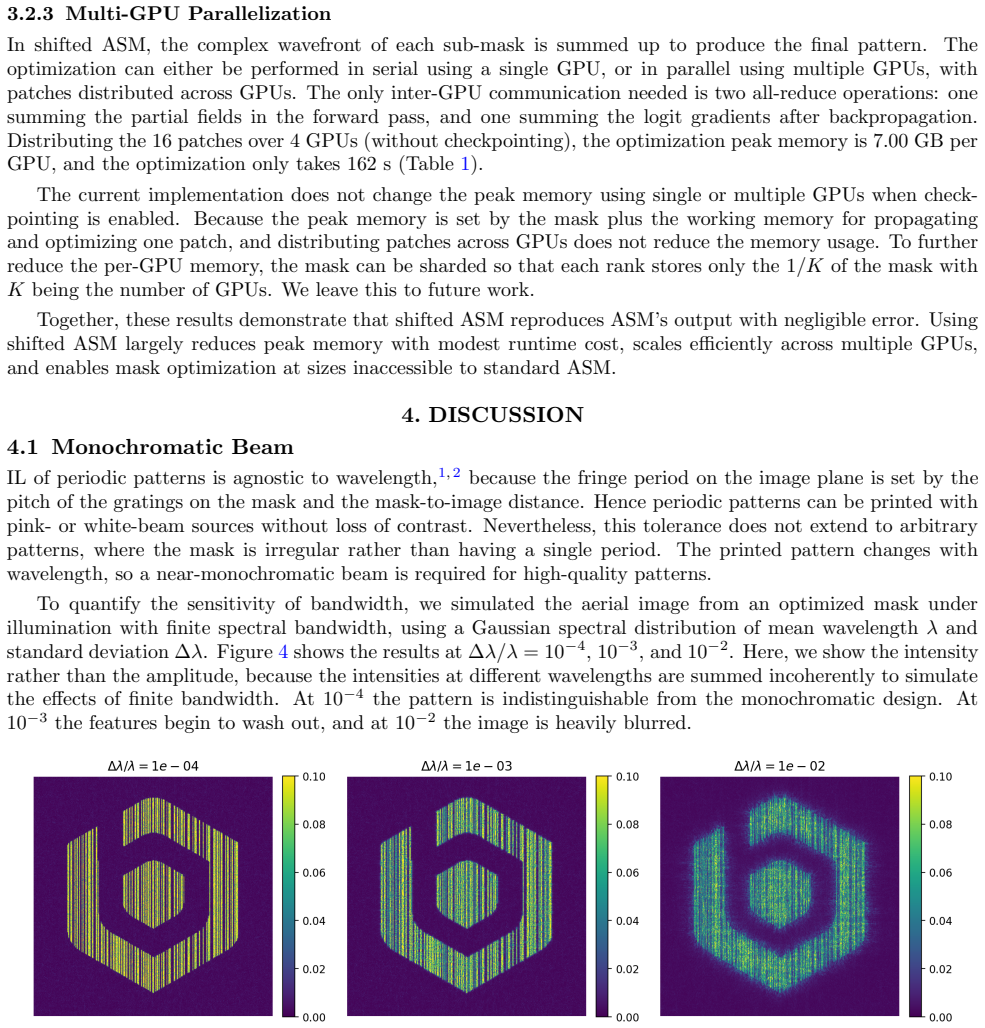
- Finite spectral bandwidth degrades arbitrary patterns: simulations show the source must satisfy $\Delta\lambda/\lambda \lesssim 5.76\times 10^{-4}$ for the reported geometry to preserve image quality.
Reading between the lines
- The 0.1% defect figure is computed with a binary resist-threshold model whose threshold value is not reported; a real workflow would need to calibrate that threshold, and the defect rate may shift when it is varied.
- Because the scalar approximation is invoked at NA 0.69, rerunning the same optimization with a vectorial forward model would show how much of the claimed resolution gain survives polarization-dependent mask responses.
- The mask degeneracy the authors mention opens an untested route: optimizing not just for image fidelity but for robustness to defocus or illumination drift by averaging the loss over perturbed conditions, which they sketch as future work.
- The memory-scaling results suggest that, for this inverse-design approach, the practical bottleneck moves from simulation memory to mask fabrication constraints such as write time and minimum manufacturable feature size.
Signed reviews
Editorial analysis
A structured set of objections, weighed in public.
Referee Report
Summary. The paper introduces a gradient-based inverse mask design framework for interference lithography, using an automatically differentiable angular spectrum method (ASM) as the forward propagator and optimizing continuous mask logits with a Pearson-correlation loss and regularization terms. The authors report that an optimized binary mask with 800-nm pixel pitch reproduces a target pattern with only 0.1% isolated pixel-level defects after binarization of the aerial intensity, resolving 400-nm features at half the mask pixel pitch. To scale beyond single-GPU memory limits, they employ a shifted ASM that partitions the mask into patches, reporting a 3.8x peak-memory reduction at 1.3x runtime cost for a 3.84 mm x 3.84 mm mask, with further reductions from gradient checkpointing and multi-GPU parallelization. The manuscript also discusses the required near-monochromaticity of the illumination and mask degeneracy as avenues for robustness.
Significance. If the quantitative claims hold, the paper gives a useful and clearly specified demonstration of automatic-differentiation-based inverse design for non-periodic interference lithography masks, an area where current IL is mostly restricted to periodic patterns. The forward model (ASM and shifted ASM) is standard and the implementation is described with enough detail to reproduce the computational scaling results. The code is publicly available, and the authors explicitly acknowledge the scalar-field approximation and the sensitivity to initialization, which is commendable. The memory-scaling contribution (shifted ASM + checkpointing + multi-GPU) is likely to be of practical value to the computational lithography community. However, the central 0.1% defect figure is a training-set metric computed under an unspecified binarization threshold and a scalar-field model at NA=0.69; these omissions currently prevent the reader from independently verifying or extrapolating the headline result.
major comments (3)
- [Section 3.1.3] The headline claim of 0.1% isolated pixel-level defects is not well-defined because the threshold used to binarize the aerial intensity I=|g|^2 into the printed pattern I_b is never reported. The loss in Eq. (14) is a Pearson correlation between the field amplitude A and the binary target I_t; Pearson correlation is invariant to the global scale of A, so the optimization does not pin the absolute intensity levels seen by the resist. Consequently, the defect rate depends on the arbitrarily chosen threshold, and if that threshold was selected post hoc to minimize defects, the 0.1% figure is not a predictive property of the mask. The authors should report the threshold value (or the equivalent exposure/dose) and provide a sensitivity curve of the defect rate versus threshold (a dose-latitude or contrast curve). Without this, the claim that the mask 'reproduces the target pattern' cannot be independently verified from the text.
- [Section 2.2] The scalar-field approximation is load-bearing for the resolution and defect claims. The paper states, 'At high numerical aperture (NA), vectorial diffraction and polarization-dependent mask responses may become non-negligible and are not included in the current model.' With NA=0.69 (Eq. 3), the 2x resolution enhancement and the 0.1% defect rate are computed entirely within this approximation. Since the mask features are at 800 nm and the wavelength is 445 nm, the mask is not deeply subwavelength, but the high propagation angle (about 34.6 degrees at the mask edge) makes the scalar approximation questionable. The authors should either quantify the expected error from vectorial effects (e.g., by comparing against a vectorial propagation model for a reduced-size problem) or clearly state that the claims are predictions of the scalar model only, with the vectorial correction as an open question for experimental testing.
- [Section 3.1.2 and Section 4.2] The 0.1% defect rate is reported for a single optimization run with one initialization. The paper itself notes in Section 4.2 that the inverse problem is sensitive to initialization and that different initializations converge to different masks with similar patterns. Because the loss landscape is non-convex and the sigmoid temperature schedule and regularization weights are manually chosen, a single run does not establish that 0.1% is a typical or robust outcome. The authors should either report statistics over several random initializations (e.g., mean and spread of the defect rate and Pearson correlation) or justify why the single chosen run is representative. This is important because the manuscript's central practical claim is that the method reliably produces low-defect masks.
minor comments (5)
- [Section 2.4] The statement 'For a binary target pattern I_t, the global optimum is the same whether A or I is optimized' is imprecise, because the optimal mask under a thresholded-resist model is not uniquely defined without specifying the threshold and the dose. Please add a caveat that the equivalence refers to the scale-invariant Pearson loss, not to the printed pattern.
- [Figure 2] The zoomed-in panels in Figure 2(b) would benefit from explicit scale bars and labels of the binarization threshold used to produce I_b. Currently the reader cannot determine the pixel size of the displayed region or the intensity level at which the binarization occurs.
- [Appendix B, Eq. (14)] The notation for the Pearson term alternates between 'L_PCC' in the text and 'L PCC' in Eq. (13). Please unify the subscript formatting for clarity.
- [References] Reference [4] is the authors' own SIAM abstract; for the statement about physics-informed machine learning for mask design in IL, it would be preferable to cite a peer-reviewed or archival source if one exists, or to mark it clearly as a conference abstract.
- [Section 3.2.2, Table 1] The memory numbers are plausible, but the table would be easier to interpret if it also listed the batch size or iteration-level memory breakdown (e.g., logits, wavefront, gradients) as a fraction of peak memory, since the deviation from the naive 1/16 scaling is explained qualitatively in the text.
Circularity Check
No significant circularity: the reconstruction is a designed fit, but the forward physics is independent and no load-bearing self-citation is present.
full rationale
The paper's derivation chain is explicit: choose a binary target pattern I_t, define a binary mask M through sigmoid logits, propagate with the standard angular spectrum method (Eqs. 4-9, following Matsushima's external work), compute the field amplitude A, form the loss L = L_PCC + w1 L_TV + w2 L_sp (Eqs. 13-16), and backpropagate to update the mask. The reported 0.1% defect rate and Pearson correlation of 0.95 are therefore measures of how well the optimized mask matches the very target pattern used in the loss. This is a designed fit, not an out-of-sample prediction. However, the paper does not mischaracterize it as a predictive test: the abstract says 'we optimize a mask that reproduces a target pattern,' which is exactly the inverse-design objective. The forward model is independent of the target and contains no fitted physical parameters; the shifted-ASM approximation is benchmarked against standard ASM in Section 3.2.1 with Pearson correlation 0.9998, an external consistency check. The only self-citation, Ref. [4], appears in the introduction to motivate recent interest in non-periodic IL and is not load-bearing in any derivation. The missing binarization threshold in Section 3.1.3 is a reproducibility and definition gap for the 0.1% defect metric, but there is no evidence in the text that the threshold was fitted to minimize defects, so it does not constitute circularity. Overall, no claimed result reduces by construction to its own inputs beyond the normal and stated purpose of inverse design.
Assumptions & free parameters
free parameters (4)
- Sigmoid temperature annealing schedule (tau) =
2 to 0.04, factor 0.7 per 50 iterations
- Regularization weights w1, w2 =
w1=0.3, w2=0.02
- Initialization width sigma_c =
not specified
- Intensity binarization threshold =
not specified
assumptions (4)
- domain assumption Scalar-field approximation is valid at NA=0.69
- domain assumption Plane-wave illumination (g0=1)
- standard math Band-limited angular spectrum transfer function is a faithful model of free-space propagation
- domain assumption The target pattern is physically realizable in the scalar diffraction-limited system
Cite this review
Pith. "Pith review of Inverse mask design for interference lithography using automatic differentiable wave propagation." pith.science (2026). https://pith.science/paper/3FE2SVYV
@misc{pith2026260805488,
  author       = {Pith},
  title        = {Pith review of: Inverse mask design for interference lithography using automatic differentiable wave propagation},
  year         = {2026},
  howpublished = {\url{https://pith.science/paper/3FE2SVYV}},
  note         = {Machine review of arXiv:2608.05488}
}
abstract
Interference lithography (IL) is powerful for fabricating high-resolution periodic nanostructures, but designing masks to produce non-periodic patterns remains challenging. We introduce a gradient-based optimization framework for binary IL mask design using automatic differentiation. The forward model is implemented using the differentiable angular spectrum method (ASM). The inverse mask design is formulated as an optimization problem, where the mask logits are updated through backpropagation of the loss between the simulated field amplitude and the target pattern. We optimize a mask that reproduces a target pattern with only 0.1% isolated pixel-level defects, resolving features at half the mask pixel pitch. To scale mask optimization, we employ the shifted ASM, which partitions the mask into patches that are propagated independently and summed at the image plane. For a 3.84 mm$\times$3.84 mm mask, shifted ASM with 16 patches reduces peak GPU memory by 3.8$\times$ at only 1.3$\times$ runtime cost relative to standard ASM. With gradient checkpointing, peak memory is reduced by 7.4$\times$ at 2$\times$ runtime. Distributing across multiple GPUs further accelerates the optimization. This work establishes a physics-informed, machine learning-driven approach for IL mask design, moving a step further towards complex, non-periodic patterns. The source code is available at https://github.com/chuntian236/holography-optimization.git .
Figures


Figures from the paper (1 more)
Reference graph
Works this paper leans on
-
[1]
Interference lithography at euv and soft x-ray wavelengths: Principles, methods, and applications,
Mojarad, N., Gobrecht, J., and Ekinci, Y., “Interference lithography at euv and soft x-ray wavelengths: Principles, methods, and applications,”Microelectronic Engineering143, 55–63 (2015). Special Issue on Micro/Nano Lithography with Photons, Electrons & Ions 2014
work page 2015
-
[2]
Extreme ultraviolet lithography reaches 5 nm resolution,
Giannopoulos, I., Mochi, I., Vockenhuber, M., Ekinci, Y., and Kazazis, D., “Extreme ultraviolet lithography reaches 5 nm resolution,”Nanoscale16, 15533–15543 (09 2024)
work page 2024
-
[3]
Holographic EUV Lithography at 40 nm Resolution
Li, Z., Giannopoulos, I., Dong, L., Kazazis, D., Ma, X., Yu, Z., Niu, Z., Ekinci, Y., Wei, Y., and Mochi, I., “Holographic euv lithography at 40 nm resolution.” arXiv:2605.21430 (2026)
work page Pith review arXiv 2026
-
[4]
Cao, C., Baity, P., Gao, Y., Griffiths, J., Yu, X., Sung, J., Tiwale, N., Shi, Z., Chu, Y. S., Nam, C.-Y., and Yoo, S., [Physics-Informed Machine Learning for Mask Design in Interference Lithography], 1–4, Society for Industrial and Applied Mathematics (2025)
work page 2025
-
[5]
Matsushima, K. and Shimobaba, T., “Band-limited angular spectrum method for numerical simulation of free-space propagation in far and near fields,”Opt. Express17, 19662–19673 (Oct 2009)
work page 2009
-
[6]
Shifted angular spectrum method for off-axis numerical propagation,
Matsushima, K., “Shifted angular spectrum method for off-axis numerical propagation,”Opt. Express18, 18453–18463 (Aug 2010)
work page 2010
-
[7]
Dose-efficient automatic differentiation for ptychographic reconstruction,
Wu, L., Yoo, S., Chu, Y. S., Huang, X., and Robinson, I. K., “Dose-efficient automatic differentiation for ptychographic reconstruction,”Optica11, 821–830 (Jun 2024)
work page 2024
-
[8]
Yao, Y., Chan, H., Sankaranarayanan, S., Balaprakash, P., Harder, R. J., and Cherukara, M. J., “Au- tophasenn: unsupervised physics-aware deep learning of 3d nanoscale bragg coherent diffraction imaging,” npj Computational Materials8(1), 124 (2022)
work page 2022
Show all 12 references
-
[9]
Enhanced EUV mask imaging using Fourier ptychographic microscopy,
Gu, C., Islegen-Wojdyla, A., Benk, M., Goldberg, K. A., and Waller, L., “Enhanced EUV mask imaging using Fourier ptychographic microscopy,” in [Optical and EUV Nanolithography XXXVIII], Burkhardt, M. and van Lare, C., eds.,13424, 134240S, International Society for Optics and P...
2025
-
[10]
Open-source differentiable lithography imaging framework,
Chen, G., Geng, H., Yu, B., and Pan, D. Z., “Open-source differentiable lithography imaging framework,” in [DTCO and Computational Patterning III], Lafferty, N. V., ed.,12954, 129540J, International Society for Optics and Photonics, SPIE (2024)
2024
-
[11]
Shifted fresnel diffraction for computational holography,
Muffoletto, R. P., Tyler, J. M., and Tohline, J. E., “Shifted fresnel diffraction for computational holography,” Opt. Express15, 5631–5640 (Apr 2007)
2007
-
[12]
Adam: A method for stochastic optimization,
Kingma, D. P. and Ba, J., “Adam: A method for stochastic optimization,” in [International Conference on Learning Representations (ICLR)], (2015)
2015
Reviewed August 8, 2026 · model on record in the stance chip above.
Discussion (0). Continue with ORCID to comment.