Survivability of radio-loud planetary cores orbiting white dwarfs
Pith reviewed 2026-05-25 19:47 UTC · model grok-4.3
The pith
Metallic planetary cores survive over a gigayear around white dwarfs only when highly viscous and in kilogauss magnetic fields.
A machine-rendered reading of the paper's core claim, the machinery that carries it, and where it could break.
Core claim
The authors couple tidal and Lorentz forces by assuming a Maxwell rheological model and perform simulations over magnetic field strengths from 10^3 to 10^9 G and conductivities from 10^{-1} to 10^4 S/m. They find that the most robust survivors have dynamic viscosities greater than or equal to 10^{24} Pa s and orbit within kilogauss-level magnetic fields, allowing survival times exceeding a gigayear.
What carries the argument
The Maxwell rheological model for the viscoelastic and electromagnetic response of metallic cores, which determines how tides and Lorentz drift act together to set orbital decay and structural integrity.
If this is right
- Cores with viscosities above 10^{24} Pa s resist both tidal disruption and magnetic drag long enough to remain intact for over a gigayear.
- Survival lifetimes peak for orbits in kilogauss magnetic fields rather than much weaker or stronger fields.
- Radio emission from surviving cores becomes feasible only for those that meet the high-viscosity and moderate-field criteria and lie within one solar radius.
- The coupled model narrows the observable parameter space for intact cores compared with models that treat tides or magnetic drift in isolation.
Where Pith is reading between the lines
- Radio surveys could prioritize white dwarfs known to have kilogauss fields when searching for signals from intact cores.
- The fragmented core already observed may represent a partially eroded survivor whose initial conditions fell near the boundary of the robust-survival region.
- Adding realistic variations in white dwarf atmospheric density or composition to the model could produce more system-specific survival maps.
Load-bearing premise
The Maxwell rheological model accurately captures the tidal and electromagnetic response of the metallic cores across the full range of simulated conductivities and field strengths.
What would settle it
A measurement of the viscosity and orbital parameters of an intact core around a white dwarf whose magnetic field strength is known, showing survival time inconsistent with the model's predictions for that viscosity and field.
Figures


read the original abstract
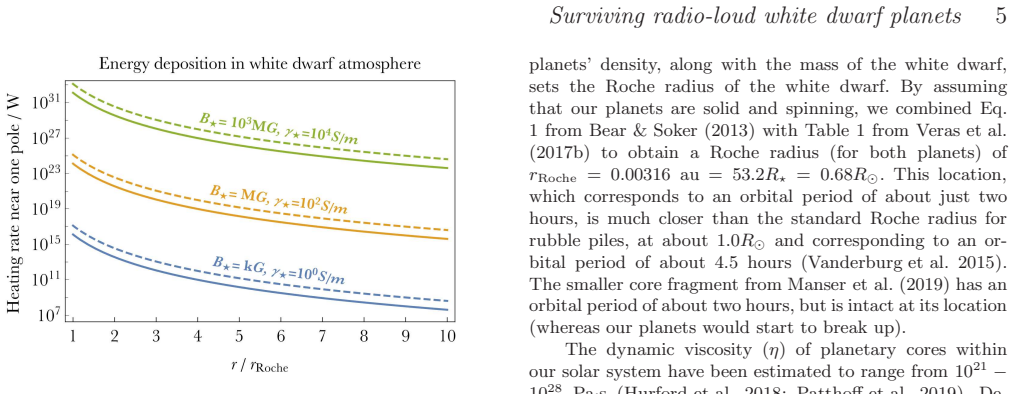
The discovery of the intact metallic planetary core fragment orbiting the white dwarf SDSS J1228+1040 within one Solar radius highlights the possibility of detecting larger, unfragmented conducting cores around magnetic white dwarfs through radio emission. Previous models of this decades-old idea focussed on determining survivability of the cores based on their inward Lorentz drift towards the star. However, gravitational tides may represent an equal or dominant force. Here, we couple both effects by assuming a Maxwell rheological model and performing simulations over the entire range of observable white dwarf magnetic field strengths (10^3 -- 10^9 G) and their potential atmospheric electrical conductivities (10^{-1} -- 10^4 S/m) in order to more accurately constrain survivability lifetimes. This force coupling allows us to better pinpoint the physical and orbital parameters which allow planetary cores to survive for over a Gyr, maximizing the possibility that they can be detected. The most robust survivors showcase high dynamic viscosities (>~ 10^{24} Pa*s) and orbit within kG-level magnetic fields.
Editorial analysis
A structured set of objections, weighed in public.
Referee Report
Summary. The paper claims that coupling tidal and Lorentz forces in a Maxwell viscoelastic model for metallic planetary cores around white dwarfs shows that survival times exceeding 1 Gyr are possible only for dynamic viscosities ≳10^{24} Pa s orbiting in kG-strength magnetic fields, over the simulated ranges of B = 10^3–10^9 G and conductivity = 0.1–10^4 S m^{-1}. This improves prior Lorentz-drift-only models and identifies conditions maximizing prospects for radio detection.
Significance. If the central modeling assumptions hold, the work supplies concrete parameter constraints that could guide targeted radio searches for intact cores around magnetic white dwarfs, building on the SDSS J1228+1040 discovery. The broad sweep over observable B-field and conductivity ranges is a positive feature; the explicit inclusion of both force types addresses a gap in earlier studies.
major comments (2)
- [Model section (paragraph on rheological model choice)] Model section (paragraph on rheological model choice): the Maxwell constitutive law with a single relaxation time τ = η/μ is applied to compute both tidal dissipation and electromagnetic torque across the full conductivity interval, yet no independent validation is supplied that this reproduces the frequency-dependent response of a metallic core or that ohmic heating does not modify the effective viscosity for the quoted η range (where τ exceeds 10^{10} yr and the response is deep in the elastic limit).
- [Results section (headline survivability claim)] Results section (headline survivability claim): the conclusion that only η ≳ 10^{24} Pa s inside kG fields permits >1 Gyr survival is obtained directly from the coupled Maxwell-body simulations; if the single-τ assumption does not hold for metallic cores, the reported parameter thresholds lose their predictive value and require either a different rheology or explicit sensitivity tests.
minor comments (1)
- [Abstract] Abstract: the phrase 'entire range of observable white dwarf magnetic field strengths' should be qualified by noting that 10^9 G is at the extreme upper end of measured fields.
Simulated Author's Rebuttal
We thank the referee for the constructive comments on our manuscript. The points raised concern the choice and validation of the Maxwell rheological model and the robustness of our survivability conclusions. We address each comment below and outline planned revisions to strengthen the presentation of our assumptions and results.
read point-by-point responses
-
Referee: Model section (paragraph on rheological model choice): the Maxwell constitutive law with a single relaxation time τ = η/μ is applied to compute both tidal dissipation and electromagnetic torque across the full conductivity interval, yet no independent validation is supplied that this reproduces the frequency-dependent response of a metallic core or that ohmic heating does not modify the effective viscosity for the quoted η range (where τ exceeds 10^{10} yr and the response is deep in the elastic limit).
Authors: The Maxwell model was selected because it furnishes a single relaxation time that consistently couples tidal dissipation and electromagnetic torque, which is essential for the force-coupling analysis that distinguishes this work from prior Lorentz-drift-only studies. For the viscosities ≳10^{24} Pa s the system lies deep in the elastic regime, consistent with the expected behavior of a solid metallic core on orbital timescales. We acknowledge that the manuscript does not supply independent validation of the frequency-dependent response for metallic cores or an explicit assessment of ohmic-heating feedback on viscosity. We will revise the model section to add a concise justification of the Maxwell choice, reference its prior use in planetary-interior studies, and state the assumption that ohmic heating remains negligible relative to tidal heating within the explored parameter space. This constitutes a partial revision. revision: partial
-
Referee: Results section (headline survivability claim): the conclusion that only η ≳ 10^{24} Pa s inside kG fields permits >1 Gyr survival is obtained directly from the coupled Maxwell-body simulations; if the single-τ assumption does not hold for metallic cores, the reported parameter thresholds lose their predictive value and require either a different rheology or explicit sensitivity tests.
Authors: The reported thresholds are direct outputs of the coupled Maxwell-body simulations over the stated ranges of B and conductivity. To address the concern, we will add explicit sensitivity tests in the results section that vary the relaxation time and compare the elastic and viscous limiting cases. These tests will quantify how the 1 Gyr survival boundary shifts under departures from the single-τ assumption and thereby demonstrate the robustness of the high-viscosity, kG-field regime within the model framework. We maintain that the coupled treatment still improves upon earlier models even if the precise numerical thresholds are model-dependent; the added tests will make this dependence transparent. revision: yes
Circularity Check
No significant circularity; results from forward simulations of assumed model
full rationale
The paper computes survivability lifetimes via numerical simulations that couple tidal and electromagnetic forces inside a Maxwell viscoelastic body over stated ranges of B-field (10^3-10^9 G) and conductivity (0.1-10^4 S/m). The Maxwell model and its relaxation time are adopted as an explicit assumption rather than fitted to or defined by the output lifetimes; no equations reduce the reported >1 Gyr survival thresholds to the input parameters by construction, and no load-bearing self-citations or uniqueness theorems are invoked in the abstract or context. The derivation chain is therefore self-contained against external parameter ranges.
Axiom & Free-Parameter Ledger
axioms (1)
- domain assumption Maxwell rheological model accurately describes tidal and electromagnetic deformation of planetary cores
Reference graph
Works this paper leans on
-
[1]
Adams, F. C., & Bloch, A. M. 2013, ApJL, 777, L30 Alcock, C., Fristrom, C. C., & Siegelman, R. 1986, ApJ, 302, 462 Bear, E., & Soker, N. 2013, New Astronomy, 19, 56 Bergfors, C., Farihi, J., Dufour, P., & Rocchetto, M. 2014, MNRAS, 444, 2147 Bidinosti, C., Chapple, E., & Hayden, M. 2007, Concepts in Magnetic Resonance Part B: Magnetic Resonance En- gineer...
-
[2]
Briggs, G. P., Ferrario, L., Tout, C. A., et al. 2015, MN- RAS, 447, 1713 Briggs, G. P., Ferrario, L., Tout, C. A., et al. 2018, MN- RAS, 478,
work page 2015
-
[3]
Ohmic heating of asteroids around magnetic stars
Bromley, B. C., & Kenyon, S. J. 2019, arXiv:1903.11533, In Press ApJ Brown, J. C., Veras, D., & G¨ ansicke, B. T. 2017, MNRAS, 468, 1575 Caiazzo, I., & Heyl, J. S. 2017, MNRAS, 469, 2750 Cassan, A., Kubas, D., Beaulieu, J.-P., et al. 2012, Nature, 481, 167 Cauley, P. W., Farihi, J., Redfield, S., et al. 2018, ApJ, 852, L22. Cortes J., Kipping D. M., 2018, ...
work page internal anchor Pith review Pith/arXiv arXiv 2019
-
[4]
Debes, J. H., & Sigurdsson, S. 2002, ApJ, 572, 556 Debes, J. H., Walsh, K. J., & Stark, C. 2012, ApJ, 747, 148 Dennihy, E., Clemens, J. C., Dunlap, B. H., Fanale, S. M., Fuchs, J. T., Hermes, J. J. 2018, ApJ, 854, 40 Dufour, P., Vornanen, T., Bergeron, P., et al. 2013, 18th European White Dwarf Workshop.,
work page 2002
-
[5]
Duncan, M. J., & Lissauer, J. J. 1998, Icarus, 134, 303 Dupuis, J., Chayer, P., Vennes, S., et al. 2000, ApJ, 537, 977 Efroimsky, M., & Makarov, V. V. 2013, ApJ, 764, 26 Efroimsky, M. 2015, AJ, 150, 98 Farihi, J., Barstow, M. A., Redfield, S., Dufour, P., & Ham- bly, N. C. 2010, MNRAS, 404, 2123 Farihi, J., Dufour, P., Napiwotzki, R., et al. 2011, MNRAS, 413,
work page 1998
-
[6]
Farihi, J., G¨ ansicke, B. T., Steele, P. R., et al. 2012, MN- RAS, 421, 1635 Farihi, J. 2016, New Astronomy Reviews, 71, 9 Farihi, J., von Hippel, T., & Pringle, J. E. 2017, MNRAS, 471, L145. Farihi, J., van Lieshout, R., Cauley, P. W., et al. 2018a, MNRAS, 481,
work page 2012
-
[7]
Ferrario, L., Wickramasinghe, D. T., Liebert, J., et al. 199 7, MNRAS, 289, 105 Ferrario, L., de Martino, D., & G¨ ansicke, B. T. 2015, Space Science Reviews, 191,
work page 2015
-
[8]
Frewen, S. F. N., & Hansen, B. M. S. 2014, MNRAS, 439, 2442 Fujii, Y., Spiegel, D. S., Mroczkowski, T., et al. 2016, ApJ, 820,
work page 2014
-
[9]
2017, A&A, 604, A112 G¨ ansicke, B
Gallet, F., Bolmont, E., Mathis, S., Charbonnel, C., & Amard, L. 2017, A&A, 604, A112 G¨ ansicke, B. T., Marsh, T. R., Southworth, J., & Rebassa- Mansergas, A. 2006, Science, 314, 1908 G¨ ansicke, B. T., Marsh, T. R., & Southworth, J. 2007, MN- RAS, 380, L35 G¨ ansicke, B. T., Koester, D., Marsh, T. R., Rebassa- Mansergas, A., & Southworth, J. 2008, MNRAS...
work page 2017
-
[10]
Goldreich, P., & Lynden-Bell, D. 1969, ApJ, 156, 59 Graham, J. R., Matthews, K., Neugebauer, G., & Soifer, B. T. 1990, ApJ, 357, 216 Guo, J., Tziamtzis, A., Wang, Z., et al. 2015, ApJ, 810, L17. Hamers A. S., Portegies Zwart S. F., 2016, MNRAS, 462, L84 Harrison, J. H. D., Bonsor, A., & Madhusudhan, N. 2018, MNRAS, 479,
work page 1969
-
[11]
Hermes, J. J., Kawaler, S. D., Romero, A. D., et al. 2017, ApJ, 841, L2. Hess, S. L. G., & Zarka, P. 2011, A&A, 531, A29. Hogg, M. A., Wynn, G. A., & Nixon, C. 2018, MNRAS, 479, 4486 Hollands, M. A., G¨ ansicke, B. T., & Koester, D. 2015, MN- RAS, 450,
work page 2017
-
[12]
A., Koester, D., Alekseev, V., Herbert, E
Hollands, M. A., Koester, D., Alekseev, V., Herbert, E. L., & G¨ ansicke, B. T. 2017, MNRAS, 467, 4970 Hollands, M. A., G¨ ansicke, B. T., & Koester, D. 2018, MN- RAS, 477,
work page 2017
-
[13]
Seismicity on Tidally Active Solid-Surface Worlds
Hurford, T. A., Henning, W. G., Maguire, R., et al. 2018, submitted to Icarus, arXiv:1811.06536. Jura, M. 2003, ApJL, 584, L91 Jura, M. 2008, AJ, 135, 1785 Jura, M., & Young, E. D. 2014, Annual Review of Earth and Planetary Sciences, 42, 45 Katarzy´ nski, K., Gawro´ nski, M., & Go´ zdziewski, K. 2016, MNRAS, 461,
work page internal anchor Pith review Pith/arXiv arXiv 2018
-
[14]
Transiting Planets with LSST IV: Detecting Planets around White Dwarfs
Kawka, A., & Vennes, S. 2014, MNRAS, 439, L90. Kawka A., Vennes S., Ferrario L., Paunzen E., 2019, MN- RAS, 482, 5201 Kenyon S. J., Bromley B. C., 2017, ApJ, 850, 50 Klein, B., Jura, M., Koester, D., Zuckerman, B., & Melis, C. 2010, ApJ, 709, 950 Klein, B., Jura, M., Koester, D., & Zuckerman, B. 2011, ApJ, 741, 64 Koester, D., G¨ ansicke, B. T., & Farihi,...
work page internal anchor Pith review Pith/arXiv arXiv 2014
-
[15]
2012, ApJL, 751, L4 Metzger, B
Melis, C., Dufour, P., Farihi, J., et al. 2012, ApJL, 751, L4 Metzger, B. D., Rafikov, R. R., & Bochkarev, K. V. 2012, MNRAS, 423, 505 Mustill, A. J., & Villaver, E. 2012, ApJ, 761, 121 Mustill, A. J., Veras, D., & Villaver, E. 2014, MNRAS, 437, 1404 Mustill, A. J., Villaver, E., Veras, D., G¨ ansicke, B. T., Bon- sor, A. 2018, MNRAS, 476,
work page 2012
- [16]
-
[17]
Nordhaus, J., & Spiegel, D. S. 2013, MNRAS, 432, 500 O’Gorman E., Coughlan C. P., Vlemmings W., Varenius E., Sirothia S., Ray T. P., Olofsson H., 2018, A&A, 612, A52 Ogilvie, G. I. 2014, ARA&A, 52, 171 Patthoff, D. A., Kattenhorn, S. A., & Cooper, C. M. 2019, Icarus, 321,
work page 2013
-
[18]
Payne, M. J., Veras, D., Holman, M. J., G¨ ansicke, B. T. 2016, MNRAS, 457, 217 Payne, M. J., Veras, D., G¨ ansicke, B. T., & Holman, M. J. 2017, MNRAS, 464, 2557 Perets, H. B. 2011, American Institute of Physics Confer- ence Series, 1331, 56 Petrovich, C., & Mu˜ noz, D. J. 2017, ApJ, 834, 116 Rao S., et al., 2018, A&A, 618, A18 Rappaport, S., Gary, B. L....
work page 2016
-
[19]
Rybicki, K. R., & Denis, C. 2001, Icarus, 151, 130 Sackmann, I.-J., Boothroyd, A. I., & Kraemer, K. E. 1993, ApJ, 418,
work page 2001
-
[20]
Schatzman, E. L. 1958, Amsterdam, North-Holland Pub. Co.; New York, Interscience Publishers, 1958 Schleicher, D. R. G., & Dreizler, S. 2014, A&A, 563, A61 Schr¨ oder, K.-P., & Smith, R. 2008, MNRAS, 386, 155 Smallwood, J. L., Martin, R. G., Livio, M., & Lubow, S. H. 2018, MNRAS, 480, 57 Sre´ ckovi´ c, V. A., Ignjatovi´ c, L. M., Mihajlov, A. A., et al. 20...
work page 1958
-
[21]
E., De Marco, O., Wood, P., Galaviz, P., & Passy, J.-C
Staff, J. E., De Marco, O., Wood, P., Galaviz, P., & Passy, J.-C. 2016, MNRAS, 458, 832 Stephan A. P., Naoz S., Zuckerman B., 2017, ApJ, 844, L16 Stephan A. P., Naoz S., Gaudi B. S., 2018, AJ, 156, 128 Stone, N., Metzger, B. D., & Loeb, A. 2015, MNRAS, 448, 188 Strugarek, A., Bolmont, E., Mathis, S., et al. 2017, ApJ, 847, L16. Strugarek, A. 2018, Handbook...
work page 2016
-
[22]
Swan, A., Farihi, J., & Wilson, T. G. 2019, MNRAS, 484, L109. Tremblay P.-E., Cummings J., Kalirai J. S., G¨ ansicke B. T., Gentile-Fusillo N., Raddi R., 2016, MNRAS, 461, 2100 Valsecchi, F. & Rasio, F. A. 2014, ApJ, 786, 102 van Lieshout, R., Kral, Q., Charnoz, S., et al. 2018, MN- RAS, 480,
work page 2019
-
[23]
Vanderburg, A., Johnson, J. A., Rappaport, S., et al. 2015, Nature, 526, 546 Veras, D., Mustill, A. J., Bonsor, A., & Wyatt, M. C. 2013, MNRAS, 431, 1686 Veras, D., Leinhardt, Z. M., Bonsor, A., G¨ ansicke, B. T. 2014c, MNRAS, 445, 2244 Veras, D., Shannon, A., G¨ ansicke, B. T. 2014a, MNRAS, 445, 4175 Veras, D., Jacobson, S. A., G¨ ansicke, B. T. 2014b, M...
work page 2015
-
[24]
2009, ApJL, 705, L81 Villaver, E., Livio, M., Mustill, A
Villaver, E., & Livio, M. 2009, ApJL, 705, L81 Villaver, E., Livio, M., Mustill, A. J., & Siess, L. 2014, ApJ , 794, 3 V¨ olschow, M., Banerjee, R., & Hessman, F. V. 2014, A&A, 562, A19 Voyatzis, G., Hadjidemetriou, J. D., Veras, D., & Varvoglis, H. 2013, MNRAS, 430, 3383 Wang, X., & Loeb, A. 2019, ApJ, 874, L23. Weber, C., Lammer, H., Shaikhislamov, I. F...
work page 2009
-
[25]
Wickramasinghe, D. T., Farihi, J., Tout, C. A., et al. 2010, MNRAS, 404, 1984 Willes, A. J., & Wu, K. 2004, MNRAS, 348,
work page 2010
- [26]
-
[27]
Wilson, D. J., G¨ ansicke, B. T., Koester, D., et al. 2014, MNRAS, 445, 1878 Wilson, D. J., G¨ ansicke, B. T., Koester, D., et al. 2015, MNRAS, 451, 3237 Wu, K., Cropper, M., Ramsay, G., et al. 2002, MNRAS, 331,
work page 2014
-
[28]
Wyatt, M. C., Farihi, J., Pringle, J. E., & Bonsor, A. 2014, MNRAS, 439, 3371 Wilson, D. J., G¨ ansicke, B. T., Koester, D., et al. 2019, MNRAS, 483, 2941 Xu, S., & Jura, M. 2014, ApJL, 792, L39 Xu, S., Zuckerman, B., Dufour, P., et al. 2017, ApJL, 836, L7 Xu, S., Su, K. Y. L., Rogers, L. K., et al. 2018, ApJ, 866,
work page 2014
-
[29]
Zarka, P., Marques, M. S., Louis, C., et al. 2018, A&A, 618, A84. Zuckerman, B., & Becklin, E. E. 1987, Nature, 330, 138 Zuckerman, B., Koester, D., Reid, I. N., H¨ unsch, M. 2003, ApJ, 596, 477 Zuckerman, B., Koester, D., Melis, C., Hansen, B. M., & Jura, M. 2007, ApJ, 671, 872 Zuckerman, B., Melis, C., Klein, B., Koester, D., & Jura, M. 2010, ApJ, 722, ...
work page 2018
discussion (0)
Sign in with ORCID, Apple, or X to comment. Anyone can read and Pith papers without signing in.