Flexible here-and-now decisions for two-stage multi-objective optimization: Method and application to energy system design selection
Pith reviewed 2026-05-25 19:42 UTC · model grok-4.3
The pith
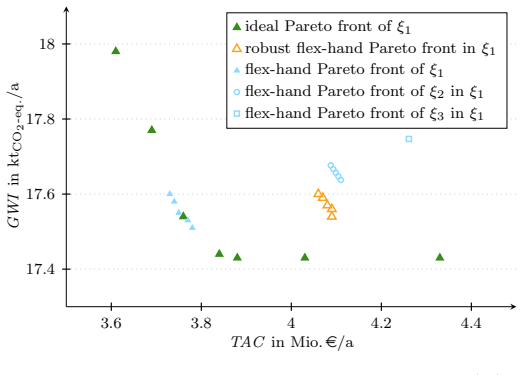
The flex-hand method selects one energy system design by minimizing how far its performance falls short of the ideal multi-design trade-offs.
A machine-rendered reading of the paper's core claim, the machinery that carries it, and where it could break.
Core claim
The flex-hand approach identifies a single here-and-now design by minimizing the distance between the Pareto front achieved with that fixed design and the Pareto front achieved when different designs are allowed for different objective trade-offs.
What carries the argument
The flex-hand optimization problem, which minimizes the distance of the single-design Pareto front to the multi-design Pareto front in the objective space.
If this is right
- The obtained design can adapt its operation to different objective functions by changing how the installed components are used.
- A robust extension of the approach accounts for uncertainty in future operation parameters.
- Application to a real-world energy system case study produces a design that is highly flexible for changing decision criteria such as shifting political priorities.
- The approach automates the selection of one design from the Pareto set without requiring additional preference information from the decision maker.
Where Pith is reading between the lines
- This method could be applied to other two-stage decision problems where upfront commitments must support multiple future goals.
- Comparing the flex-hand design against post-hoc selection methods in additional case studies would test whether the distance metric aligns with practical usefulness.
- Extending the distance measure to account for different norms or weighted objectives might improve robustness to specific decision maker preferences.
Load-bearing premise
Minimizing the distance between the single-design and multi-design Pareto fronts produces a design that remains practically useful and flexible without further adjustments.
What would settle it
An instance where the flex-hand design, once implemented, cannot achieve objective values close to those of the multi-design front for any reasonable operation strategy, or where a manually selected alternative performs substantially better under realized priorities.
Figures




read the original abstract
The synthesis of energy systems is a two-stage optimization problem where design decisions have to be implemented here-and-now (first stage), while for the operation of installed components, we can wait-and-see (second stage). To identify a sustainable design, we need to account for both economical and environmental criteria leading to multi-objective optimization problems. However, multi-objective optimization leads not to one optimal design but to multiple Pareto-efficient design options in general. Thus, the decision maker usually has to decide manually which design should finally be implemented. In this paper, we propose the flexible here-and-now decision (flex-hand) approach for automatic identification of one single design for multi-objective optimization. The approach minimizes the distance of the Pareto front based on one fixed design to the Pareto front allowing multiple designs. Uncertainty regarding parameters of future operations can be easily included through a robust extension of the flex-hand approach. Results of a real-world case study show that the obtained design is highly flexible to adapt operation to the considered objective functions. Thus, the design provides an energy system with the ability to adapt to a changing focus in decision criteria, e. g., due to changing political aims.
Editorial analysis
A structured set of objections, weighed in public.
Referee Report
Summary. The manuscript proposes the 'flex-hand' method for selecting a single here-and-now design in two-stage multi-objective optimization problems, particularly for energy system synthesis. The method minimizes the distance between the Pareto front achievable with one fixed design and the ideal Pareto front obtained by allowing multiple designs. It includes a robust extension for parameter uncertainty and is demonstrated on a real-world energy system case study, claiming the selected design is highly flexible for adapting to different objective weightings such as economic versus environmental criteria.
Significance. If validated, the approach could simplify decision-making in multi-objective energy system design by automating the selection of a flexible design, reducing reliance on manual Pareto front analysis. The robust extension for uncertainty is a positive feature. However, the significance is limited by the lack of rigorous validation that geometric proximity in objective space translates to operational flexibility in practice.
major comments (2)
- [Case study results] The central claim that distance minimization between the single-design and multi-design Pareto fronts automatically yields a practically flexible design (able to adapt second-stage operations across objectives without additional preference information) is load-bearing but rests on an unexamined assumption; the case study provides no quantitative evidence, such as performance degradation metrics under objective re-weighting, to confirm this.
- [Method description] The distance metric between Pareto fronts, the procedure for computing the multi-design front, and any error analysis or sensitivity checks are not specified, preventing assessment of whether the reported flexibility is robust or an artifact of the chosen formulation.
minor comments (1)
- The abstract would be strengthened by including a one-sentence statement of the mathematical objective (e.g., the precise distance measure) rather than remaining at a high-level description.
Simulated Author's Rebuttal
We thank the referee for the constructive comments. We address each major comment below, providing clarifications and indicating where revisions will strengthen the manuscript.
read point-by-point responses
-
Referee: [Case study results] The central claim that distance minimization between the single-design and multi-design Pareto fronts automatically yields a practically flexible design (able to adapt second-stage operations across objectives without additional preference information) is load-bearing but rests on an unexamined assumption; the case study provides no quantitative evidence, such as performance degradation metrics under objective re-weighting, to confirm this.
Authors: The case study shows that the selected design produces a Pareto front closely aligned with the multi-design front across the considered weightings, which supports the claim of flexibility in adapting second-stage operations. We acknowledge that explicit quantitative metrics, such as degradation in objective values when re-weighting, would provide stronger validation. In the revision we will add these metrics, computed by evaluating the fixed design under the same set of weight vectors used for the multi-design front and reporting the relative gaps. revision: yes
-
Referee: [Method description] The distance metric between Pareto fronts, the procedure for computing the multi-design front, and any error analysis or sensitivity checks are not specified, preventing assessment of whether the reported flexibility is robust or an artifact of the chosen formulation.
Authors: The manuscript defines the flex-hand objective as minimization of the distance between the two fronts but does not detail the metric or computational procedure in the provided sections. We will revise the method section to specify the distance as the maximum Euclidean distance after normalization of each objective to [0,1], describe the multi-design front as the union of solutions obtained by solving the two-stage problem for each weighting vector with design variables free per weighting, and include a brief sensitivity study on the number of weight vectors and on small perturbations of the uncertainty set. revision: yes
Circularity Check
No significant circularity; method is externally defined optimization
full rationale
The flex-hand method is introduced as a new formulation that minimizes distance between a single-design Pareto front and a multi-design Pareto front. This is a direct optimization definition applied to externally computed fronts from the energy system model, with no reduction of outputs to fitted inputs, self-definitional equations, or load-bearing self-citations. The case study applies the approach to real-world data without the result being forced by construction from its own assumptions. No steps match the enumerated circularity patterns.
Axiom & Free-Parameter Ledger
Reference graph
Works this paper leans on
-
[1]
Abubaker, A., Baharum, A., and Alrefaei, M. (2014). Good solution for multi-objective optimization problem. AIP Conf. Proc. , 1605(1):1147--1152
work page 2014
-
[2]
Aissi, H., Bazgan, C., and Vanderpooten, D. (2009). Min--max and min--max regret versions of combinatorial optimization problems: A survey. Eur. J. Oper. Res. , 197(2):427--438
work page 2009
-
[3]
Antipova, E., Pozo, C., Guill\' e n-Gos\' a lbez, G., Boer, D., Cabeza, L., and Jim\' e nez, L. (2015). On the use of filters to facilitate the post-optimal analysis of the P areto solutions in multi-objective optimization. Comput. Chem. Eng. , 74:48--58
work page 2015
-
[4]
Baumann, H. and Tillman, A.-M. (2004). T he H itch H iker's G uide to LCA . Studentlitteratur AB
work page 2004
-
[5]
Ben-Tal, A., Goryashko, A., Guslitzer, E., and Nemirovski, A. (2004). Adjustable robust solutions of uncertain linear programs. Math Program , 99(2):351--376
work page 2004
-
[6]
M., Lopez-Ibanez, M., Paquete, L., and Vahrenhold, J
Beume, N., Fonseca, C. M., Lopez-Ibanez, M., Paquete, L., and Vahrenhold, J. (2009). On the complexity of computing the hypervolume indicator. IEEE T. Evolut. Comput. , 13(5):1075--1082
work page 2009
-
[7]
Branke, J., Deb, K., Dierolf, H., and Osswald, M. (2004). Finding knees in multi-objective optimization. In Yao, X., Burke, E. K., Lozano, J. A., Smith, J., Merelo-Guerv \'o s, J. J., Bullinaria, J. A., Rowe, J. E., Ti n o, P., Kab \'a n, A., and Schwefel, H.-P., editors, Parallel Problem Solving from Nature - PPSN VIII , pages 722--731, Berlin, Heidelber...
work page 2004
-
[8]
Broverman, S. A. (2010). Mathematics of Investment and Credit . ACTEX Publications, Inc., 5th edition
work page 2010
-
[9]
Carvalho, M., Lozano, M. A., and Serra, L. M. (2012). Multicriteria synthesis of trigeneration systems considering economic and environmental aspects. Appl. Energy , 91(1):245--254
work page 2012
-
[10]
Chen, S.-J. and Hwang, C.-L. (1992). Fuzzy Multiple Attribute Decision Making Methods , pages 289--486. Springer Berlin Heidelberg, Berlin, Heidelberg
work page 1992
-
[11]
Das, I. (1999). A preference ordering among various P areto optimal alternatives. Struct. Optimization , 18(1):30--35
work page 1999
-
[12]
Das, I. and Dennis, J. E. (1998). Normal-boundary intersection: A new method for generating the P areto surface in nonlinear multicriteria optimization problems. Siam. J. Optim. , 8(3):631--657
work page 1998
-
[13]
de la Fuente, D., Vega-Rodríguez, M. A., and Pérez, C. J. (2018). Automatic selection of a single solution from the P areto front to identify key players in social networks. Knowl.-Based Syst. , 160:228--236
work page 2018
-
[14]
Duckstein, L. and Opricovic, S. (1980). Multiobjective optimization in river basin development. Water. Resour. Res. , 16(1):14--20
work page 1980
-
[15]
Ehrgott, M. (2005). Multicriteria Optimization . Springer Berlin Heidelberg, 2 edition
work page 2005
-
[16]
Gabrielli, P., Fürer, F., Mavromatidis, G., and Mazzotti, M. (2019). Robust and optimal design of multi-energy systems with seasonal storage through uncertainty analysis. Appl. Energy , 238:1192--1210
work page 2019
-
[17]
Guill\' e n-Gos\' a lbez, G. (2011). A novel MILP -based objective reduction method for multi-objective optimization: Application to environmental problems. Comput. Chem. Eng. , 35(8):1469--1477
work page 2011
-
[18]
Guo, L., Liu, W., Cai, J., Hong, B., and Wang, C. (2013). A two-stage optimal planning and design method for combined cooling, heat and power microgrid system. Energy Conversion and Management , 74:433--445
work page 2013
-
[19]
Hennen, M., Postels, S., Voll, P., Lampe, M., and Bardow, A. (2017). Multi-objective synthesis of energy systems: Efficient identification of design trade-offs. Comput. Chem. Eng. , 97:283--293
work page 2017
-
[20]
Hwang, C.-L. and Yoon, K. (1981). Methods for Multiple Attribute Decision Making , pages 58--191. Springer Berlin Heidelberg, Berlin, Heidelberg
work page 1981
-
[21]
IBM ILOG CPLEX Optimization Studio, Version 12.6
IBM Corporation (2015). IBM ILOG CPLEX Optimization Studio, Version 12.6 . User Guide
work page 2015
-
[22]
Ide, J. and Sch \"o bel, A. (2016). Robustness for uncertain multi-objective optimization: a survey and analysis of different concepts. OR Spectrum , 38(1):235--271
work page 2016
-
[23]
Jing, R., Wang, M., Zhang, Z., Liu, J., Liang, H., Meng, C., Shah, N., Li, N., and Zhao, Y. (2019). Comparative study of posteriori decision-making methods when designing building integrated energy systems with multi-objectives. Energy and Buildings , 194:123 -- 139
work page 2019
-
[24]
Lemos, L. P., Lima, E. L., and Pinto, J. C. (2018). New decision making criterion for multiobjective optimization problems. Ind. Eng. Chem. Res. , 57(3):1014--1025
work page 2018
-
[25]
Li, Z., Liao, H., and Coit, D. W. (2009). A two-stage approach for multi-objective decision making with applications to system reliability optimization. Reliab. Eng. Syst. Safe. , 94(10):1585--1592
work page 2009
-
[26]
E., Wirtz, M., Lampe, M., and Bardow, A
Majewski, D. E., Wirtz, M., Lampe, M., and Bardow, A. (2017). Robust multi-objective optimization for sustainable design of distributed energy supply systems. Comput. Chem. Eng. , 102:26--39
work page 2017
-
[27]
Mattson, C. A. and Messac, A. (2003). Concept selection using s- P areto frontiers. AIAA J. , 41(6)
work page 2003
-
[28]
McCarl, B. A. and Rosenthal, R. E. (2016). McCarl GAMS User Guide, Version 24.7
work page 2016
-
[29]
I., Carvalho, A., and Barbosa-Povoa, A
Mota, B., Gomes, M. I., Carvalho, A., and Barbosa-Povoa, A. P. (2015). Towards supply chain sustainability: economic, environmental and social design and planning. J. Clean. Prod. , 105:14--27
work page 2015
-
[30]
Opricovic, S. and Tzeng, G.-H. (2004). Compromise solution by MCDM methods: A comparative analysis of VIKOR and TOPSIS . Eur. J. Oper. Res. , 156(2):445 -- 455
work page 2004
-
[31]
Padhye, N. and Deb, K. (2011). Multi-objective Optimisation and Multi-criteria Decision Making for FDM Using Evolutionary Approaches , pages 219--247. Springer London, London
work page 2011
-
[32]
Pérez, C. J., Vega-Rodríguez, M. A., Reder, K., and Flörke, M. (2017). A multi-objective artificial bee colony-based optimization approach to design water quality monitoring networks in river basins. J. Clean. Prod. , 166:579--589
work page 2017
-
[33]
Quintana, D., Denysiuk, R., Garcia-Rodriguez, S., and Gaspar-Cunha, A. (2017). Portfolio implementation risk management using evolutionary multiobjective optimization. Appl. Sci. , 7(10):1079
work page 2017
-
[34]
Rachmawati, L. and Srinivasan, D. (2009). Multiobjective evolutionary algorithm with controllable focus on the knees of the P areto front. IEEE T. Evolut. Comput. , 13(4):810--824
work page 2009
-
[35]
Shang, Z. and Kokossis, A. (2005). A systematic approach to the synthesis and design of flexible site utility systems. Chem. Eng. Sci. , 60(16):4431--4451
work page 2005
-
[36]
Srinivasan, V. and Shocker, A. D. (1973). Linear programming techniques for multidimensional analysis of preferences. Psychometrika , 38(3):337--369
work page 1973
-
[37]
Sun, G., Zhang, H., Fang, J., Li, G., and Li, Q. (2018). A new multi-objective discrete robust optimization algorithm for engineering design. Appl. Math. Model. , 53:602--621
work page 2018
-
[38]
Taboada, H. A., Baheranwala, F., Coit, D. W., and Wattanapongsakorn, N. (2007). Practical solutions for multi-objective optimization: An application to system reliability design problems. Reliab. Eng. Syst. Safe. , 92(3):314 -- 322
work page 2007
-
[39]
Tock, L. and Mar \' e chal, F. (2015). Decision support for ranking P areto optimal process designs under uncertain market conditions. Comput. Chem. Eng. , 83:165--175
work page 2015
-
[40]
Voll, P., Klaffke, C., Hennen, M., and Bardow, A. (2013). Automated superstructure-based synthesis and optimization of distributed energy supply systems. Energy , 50:374--388
work page 2013
-
[41]
Wang, Y., Wang, Y., Huang, Y., Li, F., Zeng, M., Li, J., Wang, X., and Zhang, F. (2019). Planning and operation method of the regional integrated energy system considering economy and environment. Energy , 171:731--750
work page 2019
-
[42]
Zelany, M. (1974). A concept of compromise solutions and the method of the displaced ideal. Comput. Oper. Res. , 1(3-4):479--496
work page 1974
-
[43]
Zio, E. and Bazzo, R. (2011). A clustering procedure for reducing the number of representative solutions in the P areto front of multiobjective optimization problems. Eur. J. Oper. Res. , 210(3):624--634
work page 2011
-
[44]
Zitzler, E., Thiele, L., Laumanns, M., Fonseca, C. M., and da Fonseca, V. G. (2003). Performance assessment of multiobjective optimizers: an analysis and review. IEEE T. Evolut. Comput. , 7(2):117--132
work page 2003
discussion (0)
Sign in with ORCID, Apple, or X to comment. Anyone can read and Pith papers without signing in.