Topology Inference over Networks with Nonlinear Coupling
Pith reviewed 2026-05-25 18:34 UTC · model grok-4.3
The pith
Sufficient conditions enable consistent recovery of the underlying digraph from state observations in logistic-type dynamical systems.
A machine-rendered reading of the paper's core claim, the machinery that carries it, and where it could break.
Core claim
We establish sufficient conditions that allow consistent graph learning over a special class of networked systems, namely, logistic-type dynamical systems.
What carries the argument
Logistic-type dynamical systems, the special nonlinear stochastic form whose state-evolution law admits consistent digraph recovery from observations.
If this is right
- The digraph can be recovered reliably whenever the system belongs to the logistic class and the conditions hold.
- Only state-evolution trajectories are required; no direct edge measurements are needed.
- The recovery remains consistent even though the coupling is nonlinear.
- The guarantees are specific to the logistic functional form and its stochastic properties.
Where Pith is reading between the lines
- Similar consistency arguments might be developed for other nonlinear families that share the same stochastic structure.
- The conditions could guide experimental design when collecting data from biological or social networks suspected to follow logistic-like rules.
- Violation of the logistic assumption would require entirely different recovery techniques.
Load-bearing premise
The true system dynamics must match the logistic-type nonlinear form and stochastic properties for the consistency guarantees to apply.
What would settle it
A simulation or real dataset drawn from logistic-type dynamics that satisfies the stated conditions yet yields inconsistent graph estimates.
Figures

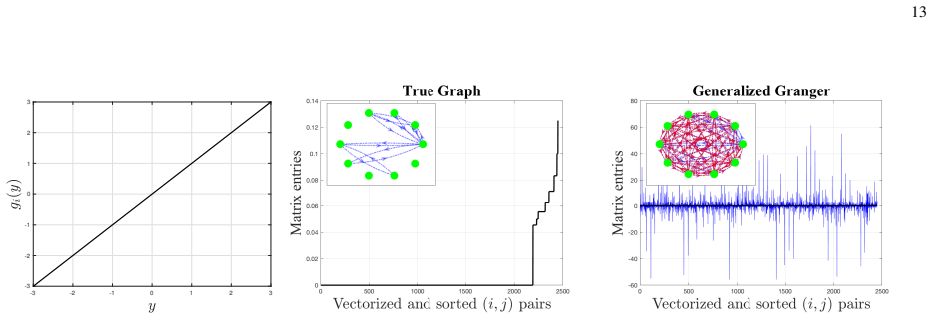
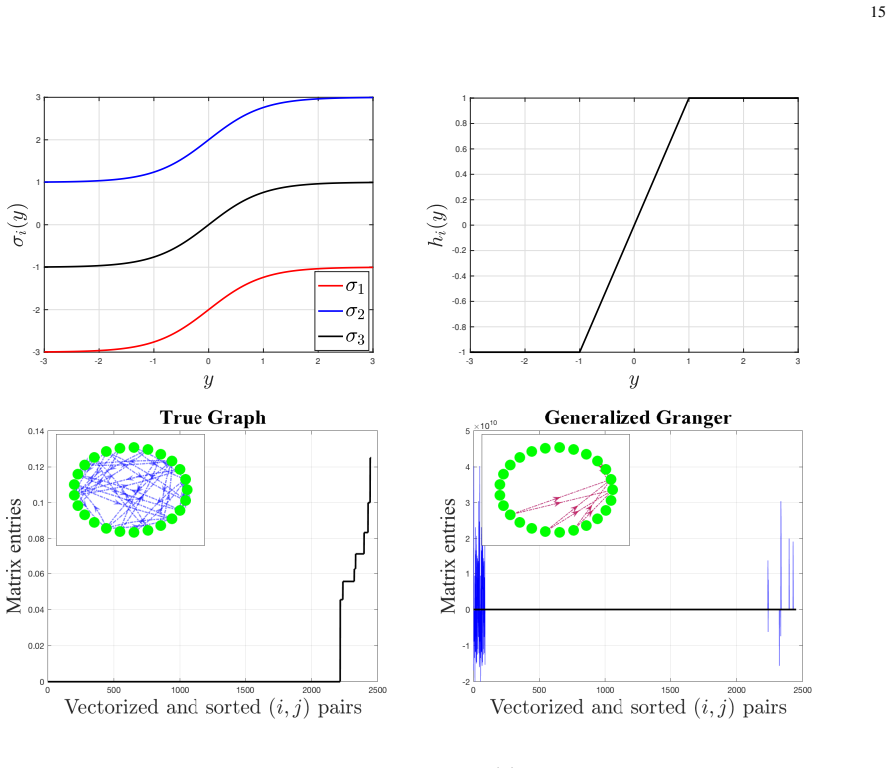
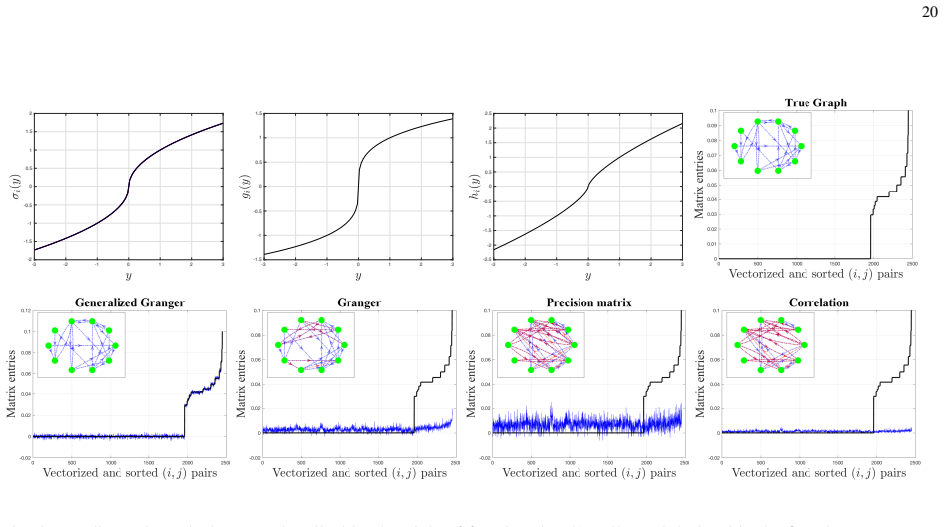
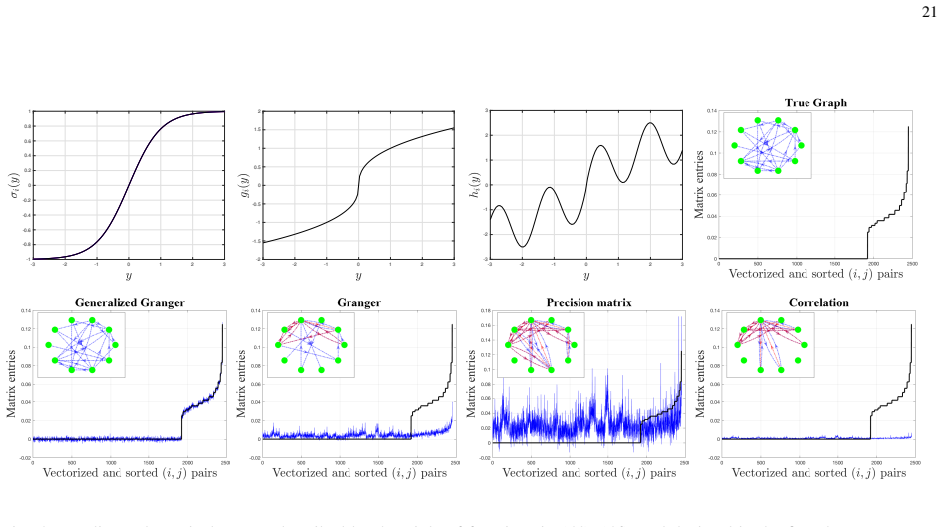
read the original abstract
This work examines the problem of topology inference over discrete-time nonlinear stochastic networked dynamical systems. The goal is to recover the underlying digraph linking the network agents, from observations of their state-evolution. The dynamical law governing the state-evolution of the interacting agents might be nonlinear, i.e., the next state of an agent can depend nonlinearly on its current state and on the states of its immediate neighbors. We establish sufficient conditions that allow consistent graph learning over a special class of networked systems, namely, logistic-type dynamical systems.
Editorial analysis
A structured set of objections, weighed in public.
Referee Report
Summary. The manuscript examines topology inference for discrete-time nonlinear stochastic networked dynamical systems, with the goal of recovering the underlying digraph from observations of agent state evolution. The dynamics may be nonlinear, with each agent's next state depending on its current state and those of its neighbors. The central contribution is the derivation of sufficient conditions guaranteeing consistent graph learning when the system belongs to the logistic-type dynamical class.
Significance. If the sufficient conditions are correctly established and the consistency proof holds, the result supplies a rigorous theoretical basis for graph recovery in a well-defined subclass of nonlinear networked systems. This is a targeted but useful advance for applications (e.g., population dynamics or certain biochemical networks) that naturally fit the logistic form, and the explicit scoping to this class avoids overclaiming generality.
minor comments (3)
- The abstract states the restriction to logistic-type systems but does not preview the form of the sufficient conditions; a one-sentence indication of the key assumptions (e.g., on the nonlinearity or noise) would improve readability.
- Notation for the digraph and the logistic map should be introduced once in §2 and used consistently thereafter; occasional redefinition of symbols across sections creates minor confusion.
- The manuscript would benefit from a short discussion (perhaps in the conclusion) of how sensitive the consistency result is to small deviations from the exact logistic form, even if only heuristically.
Simulated Author's Rebuttal
We thank the referee for their careful reading and positive assessment of the manuscript. The recommendation of minor revision is noted. No specific major comments were listed in the report, so we provide a general response below and stand ready to incorporate any additional points that may arise.
Circularity Check
No significant circularity
full rationale
The paper claims to establish sufficient conditions for consistent topology recovery specifically for logistic-type dynamical systems from state observations. No load-bearing step reduces by construction to a fitted parameter, self-citation chain, or renamed input; the result is scoped to an externally defined class of nonlinear stochastic systems whose properties enable the consistency argument. The derivation chain is therefore self-contained against external benchmarks.
Axiom & Free-Parameter Ledger
Reference graph
Works this paper leans on
- [1]
-
[2]
Social learning over weakly connected graphs,
H. Salami, B. Ying, and A. H. Sayed, “Social learning over weakly connected graphs,” IEEE Trans. Signal Inf. Process. Netw., vol. 3, no. 2, pp. 222–238, Jun. 2017
work page 2017
-
[3]
Predicting human resting-state functional connectivity from structural connectivity,
C. J. Honey, O. Sporns, L. Cammoun, X. Gigandet, J. P. Thiran, R. Meuli, and P. Hagmann, “Predicting human resting-state functional connectivity from structural connectivity,” Proceedings of the National Academy of Sciences , vol. 106, no. 6, pp. 2035–2040, Feb. 2009
work page 2035
-
[4]
Inferring dynamic topology for decoding spatiotemporal structures in complex heterogeneous networks,
S. Wang, E. D. Herzog, I. Z. Kiss, W. J. Schwartz, G. Bloch, M. Sebek, D. Granados-Fuentes, L. Wang, and J.-S. Li, “Inferring dynamic topology for decoding spatiotemporal structures in complex heterogeneous networks,” Proceedings of the National Academy of Sciences , vol. 115, no. 37, pp. 9300–9305, Sep. 2018
work page 2018
-
[5]
Reconstructing the structure of directed and weighted networks of nonlinear oscillators,
F. Alderisio, G. Fiore, and M. di Bernardo, “Reconstructing the structure of directed and weighted networks of nonlinear oscillators,” Phys. Rev. E, vol. 95, no. 4, pp. 042302-1–042302-6, Apr. 2017
work page 2017
-
[6]
Some discrete-time SI, SIR, and SIS epidemic models,
L. J. S. Allen, “Some discrete-time SI, SIR, and SIS epidemic models,” Mathematical Biosciences , vol. 124, no. 1, pp. 83–105, Nov. 1994
work page 1994
-
[7]
M. J. Keeling and K. T. D. Eames, “Networks and epidemic models,” Journal of the Royal Society Interface , vol. 2, pp. 295–307, Jun. 2005
work page 2005
-
[8]
Inferring epidemic network topology from surveillance data,
X. Wan, J. Liu, K.-W. Cheung, and T. Tong, “Inferring epidemic network topology from surveillance data,” PloS one , vol. 9, no. 6, pp. e100661-1–e100661-9, Jun. 2014
work page 2014
-
[9]
Sufficient condition for survival of the fittest in a bi-virus epidemics,
A. Santos, J. M. F. Moura, and J. M. F. Xavier, “Sufficient condition for survival of the fittest in a bi-virus epidemics,” in Proc. Asilomar Conference on Signals, Systems, and Computers , Pacific Grove, CA, USA, Nov. 2015, pp. 1323–1327
work page 2015
-
[10]
Bi-virus SIS epidemics over networks: Qualitative analysis,
A. Santos, J. M. F. Moura, and J. Xavier, “Bi-virus SIS epidemics over networks: Qualitative analysis,” IEEE Trans. Netw. Sci. Eng., vol. 2, no. 1, pp. 17–29, Jan. 2015
work page 2015
-
[11]
Non-linear incidence and stability of infectious disease models,
A. Korobeinikov and P. K. Maini, “Non-linear incidence and stability of infectious disease models,” Mathematical Medicine and Biology, vol. 22, no. 2, pp. 113–128, Jun. 2005
work page 2005
-
[12]
Global properties of infectious disease models with nonlinear incidence,
A. Korobeinikov, “Global properties of infectious disease models with nonlinear incidence,” Bulletin of Mathematical Biology, vol. 69, no. 6, pp. 1871–1886, Aug. 2007
work page 2007
-
[13]
P. Van Mieghem, J. Omic, and R. Kooij, “Virus spread in networks,” IEEE/ACM Trans. Netw., vol. 17, no. 1, pp. 1–14, Feb. 2009
work page 2009
-
[14]
Differential equation approximations for Markov chains,
J. R. Norris and R. W. R. Darling, “Differential equation approximations for Markov chains,” Probability Surveys, vol. 5, pp. 37–79, 2008
work page 2008
-
[15]
Stochastic networks with multiple stable points,
N. Antunes, C. Fricker, P. Robert, and D. Tibbi, “Stochastic networks with multiple stable points,” The Annals of Applied Probability, vol. 36, no. 1, pp. 255–278, Jan. 2008. June 24, 2019 DRAFT 34
work page 2008
-
[16]
Emergent behavior in large scale networks,
A. Santos and J. M. F. Moura, “Emergent behavior in large scale networks,” in Proc. IEEE Conference on Decision and Control and European Control Conference (CDC-ECC) , Orlando, FL, USA, Dec. 2011, pp. 4485–4490
work page 2011
-
[17]
Diffusion and topology: Large densely connected bipartite networks,
A. Santos, J. M. F. Moura, and J. Xavier, “Diffusion and topology: Large densely connected bipartite networks,” in Proc. IEEE Conference on Decision and Control (CDC) , Maui, HI, USA, Dec. 2012, pp. 2738–2743
work page 2012
-
[18]
Connecting the dots: Identifying network structure via graph signal processing,
G. Mateos, S. Segarra, A. Marques, and A. Ribeiro, “Connecting the dots: Identifying network structure via graph signal processing,” IEEE Signal Process. Mag. , vol. 36, no. 3, pp. 16–43, May 2019
work page 2019
-
[19]
Adaptation, Learning, and Optimization over Networks,
A. H. Sayed, “Adaptation, Learning, and Optimization over Networks,” Found. Trends Mach. Learn. , vol. 7, no. 4-5, pp. 311–801, 2014
work page 2014
-
[20]
Estimation and detection over adaptive networks,
V . Matta and A. H. Sayed, “Estimation and detection over adaptive networks,” in Cooperative and Graph Signal Processing, P. Djuric and C. Richard, Eds. Elsevier, 2018, pp. 69–106
work page 2018
-
[21]
V . Matta, P. Braca, S. Marano, and A. H. Sayed, “Diffusion-based adaptive distributed detection: Steady-state performance in the slow adaptation regime,” IEEE Trans. Inf. Theory , vol. 62, no. 8, pp. 4710–4732, Aug. 2016
work page 2016
-
[22]
Distributed detection over adaptive networks: Refined asymptotics and the role of connectivity,
V . Matta, P. Braca, S. Marano, and A. H. Sayed, “Distributed detection over adaptive networks: Refined asymptotics and the role of connectivity,” IEEE Trans. Signal Inf. Process. Netw. , vol. 2, no. 4, pp. 442–460, Dec. 2016
work page 2016
-
[23]
S. Kar and J. M. F. Moura, “Convergence rate analysis of distributed gossip (linear parameter) estimation: Fundamental limits and tradeoffs,” IEEE J. Sel. Topics Signal Process. , vol. 5, no. 4, pp. 674–690, Aug. 2011
work page 2011
-
[24]
Characterization and inference of graph diffusion processes from observations of stationary signals,
B. Pasdeloup, V . Gripon, G. Mercier, D. Pastor, and M. G. Rabbat, “Characterization and inference of graph diffusion processes from observations of stationary signals,” IEEE Trans. Signal Inf. Process. Netw., vol. 4, no. 3, pp. 481–496, Sep. 2018
work page 2018
-
[25]
Signal processing on graphs: Causal modeling of unstructured data,
J. Mei and J. M. F. Moura, “Signal processing on graphs: Causal modeling of unstructured data,” IEEE Trans. Signal Process., vol. 65, no. 8, pp. 2077–2092, Apr. 2017
work page 2077
-
[26]
On the problem of reconstructing an unknown topology via locality properties of the Wiener filter,
D. Materassi and M. V . Salapaka, “On the problem of reconstructing an unknown topology via locality properties of the Wiener filter,” IEEE Trans. Autom. Control , vol. 57, no. 7, pp. 1765–1777, Jul. 2012
work page 2012
-
[27]
C. J. Quinn, N. Kiyavash, and T. P. Coleman, “Directed information graphs,” IEEE Trans. Inf. Theory, vol. 61, no. 12, pp. 6887–6909, Dec. 2015
work page 2015
-
[28]
High-dimensional structure estimation in Ising models: Local separation criterion,
A. Anandkumar, V . Y . F. Tan, F. Huang, and A. S. Willsky, “High-dimensional structure estimation in Ising models: Local separation criterion,” The Annals of Statistics , vol. 40, no. 3, pp. 1346–1375, Jun. 2012
work page 2012
-
[29]
A. Anandkumar, V . Y . F. Tan, F. Huang, and A. S. Willsky, “High-dimensional Gaussian graphical model selection: Walk summability and local separation criterion,” Journal of Machine Learning Research , vol. 13, pp. 2293–2337, Jan. 2012
work page 2012
-
[30]
Efficiently learning Ising models on arbitrary graphs,
G. Bresler, “Efficiently learning Ising models on arbitrary graphs,” in Proc. ACM Symposium on Theory of Computing (STOC), Portland, OR, USA, Jun. 2015, pp. 771–782
work page 2015
-
[31]
Learning loopy graphical models with latent variables: Efficient methods and guarantees,
A. Anandkumar and R. Valluvan, “Learning loopy graphical models with latent variables: Efficient methods and guarantees,” The Annals of Statistics , vol. 41, no. 2, pp. 401–435, Apr. 2013
work page 2013
-
[32]
Latent variable graphical model selection via convex optimization,
V . Chandrasekaran, P. A. Parrilo, and A. S. Willsky, “Latent variable graphical model selection via convex optimization,” The Annals of Statistics , vol. 40, no. 4, pp. 1935–1967, Aug. 2012
work page 1935
-
[33]
Learning restricted Boltzmann machines via influence maximization,
G. Bresler, F. Koehler, A. Moitra, and E. Mossel, “Learning restricted Boltzmann machines via influence maximization,” in Proc. ACM Symposium on Theory of Computing (STOC) , Phoenix, AZ, USA, Jun. 2019
work page 2019
-
[34]
Network reconstruction of dynamical polytrees with unobserved nodes,
D. Materassi and M. V . Salapaka, “Network reconstruction of dynamical polytrees with unobserved nodes,” in Proc. IEEE Conference on Decision and Control (CDC) , Maui, HI, USA, Dec. 2012, pp. 4629–4634
work page 2012
-
[35]
Learning minimal latent directed information polytrees,
J. Etesami, N. Kiyavash, and T. Coleman, “Learning minimal latent directed information polytrees,” Neural Computation, vol. 28, no. 9, pp. 1723–1768, Aug. 2016. June 24, 2019 DRAFT 35
work page 2016
-
[36]
Causal inference by identification of vector autoregressive processes with hidden components,
P. Geiger, K. Zhang, B. Sch ¨olkopf, M. Gong, and D. Janzing, “Causal inference by identification of vector autoregressive processes with hidden components,” in Proc. International Conference on Machine Learning (ICML), vol. 37, Lille, France, Jul. 2015, pp. 1917–1925
work page 2015
-
[37]
Identification of network components in presence of unobserved nodes,
D. Materassi and M. V . Salapaka, “Identification of network components in presence of unobserved nodes,” in Proc. IEEE Conference on Decision and Control (CDC) , Osaka, Japan, Dec. 2015, pp. 1563–1568
work page 2015
-
[38]
Tomography of adaptive multi-agent networks under limited observation,
V . Matta and A. H. Sayed, “Tomography of adaptive multi-agent networks under limited observation,” in Proc. IEEE International Conference on Acoustics, Speech and Signal Processing (ICASSP) , Calgary, Canada, Apr. 2018, pp. 6638– 6642
work page 2018
-
[39]
Consistent tomography under partial observations over adaptive networks,
V . Matta and A. H. Sayed, “Consistent tomography under partial observations over adaptive networks,” IEEE Trans. Inf. Theory, vol. 65, no. 1, pp. 622–646, Jan. 2019
work page 2019
-
[40]
Divide-and-conquer tomography for large-scale networks,
A. Santos, V . Matta, and A. H. Sayed, “Divide-and-conquer tomography for large-scale networks,” in Proc. IEEE Data Science Workshop (DSW), Lausanne, Switzerland, Jun. 2018, pp. 170–174
work page 2018
-
[41]
Consistent tomography over diffusion networks under the low-observability regime,
A. Santos, V . Matta, and A. H. Sayed, “Consistent tomography over diffusion networks under the low-observability regime,” in Proc. IEEE International Symposium on Information Theory (ISIT) , Vail, CO, USA, Jun. 2018, pp. 1839–1843
work page 2018
-
[42]
Tomography of large adaptive networks under the dense latent regime,
V . Matta, A. Santos, and A. H. Sayed, “Tomography of large adaptive networks under the dense latent regime,” in Proc. Asilomar Conference on Signals, Systems, and Computers , Pacific Grove, CA, USA, Oct. 2018, pp. 2144–2148
work page 2018
-
[43]
Graph learning with partial observations: Role of degree concentration,
V . Matta, A. Santos, and A. H. Sayed, “Graph learning with partial observations: Role of degree concentration,” in Proc. IEEE International Symposium on Information Theory (ISIT) , Paris, France, Jul. 2019, pp. 1–5
work page 2019
-
[44]
Reconstructing links in directed networks from noisy dynamics,
E. S. C. Ching and H. C. Tam, “Reconstructing links in directed networks from noisy dynamics,” Physical Review E , vol. 95, no. 1, pp. 010301-1–010301-5, Jan. 2017
work page 2017
-
[45]
Linear identification of nonlinear systems: A lifting technique based on the Koopman operator,
A. Mauroy and J. Goncalves, “Linear identification of nonlinear systems: A lifting technique based on the Koopman operator,” in Proc. IEEE Conference on Decision and Control (CDC) , Las Vegas, NV , USA, Dec. 2016, pp. 6500–6505
work page 2016
-
[46]
Revealing physical interaction networks from statistics of collective dynamics,
M. Nitzan, J. Casadiego, and M. Timme, “Revealing physical interaction networks from statistics of collective dynamics,” Science Advances, vol. 3, no. 2, 2017
work page 2017
-
[47]
Kernel-based structural equation models for topology identification of directed networks,
Y . Shen, B. Baingana, and G. B. Giannakis, “Kernel-based structural equation models for topology identification of directed networks,” IEEE Trans. Signal Process. , vol. 65, no. 10, pp. 2503–2516, May 2017
work page 2017
-
[48]
Topology identification and learning over graphs: Accounting for nonlinearities and dynamics,
G. B. Giannakis, Y . Shen, and G. V . Karanikolas, “Topology identification and learning over graphs: Accounting for nonlinearities and dynamics,” Proceedings of the IEEE , vol. 106, no. 5, pp. 787–807, May 2018
work page 2018
-
[49]
Measuring causal relationships in dynamical systems through recovery of functional dependencies,
J. Etesami and N. Kiyavash, “Measuring causal relationships in dynamical systems through recovery of functional dependencies,” IEEE Trans. Signal Inf. Process. Netw. , vol. 3, no. 4, pp. 650–659, Dec. 2017
work page 2017
-
[50]
Inference of topology and the nature of synapses, and the flow of information in neuronal networks,
F. S. Borges, E. L. Lameu, K. C. Iarosz, P. R. Protachevicz, I. L. Caldas, R. L. Viana, E. E. N. Macau, A. M. Batista, and M. S. Baptista, “Inference of topology and the nature of synapses, and the flow of information in neuronal networks,” Phys. Rev. E, vol. 97, no. 2, pp. 022303-1–022303-7, Feb. 2018
work page 2018
-
[51]
Inference of transmission network structure from HIV phylogenetic trees,
F. Giardina, E. O. Romero-Severson, J. Albert, T. Britton, and T. Leitner, “Inference of transmission network structure from HIV phylogenetic trees,” PLOS Computational Biology , vol. 13, no. 1, pp. 1–22 , Jan. 2017
work page 2017
-
[52]
Kallenberg, Foundations of Modern Probability
O. Kallenberg, Foundations of Modern Probability . Springer, 2002
work page 2002
-
[53]
Causal search in structural vector autoregressive models,
A. Moneta, N. Chlaß, D. Entner, and P. Hoyer, “Causal search in structural vector autoregressive models,” in Proc. Neural Information Processing Systems (NIPS) , Vancouver, Canada, Dec. 2009, pp. 95–118
work page 2009
-
[54]
P.-Y . Lai, “Reconstructing network topology and coupling strengths in directed networks of discrete-time dynamics,” Physical Review E , vol. 95, no. 2, pp. 022311-1–022311-13, Feb. 2017
work page 2017
-
[55]
S. Meyn and R. L. Tweedie, Markov Chains and Stochastic Stability . Cambridge University Press, 2009. June 24, 2019 DRAFT 36
work page 2009
- [56]
-
[57]
O. Hern ´andez-Lerma and J. B. Lasserre, Markov Chains and Invariant Probabilities . Birkh ¨auser, 2003
work page 2003
-
[58]
O. Hern ´andez-Lerma and J. B. Lasserre, Further Topics on Discrete-Time Markov Control Processes . Springer, 1999
work page 1999
-
[59]
B. Bollob ´as, Random Graphs. Cambridge University Press, 2001
work page 2001
-
[60]
DasGupta, Asymptotic Theory of Statistics and Probability
A. DasGupta, Asymptotic Theory of Statistics and Probability . Springer, 2008
work page 2008
-
[61]
Feller, An Introduction to Probability and Its Applications, vol
W. Feller, An Introduction to Probability and Its Applications, vol. 2, Wiley, NY , 1971. June 24, 2019 DRAFT
work page 1971
discussion (0)
Sign in with ORCID, Apple, or X to comment. Anyone can read and Pith papers without signing in.