Pentaquarks
Pith reviewed 2026-05-25 18:08 UTC · model grok-4.3
The pith
LHCb and Belle have observed and searched for pentaquark states in charm, strange and beauty sectors since 2015.
A machine-rendered reading of the paper's core claim, the machinery that carries it, and where it could break.
Core claim
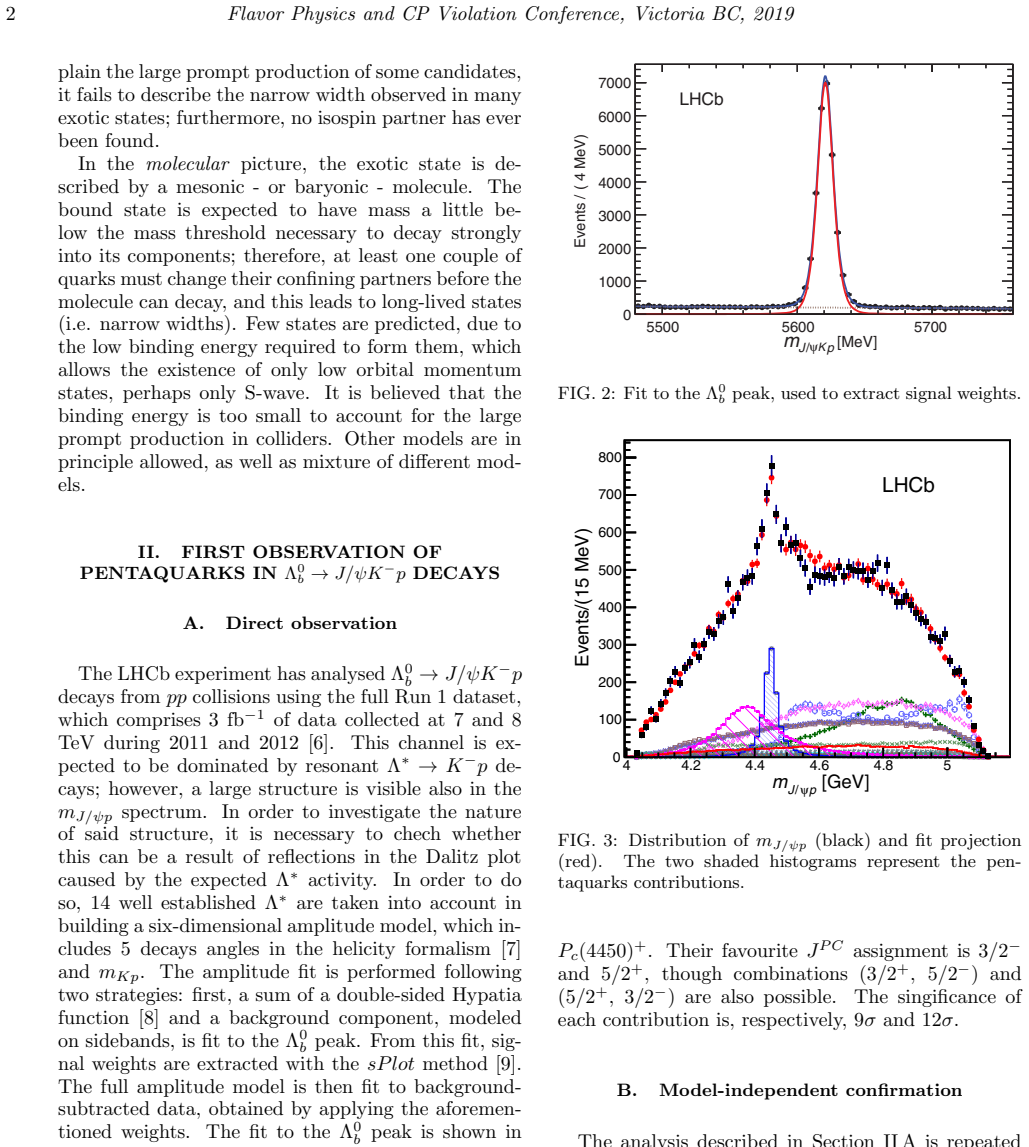
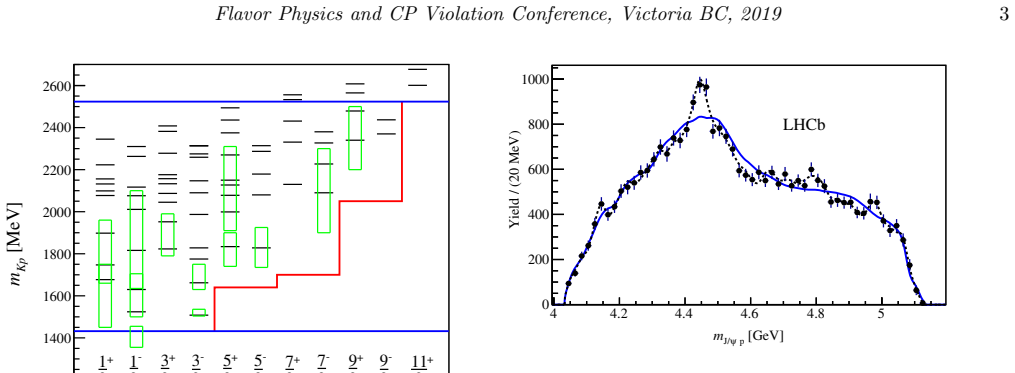
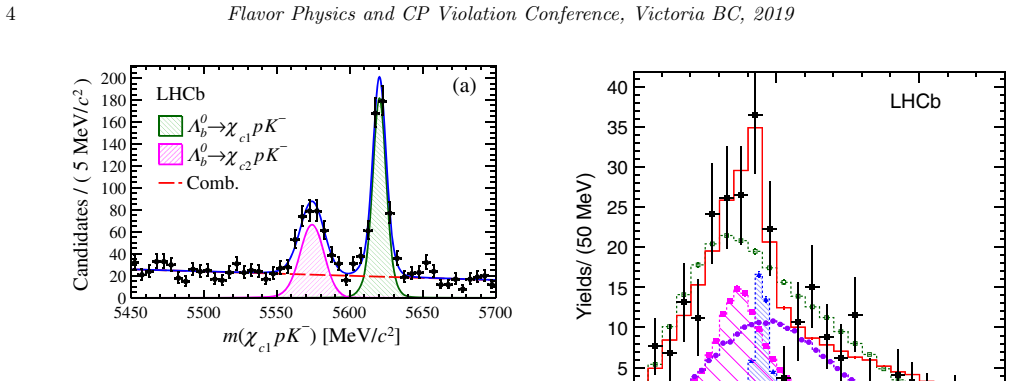
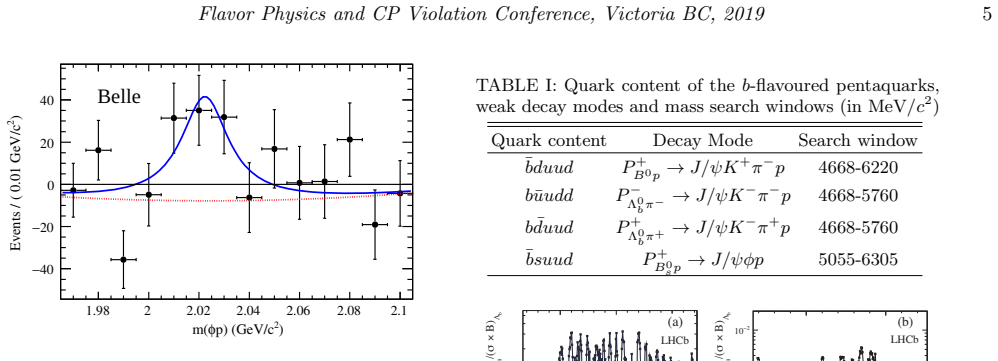
Several observations and searches for pentaquark states have been performed in the last four years, starting from the LHCb observation in 2015. This is still quite a recent discovery, and possibly the beginning of a new era in both observation of new states and understanding of the QCD binding mechanisms. The most recent results from LHCb and Belle are presented regarding measurements and searches for charm, strange and beauty pentaquarks, along with an introduction on phenomenology of multiquark states.
What carries the argument
Pentaquarks, five-quark bound states whose production and decay are described by phenomenological models of multiquark structure.
If this is right
- Additional decay channels and production modes become accessible once the states are established.
- Theoretical models of QCD binding must accommodate stable five-quark configurations.
- Searches can be extended systematically to other heavy-quark combinations.
- Quantum numbers of the states can be measured to constrain their internal structure.
Where Pith is reading between the lines
- If the states persist, collider experiments may shift focus from discovery to precision spectroscopy of multiquark systems.
- Similar five-quark structures could appear in lighter quark sectors, though with different widths and production rates.
- Lattice QCD calculations tuned to these masses would provide an independent test of the binding mechanism.
Load-bearing premise
The reported peaks correspond to genuine five-quark states rather than statistical fluctuations, background effects, or ordinary resonances.
What would settle it
A higher-statistics data set in which the reported mass peaks disappear or match the lineshape of a known conventional hadron instead.
Figures
read the original abstract
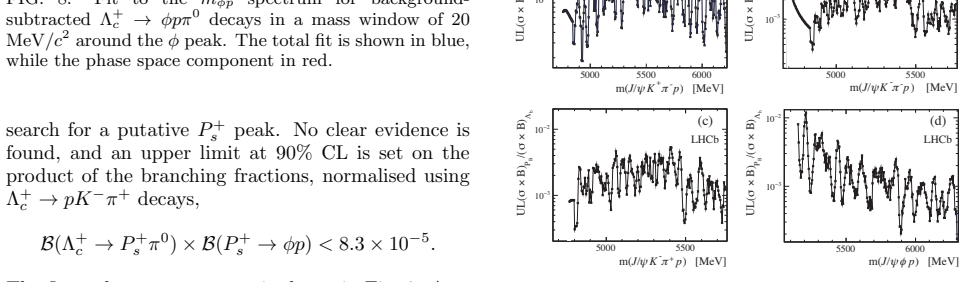
The field of exotic spectroscopy is extremely rich and productive. Several observations and searches for pentaquark states have been performed in the last 4 years, starting from the LHCb observation in 2015. This is still quite a recent discovery, and possibly the beginning of a new era in both observation of new states and understanding of the QCD binding mechanisms. The most recent results from LHCb and Belle are presented regarding measurements and searches for charm, strange and beauty pentaquarks, along with an introduction on phenomenology of multiquark states.
Editorial analysis
A structured set of objections, weighed in public.
Referee Report
Summary. This manuscript is a review talk that summarizes experimental observations and searches for pentaquark states performed in the last four years, beginning with the LHCb observation in 2015. It presents the most recent results from LHCb and Belle on measurements and searches for charm, strange, and beauty pentaquarks, together with a brief introduction to the phenomenology of multiquark states.
Significance. If the cited experimental results are accurately represented, the review consolidates recent progress in exotic hadron spectroscopy and highlights the potential for new insights into QCD binding. The manuscript introduces no new data, fits, or model derivations, so its value lies in providing a concise overview of published LHCb and Belle findings rather than advancing original claims.
minor comments (1)
- The abstract refers to 'the most recent results' without specifying the exact data samples or publication references in the provided text; adding explicit citations to the LHCb and Belle papers discussed would improve traceability for readers.
Simulated Author's Rebuttal
We thank the referee for the positive assessment of the manuscript and the recommendation to accept. The review provides a concise overview of recent pentaquark results from LHCb and Belle as intended.
Circularity Check
No significant circularity in experimental review summary
full rationale
The manuscript is a conference review summarizing published LHCb and Belle experimental results on pentaquark candidates, along with a brief phenomenology overview. No new data, equations, derivations, model fits, or predictions are introduced. All claims rest on external, independently published measurements rather than any internal chain that reduces to the paper's own inputs or self-citations. The reader's assessment of score 0.0 is confirmed by the absence of any load-bearing analytical steps.
Axiom & Free-Parameter Ledger
Reference graph
Works this paper leans on
-
[1]
placed downstream of the magnet. Different types of charged hadrons are distinguished using information from two ring-imaging Cherenkov detectors [16]. Muons are identified by a system composed of alternating layers of iron and multiwire proportional chambers [17]. Events are triggered by a J=ψ → μþμ− decay, requiring two identified muons with opposite ch...
work page 2000
-
[2]
for an illustration). The narrower the resonance, the narrower the reflection, and the higher the rank l of Legendre polynomials required to describe such a structure. Selection criteria and backgrounds can also produce high-l structures in the cos θΛ/C3 distribution. Therefore, the data are efficiency corrected and the background is sub- tracted. Even th...
work page 2000
- [3]
- [4]
- [5]
-
[6]
S. L. Olsen et al., Rev. Mod. Phys. 90, 015003 (2018)
work page 2018
-
[7]
Chen et al., Physics Reports 639, 1-121 (2016)
H. Chen et al., Physics Reports 639, 1-121 (2016)
work page 2016
- [8]
-
[9]
S. U. Chung, Report No. CERN-71-08; J. D. Rich- man, Report No. CALT-68-1148; M. Jacob and G. C. Wick, Ann. Phys. (N.Y.) 7, 404 (1959)
work page 1959
-
[10]
D. Martinez Santos and F. Dupertuis, Nucl. Instrum. Methods Phys. Res., Sect. A 764, 150 (2014)
work page 2014
- [11]
- [12]
- [13]
- [14]
- [15]
- [16]
- [17]
- [18]
-
[19]
T. H. R. Skyrme, 260 Proc. R. Soc. Lond. A (1961)
work page 1961
- [20]
-
[21]
R. Aaij et al. (LHCb Collaboration), Phys. Rev. Lett. 122, 222001 (2019). T ueB1430
work page 2019
discussion (0)
Sign in with ORCID, Apple, or X to comment. Anyone can read and Pith papers without signing in.