Superfluidity in the Interiors of Neutron Stars
Pith reviewed 2026-05-25 17:33 UTC · model grok-4.3
The pith
Theoretical arguments establish that neutron stars have superfluid and superconducting interiors that control their rotational dynamics as pulsars.
A machine-rendered reading of the paper's core claim, the machinery that carries it, and where it could break.
Core claim
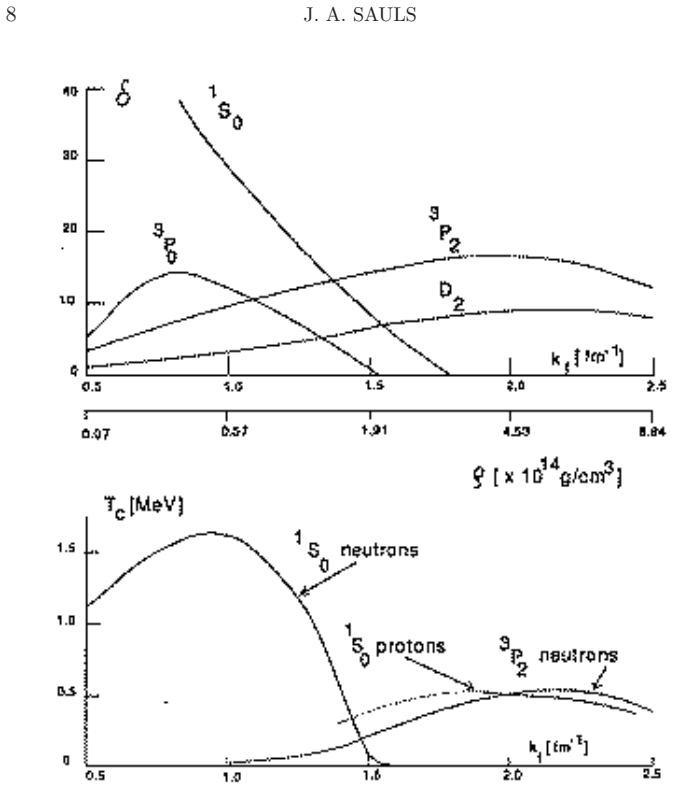
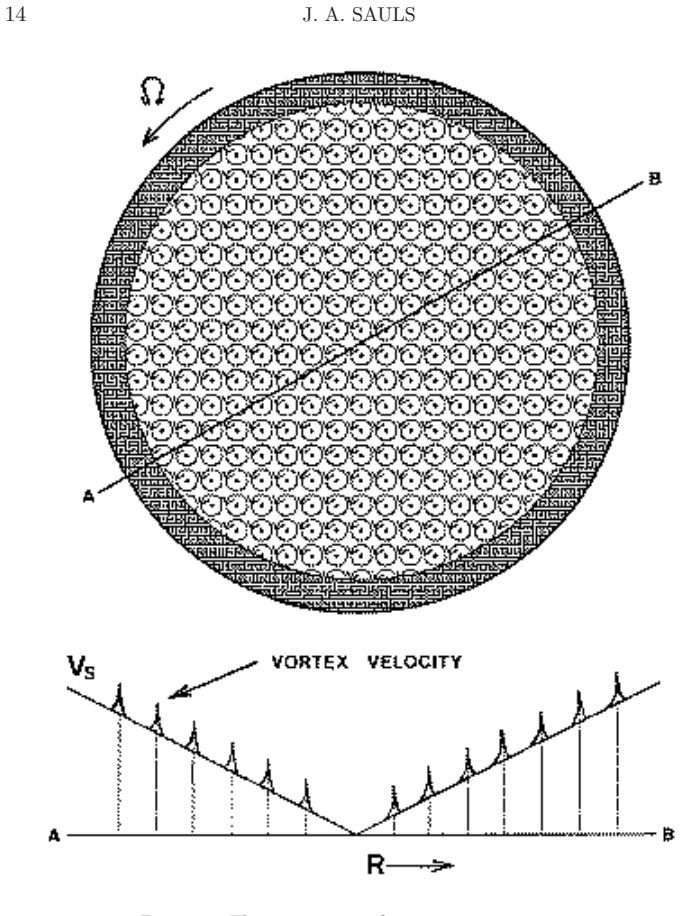
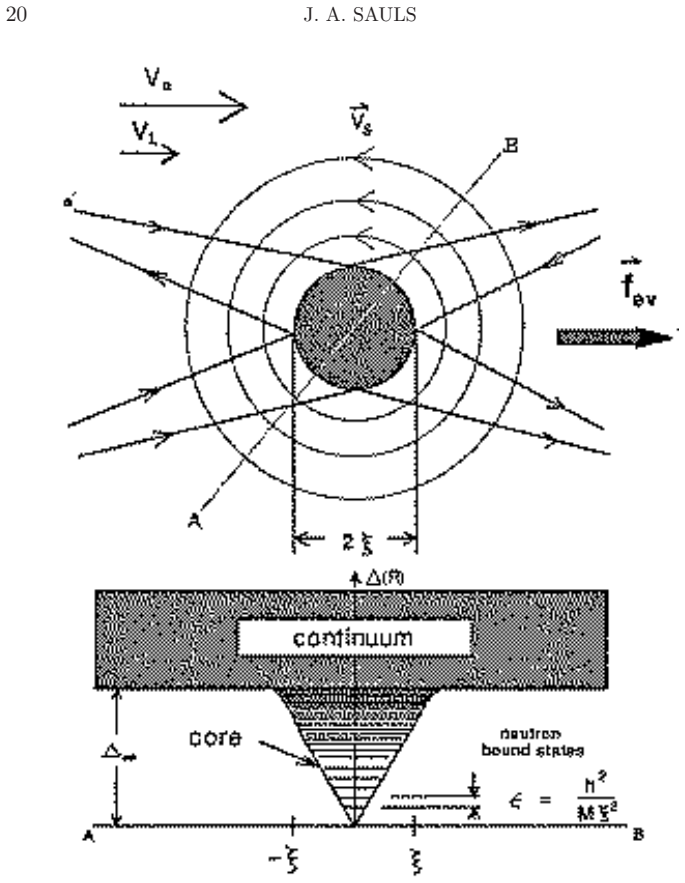
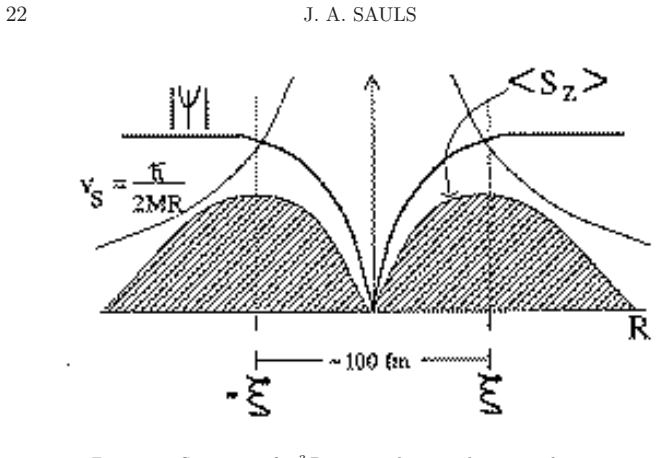
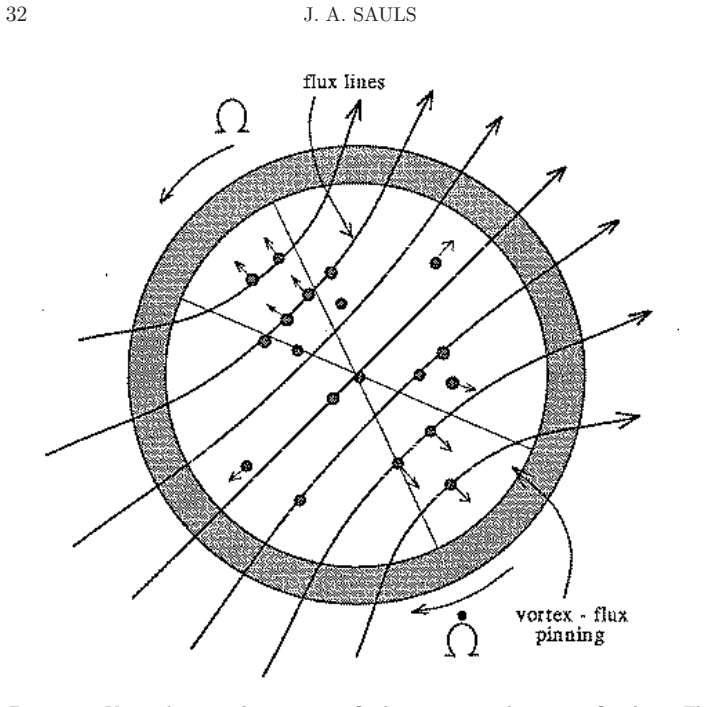
Theoretical calculations of nucleon pairing at the densities and temperatures inside neutron stars predict a superfluid state for neutrons, frequently in the spin-triplet 3P2 channel, together with proton superconductivity. The resulting superfluid-superconducting mixture supports quantized vortices whose magnetic structure and pinning behavior govern the exchange of angular momentum between the superfluid interior and the normal component, producing observable effects on the rotational history of pulsars.
What carries the argument
The superfluid-superconducting mixture and the magnetic structure of quantized vortices in spin-triplet neutron superfluids, which control angular-momentum transfer through pinning and unpinning.
If this is right
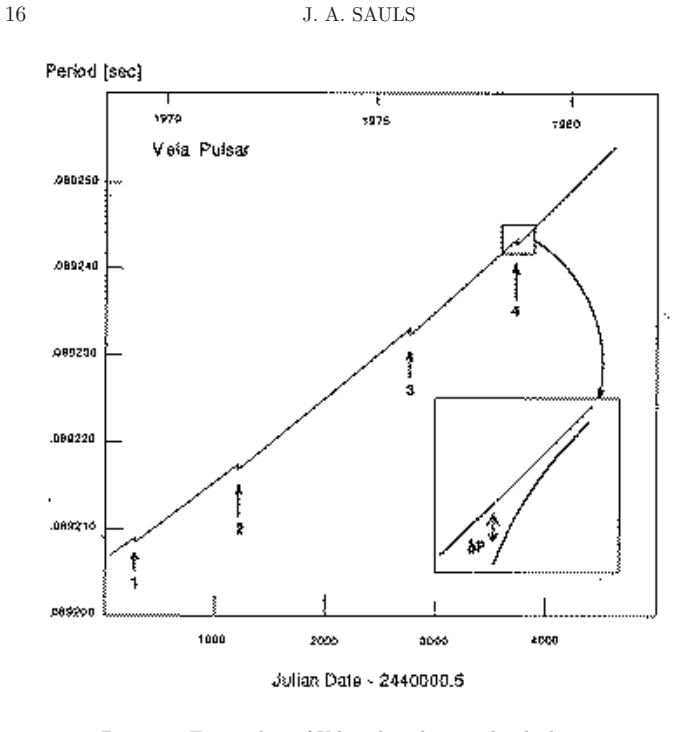
- Pulsar glitches arise when vortices unpin and transfer angular momentum to the crust on short timescales.
- The fraction of the star's moment of inertia that resides in the superfluid component sets the size and recurrence of observed spin-up events.
- The magnetic flux carried by vortex cores modifies the star's overall magnetic evolution and field decay.
- Unique features of the interacting mixture produce additional dissipation channels that affect the damping of rotational oscillations.
Where Pith is reading between the lines
- The same vortex dynamics may operate in other compact objects whose rotation is monitored over long baselines.
- Timing residuals in young neutron stars could reveal the transition temperature at which the superfluid component first appears.
- Laboratory studies of vortex pinning in analogous two-component superfluids could supply quantitative inputs for the neutron-star case.
Load-bearing premise
Models of superfluid-superconducting mixtures and vortex structures developed in other physical systems apply directly to the extreme densities and temperatures inside neutron stars.
What would settle it
A pulsar whose long-term timing data show neither glitches nor any other signature of sudden angular-momentum transfer between components would falsify the claim that superfluid vortices dominate the rotational dynamics.
Figures
read the original abstract
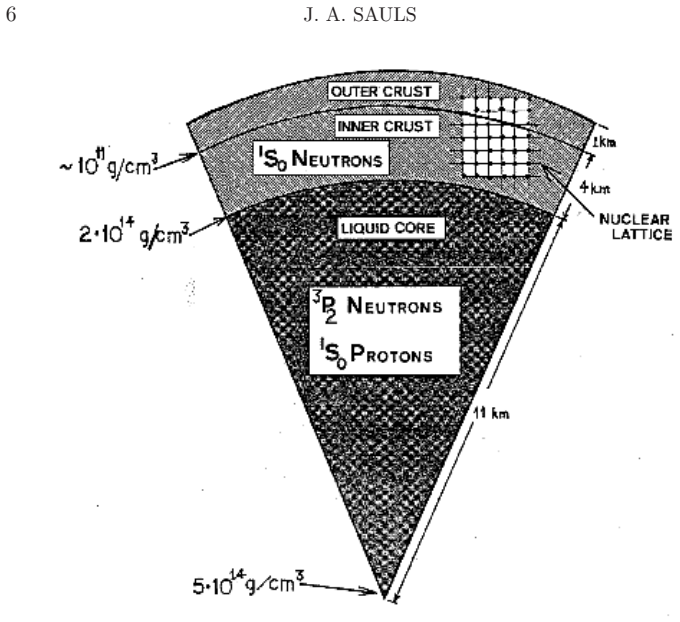
I review some of the ideas that have been proposed for the structure of neutron star interiors, and concentrate on the theoretical arguments for the existence of superfluidity in neutron stars. I also discuss the implications of neutron superfluidity and proton superconductivity for the rotational dynamics of pulsars, and review arguments that have been proposed for observable effects of superfluidity on the timing history of pulsars and perhaps other neutron stars. The Lecture notes also include discussions of several features that are unique to interacting superfluid-superconducting mixtures, as well as the magnetic structure of quantized vortices in spin-triplet ($^3$P$_2$) neutron superfluids.
Editorial analysis
A structured set of objections, weighed in public.
Referee Report
Summary. The manuscript is a set of lecture notes that reviews theoretical arguments proposed in the literature for the existence of superfluidity (and proton superconductivity) in neutron star interiors. It concentrates on implications for the rotational dynamics of pulsars, including proposed observable effects on timing histories, and discusses unique aspects of interacting superfluid-superconducting mixtures as well as the magnetic structure of quantized vortices in spin-triplet (^3P_2) neutron superfluids.
Significance. If the synthesis is accurate, the notes provide a consolidated overview of existing theoretical ideas on neutron-star superfluidity and its potential links to pulsar phenomena. This can be useful as an educational resource or entry point for researchers, particularly in highlighting distinctive features of superfluid-superconducting mixtures that are not present in simpler systems.
minor comments (2)
- [Abstract / Introduction] The title and abstract refer to 'Lecture notes' but the manuscript body does not explicitly frame the scope or selection criteria for the reviewed ideas; adding a short introductory paragraph on this point would improve clarity for readers.
- [Main text (vortex discussion)] Notation for the spin-triplet state (^3P_2) is introduced in the abstract but should be defined on first use in the main text with a brief reminder of its relevance to neutron pairing.
Simulated Author's Rebuttal
We thank the referee for their positive evaluation of the manuscript and for recommending acceptance. We are pleased that the notes are viewed as a useful consolidated overview and educational resource on neutron-star superfluidity and its implications for pulsar dynamics.
Circularity Check
No significant circularity
full rationale
This is a review lecture notes paper summarizing prior theoretical arguments from the literature on neutron star superfluidity and its implications for pulsar dynamics. No new derivations, equations, quantitative predictions, or fitted parameters are introduced. The central content consists of discussions of ideas proposed elsewhere, with no load-bearing steps that reduce to self-definition, self-citation chains, or renaming of results by construction. The paper is self-contained as a review against external benchmarks.
Axiom & Free-Parameter Ledger
Forward citations
Cited by 1 Pith paper
-
Spin effects in superfluidity, neutron matter and neutron stars
A review of spin effects, superfluidity, and magnetic fields in neutron matter and their influence on neutron-star structure, superfluid phases, and rotational dynamics.
Reference graph
Works this paper leans on
-
[1]
Alpar, M.: 1977, ‘Pinning and Threading of Quantized Vortic es in the Pulsar Crust Superfluid’. Ap. J. 213,
work page 1977
-
[2]
Alpar, M. . and J. A. Sauls: 1988, ‘On the Dynamical Coupling B etween the Superfluid Interior and Crust of a Neutron Star’. Ap. J. 327,
work page 1988
-
[3]
Alpar, M., R. Nandkumar, and D. Pines: 1985, ‘Vortex creep an d the internal temperature of neutron stars The Crab pulsar and PSR 0525+21’. Ap. J. 288,
work page 1985
-
[4]
Anderson, P. W., M. A. Alpar, D. Pines, and J. Shaham: 1982, ‘T he Rheology of Neutron Stars: Vortex-line Pinning in the Crust Superfluid’. Phil. Mag. A 45,
work page 1982
-
[5]
Anderson, P. W. and W. F. Brinkman: 1978, ‘Anisotropic Super fliudiity in Liquid 3He’. In: K. Benneman and J. Ketterson (eds.): The Physics of Liquid and Solid Helium . J. Wiley & Sons, New York, p
work page 1978
-
[6]
Anderson, P. W. and N. Itoh: 1975, ‘Pulsar Glitches and Restl essness as a Hard Super- fluidity Phenomenon’. Nature 256,
work page 1975
-
[7]
Anderson, P. W. and Y. B. Kim: 1964, ‘Hard Superconductivity : Theory of the Motion of Abrikosov Flux Lines’. Rev. Mod. Phys. 36,
work page 1964
-
[8]
Andreev, A. F. and E. P. Bashkin: 1976, ‘Hydrodynamics of Qua ntum Mixtures’. Sov. Phys. JETP 42,
work page 1976
-
[9]
Zh. Eksp. Teor. Fiz., 69, 319 (1975). Bardeen, J., L. Cooper, and J. Schrieffer: 1957, ‘Theory of Su perconductivity’. Phys. Rev. 108(5), 1175–1204. Baym, G.: 1975, ‘Superfluidity in Neutron Stars’. In: S. Tric key, W. Kirk, and J. Dufty (eds.): Quantum Statistics and the Many Body Problem . p. 221, Plenum, New York. Baym, G. and C. Pethick: 1975, ‘Neutron ...
work page 1975
-
[10]
Baym, G. and D. Pines: 1971, ‘Neutron starquakes and pulsar s peedup’. Ann. Phys. 66,
work page 1971
-
[11]
Brown, G. and A. Jackson: 1979, The Nucleon-Nucleon Interaction . Amsterdam: North- Holland. Chao, N. C., J. W. Clark, and C. H. Yang: 1972, ‘Proton Superflu idity in Neutron Star Matter’. Nucl. Phys. A179,
work page 1979
-
[12]
S.: 1981, ‘JPL pulsar timing observations
Downs, G. S.: 1981, ‘JPL pulsar timing observations. I. The V ELA pulsar’. Ap. J. 249,
work page 1981
-
[13]
Easson, I.: 1979, ‘Post-Glitch Behavior of the Plasma insid e Neutron Stars’. Ap. J. 228,
work page 1979
-
[14]
Feibelman, P.: 1971, ‘Relaxation of Electron Velocity in a R otating Neutron Superfluid: Application to the Relaxation of a Pulsar’s Slowdown Rate’. Phys. Rev. D 4,
work page 1971
-
[15]
P.: 1955, Chapter 2: The Application of Quantum Mechanics to Liquid Helium, Vol
Feynman, R. P.: 1955, Chapter 2: The Application of Quantum Mechanics to Liquid Helium, Vol. I, pp. 17–53. Amsterdam: North Holland Publishing Co. Ginzburg, V. and L. D. Landau: 1950, ‘On the Theory of Superco nductivity’. Zh. Eskp. Teor. Fiz. 20, 1064–1082. Ginzburg, V. L. and D. A. Kirzhnits: 1965, ‘On Superfluidity o f Neutron Stars’. Sov. Phys. JETP 20,
work page 1955
-
[16]
Zh. Eskp. Teor. Fiz. 47, 2006 (1964). Hoffberg, M., A. E. Glassgold, R. W. Richardson, and M. Ruderm an: 1970, ‘Anisotropic Superfluidity in Neutron Star Matter’. Phys. Rev. Lett. 24,
work page 2006
-
[17]
B.: 1987, ‘Neutron star magnetic field decay - Flux e xpulsion from the super- conducting interior’
Jones, P. B.: 1987, ‘Neutron star magnetic field decay - Flux e xpulsion from the super- conducting interior’. Mon. Not. Roy. Astron. Soc. 228,
work page 1987
-
[18]
London, F.: 1950, Superfluids: Macroscopic Theory of Superconductivity , Vol. I. New York, NY: John Wiley & Sons, Inc. Lyne, A. G.: 1987, ‘A massive glitch in an old pulsar’. Nature 326,
work page 1950
-
[19]
McCulloch, P. M., P. A. Hamilton, G. Royle, and R. N. Manchest er: 1983, ‘Daily obser- vations of a large period jump of the Vela pulsar’. Nature 302,
work page 1983
-
[20]
In: J. Ruvalds and T. Regge (eds.): Quantum fluids . New York, North Holland. Erice Lectures. Migdal, A. B.: 1960, ‘Superfluidity and the Moments of Inerti a of Nuclei’. Sov. Phys. JETP 10,
work page 1960
-
[21]
Zh. Eskp. Teor. Fiz. 37, 1, 249 (1969). Muslimov, A. G. and A. I. Tsygan: 1985, ‘Vortex lines in neutr on star superfluids and decay of pulsar magnetic fields’. Astrophys. Space Sci. 115,
work page 1969
-
[22]
Muzikar, P., J. A. Sauls, and J. W. Serene: 1980, ‘ 3P2 Pairing in Neutron Star Matter: Magnetic Field Effects and Vortices’. Phys. Rev. D21,
work page 1980
-
[23]
Onsager, L.: 1949, ‘Statistical Hydrodynamics’. Il Nouvo Cimento 6, 279–287. Packard, R. E.: 1972, ‘Pulsar Speedups Related to Metastabi lity of the Superfluid Neutron-Star Core’. Phys. Rev. Lett. 28,
work page 1949
-
[24]
Pines, D. and P. Nozi` eres: 1966, The Theory of Quantum Liquids . New York: W. J. Benjamin. Radhakrishman, V. and R. N. Manchester: 1969, ‘Detection of a Change of State in the Pulsar PSR 0833-45’. Nature 222,
work page 1966
-
[25]
In: Progress in Low Temperature Physics , Vol
Rainer, D.: 1986, ‘Principles of ab Initio Calculations of Superconducting Transition Temperatures’. In: Progress in Low Temperature Physics , Vol
work page 1986
-
[26]
371–424, Elsevier Science Publishers B.V
Amsterdam, pp. 371–424, Elsevier Science Publishers B.V. Reichley, P. E. and G. S. Downs: 1969, ‘Observed Decrease in t he Periods of Pulsar PSR 0833-45’. Nature 222,
work page 1969
-
[27]
W.: 1972, ‘Ginzburg-Landau Theory of Anisot ropic Superfluid Neutron- Star Matter’
Richardson, R. W.: 1972, ‘Ginzburg-Landau Theory of Anisot ropic Superfluid Neutron- Star Matter’. Phys. Rev. D 5,
work page 1972
-
[28]
Superfluidity in Neutron Stars 35 Ruderman, M.: 1969, ‘Neutron Starquakes and Pular Periods’ . Nature 223,
work page 1969
-
[29]
A.: 1980, ‘Anisotropic Pairing in Neutron Stars an d Liquid 3He’
Sauls, J. A.: 1980, ‘Anisotropic Pairing in Neutron Stars an d Liquid 3He’. Ph.D. thesis, State University of New York at Stony Brook. Sauls, J. A.: 1984, ‘Microscopic Theory of the Superfluid Dra g Effect’. unpublished. Sauls, J. A. and J. W. Serene: 1978, ‘ 3P2 Pairing Near the Transition Temperature in Neutron-Star Matter’. Phys. Rev. D 17,
work page 1980
-
[30]
Sauls, J. A., D. L. Stein, and J. W. Serene: 1982, ‘Magnetic Vo rtices in a Rotating 3P2 Neutron Superfluid’. Phys. Rev. D 25,
work page 1982
-
[31]
Shaham, J.: 1980, ‘Superfluidity in Neutron Stars’. J. de Phys. 41, C2–9. Sj¨ oberg, O.: 1976, ‘On the Landau Effective Mass in Asymmetr ic Nuclear Matter’. Nucl. Phys. A65,
work page 1980
-
[32]
B.: 1987, ‘Vortex Oscillations and Hydrodynamics of Rotating Superfluids’
Sonin, E. B.: 1987, ‘Vortex Oscillations and Hydrodynamics of Rotating Superfluids’. Rev. Mod. Phys. 59,
work page 1987
-
[33]
Tamagaki, R.: 1970, ‘Superfluid state in neutron star matter . I. Generalized Bogoliubov transformation and existence of 3P2 gap at high density’. Prog. Theor. Phys. 44,
work page 1970
-
[34]
Thuneberg, E., J. Kurkij¨ arvi, and D. Rainer: 1984, ‘Elementary-flux-pinning potential in type-II superconductors’. Phys. Rev. B 29,
work page 1984
-
[35]
Vardanyan, G. A. and D. M. Sedrakian: 1981, ‘Magnetohydrody namics of Superfluid Solutions’. Sov. Phys. JETP 54,
work page 1981
-
[36]
Vulovic, V. Z. and J. A. Sauls: 1984, ‘Influence of Strong-Cou pling Corrections on the Equilibrium PhaseDiagram of 3P2 Neutron-Star Matter’. Phys. Rev. D 29, 2705
work page 1984
discussion (0)
Sign in with ORCID, Apple, or X to comment. Anyone can read and Pith papers without signing in.