Automatic Intracranial Brain Segmentation from Computed Tomography Head Images
Pith reviewed 2026-05-25 19:00 UTC · model grok-4.3
The pith
A method combining intensity thresholding, ray intersection with the skull, erosion, and connected components automatically segments the intracranial region from CT head images.
A machine-rendered reading of the paper's core claim, the machinery that carries it, and where it could break.
Core claim
The authors claim that their method, consisting of HU thresholding, identification of intracranial voxels through ray intersection with the cranium, special binary erosion, and connected components per slice, provides fast and automatic segmentation of the brain from CT head images.
What carries the argument
The pipeline of HU thresholding to detect the cranium, ray intersection to mark intracranial voxels, special binary erosion, and per-slice connected components analysis.
If this is right
- Segmentation of the intracranial region can be performed automatically without user intervention.
- The process operates quickly because it applies standard operations slice by slice.
- Brain region extraction becomes part of routine CT image handling without extra software.
Where Pith is reading between the lines
- If the pipeline succeeds on diverse data it could shorten the time between scan acquisition and further brain analysis.
- The per-slice ray intersection step might be adapted to full 3D volumetric versions for consistency across slices.
- Systematic tests on scans from different manufacturers would show whether scanner-specific adjustments are needed.
Load-bearing premise
The listed combination of standard image-processing operations will produce accurate intracranial segmentations on real clinical CT data without additional tuning or failure modes from artifacts, anatomical variation, or scanner differences.
What would settle it
Running the algorithm on a collection of real clinical CT head images containing common artifacts and comparing the output masks to expert manual ground truth segmentations.
Figures
read the original abstract
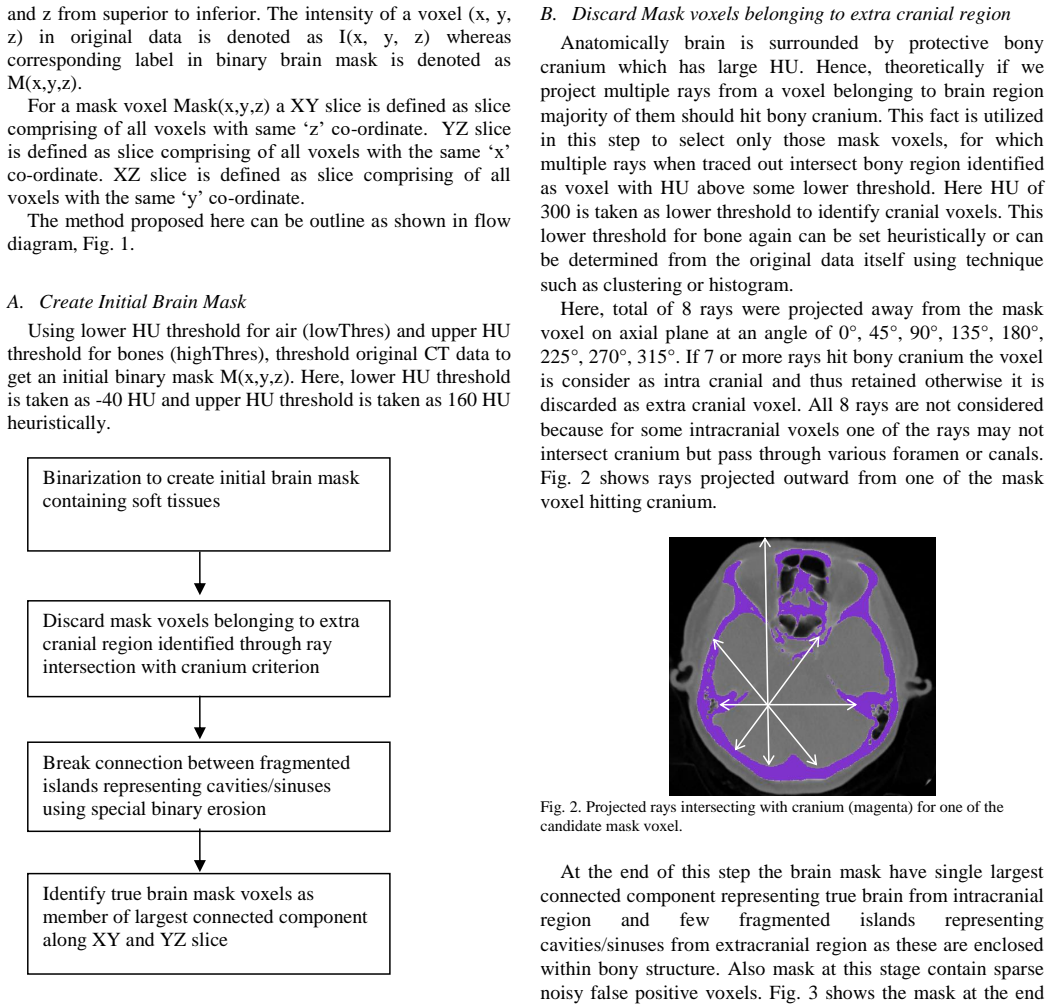
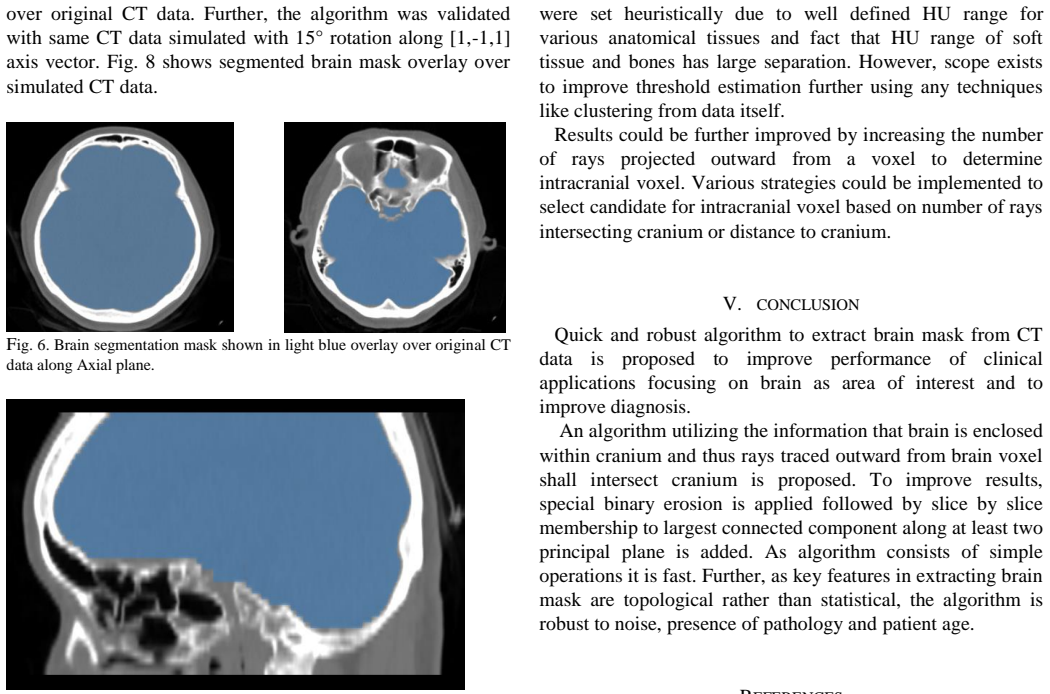
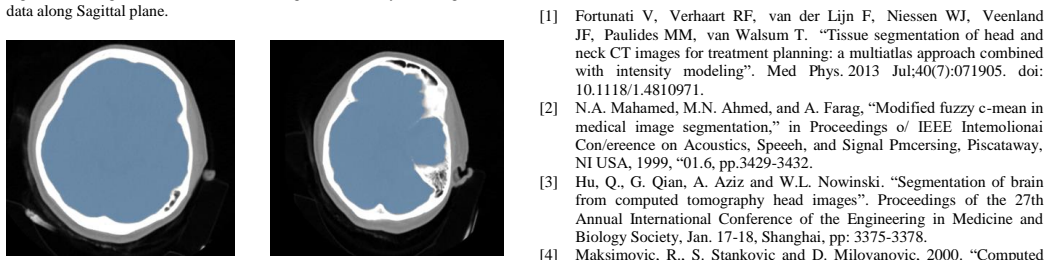
Fast and automatic algorithm to segment Brain (intracranial region) from computed tomography (CT) head images using combination of HU thresholding, identification of intracranial voxels through ray intersection with cranium, special binary erosion and connected components per slice.
Editorial analysis
A structured set of objections, weighed in public.
Referee Report
Summary. The manuscript describes a fast and automatic algorithm for segmenting the intracranial brain region from CT head images. The approach combines HU thresholding, identification of intracranial voxels through ray intersection with the cranium, special binary erosion, and connected components analysis performed per slice.
Significance. If the described pipeline were shown to be accurate and robust, it would offer a computationally lightweight, non-learning-based alternative for intracranial segmentation in CT, potentially useful in time-sensitive clinical workflows. The geometric ray-intersection step provides a distinct mechanism for boundary handling that could complement intensity-based methods. However, the complete absence of any empirical validation prevents assessment of whether these potential advantages are realized.
major comments (2)
- The abstract (and method description) claims the algorithm is fast and automatic yet supplies no quantitative results, error metrics, validation datasets, or comparisons. This is load-bearing for the central claim because the effectiveness of the HU thresholding + ray intersection + erosion + connected-components sequence cannot be evaluated from the given text alone.
- The pipeline implicitly assumes (1) the cranium forms a reliably detectable closed boundary in every slice and (2) the chosen erosion kernel removes only extracranial voxels without eroding true brain tissue. No ablation studies, failure-mode analysis (e.g., beam-hardening, metal artifacts, pediatric or post-surgical cases), or parameter-sensitivity results are provided to support these assumptions.
minor comments (1)
- The term 'special binary erosion' is introduced without specifying the kernel size, structuring element, or how it differs from standard morphological erosion; this reduces reproducibility.
Simulated Author's Rebuttal
We thank the referee for the detailed review of our manuscript on the automatic intracranial segmentation algorithm for CT head images. We address each major comment below, acknowledging the absence of empirical validation in the current version while outlining targeted revisions.
read point-by-point responses
-
Referee: The abstract (and method description) claims the algorithm is fast and automatic yet supplies no quantitative results, error metrics, validation datasets, or comparisons. This is load-bearing for the central claim because the effectiveness of the HU thresholding + ray intersection + erosion + connected-components sequence cannot be evaluated from the given text alone.
Authors: We agree that the manuscript, as a primarily methodological description, does not include quantitative benchmarks, error metrics, or comparisons. The central contribution is the algorithmic sequence itself, which is designed to be lightweight and non-learning-based. To address this, the revised manuscript will incorporate timing measurements on representative CT volumes and qualitative results on sample cases from public datasets, supporting the claims of speed and automation without altering the core method description. revision: yes
-
Referee: The pipeline implicitly assumes (1) the cranium forms a reliably detectable closed boundary in every slice and (2) the chosen erosion kernel removes only extracranial voxels without eroding true brain tissue. No ablation studies, failure-mode analysis (e.g., beam-hardening, metal artifacts, pediatric or post-surgical cases), or parameter-sensitivity results are provided to support these assumptions.
Authors: The method does rely on the cranium providing a closed boundary via HU thresholding and ray casting, as well as the erosion step selectively removing extracranial voxels. These assumptions are implicit in the geometric approach but are not tested across edge cases. In revision, we will add an explicit limitations and assumptions section discussing scenarios such as beam-hardening artifacts, metal implants, and pediatric cases, along with guidance on parameter selection for the erosion kernel. revision: yes
Circularity Check
No circularity: purely procedural description of image-processing steps
full rationale
The manuscript presents a sequence of standard operations (HU thresholding, ray casting for intracranial labeling, binary erosion, per-slice connected components) with no equations, fitted parameters, predictions, or self-citations. No derivation chain exists that could reduce to its own inputs; the central claim is an empirical assertion about the combination's performance on clinical data, which is independent of any definitional or fitted circularity. This is the most common honest non-finding for method-description papers.
Axiom & Free-Parameter Ledger
Reference graph
Works this paper leans on
-
[1]
Fortunati V , Verhaart RF , van der Lijn F , Niessen WJ , Veenland JF, Paulides MM, van Walsum T . “Tissue segmentation of head and neck CT images for treatment planning: a multiatlas approach c ombined with intensity modeling”. Med Phys. 2013 Ju l;40(7):071905. doi: 10.1118/1.4810971
-
[2]
Modified fuzzy c-mean in medical image segmentation,
N.A. Mahamed, M.N. Ahmed, and A. Farag, “Modified fuzzy c-mean in medical image segmentation,” in Proceedings o/ IEEE Intemolionai Con/ereence on Acoustics, Speeeh, and Signal Pmcersing, Piscataway, NI USA, 1999, “01.6, pp.3429-3432
work page 1999
-
[3]
Segmentation of brain from computed tomography head images
Hu, Q., G. Qian, A. Aziz and W.L. Nowinski . “Segmentation of brain from computed tomography head images ”. Proceedings of the 27th Annual International Conference of the Engineering in Medicine and Biology Society, Jan. 17-18, Shanghai, pp: 3375-3378
-
[4]
Maksimovic, R., S. Stankovic and D. Milovanovic, 2000. “Computed tomography image analyzer: 3D reconstruction and segmentation applying active contour models snakes”. Int. J. Med. Inform., 58: 29-37
work page 2000
-
[5]
Histogram analysis with automated extraction of brain-tissue region from whole-brain CT images
Masatoshi Kondo, Koji Yamashita, Takashi Yo shiura, Akio Hiwatash, Takashi Shirasaka, Hisao Arimura, Yasuhiko Nakamura and Hiroshi Honda. “Histogram analysis with automated extraction of brain-tissue region from whole-brain CT images”. SpringerPlus (2015) 4:788 DOI 10.1186/s40064-015-1587-1
discussion (0)
Sign in with ORCID, Apple, or X to comment. Anyone can read and Pith papers without signing in.