Classical Langevin dynamics derived from quantum mechanics
Pith reviewed 2026-05-25 17:21 UTC · model grok-4.3
The pith
Langevin molecular dynamics with rank-one friction from quantum coupling approximates quantum observables more accurately than Hamiltonian systems for large mass ratios.
A machine-rendered reading of the paper's core claim, the machinery that carries it, and where it could break.
Core claim
The main result proves that ab initio Langevin molecular dynamics, with a certain rank one friction matrix determined by the coupling, approximates for any temperature canonical quantum observables, based on the system coordinates, more accurately than any Hamiltonian system in these coordinates, for large mass ratio between the system and the heat bath nuclei.
What carries the argument
Ab initio Langevin molecular dynamics with a rank one friction matrix determined by the system-bath coupling, obtained by extending Zwanzig's Hamiltonian to the quantum case.
If this is right
- The Langevin model outperforms all Hamiltonian models in the same coordinates for approximating quantum observables.
- The approximation is valid for arbitrary temperatures.
- The friction matrix is rank one and fixed by the choice of coupling.
- Accuracy improves as the mass ratio between system and bath nuclei increases.
Where Pith is reading between the lines
- This approach may allow classical simulations to capture certain quantum thermal effects without solving the full quantum dynamics.
- Similar derivations could be explored for other forms of system-bath interactions in open quantum systems.
- Practical implementations might test the predicted accuracy gains in specific molecular models like proteins in solvent.
Load-bearing premise
The system-bath coupling must be of the specific form that yields a rank-one friction matrix in the derived dynamics, together with the assumption of a large mass ratio.
What would settle it
Compute the error between the approximated observables and exact quantum values for both the Langevin model and the best Hamiltonian model at a finite but large mass ratio and check whether the Langevin error is smaller.
Figures
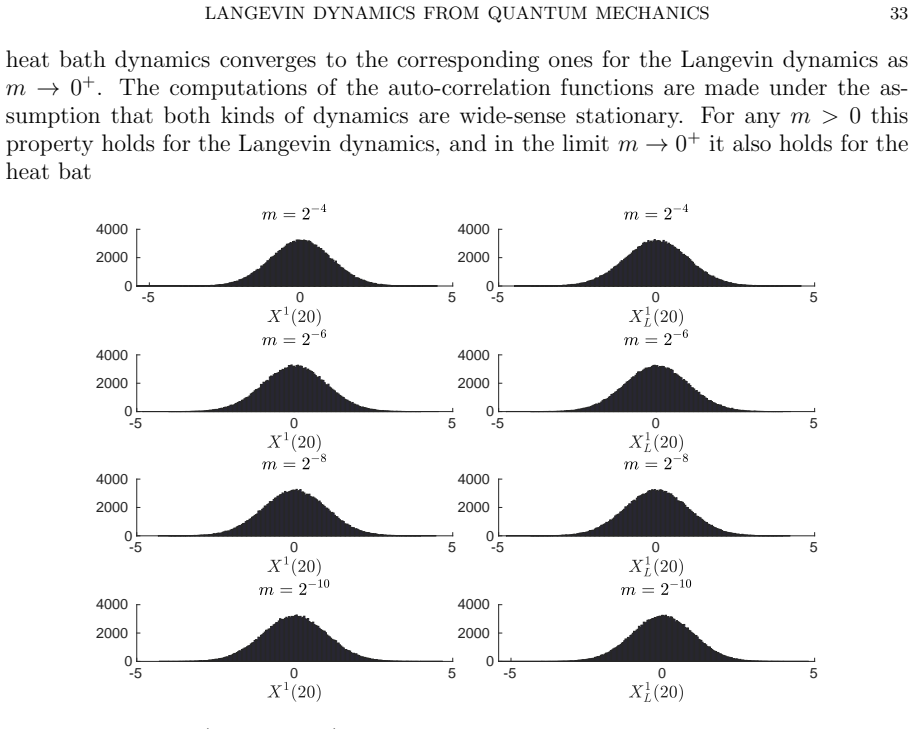
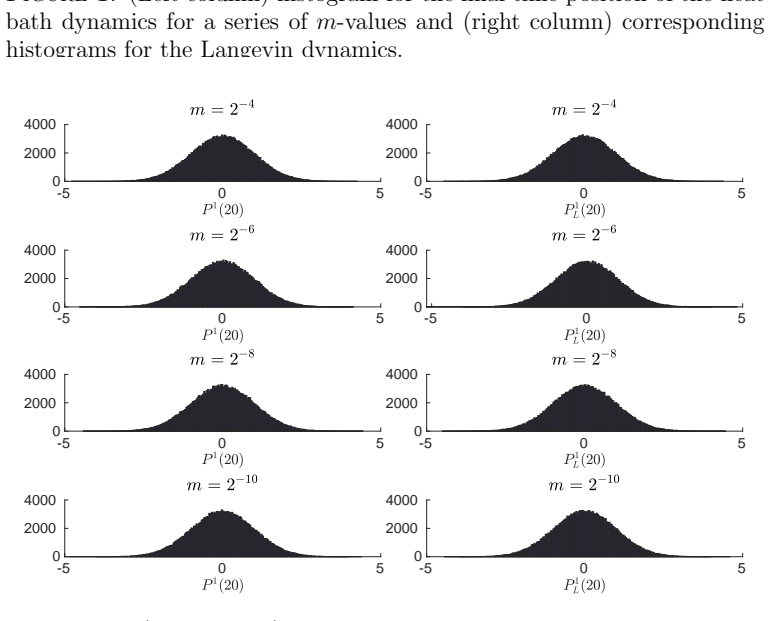
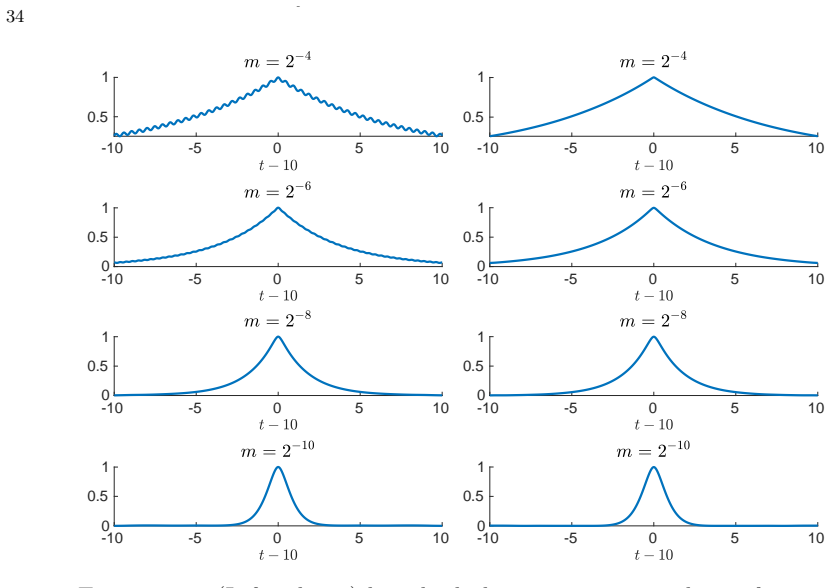
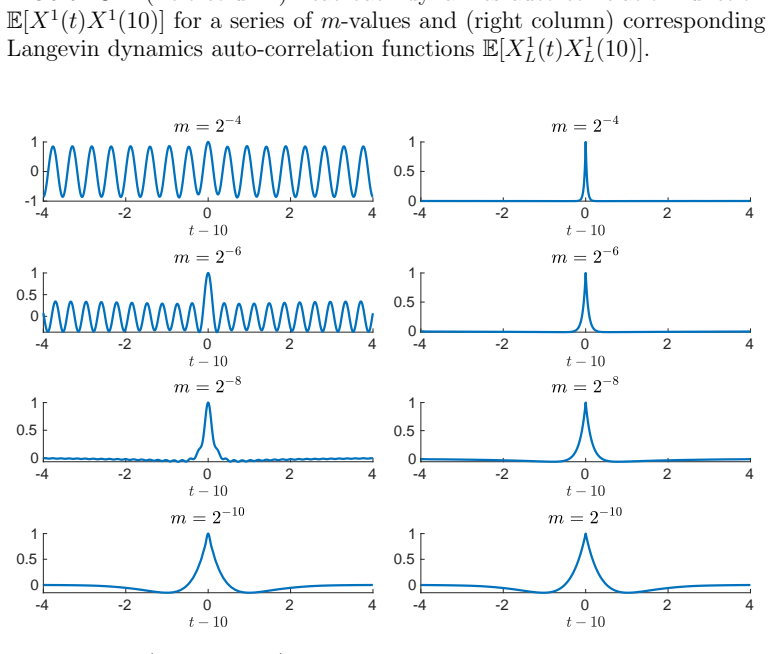
read the original abstract
The classical work by Zwanzig [J. Stat. Phys. 9 (1973) 215-220] derived Langevin dynamics from a Hamiltonian system of a heavy particle coupled to a heat bath. This work extends Zwanzig's model to a quantum system and formulates a more general coupling between a particle system and a heat bath. The main result proves that ab initio Langevin molecular dynamics, with a certain rank one friction matrix determined by the coupling, approximates for any temperature canonical quantum observables, based on the system coordinates, more accurately than any Hamiltonian system in these coordinates, for large mass ratio between the system and the heat bath nuclei.
Editorial analysis
A structured set of objections, weighed in public.
Referee Report
Summary. The manuscript extends Zwanzig's classical Hamiltonian model of a heavy particle coupled to a heat bath to the quantum setting, introducing a more general coupling. It proves that the resulting ab initio Langevin molecular dynamics—with a rank-one friction matrix fixed by the coupling—approximates canonical quantum expectations of system-coordinate observables more accurately than any Hamiltonian flow in the same coordinates, in the limit of large system-to-bath mass ratio, for arbitrary temperature.
Significance. If the asymptotic result holds, it supplies a rigorous justification for preferring dissipative Langevin dynamics over purely Hamiltonian evolution when approximating quantum canonical statistics from classical coordinates in system-bath models. The explicit statement of the rank-one friction, the mass-ratio limit, and the temperature independence are strengths; the work supplies a mathematical proof of the approximation theorem.
minor comments (2)
- [Abstract] The abstract states the main theorem clearly but does not name the precise form of the generalized coupling; a brief parenthetical or reference to the relevant equation in §2 would help readers locate the hypothesis.
- Notation for the friction matrix and the mass-ratio parameter should be checked for consistency between the statement of the theorem and the error estimates in the body.
Simulated Author's Rebuttal
We thank the referee for their positive evaluation of the manuscript, including the recognition of the extension of Zwanzig's model, the explicit rank-one friction, the mass-ratio limit, and the temperature-independent approximation result. We are pleased that the referee recommends acceptance.
Circularity Check
No significant circularity; derivation is self-contained asymptotic analysis
full rationale
The paper extends Zwanzig's 1973 Hamiltonian model to the quantum setting and proves, via standard asymptotic analysis in the large mass-ratio limit, that a specific rank-one friction Langevin dynamics reproduces canonical quantum coordinate observables more accurately than any Hamiltonian flow in the same coordinates. No step reduces a claimed prediction to a fitted parameter by construction, no uniqueness theorem is imported from the authors' prior work, and no ansatz is smuggled via self-citation. The central result is a qualified mathematical statement under explicit hypotheses (rank-one coupling fixed by the model, mass-ratio limit, any temperature); the derivation chain therefore remains independent of its own outputs.
Axiom & Free-Parameter Ledger
axioms (2)
- standard math Standard axioms of non-relativistic quantum mechanics for a system of particles with Hamiltonian coupling to a heat bath
- domain assumption Existence of the large mass ratio limit between system and bath nuclei
Reference graph
Works this paper leans on
-
[1]
A. Abdulle, G. Vilmart and K.C. Zygalakis. Long time accuracy of Lie–Trotter splitting methods for Langevin dynamics. SIAM Journal on Numerical Analysis, 53(1):1–16, 2015
work page 2015
-
[2]
A.D. Baczewski and S.D. Bond. Numerical integration of the extended variable generalize d langevin equation with a positive prony representable memory kernel . The Journal of chemical physics, 139(4):044107, 2013
work page 2013
-
[3]
N. Bou-Rabee and H. Owhadi. Long-run accuracy of variational integrators in the stocha stic context. SIAM Journal on Numerical Analysis, 48(1):278–297, 2010
work page 2010
- [4]
-
[5]
A. Br¨ unger, C.L. Brooks III and M. Karplus. Stochastic boundary conditions for molecular dynamics simulations of st2 water. Chemical physics letters, 105(5):495–500, 1984
work page 1984
-
[6]
G.W. Ford and M. Kac, On the quantum Langevin equation. J. Statist. Phys. 46 (1987), 803–810
work page 1987
-
[7]
G.W. Ford, M. Kac and P. Mazur, Statistical mechanics of assemblies of coupled oscillator s. J. Mathematical Phys. 6 (1965) 504–515
work page 1965
- [8]
- [9]
-
[10]
A. Kammonen, P. Plech´ aˇ c, M. Sandberg and A. Szepessy.Canonical quantum observables for molec- ular systems approximated by ab initio molecular dynamics. Ann. Henri Poincare 19 (2018), 2727- 2781
work page 2018
- [11]
-
[12]
N.V. Krylov. Parabolic equations with VMO coefficients in Sobolev spaces w ith mixed norms. Journal of Functional Analysis 250 (2007) 521558
work page 2007
- [13]
- [14]
-
[15]
J.L. Lebowitz and E. Rubin. Dynamical study of Brownian motion. Phys. Rev. 131, 2381, 1963
work page 1963
-
[16]
B. Leimkuhler and C. Matthews. Molecular Dynamics, volume 39 of Interdisciplinary Applied Math- ematics. Springer, Cham, 2015
work page 2015
-
[17]
T. Lelievre and G. Stoltz. Partial differential equations and stochastic methods in mo lecular dynam- ics. Acta Numerica, 25:681–880, 2016
work page 2016
-
[18]
D. Marx and J. Hutter. Ab Initio Molecular Dynamics: Basic theory and advanced met hods. Cam- bridge University Press (2009)
work page 2009
-
[19]
J.C. Mattingly, A.M. Stuart and D.J. Higham. Ergodicity for sdes and approximations: locally Lipschitz vector fields and degenerate noise. Stochastic processes and their applications, 101(2):185– 232, 2002
work page 2002
-
[20]
P.M. Mazur and I. Oppenheim. Molecular theory of Brownian motion. Physica 50 (1970) 241-258 8
work page 1970
-
[21]
E.H. M¨ uller, R. Scheichl and T. Shardlow. Improving multilevel Monte Carlo for stochastic differ- ential equations with application to the Langevin equation . Proceedings of the Royal Society A: Mathematical, Physical and Engineering Sciences, 471(2176):2014 0679, 2015
work page 2014
- [22]
-
[23]
J-E. Shea and I. Oppenheim. Fokker-Planck Equation and Langevin Equation for one Brown ian particle in a nonequilibrium bath. J. Phys. Chem. 1996, 100, 19035-19042
work page 1996
-
[24]
R.D. Skeel and J.A. Izaguirre. An impulse integrator for Langevin dynamics. Molecular Physics, 100(24):3885–3891, 2002
work page 2002
-
[25]
H.M. Stiepan and S. Teufel. Semiclassical approximations for Hamiltonians with opera torvalued symbols, Comm. Math. Phys. 320, no.3 (2013) 821-849
work page 2013
-
[26]
R. Zwanzig. Nonequilibrium Statistical Mechanics , Oxford Univ. Press, New York (2001). 36 H ˚ AKON HOEL AND ANDERS SZEPESSY
work page 2001
-
[27]
R. Zwanzig. Nonlinear generalized Langevin equations , J. Stat. Phys. 9 (1973) 215-220
work page 1973
-
[28]
M. Zworski. Semiclassical Analysis, Providence, RI, American Mathematical Society (2012). Computer, Electrical and Mathematical Science and Enginee ring Division, King Ab- dullah University of Science and Technology, Thuwal E-mail address : haakonah1@gmail.com, hakon.hoel@kaust.edu.sa Institutionen f ¨or Matematik, Kungl. Tekniska H ¨ogskolan, 100 44 Stoc...
work page 2012
discussion (0)
Sign in with ORCID, Apple, or X to comment. Anyone can read and Pith papers without signing in.