SkyNet: A Champion Model for DAC-SDC on Low Power Object Detection
Pith reviewed 2026-05-25 17:07 UTC · model grok-4.3
The pith
SkyNet is a 12-layer DNN with 1.82 MB parameters that won first place in low-power UAV object detection on both GPU and FPGA.
A machine-rendered reading of the paper's core claim, the machinery that carries it, and where it could break.
Core claim
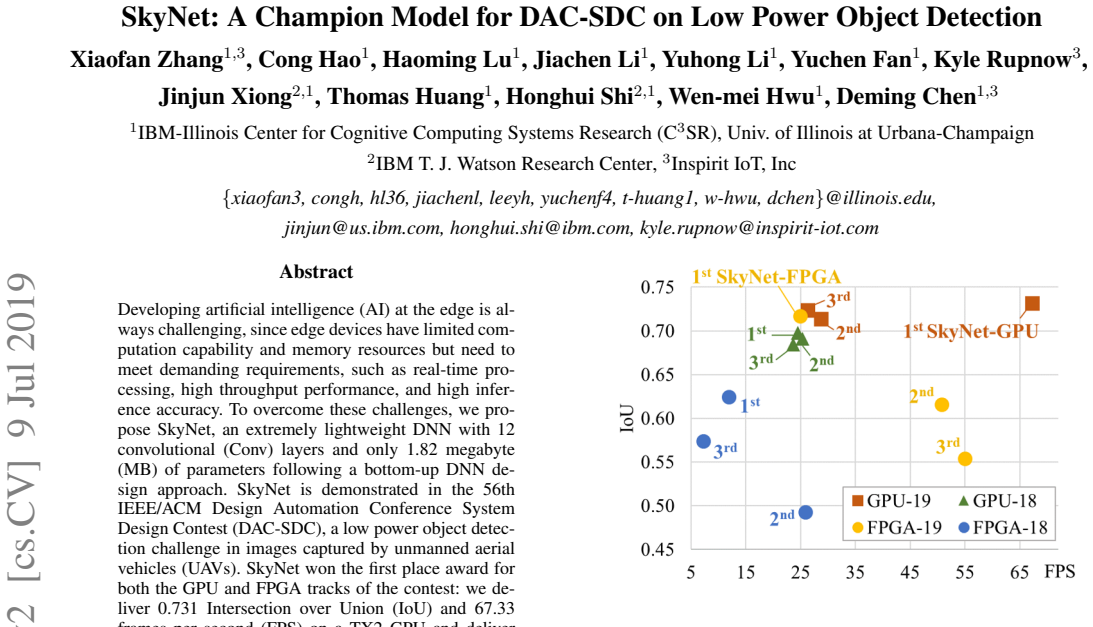
SkyNet is an extremely lightweight DNN with 12 convolutional layers and only 1.82 MB of parameters that won the first place award for both the GPU and FPGA tracks of the DAC-SDC low power object detection challenge on UAV images, delivering 0.731 IoU and 67.33 FPS on a TX2 GPU and 0.716 IoU and 25.05 FPS on an Ultra96 FPGA.
What carries the argument
Bottom-up DNN design approach that builds the 12-layer network layer by layer to meet the contest metrics of IoU and FPS under implied power limits.
If this is right
- Compact networks built this way can support real-time object detection directly on UAV hardware without cloud offload.
- The same bottom-up construction method can be reused for other edge vision tasks that face similar accuracy-throughput-power trade-offs.
- Winning entries on the DAC-SDC benchmark indicate that contest-specific optimization can produce models that meet practical drone deployment constraints.
Where Pith is reading between the lines
- If the bottom-up method generalizes, similar lightweight networks could be derived for additional embedded platforms such as mobile SoCs or custom ASICs.
- Success on UAV imagery suggests the approach may extend to other constrained vision domains like autonomous ground vehicles or surveillance cameras.
- The reported parameter count and layer depth provide a concrete baseline for measuring how much further compression remains possible while preserving the achieved IoU-FPS balance.
Load-bearing premise
The model tuned to the contest dataset and two specific hardware platforms will maintain comparable accuracy and speed on other UAV images and edge devices.
What would settle it
Running SkyNet on a fresh collection of UAV images under the same power envelope and observing IoU fall below 0.7 or FPS drop below the reported values on either the TX2 or Ultra96 would falsify the central performance claim.
Figures


read the original abstract
Developing artificial intelligence (AI) at the edge is always challenging, since edge devices have limited computation capability and memory resources but need to meet demanding requirements, such as real-time processing, high throughput performance, and high inference accuracy. To overcome these challenges, we propose SkyNet, an extremely lightweight DNN with 12 convolutional (Conv) layers and only 1.82 megabyte (MB) of parameters following a bottom-up DNN design approach. SkyNet is demonstrated in the 56th IEEE/ACM Design Automation Conference System Design Contest (DAC-SDC), a low power object detection challenge in images captured by unmanned aerial vehicles (UAVs). SkyNet won the first place award for both the GPU and FPGA tracks of the contest: we deliver 0.731 Intersection over Union (IoU) and 67.33 frames per second (FPS) on a TX2 GPU and deliver 0.716 IoU and 25.05 FPS on an Ultra96 FPGA.
Editorial analysis
A structured set of objections, weighed in public.
Referee Report
Summary. The manuscript presents SkyNet, an extremely lightweight DNN with 12 convolutional layers and 1.82 MB of parameters developed via a bottom-up design approach for low-power object detection on UAV images. It reports that this model won first place in both the GPU and FPGA tracks of the 2019 DAC-SDC contest, delivering 0.731 IoU at 67.33 FPS on a TX2 GPU and 0.716 IoU at 25.05 FPS on an Ultra96 FPGA.
Significance. If the reported contest outcomes are accurate, the work supplies a concrete, hardware-specific benchmark for efficient edge-based object detection under strict power and resource limits. The explicit first-place results on the contest-specified platforms (TX2 and Ultra96) and the small parameter count provide a practical reference point for the community. The paper does not claim or demonstrate generalization beyond the DAC-SDC evaluation dataset and hardware; the central claim remains anchored to the external contest evaluation rather than an internal derivation.
minor comments (2)
- The abstract (and likely the methods section) reports the contest-winning IoU and FPS numbers but supplies no information on training procedure, data splits, hyperparameter choices, or error analysis, limiting reproducibility of the model development process.
- The description of the bottom-up DNN design approach would benefit from additional concrete steps or pseudocode showing how the 12-layer architecture and 1.82 MB parameter count were derived from the contest metrics.
Simulated Author's Rebuttal
We thank the referee for the review and the recommendation of minor revision. No specific major comments were provided in the report, and the referee summary accurately restates the manuscript's contributions and contest results. We are pleased that the work is recognized as supplying a practical benchmark for edge-based object detection under the DAC-SDC constraints.
Circularity Check
No significant circularity
full rationale
The paper is an empirical report of a contest-winning DNN design (SkyNet) evaluated on the external DAC-SDC benchmark with measured IoU/FPS on specified hardware. No mathematical derivation, fitted parameters renamed as predictions, or self-citation chain is present in the provided text; the central claim rests on contest outcomes rather than internal equations that could reduce to inputs by construction.
Axiom & Free-Parameter Ledger
Reference graph
Works this paper leans on
-
[1]
" write newline "" before.all 'output.state := FUNCTION fin.entry add.period write newline FUNCTION new.block output.state before.all = 'skip after.block 'output.state := if FUNCTION new.sentence output.state after.block = 'skip output.state before.all = 'skip after.sentence 'output.state := if if FUNCTION not #0 #1 if FUNCTION and 'skip pop #0 if FUNCTIO...
-
[2]
Deng, J., and Zhuo, C. a. 2018. DAC-SDC'18 2nd place winner in GPU track. https://github.com/jndeng/DACSDC-DeepZ. Accessed: 2019-06-09
work page 2018
-
[3]
Deng, J.; Dong, W.; Socher, R.; Li, L.-J.; Li, K.; and Fei-Fei, L. 2009. Imagenet: A large-scale hierarchical image database. In 2009 IEEE conference on computer vision and pattern recognition , 248--255. Ieee
work page 2009
-
[4]
Deng, J.; Shen, T.; Yan, X.; Chen, Y.; Zhang, H.; Wang, R.; Zhou, P.; and Zhuo, C. 2019. DAC-SDC'19 3rd place winner in GPU track
work page 2019
-
[5]
DJI. 2018. DAC-SDC dataset. https://github.com/xyzxinyi zhang/2018-DAC-System-Design-Contest. Accessed: 2019-06-08
work page 2018
-
[6]
Franklin, D. 2017. NVIDIA Jetson TX2 delivers twice the intelligence to the edge. NVIDIA Accelerated Computing| Parallel Forall
work page 2017
-
[7]
H.; Zhang, X.; Gao, T.; Xiong, J.; Rupnow, K.; Yu, H.; Hwu, W.-M.; and Chen, D
Hao, C.; Li, Y.; Huang, S. H.; Zhang, X.; Gao, T.; Xiong, J.; Rupnow, K.; Yu, H.; Hwu, W.-M.; and Chen, D. 2018. DAC-SDC'18 3rd place winner in FPGA track. https://github.com/onioncc/iSmartDNN. Accessed: 2019-06-09
work page 2018
-
[8]
H.; Rupnow, K.; Xiong, J.; Hwu, W.-M.; and Chen, D
Hao, C.; Zhang, X.; Li, Y.; Chen, Y.; Liu, X.; Huang, S. H.; Rupnow, K.; Xiong, J.; Hwu, W.-M.; and Chen, D. 2019a. DAC-SDC'19 1st place winner in FPGA track
-
[9]
Hao, C.; Zhang, X.; Li, Y.; Huang, S.; Xiong, J.; Rupnow, K.; Hwu, W.-m.; and Chen, D. 2019b. FPGA/DNN co-design: An efficient design methodology for IoT intelligence on the edge. In Proceedings of the 56th Annual Design Automation Conference 2019 , 206. ACM
work page 2019
-
[10]
He, K.; Zhang, X.; Ren, S.; and Sun, J. 2016. Deep residual learning for image recognition. In Proceedings of the IEEE conference on computer vision and pattern recognition , 770--778
work page 2016
-
[11]
MobileNets: Efficient Convolutional Neural Networks for Mobile Vision Applications
Howard, A. G.; Zhu, M.; Chen, B.; Kalenichenko, D.; Wang, W.; Weyand, T.; Andreetto, M.; and Adam, H. 2017. Mobilenets: Efficient convolutional neural networks for mobile vision applications. arXiv preprint arXiv:1704.04861
work page internal anchor Pith review Pith/arXiv arXiv 2017
-
[12]
Hu, J.; Goeders, J.; Brisk, P.; Wang, Y.; Luo, G.; and Yu, B. 2019. 2019 DAC system design contest on low power object detection. When Accuracy meets Power: 2019 DAC System Design Contest on Low Power Object Detection
work page 2019
-
[13]
Kara, K., and Alonso, G. 2019. DAC-SDC'19 3rd place winner in FPGA track
work page 2019
-
[14]
Kara, K.; Zhang, C.; and Alonso, G. 2018. DAC-SDC'18 2nd place winner in FPGA track. https://github.com/fpgasystems/spooNN. Accessed: 2019-06-09
work page 2018
-
[15]
Krizhevsky, A.; Sutskever, I.; and Hinton, G. E. 2012. Imagenet classification with deep convolutional neural networks. In Advances in neural information processing systems , 1097--1105
work page 2012
-
[16]
Liu, W.; Anguelov, D.; Erhan, D.; Szegedy, C.; Reed, S.; Fu, C.-Y.; and Berg, A. C. 2016. Ssd: Single shot multibox detector. In European conference on computer vision , 21--37. Springer
work page 2016
-
[17]
Lu, H.; Cai, X.; Zhao, X.; and Wang, Y. 2018. DAC-SDC'18 1st place winner in GPU track. https://github.com/lvhao7896/DAC2018. Accessed: 2019-06-09
work page 2018
-
[18]
Redmon, J.; Divvala, S.; Girshick, R.; and Farhadi, A. 2016. You only look once: Unified, real-time object detection. In Proceedings of the IEEE conference on computer vision and pattern recognition , 779--788
work page 2016
-
[19]
Simonyan, K., and Zisserman, A. 2014. Very deep convolutional networks for large-scale image recognition. arXiv preprint arXiv:1409.1556
work page internal anchor Pith review Pith/arXiv arXiv 2014
-
[20]
Xiong, F.; Yin, S.; Fan, Y.; and Ouyang, P. 2019. DAC-SDC'19 2nd place winner in GPU track
work page 2019
-
[21]
DAC-SDC Low Power Object Detection Challenge for UAV Applications
Xu, X.; Zhang, X.; Yu, B.; Hu, X. S.; Rowen, C.; Hu, J.; and Shi, Y. 2018. DAC-SDC low power object detection challenge for UAV applications. arXiv preprint arXiv:1809.00110
work page internal anchor Pith review Pith/arXiv arXiv 2018
-
[22]
Zang, C.; Liu, J.; Hao, Y.; Li, S.; Yu, M.; Zhao, Y.; Li, M.; Xue, P.; Qin, X.; Ju, L.; Li, X.; Zhao, M.; and Dai, H. 2018. DAC-SDC'18 3rd place winner in GPU track. https://github.com/xiaoyuuuuu/dac-hdc-2018-object-detection-in-Jetson-TX2. Accessed: 2019-06-09
work page 2018
-
[23]
Zeng, S.; Chen, W.; Huang, T.; Lin, Y.; Meng, W.; Zhu, Z.; and Wang, Y. 2018. DAC-SDC'18 1st place winner in FPGA track. https://github.com/hirayaku/DAC2018-TGIIF. Accessed: 2019-06-09
work page 2018
-
[24]
Zhang, X.; Wang, J.; Zhu, C.; Lin, Y.; Xiong, J.; Hwu, W.-m.; and Chen, D. 2018. DNNBuilder : an automated tool for building high-performance DNN hardware accelerators for FPGAs . In Proceedings of the International Conference on Computer-Aided Design , 56. ACM
work page 2018
-
[25]
Zhang, X.; Hao, C.; Li, Y.; Chen, Y.; Xiong, J.; Hwu, W.-m.; and Chen, D. 2019a. A bi-directional co-design approach to enable deep learning on IoT devices. arXiv preprint arXiv:1905.08369
work page internal anchor Pith review Pith/arXiv arXiv 1905
-
[26]
Zhang, X.; Lu, H.; Li, J. L.; Hao, C.; Fan, Y.; Li, Y.; Huang, S.; Cheng, B.; Wei, Y.; Huang, T.; Xiong, J.; Shi, H.; Hwu, W.-m.; and Chen, D. 2019b. DAC-SDC'19 1st place winner in GPU track
-
[27]
Zhao, B.; Zhao, W.; Xia, T.; Chen, F.; Fan, L.; Zong, P.; Wei, Y.; Tu, Z.; Zhao, Z.; Dong, Z.; and Ren, P. 2019. DAC-SDC'19 2nd place winner in FPGA track
work page 2019
discussion (0)
Sign in with ORCID, Apple, or X to comment. Anyone can read and Pith papers without signing in.