Towards global fits in EFT's and New Physics implications
Pith reviewed 2026-05-25 16:22 UTC · model grok-4.3
The pith
NLO QCD calculations now enable global SMEFT fits across top, Higgs and electroweak sectors simultaneously.
A machine-rendered reading of the paper's core claim, the machinery that carries it, and where it could break.
Core claim
Recent theoretical advances in computing SMEFT effects through next-to-leading order in QCD now support the performance of global fits to dimension-six operators across multiple sectors at once, including the top quark, Higgs, and electroweak sectors.
What carries the argument
Dimension-six SMEFT operators with NLO QCD calculations matched for use in simultaneous global fits to multiple sectors.
If this is right
- Tighter combined constraints on Wilson coefficients from multiple sectors.
- Ability to test for correlations or inconsistencies between sectors.
- More reliable exclusion or preference for specific new physics scenarios.
- Foundation for extending fits to additional observables within the same framework.
Where Pith is reading between the lines
- Sector-by-sector analyses may become less central once multi-sector fits are routine.
- Patterns of deviations across sectors could point toward specific UV completions more directly.
- The approach could be extended to include flavor or other low-energy data for even broader constraints.
Load-bearing premise
The dimension-six SMEFT truncation remains valid and NLO QCD calculations can be consistently matched across sectors without uncontrolled higher-order effects.
What would settle it
A set of global fits that produce mutually incompatible best-fit values for the same operator coefficients when top, Higgs, and electroweak data are combined versus when sectors are fitted separately.
Figures


read the original abstract
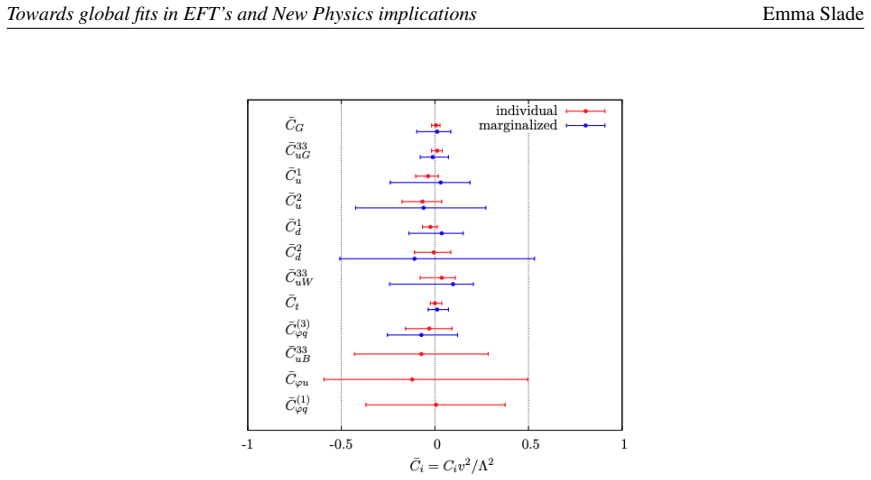
I discuss recent progress on fits to dimension-six operators in the Standard Model Effective Theory (SMEFT). I focus on the top quark sector of the SMEFT, as well as the theoretical advances made in computing SMEFT effects through to next-to-leading order in QCD and the use of these calculations in global fits. I also discuss fits performed to the Higgs and electroweak sectors of the SMEFT and the possibility for performing global fits to multiple sectors simultaneously.
Editorial analysis
A structured set of objections, weighed in public.
Referee Report
Summary. The manuscript discusses recent progress on fits to dimension-six operators in the Standard Model Effective Theory (SMEFT). It focuses on the top quark sector, theoretical advances in computing SMEFT effects to next-to-leading order in QCD and their use in global fits. It also covers fits to the Higgs and electroweak sectors and the possibility for performing global fits to multiple sectors simultaneously.
Significance. If the discussed progress holds, the work is significant for advancing the field towards more comprehensive global SMEFT fits that combine data from top, Higgs, and electroweak sectors. This could lead to tighter constraints on new physics parameters. The inclusion of NLO QCD calculations is a positive aspect as it improves the accuracy of the fits.
major comments (1)
- Abstract: the central claim that global fits spanning the top, Higgs and electroweak sectors are feasible rests on the assumptions that the dim-6 truncation remains uniformly valid and that NLO QCD calculations can be matched across sectors without uncontrolled O(1/Λ^4) effects; however, the text supplies no numerical bounds on neglected terms, no cross-validation of the combined renormalization scheme, and no example fit in which truncation error is propagated when sectors are merged.
Simulated Author's Rebuttal
We thank the referee for the positive evaluation of the manuscript's significance and for the detailed major comment. We respond point-by-point below.
read point-by-point responses
-
Referee: Abstract: the central claim that global fits spanning the top, Higgs and electroweak sectors are feasible rests on the assumptions that the dim-6 truncation remains uniformly valid and that NLO QCD calculations can be matched across sectors without uncontrolled O(1/Λ^4) effects; however, the text supplies no numerical bounds on neglected terms, no cross-validation of the combined renormalization scheme, and no example fit in which truncation error is propagated when sectors are merged.
Authors: The manuscript is a review of recent progress in SMEFT fits rather than a report of a new combined global fit. The abstract discusses the possibility of multi-sector fits based on advances in the top sector (including NLO QCD) and existing separate fits in the Higgs and electroweak sectors, without asserting that a merged analysis with validated truncation errors has been performed. Consequently, the text does not contain numerical bounds on O(1/Λ^4) terms, cross-sector renormalization validation, or an example merged fit, as these would constitute original research beyond the review's scope. The discussion of feasibility rests on the cited literature for each sector and the general SMEFT framework. We do not believe the abstract overstates the current status, so no revision is required. revision: no
Circularity Check
No circularity: discussion references external results without self-referential derivation
full rationale
The paper is a discussion of progress on SMEFT fits across sectors, with the central claim being the possibility of simultaneous global fits. The abstract and description reference external calculations and fits rather than deriving new results from the paper's own fitted parameters or equations. No load-bearing steps reduce by construction to inputs, no self-definitional relations, and no self-citation chains that justify uniqueness or ansatze are present. The claim of feasibility is presented as an outlook supported by cited advances, remaining self-contained against external benchmarks.
Axiom & Free-Parameter Ledger
Lean theorems connected to this paper
-
IndisputableMonolith/Foundation/AbsoluteFloorClosure.leanreality_from_one_distinction unclear?
unclearRelation between the paper passage and the cited Recognition theorem.
fits to dimension-six operators in the Standard Model Effective Theory (SMEFT)... possibility for performing global fits to multiple sectors simultaneously
-
IndisputableMonolith/Cost/FunctionalEquation.leanwashburn_uniqueness_aczel unclear?
unclearRelation between the paper passage and the cited Recognition theorem.
O(Λ^{-2}) corrections... O(Λ^{-4}) effects
What do these tags mean?
- matches
- The paper's claim is directly supported by a theorem in the formal canon.
- supports
- The theorem supports part of the paper's argument, but the paper may add assumptions or extra steps.
- extends
- The paper goes beyond the formal theorem; the theorem is a base layer rather than the whole result.
- uses
- The paper appears to rely on the theorem as machinery.
- contradicts
- The paper's claim conflicts with a theorem or certificate in the canon.
- unclear
- Pith found a possible connection, but the passage is too broad, indirect, or ambiguous to say the theorem truly supports the claim.
Reference graph
Works this paper leans on
-
[1]
Weinberg, Baryon and Lepton Nonconserving Processes, Phys
S. Weinberg, Baryon and Lepton Nonconserving Processes, Phys. Rev. Lett. 43 (1979) 1566–1570. 6 Towards global fits in EFT’s and New Physics implications Emma Slade
work page 1979
-
[2]
W. Buchmuller and D. Wyler, Effective Lagrangian Analysis of New Interactions and Flavor Conservation, Nucl. Phys. B268 (1986) 621–653
work page 1986
-
[3]
Dimension-Six Terms in the Standard Model Lagrangian
B. Grzadkowski, M. Iskrzynski, M. Misiak, and J. Rosiek, Dimension-Six Terms in the Standard Model Lagrangian, JHEP 10 (2010) 085, [arXiv:1008.4884]
work page internal anchor Pith review Pith/arXiv arXiv 2010
-
[4]
The Standard Model as an Effective Field Theory
I. Brivio and M. Trott, The Standard Model as an Effective Field Theory, arXiv:1706.08945
work page internal anchor Pith review Pith/arXiv arXiv
-
[5]
B. Henning, X. Lu, T. Melia, and H. Murayama, 2, 84, 30, 993, 560, 15456, 11962, 261485, ...: Higher dimension operators in the SM EFT, JHEP 08 (2017) 016, [arXiv:1512.03433]
-
[6]
Low-derivative operators of the Standard Model effective field theory via Hilbert series methods
L. Lehman and A. Martin, Low-derivative operators of the Standard Model effective field theory via Hilbert series methods, JHEP 02 (2016) 081, [arXiv:1510.00372]
work page internal anchor Pith review Pith/arXiv arXiv 2016
-
[7]
Weinberg, Baryon- and lepton-nonconserving processes, Phys
S. Weinberg, Baryon- and lepton-nonconserving processes, Phys. Rev. Lett. 43 (Nov, 1979) 1566–1570
work page 1979
-
[8]
C. N. Leung, S. T. Love, and S. Rao, Low-energy manifestations of a new interactions scale: Operator analysis, Zeitschrift für Physik C Particles and Fields31 (Sep, 1986) 433–437
work page 1986
-
[9]
Extending the Standard Model Effective Field Theory with the Complete Set of Dimension-7 Operators
L. Lehman, Extending the Standard Model Effective Field Theory with the Complete Set of Dimension-7 Operators, Phys. Rev. D90 (2014), no. 12 125023, [arXiv:1410.4193]
work page internal anchor Pith review Pith/arXiv arXiv 2014
-
[10]
Effective Field Theory: A Modern Approach to Anomalous Couplings
C. Degrande, N. Greiner, W. Kilian, O. Mattelaer, H. Mebane, T. Stelzer, S. Willenbrock, and C. Zhang, Effective Field Theory: A Modern Approach to Anomalous Couplings, Annals Phys. 335 (2013) 21–32, [arXiv:1205.4231]
work page internal anchor Pith review Pith/arXiv arXiv 2013
-
[11]
Baryon Number, Lepton Number, and Operator Dimension in the Standard Model
A. Kobach, Baryon Number, Lepton Number, and Operator Dimension in the Standard Model, Phys. Lett. B758 (2016) 455–457, [arXiv:1604.05726]
work page internal anchor Pith review Pith/arXiv arXiv 2016
- [12]
- [13]
- [14]
-
[15]
Renormalization Group Scaling of Higgs Operators and \Gamma(h -> \gamma \gamma)
C. Grojean, E. E. Jenkins, A. V . Manohar, and M. Trott,Renormalization Group Scaling of Higgs Operators and Γ(h− > γγ ), JHEP 04 (2013) 016, [arXiv:1301.2588]
work page internal anchor Pith review Pith/arXiv arXiv 2013
-
[16]
Renormalization group evolution of dimension-six baryon number violating operators
R. Alonso, H.-M. Chang, E. E. Jenkins, A. V . Manohar, and B. Shotwell, Renormalization group evolution of dimension-six baryon number violating operators, Phys. Lett. B734 (2014) 302–307, [arXiv:1405.0486]
work page internal anchor Pith review Pith/arXiv arXiv 2014
-
[17]
NLO Higgs Effective Field Theory and kappa-framework
M. Ghezzi, R. Gomez-Ambrosio, G. Passarino, and S. Uccirati, NLO Higgs effective field theory and κ-framework, JHEP 07 (2015) 175, [arXiv:1505.03706]
work page internal anchor Pith review Pith/arXiv arXiv 2015
-
[18]
F. Maltoni, E. Vryonidou, and C. Zhang, Higgs production in association with a top-antitop pair in the Standard Model Effective Field Theory at NLO in QCD, JHEP 10 (2016) 123, [arXiv:1607.05330]
work page internal anchor Pith review Pith/arXiv arXiv 2016
-
[19]
Gluon-fusion Higgs production in the Standard Model Effective Field Theory
N. Deutschmann, C. Duhr, F. Maltoni, and E. Vryonidou, Gluon-fusion Higgs production in the Standard Model Effective Field Theory, JHEP 12 (2017) 063, [arXiv:1708.00460]. [Erratum: JHEP02,159(2018)]. 7 Towards global fits in EFT’s and New Physics implications Emma Slade
work page internal anchor Pith review Pith/arXiv arXiv 2017
-
[20]
A global fit of top quark effective theory to data
A. Buckley, C. Englert, J. Ferrando, D. J. Miller, L. Moore, M. Russell, and C. D. White, Global fit of top quark effective theory to data, Phys. Rev. D92 (2015), no. 9 091501, [arXiv:1506.08845]
work page internal anchor Pith review Pith/arXiv arXiv 2015
-
[21]
Constraining top quark effective theory in the LHC Run II era
A. Buckley, C. Englert, J. Ferrando, D. J. Miller, L. Moore, M. Russell, and C. D. White, Constraining top quark effective theory in the LHC Run II era, JHEP 04 (2016) 015, [arXiv:1512.03360]
work page internal anchor Pith review Pith/arXiv arXiv 2016
-
[22]
Systematic event generator tuning for the LHC
A. Buckley, H. Hoeth, H. Lacker, H. Schulz, and J. E. von Seggern, Systematic event generator tuning for the LHC, Eur. Phys. J.C65 (2010) 331–357, [arXiv:0907.2973]
work page internal anchor Pith review Pith/arXiv arXiv 2010
-
[23]
TopFitter: Fitting top-quark Wilson Coefficients to Run II data
S. Brown, A. Buckley, C. Englert, J. Ferrando, P. Galler, D. J. Miller, L. Moore, M. Russell, C. White, and N. Warrack, TopFitter: Fitting top-quark Wilson Coefficients to Run II data, in 39th International Conference on High Energy Physics (ICHEP 2018) Seoul, Korea, July 4-11, 2018, 2019. arXiv:1901.03164
work page internal anchor Pith review Pith/arXiv arXiv 2018
-
[24]
N. P. Hartland, F. Maltoni, E. R. Nocera, J. Rojo, E. Slade, E. Vryonidou, and C. Zhang, A Monte Carlo global analysis of the Standard Model Effective Field Theory: the top quark sector, JHEP 04 (2019) 100, [arXiv:1901.05965]
work page internal anchor Pith review Pith/arXiv arXiv 2019
-
[25]
J. A. Aguilar Saavedra et al., Interpreting top-quark LHC measurements in the standard-model effective field theory, arXiv:1802.07237
work page internal anchor Pith review Pith/arXiv arXiv
-
[26]
Minimal Flavour Violation: an effective field theory approach
G. D’Ambrosio, G. F. Giudice, G. Isidori, and A. Strumia, Minimal flavor violation: An Effective field theory approach, Nucl. Phys. B645 (2002) 155–187, [hep-ph/0207036]
work page internal anchor Pith review Pith/arXiv arXiv 2002
-
[27]
Single-top associated production with a $Z$ or $H$ boson at the LHC: the SMEFT interpretation
C. Degrande, F. Maltoni, K. Mimasu, E. Vryonidou, and C. Zhang, Single-top associated production with a Z or H boson at the LHC: the SMEFT interpretation, JHEP 10 (2018) 005, [arXiv:1804.07773]
work page internal anchor Pith review Pith/arXiv arXiv 2018
-
[28]
Single Top Production at Next-to-Leading Order in the Standard Model Effective Field Theory
C. Zhang, Single Top Production at Next-to-Leading Order in the Standard Model Effective Field Theory, Phys. Rev. Lett. 116 (2016), no. 16 162002, [arXiv:1601.06163]
work page internal anchor Pith review Pith/arXiv arXiv 2016
-
[29]
C. Degrande, F. Maltoni, J. Wang, and C. Zhang, Automatic computations at next-to-leading order in QCD for top-quark flavor-changing neutral processes, Phys. Rev. D91 (2015) 034024, [arXiv:1412.5594]
work page internal anchor Pith review Pith/arXiv arXiv 2015
-
[30]
Probing top-quark chromomagnetic dipole moment at next-to-leading order in QCD
D. Buarque Franzosi and C. Zhang, Probing the top-quark chromomagnetic dipole moment at next-to-leading order in QCD, Phys. Rev. D91 (2015), no. 11 114010, [arXiv:1503.08841]
work page internal anchor Pith review Pith/arXiv arXiv 2015
-
[31]
Probing top quark neutral couplings in the Standard Model Effective Field Theory at NLO QCD
O. Bessidskaia Bylund, F. Maltoni, I. Tsinikos, E. Vryonidou, and C. Zhang, Probing top quark neutral couplings in the Standard Model Effective Field Theory at NLO in QCD, JHEP 05 (2016) 052, [arXiv:1601.08193]
work page internal anchor Pith review Pith/arXiv arXiv 2016
-
[32]
Global and optimal probes for the top-quark effective field theory at future lepton colliders
G. Durieux, M. Perello, M. V os, and C. Zhang, Global and optimal probes for the top-quark effective field theory at future lepton colliders, JHEP 10 (2018) 168, [arXiv:1807.02121]
work page internal anchor Pith review Pith/arXiv arXiv 2018
-
[33]
S. van Beek, E. R. Nocera, J. Rojo, and E. Slade, Constraining the SMEFT with Bayesian reweighting, arXiv:1906.05296
-
[34]
The NNPDF Collaboration, R. D. Ball et al., Reweighting NNPDFs: the W lepton asymmetry, Nucl. Phys. B849 (2011) 112–143, [arXiv:1012.0836]
work page internal anchor Pith review Pith/arXiv arXiv 2011
-
[35]
R. D. Ball, V . Bertone, F. Cerutti, L. Del Debbio, S. Forte, et al.,Reweighting and Unweighting of Parton Distributions and the LHC W lepton asymmetry data, Nucl.Phys. B855 (2012) 608–638, [arXiv:1108.1758]
work page internal anchor Pith review Pith/arXiv arXiv 2012
-
[36]
The Gauge-Higgs Legacy of the LHC Run II
A. BiekÃ˝ utter, T. Corbett, and T. Plehn,The Gauge-Higgs Legacy of the LHC Run II, SciPost Phys. 6 (2019) 064, [arXiv:1812.07587]. 8 Towards global fits in EFT’s and New Physics implications Emma Slade
work page internal anchor Pith review Pith/arXiv arXiv 2019
-
[37]
R. P. Moutafis, A Global Analysis of the Standard Model Effective Field Theory in the Production and Decay Channels of a Single Top Quark, Master’s thesis, Orsay, LAL, 2019
work page 2019
-
[38]
Gfitter Group Collaboration, M. Baak, J. CÞth, J. Haller, A. Hoecker, R. Kogler, K. MÃ˝ unig, M. Schott, and J. Stelzer, The global electroweak fit at NNLO and prospects for the LHC and ILC, Eur. Phys. J.C74 (2014) 3046, [arXiv:1407.3792]
work page internal anchor Pith review Pith/arXiv arXiv 2014
-
[39]
A. Akhundov, A. Arbuzov, S. Riemann, and T. Riemann, The ZFITTER project, Phys. Part. Nucl. 45 (2014), no. 3 529–549, [arXiv:1302.1395]
work page internal anchor Pith review Pith/arXiv arXiv 2014
-
[40]
The Global Electroweak and Higgs Fits in the LHC era
J. de Blas, M. Ciuchini, E. Franco, S. Mishima, M. Pierini, L. Reina, and L. Silvestrini, The Global Electroweak and Higgs Fits in the LHC era, PoS EPS-HEP2017 (2017) 467, [arXiv:1710.05402]
work page internal anchor Pith review Pith/arXiv arXiv 2017
-
[41]
Updated Global SMEFT Fit to Higgs, Diboson and Electroweak Data
J. Ellis, C. W. Murphy, V . Sanz, and T. You,Updated Global SMEFT Fit to Higgs, Diboson and Electroweak Data, JHEP 06 (2018) 146, [arXiv:1803.03252]
work page internal anchor Pith review Pith/arXiv arXiv 2018
-
[42]
Electroweak Sector Under Scrutiny: A Combined Analysis of LHC and Electroweak Precision Data
E. da Silva Almeida, A. Alves, N. Rosa Agostinho, O. J. P. ÃL ’boli, and M. C. Gonzalezâ˘A¸ SGarcia, Electroweak Sector Under Scrutiny: A Combined Analysis of LHC and Electroweak Precision Data, Phys. Rev. D99 (2019), no. 3 033001, [arXiv:1812.01009]
work page internal anchor Pith review Pith/arXiv arXiv 2019
-
[43]
A Global Likelihood for Precision Constraints and Flavour Anomalies
J. Aebischer, J. Kumar, P. Stangl, and D. M. Straub, A Global Likelihood for Precision Constraints and Flavour Anomalies, Eur. Phys. J.C79 (2019), no. 6 509, [arXiv:1810.07698]
work page internal anchor Pith review Pith/arXiv arXiv 2019
-
[44]
S. Alioli, W. Dekens, M. Girard, and E. Mereghetti, NLO QCD corrections to SM-EFT dilepton and electroweak Higgs boson production, matched to parton shower in POWHEG, JHEP 08 (2018) 205, [arXiv:1804.07407]
work page internal anchor Pith review Pith/arXiv arXiv 2018
-
[45]
A framework for Higgs characterisation
P. Artoisenet, P. de Aquino, F. Demartin, R. Frederix, S. Frixione, et al., A framework for Higgs characterisation, JHEP 1311 (2013) 043, [arXiv:1306.6464]
work page internal anchor Pith review Pith/arXiv arXiv 2013
-
[46]
F. Maltoni, K. Mawatari, and M. Zaro, Higgs characterisation via vector-boson fusion and associated production: NLO and parton-shower effects, Eur. Phys. J.C74 (2014), no. 1 2710, [arXiv:1311.1829]
work page internal anchor Pith review Pith/arXiv arXiv 2014
-
[47]
Higgs characterisation at NLO in QCD: CP properties of the top-quark Yukawa interaction
F. Demartin, F. Maltoni, K. Mawatari, B. Page, and M. Zaro, Higgs characterisation at NLO in QCD: CP properties of the top-quark Yukawa interaction, Eur.Phys.J.C74 (2014), no. 9 3065, [arXiv:1407.5089]
work page internal anchor Pith review Pith/arXiv arXiv 2014
-
[48]
Higgs production in association with a single top quark at the LHC
F. Demartin, F. Maltoni, K. Mawatari, and M. Zaro, Higgs production in association with a single top quark at the LHC, Eur. Phys. J.C75 (2015), no. 6 267, [arXiv:1504.00611]
work page internal anchor Pith review Pith/arXiv arXiv 2015
-
[49]
K. Mimasu, V . Sanz, and C. Williams, Higher Order QCD predictions for Associated Higgs production with anomalous couplings to gauge bosons, JHEP 08 (2016) 039, [arXiv:1512.02572]
work page internal anchor Pith review Pith/arXiv arXiv 2016
-
[50]
C. Degrande, B. Fuks, K. Mawatari, K. Mimasu, and V . Sanz, Electroweak Higgs boson production in the standard model effective field theory beyond leading order in QCD, Eur. Phys. J.C77 (2017), no. 4 262, [arXiv:1609.04833]. 9
work page internal anchor Pith review Pith/arXiv arXiv 2017
discussion (0)
Sign in with ORCID, Apple, or X to comment. Anyone can read and Pith papers without signing in.