Early formation of moons around large trans-Neptunian objects via giant impacts
Pith reviewed 2026-05-25 15:30 UTC · model grok-4.3
The pith
Giant impacts formed all moons of large trans-Neptunian objects early on, with the bodies starting molten and later becoming rigid.
A machine-rendered reading of the paper's core claim, the machinery that carries it, and where it could break.
Core claim
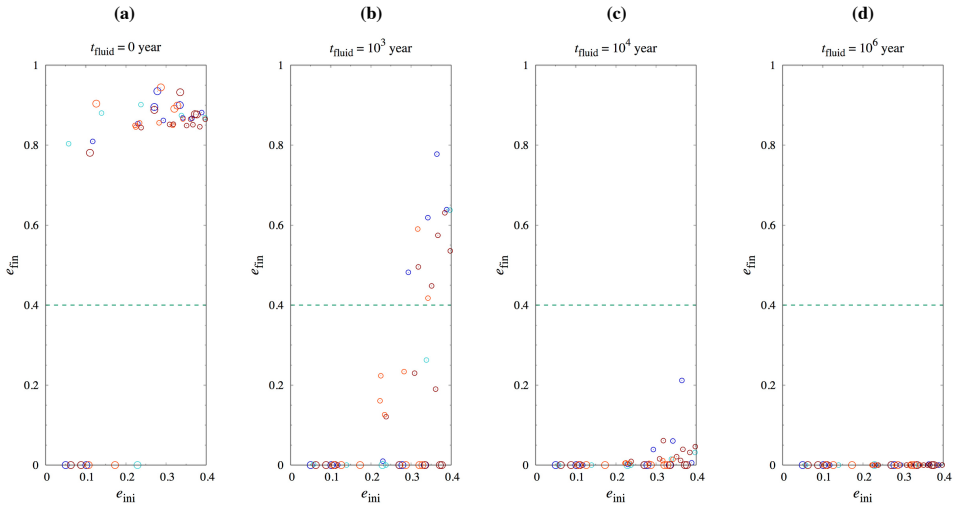
Through systematic hydrodynamic simulations of giant impacts, the secondary-to-primary mass ratio in the resulting satellite systems varies over a wide range that overlaps with observed values. The distributions of spin and orbital periods together with small eccentricities are reproducible only when the bodies undergo tidal evolution that begins while fluid-like and ends while rigid. All satellites of large TNOs therefore originated from giant impacts in the early solar system, prior to Neptune's outward migration, while the parent bodies were fully or partially molten.
What carries the argument
Hydrodynamic simulations of giant impacts that generate variable secondary-to-primary mass ratios, followed by a two-stage tidal evolution model from fluid-like to rigid states.
If this is right
- Observed mass ratios among TNO satellites arise directly from the outcomes of giant impacts.
- Matching periods and eccentricities requires an initial fluid-like phase of tidal evolution followed by a rigid phase.
- All large TNO satellites formed via giant impacts before Neptune's outward migration.
- The parent bodies were fully or partially molten during the era of these impacts.
Where Pith is reading between the lines
- The scenario ties satellite formation timing to the dynamical rearrangement of the outer solar system.
- Similar impact-driven formation could apply to other distant bodies that experienced comparable collisions.
- Compositional measurements of TNO satellites might show chemical signatures of an early molten state.
Load-bearing premise
The current spin, orbital periods, and eccentricities of these satellite systems can be explained only by tidal evolution that starts fluid-like and ends rigid.
What would settle it
A large TNO satellite system whose mass ratio or spin/orbital properties lie outside the range produced by any combination of the impact simulations and fluid-then-rigid tidal evolution.
Figures


read the original abstract
Recent studies have revealed that all large (over 1000 km in diameter) trans-Neptunian objects (TNOs) form satellite systems. Although the largest Plutonian satellite, Charon, is thought to be an intact fragment of an impactor directly formed via a giant impact, whether giant impacts can explain the variations in secondary-to-primary mass ratios and spin/orbital periods among all large TNOs remains to be determined. Here we systematically perform hydrodynamic simulations to investigate satellite formation via giant impacts. We find that the simulated secondary-to-primary mass ratio varies over a wide range, which overlaps with observed mass ratios. We also reveal that the satellite systems' current distribution of spin/orbital periods and small eccentricity can be explained only when their spins and orbits tidally evolve: initially as fluid-like bodies, but finally as rigid bodies. These results suggest that all satellites of large TNOs were formed via giant impacts in the early stage of solar system formation, before the outward migration of Neptune, and that they were fully or partially molten during the giant impact era.
Editorial analysis
A structured set of objections, weighed in public.
Referee Report
Summary. The manuscript reports results from hydrodynamic simulations of giant impacts between large trans-Neptunian objects. These simulations produce secondary-to-primary mass ratios spanning a wide range that overlaps observed values for TNO satellite systems. The authors further argue that the observed distribution of spin/orbital periods together with low eccentricities can be reproduced only via a specific two-stage tidal evolution in which the bodies first behave as fluid-like and later as rigid. This leads to the claim that all satellites of large TNOs formed via giant impacts early in solar-system history, prior to Neptune's outward migration, while the bodies were fully or partially molten.
Significance. If the central results hold, the work supplies a single formation channel that accounts for the satellite systems of every large TNO, tying their origin to the giant-impact epoch and implying a molten state at that time. It thereby links satellite properties directly to the dynamical architecture of the outer solar system before Neptune's migration.
major comments (2)
- [Abstract] Abstract: the assertion that the observed periods and eccentricities 'can be explained only when' spins and orbits tidally evolve first as fluid-like bodies and finally as rigid bodies is load-bearing for the interpretation, yet the manuscript provides no explicit comparisons against alternative rheology sequences (always-rigid, always-fluid, or different transition epochs).
- [Abstract] Abstract: the conclusion that 'all satellites of large TNOs were formed via giant impacts' rests on both the mass-ratio overlap and the uniqueness of the tidal path; the reported overlap is described only qualitatively ('varies over a wide range') without quantitative coverage metrics or sensitivity tests to the listed free parameters (impact velocity, angle, mass ratio, initial thermal/spin states).
minor comments (1)
- The abstract refers to 'systematic' hydrodynamic simulations but supplies no reference to resolution tests, convergence criteria, or tabulated parameter ranges that would allow independent assessment of robustness.
Simulated Author's Rebuttal
We thank the referee for the constructive report. We address the two major comments below. Both identify legitimate gaps in the current presentation, and we will revise the manuscript to incorporate the requested comparisons and quantitative metrics.
read point-by-point responses
-
Referee: [Abstract] Abstract: the assertion that the observed periods and eccentricities 'can be explained only when' spins and orbits tidally evolve first as fluid-like bodies and finally as rigid bodies is load-bearing for the interpretation, yet the manuscript provides no explicit comparisons against alternative rheology sequences (always-rigid, always-fluid, or different transition epochs).
Authors: We agree that explicit comparisons to alternative rheology sequences are needed to substantiate the uniqueness claim. The main text contains tidal-evolution calculations for the fluid-to-rigid pathway, but does not show side-by-side results for always-rigid, always-fluid, or alternate transition epochs. In the revised manuscript we will add a dedicated subsection and accompanying figure that directly compares the final spin/orbital periods and eccentricities obtained under each rheology sequence, confirming that only the two-stage fluid-then-rigid evolution reproduces the observed distribution. revision: yes
-
Referee: [Abstract] Abstract: the conclusion that 'all satellites of large TNOs were formed via giant impacts' rests on both the mass-ratio overlap and the uniqueness of the tidal path; the reported overlap is described only qualitatively ('varies over a wide range') without quantitative coverage metrics or sensitivity tests to the listed free parameters (impact velocity, angle, mass ratio, initial thermal/spin states).
Authors: The referee is correct that the abstract and results section describe the mass-ratio overlap only qualitatively. Although the simulation suite varies the listed parameters, we do not report quantitative coverage fractions or systematic sensitivity tests. We will revise the results section to include (i) histograms or cumulative distribution functions of secondary-to-primary mass ratios across the full parameter grid, (ii) the fraction of runs that fall within the observed TNO range, and (iii) sensitivity plots showing how the overlap changes with impact velocity, angle, mass ratio, and initial thermal/spin state. The abstract will be updated to reflect these quantitative findings. revision: yes
Circularity Check
No significant circularity; results from independent hydrodynamic simulations
full rationale
The derivation relies on hydrodynamic impact simulations that generate a range of secondary-to-primary mass ratios overlapping observations, plus separate tidal evolution modeling to match periods and eccentricities. Neither reduces by construction to the target data via definition, fitting, or self-citation chain. The 'only when' phrasing for fluid-then-rigid evolution is a modeling outcome rather than a self-definitional or fitted-input prediction. No load-bearing self-citation or ansatz smuggling is exhibited in the text. This is the common honest finding of a self-contained simulation study.
Axiom & Free-Parameter Ledger
free parameters (2)
- Impact velocity, angle, and mass ratio
- Initial thermal and spin states of colliding bodies
axioms (2)
- domain assumption Hydrodynamic equations govern the outcome of giant impacts between icy bodies at the relevant scales
- domain assumption Tidal evolution proceeds first as fluid-like bodies and later as rigid bodies
Lean theorems connected to this paper
-
IndisputableMonolith/Cost/FunctionalEquation.leanwashburn_uniqueness_aczel unclear?
unclearRelation between the paper passage and the cited Recognition theorem.
We also reveal that the satellite systems’ current distribution of spin/orbital periods and small eccentricity can be explained only when their spins and orbits tidally evolve: initially as fluid-like bodies, but finally as rigid bodies.
-
IndisputableMonolith/Foundation/AbsoluteFloorClosure.leanreality_from_one_distinction unclear?
unclearRelation between the paper passage and the cited Recognition theorem.
systematically perform hydrodynamic simulations to investigate satellite formation via giant impacts
What do these tags mean?
- matches
- The paper's claim is directly supported by a theorem in the formal canon.
- supports
- The theorem supports part of the paper's argument, but the paper may add assumptions or extra steps.
- extends
- The paper goes beyond the formal theorem; the theorem is a base layer rather than the whole result.
- uses
- The paper appears to rely on the theorem as machinery.
- contradicts
- The paper's claim conflicts with a theorem or certificate in the canon.
- unclear
- Pith found a possible connection, but the passage is too broad, indirect, or ambiguous to say the theorem truly supports the claim.
Reference graph
Works this paper leans on
-
[1]
primary", and the second largest body the
Analysis of the masses of planetary bodies 13 To obtain the masses of planetary bodies from the collision outcome data, we used a friends-of-friends algorithm14 to identify clumps of SPH particles. If the distance between two particles was less than a critical value (lFOF) we defined these particles as belonging to the same clump. lFOF is given by lFOF = ...
-
[2]
Orbital Evolution of Formed Satellites Both the planet and satellite raise tides on each other. The tidal lag caused by friction leads to angular momentum exchange, which also leads to spin and orbital evolution. The tidal evolution of Pluto-Charon has been investigated by several previous studies34,35. In this study, we used O(e6) tidal evolution equatio...
-
[3]
Monaghan, J. J. 1992, ARA&A, 30, 543. 31. Genda, H., Fujita, T., Kobayashi, H., Tanaka, H., & Abe, Y. 2015, Icarus, 262, 58. 32. Tillotson, J. H. 1962, General Atomic Report, GA-3216. 33. Agnor, C., & Asphaug, E. 2004, ApJL, 613, L157. 34. Ward, W. R., & Canup, R. M. 2006, Science, 313, 1107. 35. Cheng, W. H., Lee, M. H., & Peale, S. J. 2014, Icarus, 233,...
work page 1992
-
[4]
+ 𝒪(𝑒U)1 − 3𝑛2 𝑀&𝑀- 2𝑅-𝑎5M 𝑘.,-𝑄- Q732𝑒
TIDAL HEATING ON INTACT MOONS When the primary rotates quickly and the secondary is in synchronous state, the orbit-averaged variation of the semimajor axis can be simplified as follows: 1𝑎d𝑎d𝑡 = 3𝑛2 𝑀-𝑀& 2𝑅&𝑎5M 𝑘.,&𝑄& /2 + 27𝑒. + 𝒪(𝑒U)1 − 3𝑛2 𝑀&𝑀- 2𝑅-𝑎5M 𝑘.,-𝑄- Q732𝑒. + 𝒪(𝑒U)W. Here we discuss whether satellites in solid-state can turn into fluid-like bo...
-
[5]
CATASTROPHIC DISRUPTION OF PRIMORDIAL MOONS AND THE FORMATION OF HAUMEAN MOONS Haumea has a short spin period of 3.92 hours11, and it has two satellites named Hi’iaka and Namaka. The masses of Haumea, Hi’iaka, and Namaka are 4.0 × 10²¹ kg, 1.8 × 10¹⁹ kg, and 1.8 × 10¹⁸ kg, respectively12, and the secondary-to-primary mass ratio (γsp) of the Haumean system...
work page internal anchor Pith review Pith/arXiv arXiv 2007
discussion (0)
Sign in with ORCID, Apple, or X to comment. Anyone can read and Pith papers without signing in.