Making Smartphone Application Permissions Meaningful for the Average User
Pith reviewed 2026-05-25 16:07 UTC · model grok-4.3
The pith
Smartphone permissions can shift from device resources to user-tangible services via middleware without refactoring applications.
A machine-rendered reading of the paper's core claim, the machinery that carries it, and where it could break.
Core claim
The paper claims that the UNIX-rooted permission system is both too coarse and too fine-grained because it uses the wrong axes, and that replacing the paradigm of an app accessing device resources with one where an app accesses user-tangible services, implemented through a simple middleware wrapper around today's permission system, closes the conceptual gap for users without any refactoring of applications.
What carries the argument
Middleware that wraps a view of application control based on user-tangible services around the existing permission system.
If this is right
- Existing applications continue to function unchanged while users see a different permission model.
- The security model remains compatible with current platforms such as Android.
- Users encounter permissions expressed in terms of everyday services rather than low-level resources.
- The middleware approach avoids the need for a full redesign of the underlying operating system permission mechanisms.
Where Pith is reading between the lines
- Similar middleware wrappers could be explored for other permission-based systems outside smartphones.
- Standard categories of user-tangible services might emerge as a practical next step.
- The approach leaves open whether the service framing itself needs further refinement through user testing.
Load-bearing premise
That framing permissions as access to user-tangible services will lead users to make meaningfully different and better decisions than the current resource-based model.
What would settle it
A controlled study in which users are shown identical apps under both permission framings and their installation or permission-granting choices are compared for differences in rate or pattern.
Figures
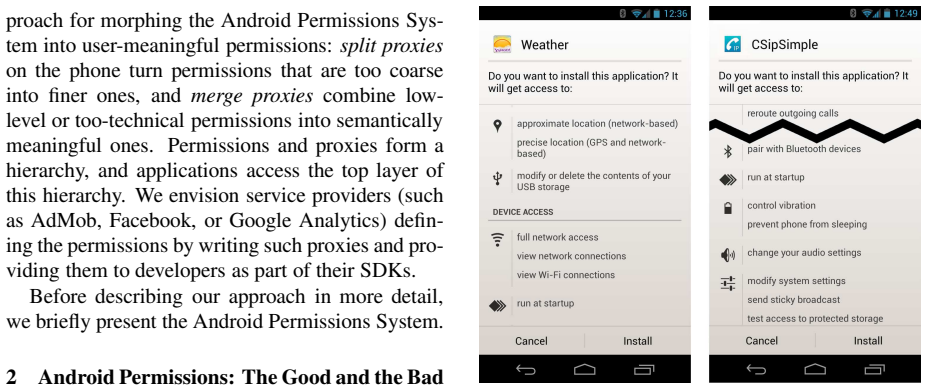
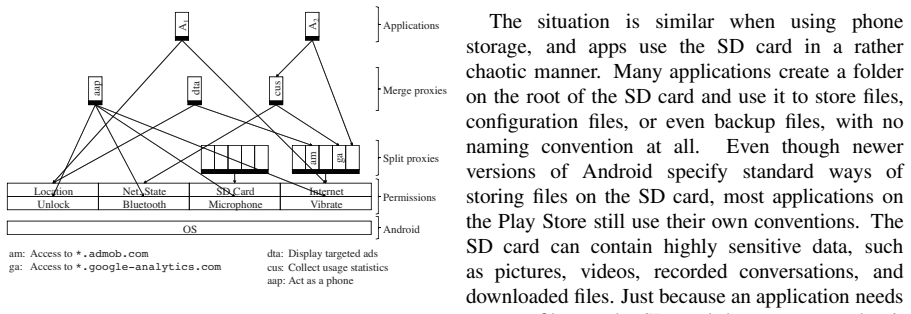
read the original abstract
Smartphones hold important private information, yet users routinely expose this information to questionable applications written by developers they know nothing about. Users may be tempted to think of smartphones as old-style dumb phones, not as powerful network-connected computers, and this opens a gap between the permissions-based security paradigm (offered by platforms like Android) and what users expect. This makes it easy to fool users into installing applications that steal their information. Not surprisingly, Android is now a more favored target for hackers than Windows. We propose an approach for closing this gap, based on the observation that the current permissions system--rooted in good ol' UNIX-style thinking--is both too coarse and too fine grained, because it uses the wrong axes for defining the permissions space. We argue for replacing the paradigm in which "an app accesses device resources" (which is foreign to most non-geeks) with a paradigm in which "an app accesses user-tangible services." By using a simple piece of middleware, we can wrap this view of application control around today's permission system, and, by doing so, no conceptual refactoring of applications is required.
Editorial analysis
A structured set of objections, weighed in public.
Referee Report
Summary. The paper claims that the Android permission system is mismatched to user expectations because it is rooted in resource-access thinking that is both too coarse and too fine-grained; it proposes replacing this with a paradigm of 'user-tangible services' and asserts that a simple middleware layer can wrap the existing permission system to present this view without requiring any conceptual refactoring of applications.
Significance. If the middleware construction can be shown to work and to improve user comprehension, the idea would address a well-known usability gap in mobile security that contributes to over-granting of permissions and successful malware. The proposal is forward-looking and identifies a genuine conceptual mismatch, but its significance remains prospective until the translation mechanism is specified and evaluated.
major comments (2)
- [Abstract] Abstract: the central assertion that 'a simple piece of middleware' can wrap the existing permission system to re-express accesses as user-tangible services while preserving app behavior and OS enforcement is stated without any mechanism, mapping rules, interception strategy, or runtime translation example (e.g., how 'access fine location' becomes 'share my location with contacts'). This premise is load-bearing for the claim that no conceptual refactoring of applications is required.
- [Abstract] Abstract: the paper offers no user study, illustrative mapping, or even a single worked example showing that re-expressing permissions in terms of user-tangible services would actually close the gap between the technical model and average-user expectations; the argument therefore rests entirely on an untested conceptual premise.
Simulated Author's Rebuttal
Thank you for the opportunity to respond to the referee's report. The comments correctly identify that the manuscript presents its core idea at a conceptual level. We address each major comment below.
read point-by-point responses
-
Referee: [Abstract] Abstract: the central assertion that 'a simple piece of middleware' can wrap the existing permission system to re-express accesses as user-tangible services while preserving app behavior and OS enforcement is stated without any mechanism, mapping rules, interception strategy, or runtime translation example (e.g., how 'access fine location' becomes 'share my location with contacts'). This premise is load-bearing for the claim that no conceptual refactoring of applications is required.
Authors: The referee is correct that the abstract states the middleware premise at a high level without specifying mechanisms or examples. The manuscript is a conceptual proposal focused on reframing the permission paradigm rather than a systems paper detailing implementation. We will revise the manuscript to include a high-level description of a possible interception approach (e.g., via Android's permission broker or proxy layers) and at least one concrete mapping example to illustrate feasibility while preserving app behavior and OS enforcement. revision: yes
-
Referee: [Abstract] Abstract: the paper offers no user study, illustrative mapping, or even a single worked example showing that re-expressing permissions in terms of user-tangible services would actually close the gap between the technical model and average-user expectations; the argument therefore rests entirely on an untested conceptual premise.
Authors: We agree that the manuscript contains no user study, mappings, or worked examples. As a conceptual contribution identifying a paradigm mismatch, the paper does not claim empirical validation. We will add an illustrative worked example in the revision to make the translation concrete. A full user study lies beyond the scope of this work and would be appropriate for follow-on research. revision: partial
Circularity Check
No circularity; proposal is a forward-looking conceptual argument without self-referential derivation or fitted inputs
full rationale
The paper presents a high-level proposal to reframe Android permissions around 'user-tangible services' via middleware, without any equations, parameter fitting, or mathematical derivation. No load-bearing step reduces to a prior self-citation, self-definition, or renamed known result; the text simply states the observation that current permissions are 'too coarse and too fine grained' and asserts that middleware can wrap the existing system. This is a design suggestion rather than a closed derivation chain, so the argument remains self-contained against external benchmarks and does not exhibit any of the enumerated circularity patterns.
Axiom & Free-Parameter Ledger
axioms (2)
- domain assumption The current permissions system is both too coarse and too fine grained because it uses the wrong axes.
- domain assumption Users routinely expose private information because they do not understand the permission model.
invented entities (1)
-
Middleware layer that translates resource permissions into user-tangible services
no independent evidence
Reference graph
Works this paper leans on
- [1]
-
[2]
http://reviews.cnet.com/8301-19512_7-57435397- 233/nielsen-1-in-2-own-a-smartphone-average-41-apps/
-
[3]
http://developer.android.com/guide/ topics/security/permissions.html
Android permissions. http://developer.android.com/guide/ topics/security/permissions.html
-
[4]
Android permissions reference. http://developer.android. com/reference/android/Manifest.permission.html
-
[5]
Pausing Google Play: More than 100,000 Android apps may pose security risks
Bit9. Pausing Google Play: More than 100,000 Android apps may pose security risks. https://www.bit9.com/files/ 1/Pausing-Google-Play-October2012.pdf, Oct. 2012
work page 2012
- [6]
-
[7]
M. Burrows, M. Abadi, and R. Needham. A logic of au- thentication.ACM Transactions on Computer Systems, 8(1):18–36, Feb 1990
work page 1990
- [8]
-
[9]
V . Chipounov, V . Georgescu, C. Zamfir, and G. Candea. Selective symbolic execution. InHotDep,2 0 0 9
-
[10]
A. P . Felt, E. Ha, S. Egelman, A. Haney, E. Chin, and D. Wagner. Android permissions: User attention, com- prehension, and behavior. InSOUPS,2 0 1 2
- [11]
-
[12]
B. Levine. Be wary of free Android apps. http://www.sci- tech-today.com/story.xhtml?story_id=13200006Q1XO
-
[13]
I. Lunden. In mobile apps, free ain’t free, but cambridge university has a plan to fix it. TechCrunch,M a r .2 0 1 2 . http://techcrunch.com/2012/03/06/in-mobile-apps-free- aint-free-but-cambridge-university-has-a-plan-to-fix-it/
work page 2012
-
[14]
A. Mindlin. Using phones, but not to talk or surf. The New York Times ,M a r . 2 0 1 1 . http://www.nytimes.com/2011/03/07/business/me- dia/07drill.html
work page 2011
- [15]
-
[16]
R. Ritchie. iOS 6 wants: Granular privacy control.iMore, Feb. 2012. http://www.imore.com/path-apps-accessing- contacts-inspiration-android. 6
work page 2012
discussion (0)
Sign in with ORCID, Apple, or X to comment. Anyone can read and Pith papers without signing in.