Evaluation of head segmentation quality for treatment planning of tumor treating fields in brain tumors
Pith reviewed 2026-05-25 15:28 UTC · model grok-4.3
The pith
Machine learning on segmentation-relevant features can predict the quality of automatic head segmentations for TTFields treatment planning.
A machine-rendered reading of the paper's core claim, the machinery that carries it, and where it could break.
Core claim
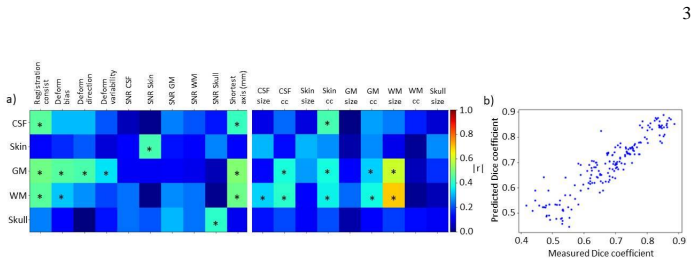
A set of features relevant to atlas-based segmentation correlate significantly with similarity between validated and automatic head segmentations. These features, when supplied to a decision tree regressor, predict the similarity measures for 20 TTFields patients under leave-one-out validation with average absolute difference of 3 percent and correlation coefficient 0.92. The work therefore concludes that quality estimation of segmentations is feasible by incorporating machine learning and segmentation-relevant features.
What carries the argument
Decision tree regressor trained on atlas-based segmentation features to predict similarity between automatic and validated head segmentations.
If this is right
- Automatic refinement of segmentation parameters becomes possible without constant expert oversight.
- The method can highlight specific flaw points in a segmentation for user correction.
- Segmentations can be screened for sufficient accuracy before electric-field simulations are run.
- The quality score supports iterative improvement of transducer-array placement recommendations.
Where Pith is reading between the lines
- The same feature-plus-regressor approach could be tested on segmentation tasks for other therapies that rely on tissue property maps.
- Embedding the predictor inside clinical software might shorten the time from imaging to finalized TTFields plan.
- If the similarity measure is later validated directly against field simulation error, the estimator could serve as a gatekeeper for automated planning pipelines.
Load-bearing premise
The chosen similarity measure between validated and automatic segmentations serves as a sufficient proxy for the accuracy needed to produce reliable electric-field simulations in TTFields planning.
What would settle it
Finding that large differences in the predicted similarity measure produce only negligible changes in the resulting electric-field distributions or in the recommended transducer-array positions would show the quality estimator does not track planning-relevant accuracy.
Figures
read the original abstract
Tumor treating fields (TTFields) is an FDA approved therapy for the treatment of Gliobastoma Multiform (GBM) and currently being investigated for additional tumor types. TTFields are delivered to the tumor through the placement of transducer arrays (TAs) placed on the patient scalp. The positions of the TAs are associated with treatment outcomes via simulations of the electric fields. Therefore, we are currently developing a method for recommending optimal placement of TAs. A key step to achieve this goal is to correctly segment the head into tissues of similar electrical properties. Visual inspection of segmentation quality is invaluable but time-consuming. Automatic quality assessment can assist in automatic refinement of the segmentation parameters, suggest flaw points to the user and indicate if the segmented method is of sufficient accuracy for TTFields simulation. As a first step in this direction, we identified a set of features that are relevant to atlas-based segmentation and show that these are significantly correlated (p < 0.05) with a similarity measure between validated and automatically computed segmentations. Furthermore, we incorporated these features in a decision tree regressor to predict the similarity of the validated and computed segmentations of 20 TTFields patients using a leave-one-out approach. The predicted similarity measures were highly correlated with the actual ones (average abs. difference 3% (SD = 3%); r = 0.92, p < 0.001). We conclude that quality estimation of segmentations is feasible by incorporating machine learning and segmentation-relevant features.
Editorial analysis
A structured set of objections, weighed in public.
Referee Report
Summary. The paper claims that a set of atlas-based segmentation features are significantly correlated (p<0.05) with a similarity measure between manual and automatic head segmentations, and that a decision-tree regressor trained on these features can predict the similarity measure for 20 TTFields patients with r=0.92 and mean absolute error of 3% under leave-one-out cross-validation, concluding that automatic quality estimation of segmentations is feasible for TTFields treatment planning.
Significance. If the chosen similarity metric is shown to be a reliable proxy for segmentation-induced errors in electric-field distributions, the approach could support automated quality control and parameter refinement in TTFields planning pipelines. The reported correlations and LOOCV performance provide preliminary evidence that the selected features carry predictive information about segmentation overlap, but the absence of any forward simulation tying the metric to field quantities limits the assessed clinical significance.
major comments (2)
- [Abstract] Abstract (final paragraph) and Methods: The similarity measure is adopted as the sole target variable for both correlation analysis and regression without any reported forward simulation or sensitivity study demonstrating that changes in this measure produce clinically relevant variation in the electric-field quantities (e.g., |E| inside the tumor or resection cavity) that determine transducer-array placement. This link is load-bearing for the stated motivation.
- [Results] Results (regressor evaluation): The manuscript provides no description of the feature-selection procedure, whether selection was performed inside or outside the LOOCV loop, or any hyperparameter tuning details for the decision tree. On a cohort of only 20 patients this omission directly affects the credibility of the reported r=0.92 and 3% mean absolute error.
minor comments (2)
- [Abstract] Abstract: 'Gliobastoma Multiform' should read 'Glioblastoma Multiforme'.
- [Abstract] Abstract: 'abs. difference' and 'SD =' should be written out consistently for readability.
Simulated Author's Rebuttal
We appreciate the referee's thorough review and constructive suggestions. Below we provide point-by-point responses to the major comments.
read point-by-point responses
-
Referee: [Abstract] Abstract (final paragraph) and Methods: The similarity measure is adopted as the sole target variable for both correlation analysis and regression without any reported forward simulation or sensitivity study demonstrating that changes in this measure produce clinically relevant variation in the electric-field quantities (e.g., |E| inside the tumor or resection cavity) that determine transducer-array placement. This link is load-bearing for the stated motivation.
Authors: The referee correctly identifies that our study uses the segmentation similarity measure as the target without direct validation against electric field simulation errors. This is a valid point regarding the strength of the clinical motivation. As the work is presented as a preliminary study on the feasibility of using machine learning for quality estimation, we will revise the abstract and discussion to better contextualize the similarity measure as a proxy and to outline the need for future sensitivity analyses linking it to field distributions. revision: partial
-
Referee: [Results] Results (regressor evaluation): The manuscript provides no description of the feature-selection procedure, whether selection was performed inside or outside the LOOCV loop, or any hyperparameter tuning details for the decision tree. On a cohort of only 20 patients this omission directly affects the credibility of the reported r=0.92 and 3% mean absolute error.
Authors: We agree that additional details on the feature selection procedure and hyperparameter settings are necessary for full transparency, especially given the small sample size. The features were pre-selected based on the statistically significant correlations reported earlier in the manuscript, with the selection performed on the entire dataset prior to LOOCV. The decision tree regressor was implemented using default hyperparameters from the scikit-learn library without further tuning. We will update the Methods section to explicitly describe this process and discuss its implications for the LOOCV results. revision: yes
- Forward simulation studies to establish the relationship between the similarity measure and clinically relevant electric field variations, which are outside the scope of the present work.
Circularity Check
No significant circularity; standard ML prediction of independent similarity metric
full rationale
The paper extracts atlas-relevant features, demonstrates their correlation (p<0.05) with a Dice-like similarity measure between manual and automatic segmentations, and trains a decision-tree regressor via LOOCV to predict that measure (r=0.92). This is a conventional supervised regression setup where features are independently computed quantities and the target is an external validation metric; the regressor output is not equivalent to any fitted parameter or input by construction. No self-citations, self-definitional steps, or imported uniqueness claims appear in the text. The derivation chain is self-contained against the reported cross-validation benchmark.
Axiom & Free-Parameter Ledger
Reference graph
Works this paper leans on
-
[1]
Stupp, R., Taillibert, S., Kanner, A., Read, W., Steinberg, D., Lhermitte, B., Toms, S., Idbaih, A., Ahluwalia, M.S., Fink, K., Di Meco, F., Lieberman, F., Zhu, J. -J., Stragliotto, G., Tran, D., Brem, S., Hottinger, A., Kirson, E.D., Lavy-Shahaf, G., Weinberg, U., Kim, C.-Y., Paek, S.-H., Nicholas, G., Bruna, J., Hirte, H., Weller, M., Palti, Y., Heg i, ...
work page 2017
-
[2]
Bomzon, Z., Hershkovich, H.S., Urman, N., Chaudhry, A., Garcia -Carracedo, D., Korshoej, A.R., Weinberg, U., Wenger, C., Miranda, P., Wasserman, Y., Kirson, E.D., Yoram: Using computational phantoms to improve delivery of Tumor Treating Fields (TTFields) to patients. In: 2016 38th Annual International Conference of the IEEE Engineering in Medicine and Bio...
work page 2016
- [3]
-
[4]
Presented at the October 14 (2001)
Gerig, G., Jomier, M., Chakos, M.: Valmet: A New Validation Tool for Assessing and Improving 3D Object Segmentation. Presented at the October 14 (2001)
work page 2001
-
[5]
Warfield, S.K., Zou, K.H., Wells, W.M.: Simultaneous truth and performance level estimation (STAPLE): an algorithm for the validation of image segmentation. IEEE Trans. Med. Imaging. 23, 903–21 (2004)
work page 2004
-
[6]
Commowick, O., Akhondi -Asl, A., Warfield, S.K.: Estimating a reference standard segmentation with spatially varying performance para meters: local MAP STAPLE. IEEE Trans. Med. Imaging. 31, 1593–606 (2012)
work page 2012
-
[7]
Rivest-Hénault, D., Dowson, N., Greer, P.B., Fripp, J., Dowling, J.A.: Robust inverse-consistent affine CT–MR registration in MRI -assisted and MRI-alone prostate radiation therapy. Med. Image Anal. 23, 56–69 (2015)
work page 2015
- [8]
-
[9]
Akhondi-Asl, A., Warfield, S.K.: Simultaneous truth and performance level estimation through fusion of probabilistic segmentations. IEEE Trans. Me d. Imaging. 32, 1840–52 (2013)
work page 2013
discussion (0)
Sign in with ORCID, Apple, or X to comment. Anyone can read and Pith papers without signing in.