Resonance of bounded isochronous oscillators
Pith reviewed 2026-05-25 15:18 UTC · model grok-4.3
The pith
A sufficient condition on the perturbation guarantees that all solutions escape the bounded period annulus of an isochronous oscillator.
A machine-rendered reading of the paper's core claim, the machinery that carries it, and where it could break.
Core claim
For an isochronous oscillator whose period annulus is bounded, if the time-periodic perturbation has exactly the same period and satisfies the given sufficient condition, then resonance occurs and every solution escapes the annulus.
What carries the argument
The sufficient condition on the time-periodic perturbation that forces escape from the bounded period annulus.
If this is right
- Every orbit starting inside the annulus eventually leaves it when the perturbation meets the condition.
- No periodic motion inside the annulus survives the forcing.
- The boundedness of the annulus is essential for the escape result to hold under the stated condition.
- Resonance is detected precisely by the absence of any trapped solutions.
Where Pith is reading between the lines
- The condition may be checked explicitly on concrete examples such as perturbed harmonic oscillators with bounded annuli.
- Similar escape criteria could be sought for isochronous systems whose annuli are unbounded.
- The result suggests that resonance in this setting is controlled by an integral or averaging property of the perturbation over one period.
Load-bearing premise
The unforced system must be an isochronous oscillator whose period annulus is bounded, and the perturbation must be time-periodic with exactly the same period as the unforced motions.
What would settle it
Exhibiting even one solution that remains inside the bounded period annulus for all time under a perturbation satisfying the sufficient condition would disprove the claim.
Figures
read the original abstract
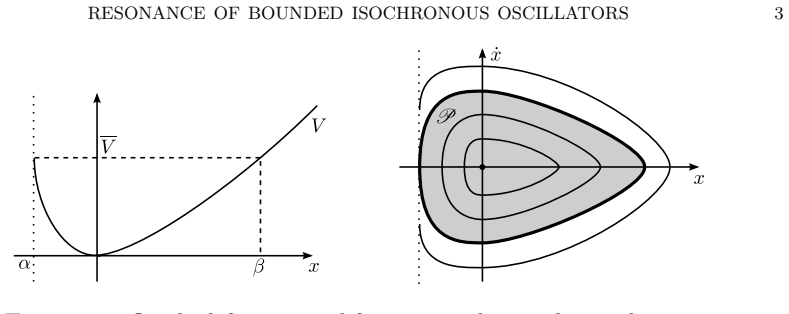
An oscillator is called isochronous if all motions have a common period. When the system is forced by a time-dependent perturbation with the same period the phenomenon of resonance may appear. We give a sufficient condition on the perturbation in order that resonance occurs when the period annulus of the isochronous oscillator is bounded. In this context, resonance means that all solutions escape from the period annulus.
Editorial analysis
A structured set of objections, weighed in public.
Referee Report
Summary. The paper claims to give a sufficient condition on a time-periodic perturbation (commensurate with the common period of the unforced isochronous oscillator) such that resonance occurs, meaning every solution eventually escapes the bounded period annulus.
Significance. If the stated sufficient condition is rigorously established, the result supplies an explicit, checkable criterion for forced escape from a bounded isochronous annulus. This is a concrete contribution to the literature on commensurate forcing of nonlinear oscillators and could be used to design or rule out resonant behavior in applications.
minor comments (3)
- [Abstract] The abstract states the existence of a sufficient condition but does not display the condition itself; readers must reach the main theorem to see the precise statement.
- [Introduction] Notation for the period annulus, the common period T, and the form of the perturbation should be introduced once in a dedicated preliminary section rather than piecemeal.
- A short remark comparing the new condition with classical small-amplitude or averaging results for isochronous centers would help situate the contribution.
Simulated Author's Rebuttal
We thank the referee for the positive assessment of the manuscript and the recommendation for minor revision. The referee correctly identifies the contribution as supplying an explicit, checkable criterion for resonance under commensurate forcing of bounded isochronous oscillators.
Circularity Check
No significant circularity; derivation self-contained as sufficient-condition theorem
full rationale
The paper states a sufficient condition on a time-periodic perturbation that forces escape from a bounded period annulus of an isochronous center. The claim is a direct existence result under standard commensurate-period assumptions; no fitted parameters are renamed as predictions, no self-citation chain is invoked to justify uniqueness or the central premise, and the derivation does not reduce by construction to its inputs. The setup is internally consistent and externally falsifiable via the stated hypotheses on the unforced flow and forcing term.
Axiom & Free-Parameter Ledger
axioms (2)
- domain assumption The unforced system is an isochronous oscillator whose period annulus is bounded.
- domain assumption The perturbation is time-periodic with exactly the same period as the unforced motions.
Reference graph
Works this paper leans on
-
[1]
M. Abramowitz, I. Stegun, Handbook of Mathematical Functions with Formulas, Graphs, and Mathematical Tables, Dover Publications, 1965
work page 1965
- [2]
-
[3]
D. Bonheure, C. Fabry, D. Smets, Periodic solutions of forced isochronous oscillators at reso- nance, Discrete Contin. Dyn. Syst. 8 (2002) 907–930
work page 2002
- [4]
-
[5]
Liu, Boundedness in asymmetric oscillators , J
B. Liu, Boundedness in asymmetric oscillators , J. Math. Anal. Appl. 231 355–373
-
[6]
F. Ma˜ nosas, D. Rojas, J. Villadelprat, Study of the period function of a two-parameter family of centers, J. Math. Anal. Appl. 452 (2017) 188–208
work page 2017
-
[7]
R. Ortega, Periodic perturbations of an isochronous center , Qualitative Theory of Dynamical systems 3 (2002) 83–91
work page 2002
-
[8]
Ortega, Unbounded motions in forced Newtonian equations , Annali di Mathematica 185 (2006) S245–S257
R. Ortega, Unbounded motions in forced Newtonian equations , Annali di Mathematica 185 (2006) S245–S257
work page 2006
-
[9]
Ortega, Periodic differential equations in the plane: a topological perspective
R. Ortega, Periodic differential equations in the plane: a topological perspective . De Gruyter, Incorporated, 2019
work page 2019
-
[10]
R. Ortega and D. Rojas, A proof of Bertrand’s theorem using the theory of isochronous po- tentials, J. Dyn. Diff. Equat. (2018)
work page 2018
-
[11]
R. Ortega and D. Rojas, Periodic oscillators, isochronous centers and resonance, Nonlinearity 32 (2019) 800–832
work page 2019
-
[12]
H. Pollard, Mathematical introduction to celestial mechanics , Prentice-Hall, Inc., Englewood Cliffs, N.J. 1966
work page 1966
- [13]
-
[14]
Urabe, Potential forces which yield periodic motions of a fixed period , J
M. Urabe, Potential forces which yield periodic motions of a fixed period , J. Math. Mech. 10 (1961) 569–578
work page 1961
-
[15]
M. Urabe, The potential force yielding a periodic motion whose period is an arbitrary con- tinuous function of the amplitude of the velocity , M. Arch. Rational Mech. Anal. 11 (1962) 27–33. Departament d’ Inform`atica, Matem`atica Aplicada i Estad´ıstica, Universitat de Girona, 17003 Girona, Spain E-mail address : david.rojas@udg.edu
work page 1962
discussion (0)
Sign in with ORCID, Apple, or X to comment. Anyone can read and Pith papers without signing in.