Generalization of Dempster-Shafer theory: A complex belief function
Pith reviewed 2026-05-25 15:12 UTC · model grok-4.3
The pith
Modeling belief masses as complex numbers removes the conflict restriction from Dempster's combination rule.
A machine-rendered reading of the paper's core claim, the machinery that carries it, and where it could break.
Core claim
A mass function in the generalized Dempster-Shafer evidence theory is modeled by a complex number, called a complex basic belief assignment, which has more powerful ability to express uncertain information. Based on that, a generalized Dempster's combination rule is exploited. In contrast to the classical Dempster's combination rule, the condition in terms of the conflict coefficient between the evidences K<1 is released in the generalized Dempster's combination rule. Hence, it is more general and applicable than the classical Dempster's combination rule. When the complex mass function is degenerated from complex numbers to real numbers, the generalized Dempster's combination rule degeneresr
What carries the argument
The complex basic belief assignment, a mass function whose values are complex numbers, which carries both belief magnitude and phase information into the generalized combination rule.
If this is right
- Evidence sources can be combined even when their conflict coefficient K meets or exceeds one.
- Uncertainty and concurrent phase or periodicity changes are expressed in a single mass function.
- The classical theory is recovered precisely when complex values reduce to real numbers and K remains below one.
- The approach applies directly to data whose timing or oscillation properties matter for uncertainty modeling.
Where Pith is reading between the lines
- The complex representation could integrate with existing complex-valued signal processing or neural network pipelines that already track phase.
- One could check whether the new rule preserves algebraic properties such as associativity or commutativity under complex arithmetic.
- Practical tests on time-series sensor data would reveal whether the added phase dimension changes fusion accuracy compared with real-valued baselines.
- Interpretation rules for the imaginary part of combined beliefs would need to be developed before routine use.
Load-bearing premise
Representing belief masses as complex numbers faithfully encodes both the degree of belief and any phase-related fluctuations in a way that produces coherent combined results under the new rule.
What would settle it
Apply the generalized rule to two complex basic belief assignments whose real parts form a classical pair with conflict coefficient at least one; if the output masses fail to sum to one or yield uninterpretable negative components, the generalization does not hold.
Figures
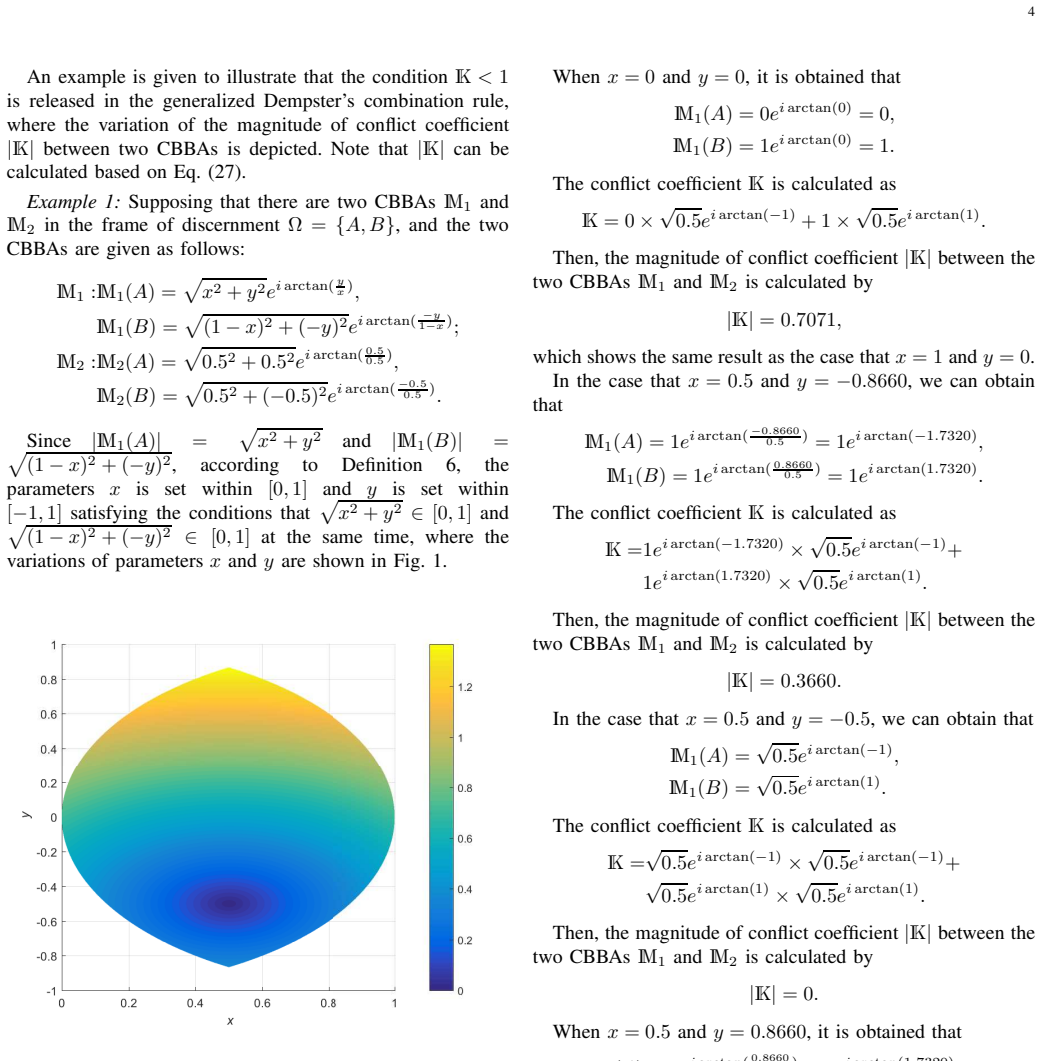
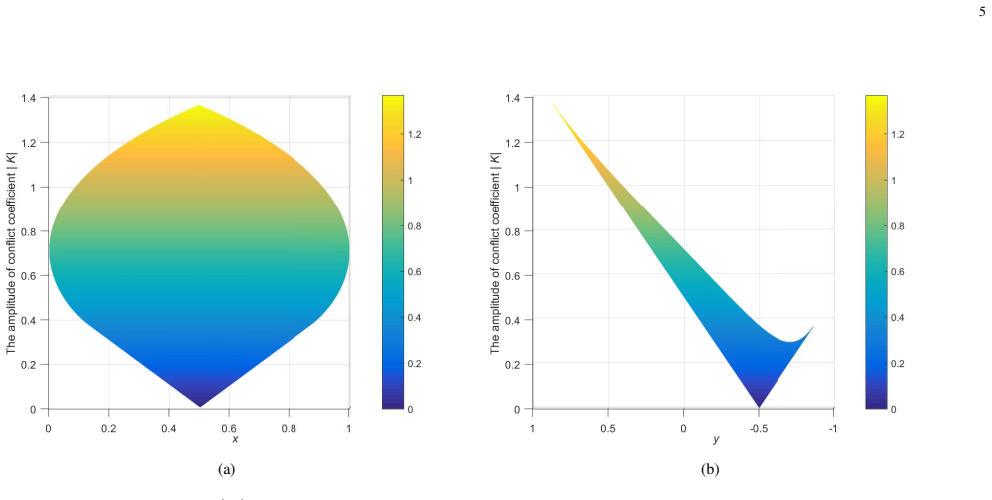
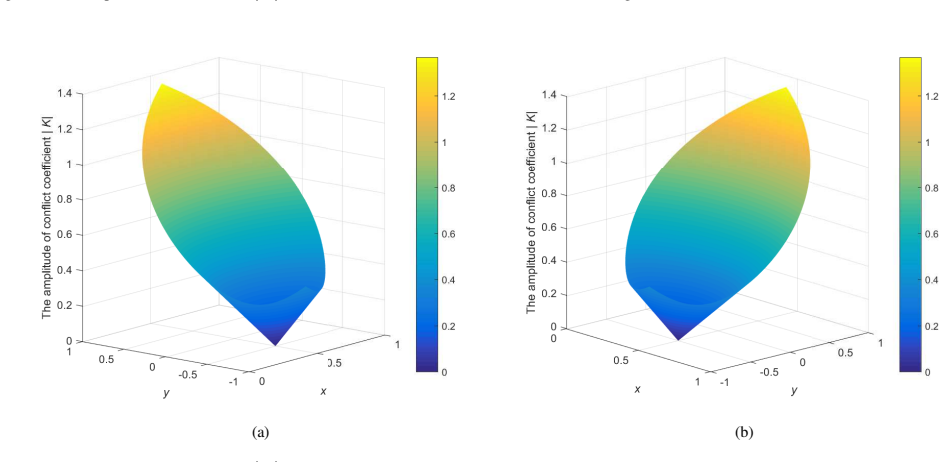
read the original abstract
Dempster-Shafer evidence theory has been widely used in various fields of applications, because of the flexibility and effectiveness in modeling uncertainties without prior information. However, the existing evidence theory is insufficient to consider the situations where it has no capability to express the fluctuations of data at a given phase of time during their execution, and the uncertainty and imprecision which are inevitably involved in the data occur concurrently with changes to the phase or periodicity of the data. In this paper, therefore, a generalized Dempster-Shafer evidence theory is proposed. To be specific, a mass function in the generalized Dempster-Shafer evidence theory is modeled by a complex number, called as a complex basic belief assignment, which has more powerful ability to express uncertain information. Based on that, a generalized Dempster's combination rule is exploited. In contrast to the classical Dempster's combination rule, the condition in terms of the conflict coefficient between the evidences K<1 is released in the generalized Dempster's combination rule. Hence, it is more general and applicable than the classical Dempster's combination rule. When the complex mass function is degenerated from complex numbers to real numbers, the generalized Dempster's combination rule degenerates to the classical evidence theory under the condition that the conflict coefficient between the evidences K is less than 1. In a word, this generalized Dempster-Shafer evidence theory provides a promising way to model and handle more uncertain information.
Editorial analysis
A structured set of objections, weighed in public.
Referee Report
Summary. The manuscript proposes a generalization of Dempster-Shafer evidence theory in which basic belief assignments are represented as complex numbers (complex BBAs) to capture fluctuations of data at given phases and concurrent uncertainties with phase or periodicity changes. It introduces a generalized Dempster combination rule that removes the classical requirement that the conflict coefficient K be less than 1. The paper states that the new rule degenerates to the classical Dempster rule when the complex masses reduce to real numbers and K<1.
Significance. If the complex representation and rule were shown to be coherent and to preserve the core properties of belief functions while meaningfully encoding phase information, the work could extend evidence theory to domains involving periodic or phased data. The removal of the K<1 restriction would address a known limitation of classical DS theory in high-conflict settings. No such demonstration, derivation, or validation is supplied.
major comments (4)
- [Abstract] Abstract: the central claims—that complex BBAs have 'more powerful ability to express uncertain information' and that the generalized rule is valid without the K<1 condition—are introduced by definition with no derivation, semantic mapping from phase/periodicity to the imaginary part, or proof that the resulting quantities remain valid belief functions (non-negative real parts, normalization).
- [Abstract] Abstract: no constraints are stated on the complex masses (e.g., Re(m(A)) ≥ 0, ∑ Re(m(A)) = 1, or bounds on |m(A)|), so the generalized rule can produce masses with negative real parts or fail to normalize, undermining the claim that it is a coherent generalization.
- [Abstract] Abstract: the degeneration statement only recovers the classical case under K<1; it does not establish that the complex rule itself is well-defined or that the complex masses correspond to a valid extension of belief functions when K≥1.
- [Abstract] Abstract: the manuscript contains no example, numerical check, or formal property (e.g., associativity, commutativity, or reduction to Bayesian updating) to support the new rule, leaving the central claim without any empirical or theoretical grounding.
minor comments (1)
- [Abstract] Abstract contains minor grammatical issues ('called as a complex basic belief assignment', 'in a word') that should be corrected for clarity.
Simulated Author's Rebuttal
We thank the referee for the constructive critique of our manuscript. The comments correctly identify that the current version is primarily a definitional proposal without supporting derivations, constraints, or examples. We address each point below and commit to revisions that add the requested material.
read point-by-point responses
-
Referee: [Abstract] Abstract: the central claims—that complex BBAs have 'more powerful ability to express uncertain information' and that the generalized rule is valid without the K<1 condition—are introduced by definition with no derivation, semantic mapping from phase/periodicity to the imaginary part, or proof that the resulting quantities remain valid belief functions (non-negative real parts, normalization).
Authors: The motivation for complex BBAs is to encode phase/periodicity via the imaginary component, but we agree the abstract and manuscript lack an explicit semantic mapping and formal proof that real parts stay non-negative with proper normalization. We will revise by adding a new section that derives these properties from the definition and provides the phase-to-imaginary mapping. revision: yes
-
Referee: [Abstract] Abstract: no constraints are stated on the complex masses (e.g., Re(m(A)) ≥ 0, ∑ Re(m(A)) = 1, or bounds on |m(A)|), so the generalized rule can produce masses with negative real parts or fail to normalize, undermining the claim that it is a coherent generalization.
Authors: We acknowledge that explicit constraints are missing from the presented text. The revision will state the required conditions (Re(m(A)) ≥ 0, sum of real parts equals 1, and appropriate bounds) and prove that the generalized combination rule preserves them. revision: yes
-
Referee: [Abstract] Abstract: the degeneration statement only recovers the classical case under K<1; it does not establish that the complex rule itself is well-defined or that the complex masses correspond to a valid extension of belief functions when K≥1.
Authors: The degeneration claim is limited to the K<1 case as stated. For K≥1 the rule is defined by construction, but we agree a formal argument for well-definedness is absent. The revision will include a derivation showing the rule remains well-defined for K≥1 while recovering the classical rule when masses are real and K<1. revision: yes
-
Referee: [Abstract] Abstract: the manuscript contains no example, numerical check, or formal property (e.g., associativity, commutativity, or reduction to Bayesian updating) to support the new rule, leaving the central claim without any empirical or theoretical grounding.
Authors: The current manuscript is introductory and supplies none of the requested checks. We will add a numerical example, verify commutativity (and associativity where it holds), and demonstrate reduction to Bayesian updating in the appropriate limit. revision: yes
Circularity Check
Complex BBA and generalized combination rule introduced by direct definition without independent derivation
specific steps
-
self definitional
[Abstract]
"a mass function in the generalized Dempster-Shafer evidence theory is modeled by a complex number, called as a complex basic belief assignment, which has more powerful ability to express uncertain information. Based on that, a generalized Dempster's combination rule is exploited. In contrast to the classical Dempster's combination rule, the condition in terms of the conflict coefficient between the evidences K<1 is released in the generalized Dempster's combination rule."
The generalized theory is introduced by defining the mass function as a complex number (CBBA) and then exploiting the combination rule as its direct analogue; the release of K<1 and the asserted greater expressive power are therefore true by the act of definition rather than derived from first principles or shown to preserve belief-function semantics (e.g., non-negative real parts).
-
self definitional
[Abstract]
"When the complex mass function is degenerated from complex numbers to real numbers, the generalized Dempster's combination rule degenerates to the classical evidence theory under the condition that the conflict coefficient between the evidences K is less than 1."
The degeneration statement is tautological: the generalized rule is constructed so that it recovers the classical rule precisely when the inputs are real and K<1, confirming that the extension itself is the definitional move rather than an independently justified generalization.
full rationale
The paper defines the generalization by modeling mass functions as complex numbers and adapting the combination rule as the direct complex analogue, releasing the K<1 condition by construction. The claimed ability to capture phase/periodicity fluctuations and the validity of the rule without real-valued constraints reduce to this definitional choice rather than a derived result. Degeneration to classical DS theory is explicitly built into the definition. No external principle or validation is invoked to establish the complex case as a coherent belief function.
Axiom & Free-Parameter Ledger
axioms (2)
- standard math Standard axioms of classical Dempster-Shafer theory
- ad hoc to paper Complex numbers can represent phase and periodicity fluctuations in uncertain data
invented entities (1)
-
complex basic belief assignment
no independent evidence
Reference graph
Works this paper leans on
-
[1]
On using the shapley value to approximate the Choquet integral in cases of uncertain arguments,
R. R. Y ager, “On using the shapley value to approximate the Choquet integral in cases of uncertain arguments,” IEEE Transactions on Fuzzy Systems , vol. 26, no. 3, pp. 1303–1310, 2018
work page 2018
-
[2]
E. K. Zavadskas, J. Antucheviciene, S. H. R. Hajiagha, and S. S. Hashemi, “Extension of weighted aggregated sum product assessment with interval-valued intuitionis- tic fuzzy numbers (W ASP AS-IVIF),”Applied Soft Com- puting, vol. 24, pp. 1013–1021, 2014
work page 2014
-
[3]
Data-driven multiple criteria decision making for diagnosis of thyroid cancer,
C. Fu, W . Liu, and W . Chang, “Data-driven multiple criteria decision making for diagnosis of thyroid cancer,” Annals of Operations Research , pp. 1–30, 2018
work page 2018
-
[4]
On interval-valued fuzzy decision-making usin g soft likelihood functions,
L. Fei, “On interval-valued fuzzy decision-making usin g soft likelihood functions,” International Journal of Intel- ligent Systems , 2019
work page 2019
-
[5]
Divergence measure of Pythagorean fuzzy sets and its application in medical diagnosis,
F. Xiao and W . Ding, “Divergence measure of Pythagorean fuzzy sets and its application in medical diagnosis,” Applied Soft Computing , vol. 79, pp. 254– 267, 2019
work page 2019
-
[6]
Soft set based association rule mining,
F. Feng, J. Cho, W . Pedrycz, H. Fujita, and T. Herawan, “Soft set based association rule mining,” Knowledge- Based Systems , vol. 111, pp. 268–282, 2016
work page 2016
-
[7]
A new method to identify incom- plete frame of discernment in evidence theory,
R. Sun and Y . Deng, “A new method to identify incom- plete frame of discernment in evidence theory,” IEEE Access, vol. 7, no. 1, pp. 15 547–15 555, 2019
work page 2019
-
[8]
A correlation coefficient for belief function s,
W . Jiang, “A correlation coefficient for belief function s,” International Journal of Approximate Reasoning , vol. 103, pp. 94–106, 2018
work page 2018
-
[9]
Performer selection in Hu- man Reliability analysis: D numbers approach,
J. Zhao and Y . Deng, “Performer selection in Hu- man Reliability analysis: D numbers approach,” Interna- tional Journal of Computers Communications & Control , vol. 14, no. 4, pp. 521–536, 2019
work page 2019
-
[10]
X. Deng and W . Jiang, “D number theory based game- theoretic framework in adversarial decision making under a fuzzy environment,” International Journal of Approxi- mate Reasoning , vol. 106, pp. 194–213, 2019
work page 2019
-
[11]
A Novel Z-network Model Based on Bayesian Network and Z-number,
W . Jiang, Y . Cao, and X. Deng, “A Novel Z-network Model Based on Bayesian Network and Z-number,” IEEE Transactions on Fuzzy Systems , 2019
work page 2019
-
[12]
Environmental assessment under uncertainty using Dempster–Shafer theory and Z- numbers,
B. Kang, P . Zhang, Z. Gao, G. Chhipi-Shrestha, K. Hewage, and R. Sadiq, “Environmental assessment under uncertainty using Dempster–Shafer theory and Z- numbers,” Journal of Ambient Intelligence and Human- ized Computing , pp. DOI: 10.1007/s12 652–019–01 228– y, 2019. 7
work page doi:10.1007/s12 2019
-
[13]
H. Seiti, A. Hafezalkotob, and L. Mart´ ınez, “R-number s, a new risk modeling associated with fuzzy numbers and its application to decision making,” Information Sciences, vol. 483, pp. 206–231, 2019
work page 2019
-
[14]
H. Seiti and A. Hafezalkotob, “Developing the R- TOPSIS methodology for risk-based preventive mainte- nance planning: A case study in rolling mill company,” Computers & Industrial Engineering , vol. 128, pp. 622– 636, 2019
work page 2019
-
[15]
Inherent fuzzy entropy for the improvement of EEG complexity evaluation,
Z. Cao and C. T. Lin, “Inherent fuzzy entropy for the improvement of EEG complexity evaluation,” IEEE Transactions on Fuzzy Systems , vol. 26, no. 2, pp. 1032– 1035, 2018
work page 2018
-
[16]
Analysis of feature fatigue EEG signals based on wavelet entropy,
Q. Wang, Y . Li, and X. Liu, “Analysis of feature fatigue EEG signals based on wavelet entropy,” International Journal of Pattern Recognition and Artificial Intelligence , vol. 32, no. 08, p. 1854023, 2018
work page 2018
-
[17]
Using quality measures in the intelligent fusion of probabilistic information,
R. R. Y ager and F. E. Petry, “Using quality measures in the intelligent fusion of probabilistic information,” i n Information Quality in Information Fusion and Decision Making. Springer, 2019, pp. 51–77
work page 2019
-
[18]
H. Seiti, A. Hafezalkotob, and R. Fattahi, “Extending a pessimistic–optimistic fuzzy information axiom based approach considering acceptable risk: Application in the selection of maintenance strategy,” Applied Soft Comput- ing, vol. 67, pp. 895–909, 2018
work page 2018
-
[19]
X. Deng and W . Jiang, “Evaluating green supply chain management practices under fuzzy environment: a novel method based on D number theory,” International Jour- nal of Fuzzy Systems , pp. DOI: 10.1007/s40 815–019– 00 639–5, 2019
work page doi:10.1007/s40 2019
-
[20]
Saliency-guided deep neural networks for SAR image change detection,
J. Geng, X. Ma, X. Zhou, and H. Wang, “Saliency-guided deep neural networks for SAR image change detection,” IEEE Transactions on Geoscience and Remote Sensing , pp. 1–13, 2019
work page 2019
-
[21]
D. Zhou, A. Al-Durra, K. Zhang, A. Ravey, and F. Gao, “A robust prognostic indicator for renewable energy technologies: A novel error correction grey prediction model,” IEEE Transactions on Industrial Electronics , p. DOI: 10.1109/TIE.2019.2893867, 2019
-
[22]
Z. Cao, C.-T. Lin, K.-L. Lai, L.-W . Ko, J.-T. King, K.-K. Liao, J.-L. Fuh, and S.-J. Wang, “Extraction of SSVEPs- based inherent fuzzy entropy using a wearable headband EEG in migraine patients,” IEEE Transactions on Fuzzy Systems, p. DOI: 10.1109/TFUZZ.2019.2905823, 2019
-
[23]
F. Xiao, “A novel multi-criteria decision making metho d for assessing health-care waste treatment technologies based on D numbers,” Engineering Applications of Arti- ficial Intelligence , vol. 71, no. 2018, pp. 216–225, 2018
work page 2018
-
[24]
F. Feng, H. Fujita, M. I. Ali, R. R. Y ager, and X. Liu, “Another view on generalized intuitionistic fuzzy soft sets and related multiattribute decision making methods,” IEEE Transactions on Fuzzy Systems , vol. 27, no. 3, pp. 474–488, 2018
work page 2018
-
[25]
A multiple criteria decision-making method based on D numbers and belief entropy,
F. Xiao, “A multiple criteria decision-making method based on D numbers and belief entropy,” International Journal of Fuzzy Systems , vol. 21, no. 4, pp. 1144–1153, 2019
work page 2019
-
[26]
Upper and lower probabilities induced by a multivalued mapping,
A. P . Dempster, “Upper and lower probabilities induced by a multivalued mapping,” Annals of Mathematical Statistics, vol. 38, no. 2, pp. 325–339, 1967
work page 1967
-
[27]
G. Shafer et al. , A mathematical theory of evidence . Princeton University Press Princeton, 1976, vol. 1
work page 1976
-
[28]
Zero-sum polymatrix games with link uncertainty: A Dempster-Shafer theory solution,
X. Deng, W . Jiang, and Z. Wang, “Zero-sum polymatrix games with link uncertainty: A Dempster-Shafer theory solution,” Applied Mathematics and Computation , vol. 340, pp. 101–112, 2019
work page 2019
-
[30]
Soft likelihood functions in combining evidence,
R. R. Y ager, P . Elmore, and F. Petry, “Soft likelihood functions in combining evidence,” Information Fusion , vol. 36, pp. 185–190, 2017
work page 2017
-
[31]
Research on the fusion of dependent evidence based on mutual information,
X. Su, L. Li, F. Shi, and H. Qian, “Research on the fusion of dependent evidence based on mutual information,” IEEE Access , vol. 6, pp. 71 839–71 845, 2018
work page 2018
-
[32]
Satisfying uncertain targets using mea- sure generalized Dempster-Shafer belief structures,
R. R. Y ager, “Satisfying uncertain targets using mea- sure generalized Dempster-Shafer belief structures,” Knowledge-Based Systems , vol. 142, pp. 1–6, 2018
work page 2018
-
[33]
H. Seiti, A. Hafezalkotob, S. Najafi, and M. Khalaj, “A risk-based fuzzy evidential framework for FMEA analy- sis under uncertainty: An interval-valued DS approach,” Journal of Intelligent & Fuzzy Systems , no. Preprint, pp. 1–12, 2018
work page 2018
-
[34]
A hybrid fuzzy soft sets decision making method in medical diagnosis,
F. Xiao, “A hybrid fuzzy soft sets decision making method in medical diagnosis,” IEEE Access , vol. 6, pp. 25 300–25 312, 2018
work page 2018
-
[35]
Generalized Dempster–Shafer structures ,
R. R. Y ager, “Generalized Dempster–Shafer structures ,” IEEE Transactions on Fuzzy Systems , vol. 27, no. 3, pp. 428–435, 2019
work page 2019
-
[36]
An evidential Markov decision making model,
Z. He and W . Jiang, “An evidential Markov decision making model,” Information Sciences, vol. 467, pp. 357– 372, 2018
work page 2018
-
[37]
Fuzzy rule bases with generalized belief structure inputs,
R. R. Y ager, “Fuzzy rule bases with generalized belief structure inputs,” Engineering Applications of Artificial Intelligence, vol. 72, pp. 93–98, 2018
work page 2018
-
[38]
M. J. Ablowitz and A. S. Fokas, Complex variables: introduction and applications . Cambridge University Press, 2003
work page 2003
-
[39]
Model for residential house element and material selection by neutrosophic MULTI- MOORA method,
E. K. Zavadskas, R. Bausys, B. Juodagalviene, and I. Garnyte-Sapranaviciene, “Model for residential house element and material selection by neutrosophic MULTI- MOORA method,” Engineering Applications of Artificial Intelligence, vol. 64, pp. 315–324, 2017
work page 2017
-
[40]
Evi- dential reasoning rule for MADM with both weights and reliabilities in group decision making,
M. Zhou, X.-B. Liu, Y .-W . Chen, and J.-B. Y ang, “Evi- dential reasoning rule for MADM with both weights and reliabilities in group decision making,” Knowledge-Based Systems, vol. 143, pp. 142–161, 2018
work page 2018
-
[41]
Robust automated cardiac arrhythmia detection in ECG beat signals,
V . H. C. de Albuquerque, T. M. Nunes, D. R. Pereira, E. J. d. S. Luz, D. Menotti, J. P . Papa, and J. M. R. Tavares, “Robust automated cardiac arrhythmia detection in ECG beat signals,” Neural Computing and Applica- tions, vol. 29, no. 3, pp. 679–693, 2018
work page 2018
-
[42]
R. R. Y ager, “Multi-criteria decision making with inte rval criteria satisfactions using the golden rule representati ve 8 value,” IEEE Transactions on Fuzzy Systems , vol. 26, no. 2, pp. 1023–1031, 2018
work page 2018
-
[43]
Lexicographic orders of intuitionistic fuzzy values and their relationships,
F. Feng, M. Liang, H. Fujita, R. R. Y ager, and X. Liu, “Lexicographic orders of intuitionistic fuzzy values and their relationships,” Mathematics, vol. 7, no. 2, pp. 1–26, 2019
work page 2019
-
[44]
Uncertainty measure in evi- dence theory with its applications,
X. Wang and Y . Song, “Uncertainty measure in evi- dence theory with its applications,” Applied Intelligence , vol. 48, no. 7, pp. 1672–1688, 2018
work page 2018
-
[45]
Generalized ordered propositions fusion based on belief entropy,
Y . Li and Y . Deng, “Generalized ordered propositions fusion based on belief entropy,” International Journal of Computers Communications & Control , vol. 13, no. 5, pp. 792–807, 2018
work page 2018
-
[46]
Clas- sifier fusion with contextual reliability evaluation,
Z. Liu, Q. Pan, J. Dezert, J.-W . Han, and Y . He, “Clas- sifier fusion with contextual reliability evaluation,” IEEE Transactions on Cybernetics , vol. 48, no. 5, pp. 1605– 1618, 2018
work page 2018
-
[47]
Y . Gong, X. Su, H. Qian, and N. Y ang, “Research on fault diagnosis methods for the reactor coolant system of nuclear power plant based on D-S evidence theory,” Annals of Nuclear Energy , pp. 395–399, 2018
work page 2018
-
[48]
A new probability transformation method based on a correlation coefficient of belief functions,
W . Jiang, C. Huang, and X. Deng, “A new probability transformation method based on a correlation coefficient of belief functions,” International Journal of Intelligent Systems, pp. In press, DOI: 10.1002/int.22 098, 2019
-
[49]
Multi-sensor data fusion based on the belief divergence measure of evidences and the belief entropy,
F. Xiao, “Multi-sensor data fusion based on the belief divergence measure of evidences and the belief entropy,” Information Fusion , vol. 46, no. 2019, pp. 23–32, 2019
work page 2019
-
[51]
A new method to determine generalized basic probability assignment in the open world,
R. Sun and Y . Deng, “A new method to determine generalized basic probability assignment in the open world,” IEEE Access , vol. 7, no. 1, pp. 52 827–52 835, 2019
work page 2019
-
[52]
Total belief theorem and conditional belief functions,
J. Dezert, A. Tchamova, and D. Han, “Total belief theorem and conditional belief functions,” International Journal of Intelligent Systems , vol. 33, no. 12, pp. 2314– 2340, 2018
work page 2018
-
[53]
Z. He and W . Jiang, “An evidential dynamical model to predict the interference effect of categorization on decision making results,” Knowledge-Based Systems, vol. 150, pp. 139–149, 2018
work page 2018
-
[54]
TDBF: Two Dimension Belief Function,
Y . Li and Y . Deng, “TDBF: Two Dimension Belief Function,” International Journal of Intelligent Systems , vol. 34, p. DOI: 10.1002/int.22135, 2019
-
[55]
Entailment for measure based belief struc - tures,
R. R. Y ager, “Entailment for measure based belief struc - tures,” Information Fusion , vol. 47, pp. 111–116, 2019
work page 2019
-
[56]
The negation of basic probabil- ity assignment,
X. Gao and Y . Deng, “The negation of basic probabil- ity assignment,” IEEE Access , vol. 7, no. 1, p. DOI: 10.1109/ACCESS.2019.2901932, 2019
-
[57]
——, “The generalization negation of probability dis- tribution and its application in target recognition based on sensor fusion,” International Journal of Dis- tributed Sensor Networks , vol. 15, no. 5, p. DOI: 10.1177/1550147719849381, 2019
-
[58]
Belief interval-based distance measures in the theory of belief functions,
D. Han, J. Dezert, and Y . Y ang, “Belief interval-based distance measures in the theory of belief functions,” IEEE Transactions on Systems, Man, and Cybernetics: Systems, vol. 48, no. 6, pp. 833–850, 2016
work page 2016
-
[59]
Uncertainty mea- sure for interval-valued belief structures,
Y . Song, X. Wang, L. Lei, and S. Y ue, “Uncertainty mea- sure for interval-valued belief structures,” Measurement, vol. 80, pp. 241–250, 2016
work page 2016
-
[60]
A new method to measure the divergence in evidential sensor data fusion,
Y . Song and Y . Deng, “A new method to measure the divergence in evidential sensor data fusion,” International Journal of Distributed Sensor Networks , vol. 15, no. 4, p. DOI: 10.1177/1550147719841295, 2019
-
[61]
An improved deng entropy and its application in pattern recognition,
H. Cui, Q. Liu, J. Zhang, and B. Kang, “An improved deng entropy and its application in pattern recognition,” IEEE Access , vol. 7, pp. 18 284–18 292, 2019
work page 2019
-
[62]
Entropy and specificity in a mathematical theory of evidence,
R. R. Y ager, “Entropy and specificity in a mathematical theory of evidence,” in Classic W orks of the Dempster- Shafer Theory of Belief Functions . Springer, 2008, pp. 291–310
work page 2008
-
[63]
Y . Dong, J. Zhang, Z. Li, Y . Hu, and Y . Deng, “Combi- nation of evidential sensor reports with distance function and belief entropy in fault diagnosis,” International Jour- nal of Computers Communications & Control , vol. 14, no. 3, pp. 293–307, 2019
work page 2019
-
[64]
Combina- tion of classifiers with optimal weight based on evidential reasoning,
Z.-G. Liu, Q. Pan, J. Dezert, and A. Martin, “Combina- tion of classifiers with optimal weight based on evidential reasoning,” IEEE Transactions on Fuzzy Systems , vol. 26, no. 3, pp. 1217–1230, 2018
work page 2018
-
[65]
H. Zhang and Y . Deng, “ Engine fault diagnosis based on sensor data fusion considering information quality and evidence theory,” Advances in Mechanical Engineering , vol. 10, no. 11, pp. 1–10, 2018
work page 2018
-
[66]
Maxitive belief structures and imprecise possibility distributions,
R. R. Y ager and N. Alajlan, “Maxitive belief structures and imprecise possibility distributions,” IEEE Transac- tions on Fuzzy Systems, vol. 25, no. 4, pp. 768–774, 2017
work page 2017
-
[67]
Dependent Evidence Combination Based on DEMA TEL Method,
H. Xu and Y . Deng, “Dependent Evidence Combination Based on DEMA TEL Method,” International Journal of Intelligent Systems , p. DOI: 10.1002/int.22107, 2019
-
[68]
Z. Huang, L. Y ang, and W . Jiang, “Uncertainty measure- ment with belief entropy on the interference effect in the quantum-like Bayesian Networks,” Applied Mathematics and Computation , vol. 347, pp. 417–428, 2019
work page 2019
-
[69]
Evidential reasoning approach with multiple kinds of attributes and entropy-based weight assignment,
M. Zhou, X.-B. Liu, J.-B. Y ang, Y .-W . Chen, and J. Wu, “Evidential reasoning approach with multiple kinds of attributes and entropy-based weight assignment,” Knowledge-Based Systems, vol. 163, pp. 358–375, 2019
work page 2019
-
[70]
C. Fu, W . Chang, M. Xue, and S. Y ang, “Multiple criteria group decision making with belief distributions and distributed preference relations,” European Journal of Operational Research , vol. 273, no. 2, pp. 623–633, 2019
work page 2019
-
[71]
Sensor dynamic reliability evaluation based on evidence theory and intu- itionistic fuzzy sets,
Y . Song, X. Wang, J. Zhu, and L. Lei, “Sensor dynamic reliability evaluation based on evidence theory and intu- itionistic fuzzy sets,” Applied Intelligence, vol. 48, no. 11, pp. 3950–3962, 2018
work page 2018
-
[72]
Evidence reasoning for temporal uncertain information based on relative reliability evaluation,
C.-l. Fan, Y . Song, L. Lei, X. Wang, and S. Bai, “Evidence reasoning for temporal uncertain information based on relative reliability evaluation,” Expert Systems with Applications , vol. 113, pp. 264–276, 2018
work page 2018
-
[73]
Weighted belief function of sensor data fusion in engine fault diagnosis,
H. Zhang and Y . Deng, “Weighted belief function of sensor data fusion in engine fault diagnosis,” Soft Com- 9 puting, pp. DOI: 10.1007/s00 500–019–04 063–7, 2019
work page doi:10.1007/s00 2019
-
[74]
Evidential reasoning ap- proach for MADM based on incomplete interval value,
M. Zhou, X. Liu, and J. Y ang, “Evidential reasoning ap- proach for MADM based on incomplete interval value,” Journal of Intelligent & Fuzzy Systems , vol. 33, no. 6, pp. 3707–3721, 2017
work page 2017
-
[75]
Decision-making with belief interval dis- tance,
J. Dezert, D. Han, J.-M. Tacnet, S. Carladous, and Y . Y ang, “Decision-making with belief interval dis- tance,” in International Conference on Belief Functions . Springer, 2016, pp. 66–74
work page 2016
-
[76]
Evidence combination based on credal belief redistribution for pat- tern classification,
Z. Liu, Y . Liu, J. Dezert, and F. Cuzzolin, “Evidence combination based on credal belief redistribution for pat- tern classification,” IEEE Transactions on Fuzzy Systems , p. DOI: 10.1109/TFUZZ.2019.2911915, 2019
-
[77]
A new pattern classification improvement method with local quality matrix based on K-NN,
Z.-g. Liu, Z. Zhang, Y . Liu, J. Dezert, and Q. Pan, “A new pattern classification improvement method with local quality matrix based on K-NN,” Knowledge-Based Systems, vol. 164, pp. 336–347, 2019
work page 2019
discussion (0)
Sign in with ORCID, Apple, or X to comment. Anyone can read and Pith papers without signing in.