Bulk single crystal growth of the theoretically predicted magnetic Weyl semimetals RAlGe (R = Pr, Ce)
Pith reviewed 2026-05-25 14:54 UTC · model grok-4.3
The pith
Floating zone growth produces stoichiometric PrAlGe and CeAlGe crystals that adopt the predicted polar structure but display spin-glass and antiferromagnetic orders instead of the expected ferromagnetism.
A machine-rendered reading of the paper's core claim, the machinery that carries it, and where it could break.
Core claim
Both systems with the intended 1:1:1 stoichiometry crystallize in the anticipated polar I4₁md (No. 109) space group, although neither displays the theoretically expected ferromagnetic ground state. Instead PrAlGe displays a spin-glass-like transition below 16 K with an easy-c-axis and CeAlGe has an easy-ab-plane antiferromagnetic order below 5 K. The grown crystals provide an ideal platform for microscopic studies of the magnetic field-tunable correlation physics involving magnetism and topological Weyl nodes.
What carries the argument
The floating zone technique, which grows crystals without a crucible or flux to enforce exact 1:1:1 stoichiometry and the target polar structure.
If this is right
- The crystals allow direct microscopic probes such as neutron scattering or ARPES to map how the observed magnetic orders modify the Weyl nodes.
- Field-dependent measurements can test whether the spin-glass or antiferromagnetic states can be tuned to recover ferromagnetic-like behavior near the Weyl points.
- Comparison of transport data between floating-zone and flux-grown crystals isolates the role of aluminum excess in suppressing the predicted ferromagnetism.
Where Pith is reading between the lines
- If the magnetic transitions prove robust across multiple growth batches, theoretical calculations of the Weyl spectrum must incorporate the actual antiferromagnetic or spin-glass order rather than the assumed ferromagnetism.
- The polar space group combined with the observed easy-axis or easy-plane magnetism suggests possible electric-field control of the magnetic domains or node positions, a direction not addressed in the growth paper.
- Extending the floating-zone approach to other RAlGe members could map how rare-earth choice tunes the balance between glassy, antiferromagnetic, and ferromagnetic regimes.
Load-bearing premise
The floating zone method produces crystals whose measured magnetic transitions are intrinsic to perfect 1:1:1 stoichiometry and unaffected by undetected defects or small composition shifts.
What would settle it
Magnetization or resistivity measurements on crystals deliberately grown with controlled 1-2 percent aluminum excess or intentional vacancies that reproduce the spin-glass or antiferromagnetic transitions seen in the floating-zone samples.
Figures




read the original abstract
We explore two methods for single crystal growth of the theoretically proposed magnetic Weyl semimetals $R$AlGe ($R$ = Pr,Ce), which prove that a floating zone technique, being both crucible- and flux-free, is crucial to obtain perfectly stoichiometric $R$AlGe crystals. In contrast, the crystals grown by a flux growth technique tend to be Al-rich. We further present both structural and elemental analysis, along with bulk magnetization and electrical resistivity data on the crystals prepared by the floating zone technique. Both systems with the intended 1:1:1 stoichiometry crystallize in the anticipated polar I4$_{1}$md (No. 109) space group, although neither displays the theoretically expected ferromagnetic ground state. Instead PrAlGe displays a spin-glass-like transition below 16 K with an easy-c-axis and CeAlGe has an easy-ab-plane antiferromagnetic order below 5 K. The grown crystals provide an ideal platform for microscopic studies of the magnetic field-tunable correlation physics involving magnetism and topological Weyl nodes.
Editorial analysis
A structured set of objections, weighed in public.
Referee Report
Summary. The manuscript reports single-crystal growth of PrAlGe and CeAlGe via floating-zone (FZ) and flux methods, asserting that the crucible- and flux-free FZ technique is essential for obtaining perfectly stoichiometric 1:1:1 crystals that crystallize in the polar I4₁md (No. 109) space group. Structural and elemental analyses plus bulk magnetization and resistivity data are presented on the FZ crystals; these show a spin-glass-like transition below 16 K with easy c-axis anisotropy for PrAlGe and easy ab-plane antiferromagnetic order below 5 K for CeAlGe, in contrast to the theoretically predicted ferromagnetic ground state. The crystals are offered as a platform for microscopic studies of magnetic field-tunable correlation physics involving magnetism and Weyl nodes.
Significance. If the stoichiometry claim and the intrinsic character of the observed magnetic states are substantiated, the work supplies high-quality crystals for examining the interplay between magnetism and topological Weyl nodes, which addresses an important experimental bottleneck in magnetic topological semimetals.
major comments (2)
- [Elemental analysis section] Elemental analysis section (and abstract): the central claim that FZ growth yields 'perfectly stoichiometric' crystals whose magnetic transitions are intrinsic rests on the assertion that flux crystals are Al-rich while FZ crystals are not; however, no tabulated EDX/WDS/ICP values, standard deviations, spatial homogeneity maps, or detection limits are supplied to quantify deviations below the 0.5–2 at.% thresholds known to alter magnetic ground states in related R-T-X compounds.
- [Magnetization and resistivity results] Magnetization and resistivity results: the reported transition temperatures (16 K spin-glass-like for PrAlGe; 5 K AFM for CeAlGe) and anisotropy directions are load-bearing for the claim that the states differ from theory, yet the manuscript provides neither raw data files, error bars on susceptibility or resistivity curves, nor quantitative criteria used to classify the PrAlGe transition as spin-glass-like versus other possibilities.
minor comments (2)
- [Abstract] Abstract: inconsistent LaTeX rendering of the space group (I4₁md versus I4_{1}md); standardize notation throughout.
- [Introduction] The manuscript would benefit from explicit comparison of the observed magnetic structures to the theoretical predictions cited in the introduction, including any calculated doping sensitivity of the FM state.
Simulated Author's Rebuttal
We thank the referee for the careful reading of our manuscript and the constructive comments. We address each major point below and will revise the manuscript accordingly to strengthen the presentation of our data.
read point-by-point responses
-
Referee: [Elemental analysis section] Elemental analysis section (and abstract): the central claim that FZ growth yields 'perfectly stoichiometric' crystals whose magnetic transitions are intrinsic rests on the assertion that flux crystals are Al-rich while FZ crystals are not; however, no tabulated EDX/WDS/ICP values, standard deviations, spatial homogeneity maps, or detection limits are supplied to quantify deviations below the 0.5–2 at.% thresholds known to alter magnetic ground states in related R-T-X compounds.
Authors: We agree that quantitative tabulation of the elemental analysis is necessary to fully support the stoichiometry claims. The manuscript does include EDX and WDS measurements showing Al-rich compositions in flux crystals and closer-to-ideal 1:1:1 ratios in FZ crystals, but these were presented only in summary form without tables or error statistics. In the revised version we will add tabulated EDX/WDS values (including standard deviations from multiple spots), details on the number of measurements per crystal, and any available spatial homogeneity information. We will also note the detection limits of the instruments used. revision: yes
-
Referee: [Magnetization and resistivity results] Magnetization and resistivity results: the reported transition temperatures (16 K spin-glass-like for PrAlGe; 5 K AFM for CeAlGe) and anisotropy directions are load-bearing for the claim that the states differ from theory, yet the manuscript provides neither raw data files, error bars on susceptibility or resistivity curves, nor quantitative criteria used to classify the PrAlGe transition as spin-glass-like versus other possibilities.
Authors: We accept that the magnetic data require clearer quantitative support. The manuscript reports DC magnetization and resistivity curves that define the transition temperatures and anisotropy directions, but error bars and explicit classification criteria were omitted. In revision we will add error bars to all susceptibility and resistivity plots (derived from multiple measurements or instrument resolution), state the quantitative criteria used to classify the PrAlGe transition as spin-glass-like (e.g., ZFC/FC bifurcation, frequency dependence if AC data exist, or memory effects), and clarify how the AFM order in CeAlGe was identified. Raw data files can be provided as supplementary material or deposited in a public repository. revision: yes
Circularity Check
No circularity: purely experimental report with no derivations or fitted predictions
full rationale
The paper reports crystal growth methods, structural characterization (XRD confirming I4₁md), elemental analysis, and bulk magnetic/resistivity measurements. No equations, theoretical derivations, parameter fits, or predictions are present that could reduce to self-definition or self-citation. Claims rest on standard laboratory techniques and external instruments; the mismatch with theory (no FM order) is presented as an observation, not a derived result. Self-citations, if any, are not load-bearing for any chain. This matches the default expectation of no significant circularity for experimental work.
Axiom & Free-Parameter Ledger
Reference graph
Works this paper leans on
-
[1]
and 760 ¨ ı¿œC (see red curves of Fig. 1), respectively. 3 B. Flux growth Figure 2. Pictures of the flux-grown crystals of a) CeAlGe and b) PrAlGe right after flux removal using NaOH-H 2O, and before subsequent annealing. Aiming to obtain sizeable ∼mm3 crystals, we chose to perform flux growth without quartz ampules, and used instead up-scaled alumina crucib...
work page 1900
-
[2]
Similar results are obtained for PrAlGe samples with Pr 1.0(1)Al1.2(2)Ge0.8(2) measured on the surface and Pr1.0(1)Al1.14(1)Ge0.86(1) on a polished crystal. EDS measurements done on floating zone crystals shows them to be systematically much closer to the in- tended 1:1:1 stoichiometry, which can be expected for a crucible free growth in a congruently melt...
-
[3]
or Θ W = −3.6 K [21] and an effective moment of µef f ≈ 2.57 µB [17, 21] indicates a Ce 3+ valence. Figure 7. Low temperature magnetization measured in zero field cooled and field cooled manner on a powder sample of 22 mg (x = 1.1) and 20 mg ( x = 0.9) of CeAl xGe2−x in a field of 5 mT. The inset shows the corresponding field dependence of the magnetization me...
-
[4]
The data show the first magnetic ordering transi- tion temperatures indeed display a pronounced depen- dence on the stoichiometry. For the Al-deficient sample, we observe a kink in the susceptibility denoting an anti- ferromagnetic transition near 4 K, similarly as reported in Ref. [16, 17]. On the other hand, the Al-rich sam- ple shows a more irregular the...
-
[5]
The obtained values for the metamagnetic transition fields are ∼0.3 T for H || a and ∼0.6 T for H || c. A further transi- tion for fields applied parallel to a is observed at a lower field of around 0.1 T, similarly as reported on the flux- grown samples [21]. At 7 T, the saturation magnetization Ms is not reached as we still observe a slight increase; at 2 K...
-
[6]
The magnetic transition is visible as a slight maximum in the expected temperature region
The estimated residual resistivity ra- tio (RRR) is 1.3 which is a relatively low value even for a semimetal [22], nonetheless it is comparable to that re- ported for flux grown crystals of 2.3 [17] and 2 [21]. The magnetic transition is visible as a slight maximum in the expected temperature region. In the bottom right inset of figure 10, the field dependen...
-
[7]
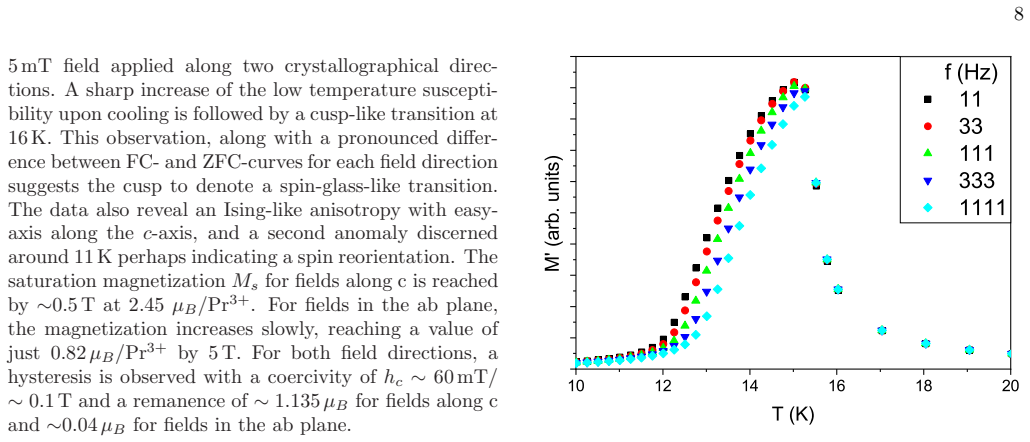
The resulting residual resistivity ratio (RRR) is estimated to be 1.73, and thus similar 9 to CeAlGe. The spin-glass-like transition is visible in the resistivity as a slight kink just below ∼ 16 K. The inset of figure 14 shows the field dependent resistivity for fields applied along the c-axis to be featureless over the explored range measured at 2 K. /s48 ...
-
[8]
Weyl, Zeitschrift f¨ ur Physik56, 330 (1929)
H. Weyl, Zeitschrift f¨ ur Physik56, 330 (1929)
work page 1929
-
[9]
S.-Y. Xu, I. Belopolski, N. Alidoust, M. Neupane, G. Bian, C. Zhang, R. Sankar, G. Chang, Z. Yuan, C.- C. Lee, S.-M. Huang, H. Zheng, J. Ma, D. S. Sanchez, B. Wang, A. Bansil, F. Chou, P. P. Shibayev, H. Lin, S. Jia, and M. Z. Hasan, Science 349, 613 (2015)
work page 2015
-
[10]
B. Lv, H. Weng, B. Fu, X. Wang, H. Miao, J. Ma, P. Richard, X. Huang, L. Zhao, G. Chen, Z. Fang, X. Dai, T. Qian, and H. Ding, Physical Review X 5 (2015), 10.1103/physrevx.5.031013
-
[11]
S.-Y. Xu, N. Alidoust, I. Belopolski, Z. Yuan, G. Bian, T.-R. Chang, H. Zheng, V. N. Strocov, D. S. Sanchez, G. Chang, C. Zhang, D. Mou, Y. Wu, L. Huang, C.- C. Lee, S.-M. Huang, B. Wang, A. Bansil, H.-T. Jeng, T. Neupert, A. Kaminski, H. Lin, S. Jia, and M. Z. Hasan, Nature Physics 11, 748 (2015)
work page 2015
-
[12]
M. Z. Hasan, S.-Y. Xu, and G. Bian, Physica Scripta T164, 014001 (2015)
work page 2015
-
[13]
M. Z. Hasan, S.-Y. Xu, I. Belopolski, and S.-M. Huang, Annual Review of Condensed Matter Physics 8, 289 (2017)
work page 2017
-
[14]
C. R. Rajamathi, U. Gupta, N. Kumar, H. Yang, Y. Sun, V. S ˜AŒß, C. Shekhar, M. Schmidt, H. Blumtritt, P. Werner, B. Yan, S. Parkin, C. Felser, and C. N. R. Rao, Advanced Materials 29, 1606202 (2017)
work page 2017
-
[15]
A. Politano, G. Chiarello, Z. Li, V. Fabio, L. Wang, L. Guo, X. Chen, and D. W. Boukhvalov, Advanced Functional Materials 28, 1800511 (2018)
work page 2018
-
[16]
C.-K. Chan, N. H. Lindner, G. Refael, and P. A. Lee, Physical Review B 95 (2017), 10.1103/physrevb.95.041104
-
[17]
E. J. Sie, C. M. Nyby, C. D. Pemmaraju, S. J. Park, X. Shen, J. Yang, M. C. Hoffmann, B. K. Ofori-Okai, R. Li, A. H. Reid, S. Weathersby, E. Mannebach, N. Finney, D. Rhodes, D. Chenet, A. Antony, L. Bali- cas, J. Hone, T. P. Devereaux, T. F. Heinz, X. Wang, and A. M. Lindenberg, Nature 565, 61 (2019) . 10
work page 2019
- [18]
-
[19]
E. Liu, Y. Sun, N. Kumar, L. Muechler, A. Sun, L. Jiao, S.-Y. Yang, D. Liu, A. Liang, Q. Xu, J. Kroder, V. S ˜AŒß, H. Borrmann, C. Shekhar, Z. Wang, C. Xi, W. Wang, W. Schnelle, S. Wirth, Y. Chen, S. T. B. Goennenwein, and C. Felser, Nature Physics (2018), 10.1038/s41567-018-0234-5
-
[20]
K. Kim, J. Seo, E. Lee, K.-T. Ko, B. S. Kim, B. G. Jang, J. M. Ok, J. Lee, Y. J. Jo, W. Kang, J. H. Shim, C. Kim, H. W. Yeom, B. I. Min, B.-J. Yang, and J. S. Kim, Nature Materials 17, 794 (2018)
work page 2018
- [21]
-
[22]
G. Chang, B. Singh, S.-Y. Xu, G. Bian, S.-M. Huang, C.-H. Hsu, I. Belopolski, N. Alidoust, D. S. Sanchez, H. Zheng, H. Lu, X. Zhang, Y. Bian, T.-R. Chang, H.-T. Jeng, A. Bansil, H. Hsu, S. Jia, T. Neupert, H. Lin, and M. Z. Hasan, Physical Review B 97 (2018), 10.1103/physrevb.97.041104
-
[23]
S. Dhar, S. Pattalwar, and R. Vijayaraghavan, Journal of Magnetism and Magnetic Materials 104-107, 1303 (1992)
work page 1992
-
[24]
S. Dhar and S. Pattalwar, Journal of Magnetism and Magnetic Materials 152, 22 (1996)
work page 1996
-
[25]
E. Gladyshevskii, N. Nakonechna, K. Cen- zual, R. Gladyshevskii, and J.-L. Jorda, Journal of Alloys and Compounds 296, 265 (2000)
work page 2000
- [26]
-
[27]
H. Flandorfer, D. Kaczorowski, J. Gr¨ obner, P. Rogl, R. Wouters, C. Godart, and A. Kostikas, Journal of Solid State Chemistry 137, 191 (1998)
work page 1998
-
[28]
H. Hodovanets, C. J. Eckberg, P. Y. Zavalij, H. Kim, W.-C. Lin, M. Zic, D. J. Camp- bell, J. S. Higgins, and J. Paglione, Physical Review B 98 (2018), 10.1103/physrevb.98.245132
-
[29]
B. Chen, X. Duan, H. Wang, J. Du, Y. Zhou, C. Xu, Y. Zhang, L. Zhang, M. Wei, Z. Xia, C. Cao, J. Dai, M. Fang, and J. Yang, npj Quantum Materials 3 (2018), 10.1038/s41535-018-0114-3
-
[30]
J. A. Mydosh, Reports on Progress in Physics 78, 052501 (2015)
work page 2015
-
[31]
X. Wan, A. M. Turner, A. Vish- wanath, and S. Y. Savrasov, Physical Review B 83 (2011), 10.1103/physrevb.83.205101
-
[32]
L. Lu, Z. Wang, D. Ye, L. Ran, L. Fu, J. D. Joannopoulos, and M. S. i, Science 349, 622 (2015)
work page 2015
-
[33]
X. Huang, L. Zhao, Y. Long, P. Wang, D. Chen, Z. Yang, H. Liang, M. Xue, H. Weng, Z. Fang, X. Dai, and G. Chen, Physical Review X 5 (2015), 10.1103/physrevx.5.031023
- [34]
discussion (0)
Sign in with ORCID, Apple, or X to comment. Anyone can read and Pith papers without signing in.