A Sweet Recipe for Consolidated Vulnerabilities: Attacking a Live Website by Harnessing a Killer Combination of Vulnerabilities
Pith reviewed 2026-05-25 14:26 UTC · model grok-4.3
The pith
A finite state machine model maps connections among web vulnerabilities to enable chained attacks on live sites.
A machine-rendered reading of the paper's core claim, the machinery that carries it, and where it could break.
Core claim
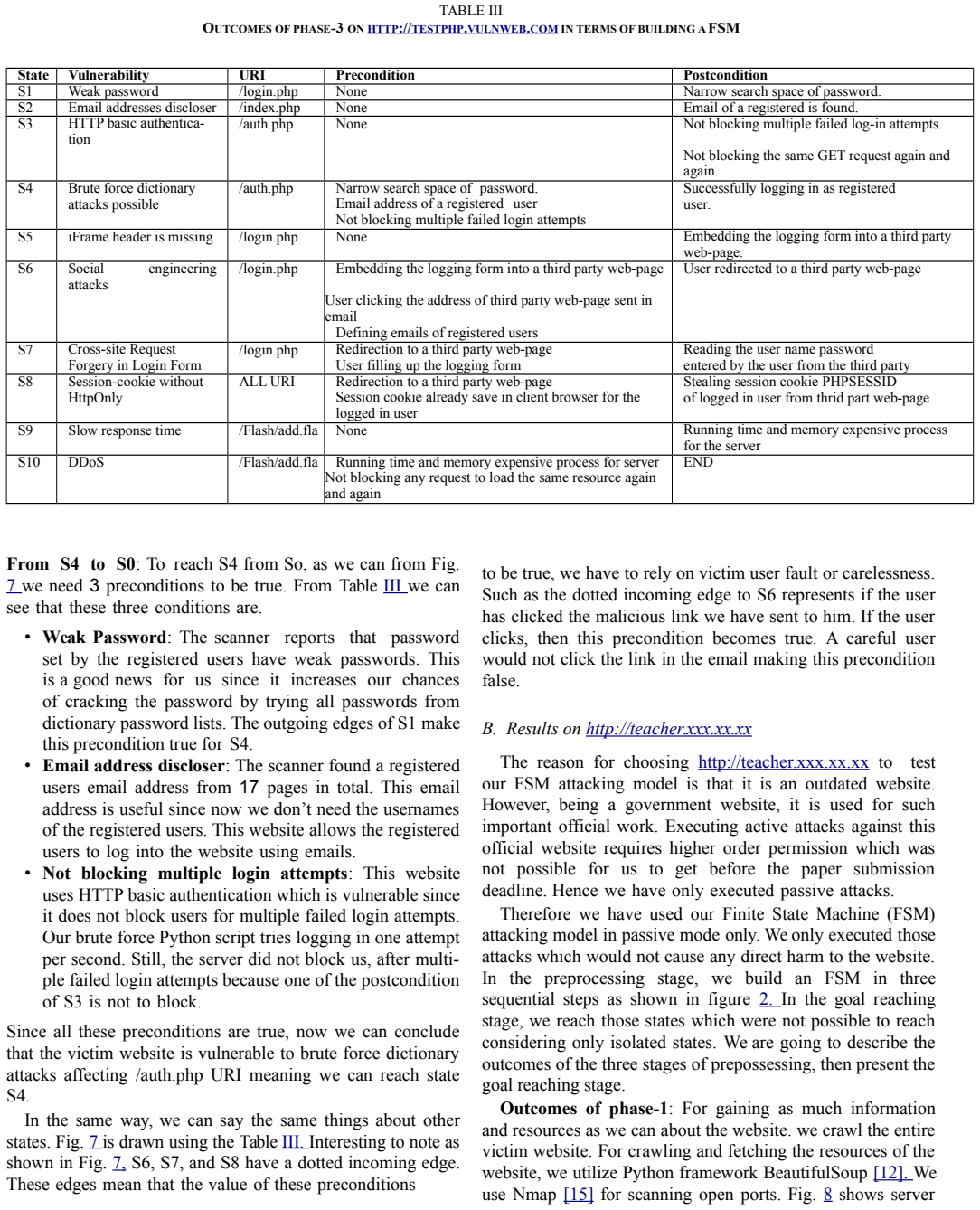
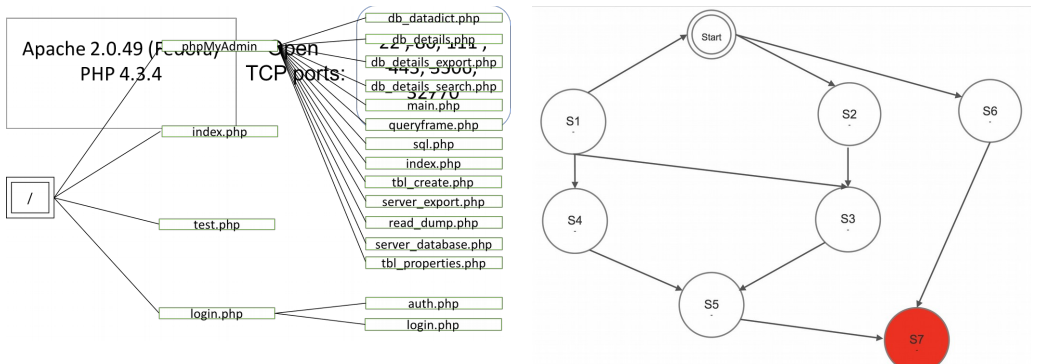
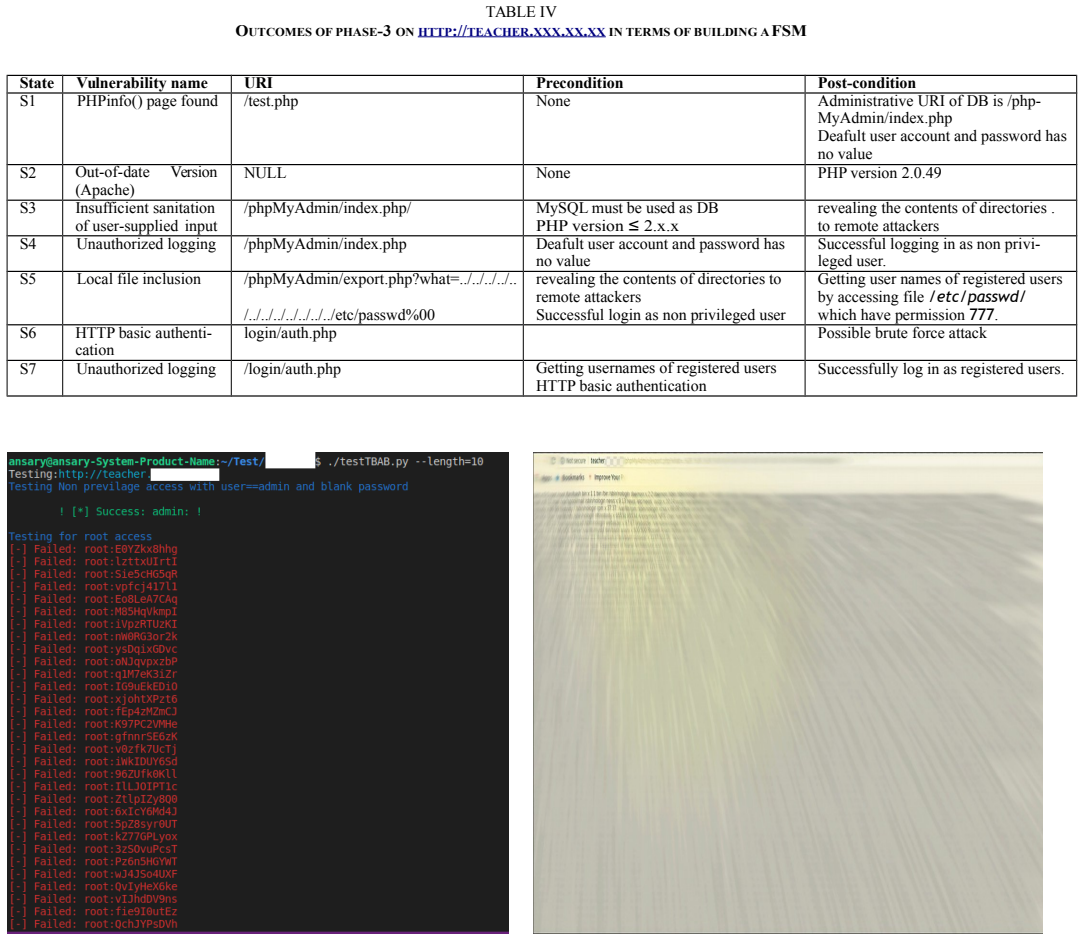
We develop a Finite State Machine (FSM) attacking model, which analyzes a set of vulnerabilities towards the road to finding connections. We demonstrate the efficacy of our model by applying it to the set of vulnerabilities found on two live websites.
What carries the argument
The Finite State Machine (FSM) attacking model that treats vulnerabilities as states and transitions as exploitation steps to discover chained attack sequences.
If this is right
- Combinations of vulnerabilities such as cross-site scripting, file inclusion, and CSRF produce greater damage than any single one.
- The FSM model can identify connections within any given set of discovered vulnerabilities.
- Live websites with multiple unpatched issues become susceptible to sequenced attacks.
- Applying the model shows concrete paths from initial access to full compromise on real sites.
Where Pith is reading between the lines
- Automated security tools could adopt similar state models to prioritize combinations over isolated findings.
- The same modeling technique might extend to other systems such as network services or application frameworks.
- Vulnerability databases could be augmented with transition data to generate FSMs automatically.
Load-bearing premise
The finite state machine accurately represents real exploitation sequences that attackers can chain on live websites without being adjusted to the specific sites tested.
What would settle it
Running the attack sequences predicted by the FSM on the two websites and checking whether they produce successful compromises when performed independently.
Figures

read the original abstract
The recent emergence of new vulnerabilities is an epoch-making problem in the complex world of website security. Most of the websites are failing to keep updating to tackle their websites from these new vulnerabilities leaving without realizing the weakness of the websites. As a result, when cyber-criminals scour such vulnerable old version websites, the scanner will represent a set of vulnerabilities. Once found, these vulnerabilities are then exploited to steal data, distribute malicious content, or inject defacement and spam content into the vulnerable websites. Furthermore, a combination of different vulnerabilities is able to cause more damages than anticipation. Therefore, in this paper, we endeavor to find connections among various vulnerabilities such as cross-site scripting, local file inclusion, remote file inclusion, buffer overflow CSRF, etc. To do so, we develop a Finite State Machine (FSM) attacking model, which analyzes a set of vulnerabilities towards the road to finding connections. We demonstrate the efficacy of our model by applying it to the set of vulnerabilities found on two live websites.
Editorial analysis
A structured set of objections, weighed in public.
Referee Report
Summary. The manuscript claims to develop a Finite State Machine (FSM) attacking model that identifies connections among web vulnerabilities including cross-site scripting, local file inclusion, remote file inclusion, buffer overflow, and CSRF. Efficacy is demonstrated by applying the model to the set of vulnerabilities found on two live websites.
Significance. A general, pre-specified FSM model for chaining web vulnerabilities could provide a structured framework for analyzing multi-stage attacks if the states and transitions are defined independently of any particular site and shown to generalize. The use of live websites for demonstration is a strength, but the absence of model specification or quantitative validation in the provided description prevents assessment of whether the result would advance the field.
major comments (2)
- [Abstract] Abstract: The FSM attacking model is described only at the level of 'analyzes a set of vulnerabilities towards the road to finding connections' with no enumeration of states (one per vulnerability class?), transition rules (e.g., conditions under which LFI enables XSS), or input alphabet. Without this definition it is impossible to determine whether the model was constructed from general principles before site analysis or reverse-engineered from the vulnerabilities discovered on the two sites.
- [Abstract] Abstract: The demonstration of efficacy consists solely of the statement that the model was 'applied' to vulnerabilities on two live websites; no success metric, attack path length, false-positive rate, or comparison against manual chaining or existing attack-graph tools is supplied. This leaves the central claim without measurable support.
minor comments (1)
- [Abstract] Abstract: The phrase 'buffer overflow CSRF' is ambiguous; it is unclear whether this intends two separate vulnerabilities or a combined class.
Simulated Author's Rebuttal
We thank the referee for the constructive comments on our manuscript. We address each major comment below and will revise the paper to incorporate additional details on the FSM model specification and evaluation metrics.
read point-by-point responses
-
Referee: [Abstract] Abstract: The FSM attacking model is described only at the level of 'analyzes a set of vulnerabilities towards the road to finding connections' with no enumeration of states (one per vulnerability class?), transition rules (e.g., conditions under which LFI enables XSS), or input alphabet. Without this definition it is impossible to determine whether the model was constructed from general principles before site analysis or reverse-engineered from the vulnerabilities discovered on the two sites.
Authors: The FSM was constructed from general principles of vulnerability chaining prior to site analysis. States represent the vulnerability classes (XSS, LFI, RFI, buffer overflow, CSRF), transitions encode enabling conditions (e.g., LFI exposing file paths usable for RFI or XSS injection), and the input alphabet consists of the corresponding payloads and actions. We will add a dedicated section with the formal FSM definition, state-transition diagram, and explicit statement that the model was pre-specified, to address this concern. revision: yes
-
Referee: [Abstract] Abstract: The demonstration of efficacy consists solely of the statement that the model was 'applied' to vulnerabilities on two live websites; no success metric, attack path length, false-positive rate, or comparison against manual chaining or existing attack-graph tools is supplied. This leaves the central claim without measurable support.
Authors: The manuscript demonstrates efficacy through concrete attack paths identified on the two live sites. We agree that explicit metrics strengthen the claim and will revise to report the number and lengths of discovered paths, along with a comparison to manual chaining performed by the authors. Quantitative false-positive rates are difficult to define without an external oracle on live sites, but we will provide the raw path counts and qualitative validation. A full benchmark against attack-graph tools is outside the paper's scope but a brief discussion will be added. revision: partial
Circularity Check
No circularity: FSM model presented as developed independently before site application
full rationale
The paper claims to develop an FSM attacking model to find connections among vulnerabilities and then demonstrates it on two live websites. No equations, fitted parameters, or self-citations are present in the provided abstract or description. The derivation chain does not reduce any prediction to its inputs by construction, as the model is described as an analytical tool applied to discovered vulnerabilities rather than reverse-engineered from them. This is a standard non-finding for a descriptive security paper without mathematical derivations.
Axiom & Free-Parameter Ledger
Reference graph
Works this paper leans on
-
[1]
Nagpal, Bharti, Nanhay Singh, Naresh Chauhan, and Angel Panesar. ”Tool based implementation of SQL injection for penetration testing.” In Computing, Communication and Automation (ICCCA), 2015 Inter- national Conference on, pp. 746-749. IEEE, 2015. [11]Jajodia, Sushil, Steven Noel, and Brian OBerry. Topological analysis of network attack vulnerability. In ...
work page 2015
-
[2]
Beautiful Soup Documentation https://www.crummy.com/software/ BeautifulSoup/bs4/doc/, Last Accessed ,Last Accessed 8 9 2018. [13]Dirbuster(URLfuzzer:OWASP) https://www.owasp.org/index.php/ Category:OWASP DirBuster Project, Last Accessed 8 9 2018. [14]Nikto web scanner https://cirt.net/Nikto2, Last Accessed 8 9 2018. [15]Nmap: the Network Mapper- Free Secu...
work page 2018
discussion (0)
Sign in with ORCID, Apple, or X to comment. Anyone can read and Pith papers without signing in.