Measurement of CKM angle boldsymbol{ φ₃} at Belle II
Pith reviewed 2026-05-25 13:45 UTC · model grok-4.3
The pith
Belle II plans to determine the CKM angle φ₃ to 1° precision or better with its full 50 ab⁻¹ dataset.
A machine-rendered reading of the paper's core claim, the machinery that carries it, and where it could break.
Core claim
The Belle II experiment at SuperKEKB will measure the CKM angle φ₃ by exploiting interference in B+ to D0 K+ and B+ to Dbar0 K+ decays across multiple modes, achieving a precision of 1° or better with 50 ab⁻¹ of data.
What carries the argument
Interference between B⁺ → D⁰ K⁺ and B⁺ → D̄⁰ K⁺ decays when the charm decay final state is common to both D⁰ and D̄⁰.
Load-bearing premise
The SuperKEKB collider will reach its design luminosity and Belle II will achieve the necessary reconstruction efficiencies and background rejection for the decay modes.
What would settle it
If the actual integrated luminosity falls well short of 50 ab⁻¹ or if the observed signal yields and backgrounds deviate substantially from projections.
Figures
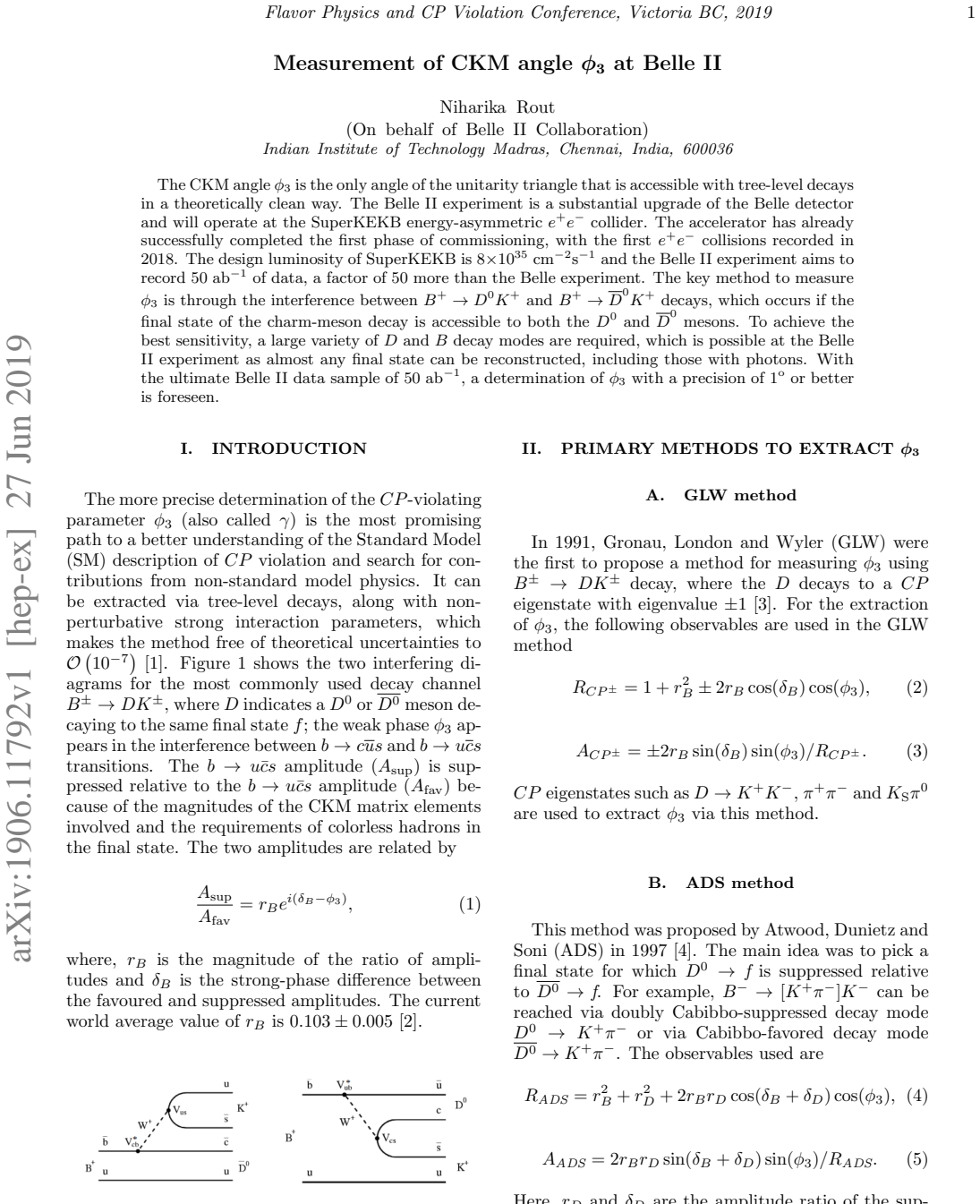
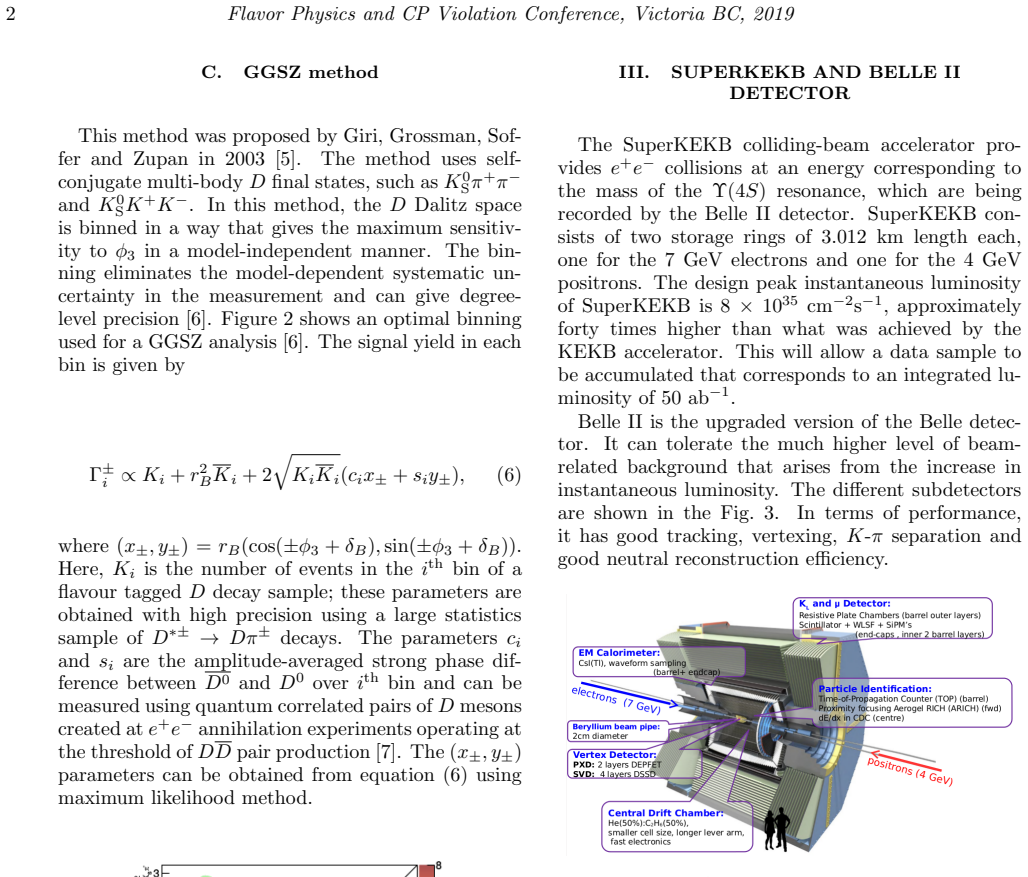
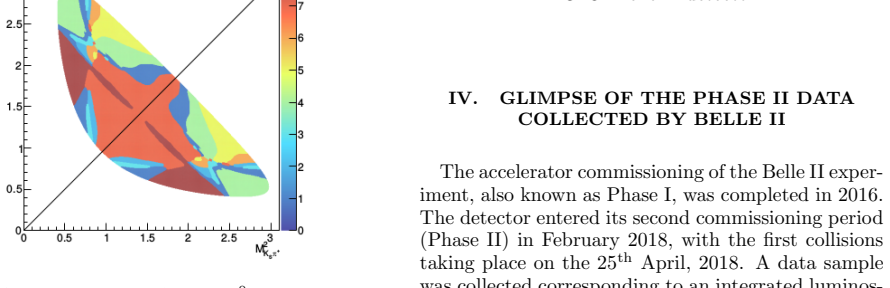
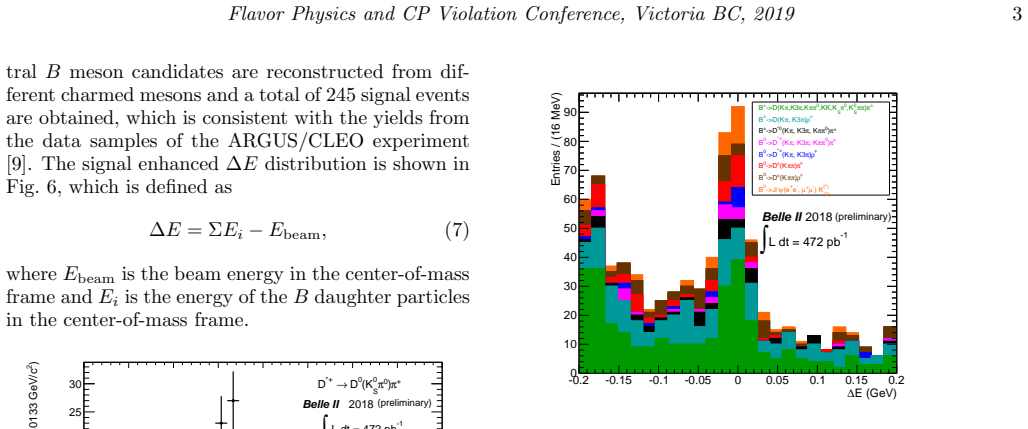


read the original abstract
The CKM angle $ \phi_{3} $ is the only angle of the unitarity triangle that is accessible with tree-level decays in a theoretically clean way. The Belle II experiment is a substantial upgrade of the Belle detector and will operate at the SuperKEKB energy-asymmetric $ e^{+}e^{-} $ collider. The accelerator has already successfully completed the first phase of commissioning, with the first $ e^{+}e^{-} $ collisions recorded in 2018. The design luminosity of SuperKEKB is 8$ \times 10^{35}$ cm$^{-2}$s$^{-1}$ and the Belle II experiment aims to record 50 ab$ ^{-1} $ of data, a factor of 50 more than the Belle experiment. The key method to measure $ \phi_{3} $ is through the interference between $ B^{+} \to D^{0}K^{+} $ and $ B^{+} \to \overline{D}^{0}K^{+} $ decays, which occurs if the final state of the charm-meson decay is accessible to both the $ D^{0} $ and $ \overline{D}^{0} $ mesons. To achieve the best sensitivity, a large variety of $ D $ and $ B $ decay modes are required, which is possible at the Belle II experiment as almost any final state can be reconstructed, including those with photons. With the ultimate Belle II data sample of 50 ab$ ^{-1} $, a determination of $ \phi_{3} $ with a precision of 1$^{\rm o} $ or better is foreseen.
Editorial analysis
A structured set of objections, weighed in public.
Referee Report
Summary. The manuscript describes the Belle II experiment at SuperKEKB and its prospects for measuring the CKM angle φ₃ via interference in B⁺ → D⁰K⁺ and B⁺ → D̄⁰K⁺ decays (with D decays accessible to both). It highlights the design luminosity of 8×10³⁵ cm⁻²s⁻¹, the target 50 ab⁻¹ data sample (50 times Belle), the ability to reconstruct many D and B modes including those with photons, and concludes that a precision of 1° or better on φ₃ is foreseen.
Significance. If the stated precision is achieved, the result would furnish a theoretically clean, tree-level determination of φ₃ at the 1° level, providing an important constraint on the CKM unitarity triangle with minimal hadronic uncertainty and complementing other angle measurements.
major comments (1)
- [Abstract] Abstract, final paragraph: the central projection of 'a determination of φ₃ with a precision of 1° or better' is stated directly from the design luminosity and integrated luminosity without any accompanying sensitivity study, error budget, efficiency tables, or reference to Monte Carlo results that quantify the impact of reconstruction efficiencies, background rejection, and systematic uncertainties (D-decay modeling, PID, continuum suppression) at 50 ab⁻¹.
Simulated Author's Rebuttal
We thank the referee for the positive assessment of the scientific significance and for the constructive comment on the abstract. We address the point below.
read point-by-point responses
-
Referee: [Abstract] Abstract, final paragraph: the central projection of 'a determination of φ₃ with a precision of 1° or better' is stated directly from the design luminosity and integrated luminosity without any accompanying sensitivity study, error budget, efficiency tables, or reference to Monte Carlo results that quantify the impact of reconstruction efficiencies, background rejection, and systematic uncertainties (D-decay modeling, PID, continuum suppression) at 50 ab⁻¹.
Authors: The manuscript is a concise overview of Belle II and its physics reach rather than a dedicated sensitivity analysis paper. The 1° projection is an estimate based on the factor-of-50 increase in integrated luminosity relative to Belle together with the improved detector performance documented in the Belle II Technical Design Report. Detailed Monte Carlo studies, efficiency tables, background rejection strategies, and systematic uncertainty evaluations for φ₃ at 50 ab⁻¹ appear in the Belle II Physics Book (arXiv:1808.10567) and associated B-physics prospect papers. We will revise the abstract to cite these references explicitly so that the basis of the quoted precision is clear to the reader. revision: yes
Circularity Check
No circularity: precision projection is a forward-looking design estimate without derivation or self-referential reduction.
full rationale
The paper contains no derivation chain, equations, parameter fits, or first-principles results. The central statement that 50 ab⁻¹ will yield 1° or better precision on φ₃ is presented as a direct scaling expectation from design luminosity and prior methods, with no internal step that reduces to itself by construction. No self-definitional, fitted-input, or self-citation patterns apply; the text is self-contained as a prospects summary relying on external benchmarks.
Axiom & Free-Parameter Ledger
free parameters (2)
- design luminosity 8×10^35 cm^{-2}s^{-1}
- 50 ab^{-1} data sample
axioms (1)
- domain assumption Tree-level decays provide theoretically clean access to φ₃
Lean theorems connected to this paper
-
IndisputableMonolith/Cost/FunctionalEquation.leanwashburn_uniqueness_aczel unclear?
unclearRelation between the paper passage and the cited Recognition theorem.
RCP± = 1 + r_B² ± 2 r_B cos(δ_B) cos(φ₃)
What do these tags mean?
- matches
- The paper's claim is directly supported by a theorem in the formal canon.
- supports
- The theorem supports part of the paper's argument, but the paper may add assumptions or extra steps.
- extends
- The paper goes beyond the formal theorem; the theorem is a base layer rather than the whole result.
- uses
- The paper appears to rely on the theorem as machinery.
- contradicts
- The paper's claim conflicts with a theorem or certificate in the canon.
- unclear
- Pith found a possible connection, but the passage is too broad, indirect, or ambiguous to say the theorem truly supports the claim.
Reference graph
Works this paper leans on
-
[1]
The design luminosity of SuperKEKB is 8×1035 cm−2s−1 and the Belle II experiment aims to record 50 ab −1 of data, a factor of 50 more than the Belle experiment. The key method to measure φ3 is through the interference between B+→D0K + and B+→D 0 K + decays, which occurs if the final state of the charm-meson decay is accessible to both the D0 and D 0 mesons...
work page internal anchor Pith review Pith/arXiv arXiv 1991
- [2]
-
[3]
HFLAV16, Y. Amhis et al. (Heavy Flavor Averaging Group), Eur. Phys. J. C 77, 895 (2017)
work page 2017
-
[4]
M. Gronau and D. London, Phys. Lett. B 253, 483 (1991); M. Gronau and D. Wyler, Phys. Lett. B 265, 172 (1991)
work page 1991
- [5]
- [6]
- [7]
-
[8]
Libby, J. et al. (CLEO Collaboration), Phys. Rev. D.82, 112006 (2010)
work page 2010
-
[9]
The LHCb Collaboration, LHCb-CONF-2017-004
work page 2017
- [10]
-
[11]
J. Brod, A. Lenz, G. Tetlalmatzi-Xolocotzi and M. Wiebusch, Phys. Rev. D 92, 033002 (2015)
work page 2015
-
[12]
http://www-superkekb.kek.jp/ T ueB1730
discussion (0)
Sign in with ORCID, Apple, or X to comment. Anyone can read and Pith papers without signing in.