Generation of Quantum Entanglement based on Electromagnetically Induced Transparency Media
Pith reviewed 2026-05-25 14:17 UTC · model grok-4.3
The pith
Introducing two-photon detuning in EIT systems generates stronger continuous-variable entanglement with less added noise than decoherence-based methods.
A machine-rendered reading of the paper's core claim, the machinery that carries it, and where it could break.
Core claim
By introducing a two-photon detuning into the EIT system, the degree of entanglement between the probe and coupling fields can be enhanced more effectively than by utilizing the decoherence rate, which adds far more excess fluctuation or noise. Maximum degree of entanglement at a given optical depth can be achieved with a wide range of the coupling Rabi frequency and the two-photon detuning. While EIT operates in the perturbation limit, an optimum ratio of the probe to coupling intensities still exists for achieving the maximum entanglement.
What carries the argument
Two-photon detuning applied to the EIT interaction between probe and coupling fields, which produces entanglement or two-mode squeezing without depending on ground-state dephasing.
If this is right
- The scheme works across a wide range of coupling Rabi frequencies and detuning values while reaching maximum entanglement at fixed optical depth.
- An optimum probe-to-coupling intensity ratio maximizes entanglement even when the probe field is much weaker than the coupling field.
- The approach avoids the large excess noise that the decoherence-rate method adds to the system.
- It can support applications in continuous-variable quantum communication that rely on squeezed light.
Where Pith is reading between the lines
- The detuning method could lower the optical depth or power requirements needed to reach a target level of squeezing in practical setups.
- The same detuning idea might extend to other three-level or multi-level atomic configurations used for light-atom entanglement.
- Direct comparison of noise spectra with and without detuning would quantify the efficiency gain in a given laboratory system.
Load-bearing premise
Adding two-photon detuning increases entanglement without bringing in extra unmodeled noise, loss, or other effects that would cancel the advantage over the decoherence route.
What would settle it
An experiment that measures the quadrature noise variances or entanglement witness for the probe and coupling fields, comparing the case with controlled two-photon detuning against the zero-detuning case at the same optical depth and showing whether net entanglement improves or noise decreases.
Figures


read the original abstract
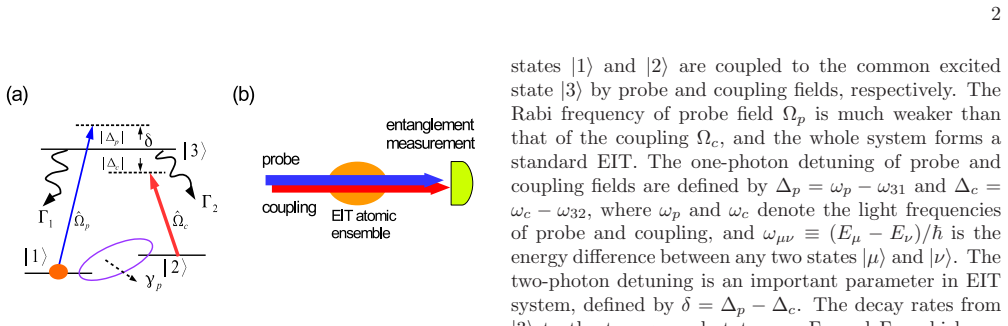
Quantum entanglement is an essential ingredient for the absolute security of quantum communication. Generation of continuous-variable entanglement or two-mode squeezing between light fields based on the effect of electromagnetically induced transparency (EIT) has been systematically investigated in this work. Here, we propose a new scheme to enhance the degree of entanglement between probe and coupling fields of coherent-state light by introducing a two-photon detuning in the EIT system. This proposed scheme is more efficient than the conventional one, utilizing the dephasing rate of ground-state coherence, i.e., the decoherence rate to produce entanglement or two-mode squeezing which adds far more excess fluctuation or noise to the system. In addition, maximum degree of entanglement at a given optical depth can be achieved with a wide range of the coupling Rabi frequency and the two-photon detuning, showing our scheme is robust and flexible. It is also interesting to note that while EIT is the effect in the perturbation limit, i.e. the probe field being much weaker than the coupling field and treated as a perturbation, there exists an optimum ratio of the probe to coupling intensities to achieve the maximum entanglement. Our proposed scheme can advance the continuous-variable-based quantum technology and may lead to applications in quantum communication utilizing squeezed light.
Editorial analysis
A structured set of objections, weighed in public.
Referee Report
Summary. The manuscript proposes a scheme to generate continuous-variable entanglement or two-mode squeezing between probe and coupling fields in an EIT system by introducing two-photon detuning. It claims this is more efficient than the conventional approach that relies on the ground-state decoherence rate (which adds excess noise), achieves maximum entanglement at fixed optical depth over wide ranges of coupling Rabi frequency and detuning, and exhibits an optimum probe-to-coupling intensity ratio even within the EIT perturbation regime.
Significance. If the central claim holds under a complete model, the work would offer a more robust and flexible route to squeezed light for continuous-variable quantum communication. The manuscript does not, however, supply the density-matrix derivations, input-output relations, or numerical comparisons needed to establish that two-photon detuning yields a larger squeezing parameter with lower net variance product and without additional absorption or phase diffusion.
major comments (2)
- [Abstract] Abstract: the assertion that the two-photon-detuning scheme 'adds far more excess fluctuation or noise' is avoided while still producing higher entanglement rests on the unverified assumption that the steady-state susceptibility under detuning δ remains in the linear-response regime with no extra decoherence channels (finite ground-state lifetime, inhomogeneous broadening, or higher-order nonlinearities). No explicit master-equation solution or input-output calculation is referenced to support this.
- [Abstract] Abstract: the robustness claim ('maximum degree of entanglement at a given optical depth can be achieved with a wide range of the coupling Rabi frequency and the two-photon detuning') is stated without any quantitative model, plot, or parameter scan showing how the entanglement measure varies with δ and Ω_c at fixed OD; the load-bearing step that detuning enhances the squeezing parameter without comparable loss therefore cannot be assessed.
minor comments (1)
- [Abstract] Abstract: the parenthetical 'i.e., the decoherence rate' after 'dephasing rate of ground-state coherence' is redundant and should be removed or rephrased for clarity.
Simulated Author's Rebuttal
We thank the referee for the careful reading of our manuscript and the constructive comments. We address the two major comments below and will revise the manuscript to incorporate the requested supporting material.
read point-by-point responses
-
Referee: [Abstract] Abstract: the assertion that the two-photon-detuning scheme 'adds far more excess fluctuation or noise' is avoided while still producing higher entanglement rests on the unverified assumption that the steady-state susceptibility under detuning δ remains in the linear-response regime with no extra decoherence channels (finite ground-state lifetime, inhomogeneous broadening, or higher-order nonlinearities). No explicit master-equation solution or input-output calculation is referenced to support this.
Authors: We agree that the abstract claims require explicit backing from the full model. In the revised manuscript we will add the density-matrix master equation, its steady-state solution for the susceptibility under two-photon detuning δ, the input-output relations for the probe and coupling quadratures, and numerical comparisons of the variance product. These additions will confirm that the scheme remains in the linear-response regime without extra decoherence channels. revision: yes
-
Referee: [Abstract] Abstract: the robustness claim ('maximum degree of entanglement at a given optical depth can be achieved with a wide range of the coupling Rabi frequency and the two-photon detuning') is stated without any quantitative model, plot, or parameter scan showing how the entanglement measure varies with δ and Ω_c at fixed OD; the load-bearing step that detuning enhances the squeezing parameter without comparable loss therefore cannot be assessed.
Authors: We acknowledge that the robustness statement needs quantitative demonstration. The revised version will include parameter-scan plots of the entanglement (squeezing) measure versus δ and Ω_c at fixed optical depth, together with the underlying analytical expressions, to show the wide range over which maximum entanglement is preserved. revision: yes
Circularity Check
No circularity: derivation chain is self-contained with no reductions to inputs or self-citations
full rationale
The abstract and provided text describe a proposed EIT-based scheme for entanglement via two-photon detuning, claiming efficiency gains over decoherence-rate methods and robustness across parameters. No equations, fitted parameters, or derivation steps are shown that equate a 'prediction' to its own input by construction. No self-citations are invoked as load-bearing uniqueness theorems. The central claim rests on standard density-matrix modeling of EIT susceptibility (linear response under detuning), which is externally falsifiable and not reduced to a fit or renaming within the paper. This matches the default expectation of no circularity.
Axiom & Free-Parameter Ledger
Reference graph
Works this paper leans on
-
[1]
In our analytical study, we assume that the amplitudes of probe and coupling fields are unchanged
We also have ǫ ≡ Γδ/ Ω2 c. In our analytical study, we assume that the amplitudes of probe and coupling fields are unchanged. It means that r is a constant. Moreover, we don not consider the phase of coupling field because the phase change is very small. Thus, Ω c is real in our case. On the contrary, we have to take the probe field phase into account. The p...
-
[2]
A larger value of αǫr neither causes any decay nor introduces more noise into the system
On the other hand, in detuning case, S1 and Q2 have the phase term, eiαǫζ (where ǫ = Γ δ/ |Ωc|2), instead of the decay term. A larger value of αǫr neither causes any decay nor introduces more noise into the system. In the 7 scenario, the contribution from S1 and Q2 is proportional to αǫr. The result implies that the entanglement degree can be enhanced by ...
-
[3]
A. Furusawa, J. L. Sørensen, S. L. Braunstein, C. A. 10 Fuchs, H. J. Kimble, E. S. Polzik, Science 282, 706 (1998)
work page 1998
-
[4]
L. S. Madsen, V. C. Usenko, M. Lassen, R. Filip, and U. L. Andersen, Nat. Commun. 3, 1083 (2012)
work page 2012
-
[5]
D. Bouweester, A. Ekert, and A. Zeilinger, The Physics of Quantum Information (Springer-Verlag, Berlin, 2000)
work page 2000
-
[6]
S. L. Braunstein and P. V. Loock, Rev. Mod. Phys. 77, 513 (2005)
work page 2005
-
[7]
M. A. Nielsen and I. L. Chuang, Quantum Computation and Quantum Information (Cambridge University Press, Cambridge, 2000)
work page 2000
-
[8]
N. Korolkova, G. Leuchs, R. Loudon, T. C. Ralph, and C. Silberhorn, Phys. Rev. A 65, 052306 (2002)
work page 2002
-
[9]
W. P. Bowen, N. Treps, R. Schnabel, and P. K. Lam, Phys. Rev. Lett. 89, 253601 (2002)
work page 2002
- [10]
- [11]
- [12]
- [13]
- [14]
- [15]
-
[16]
M. D. Reid, and P. D. Drummond, Phys. Rev. Lett. 60, 2731 (1988)
work page 1988
-
[17]
Z. Y. Ou, S. F. Pereira, H. J. Kimble, and K. C. Peng Phys. Rev. Lett. 68, 3663 (1992)
work page 1992
- [18]
-
[19]
W. P. Bowen, R. Schnabel, P. K. Lam, and T. C. Ralph Phys. Rev. Lett. 90, 043601 (2003)
work page 2003
- [20]
-
[21]
C. F. McCormick, V. Boyer, E. Arimondo, and P. D. Lett, Opt. Lett. 32, 178 (2007)
work page 2007
-
[22]
C. F. McCormick, A. M. Marino, V. Boyer, and P. D. Lett, Phys. Rev. A 78, 043816 (2008)
work page 2008
-
[23]
R. C. Pooser, A. M. Marino, V. Boyer, K. M. Jones, and P. D. Lett, Phys. Rev. Lett. 103, 010501 (2009)
work page 2009
-
[24]
Q. Glorieux, R. Dubessy, S. Guibal, L. Guidoni, J.-P. Likforman, T. Coudreau, and E. Arimondo, Phys. Rev. A 82, 033819 (2010)
work page 2010
-
[25]
Q. Glorieux, L. Guidoni, S. Guibal, J.-P. Likforman, an d T. Coudreau, Phys. Rev. A 84, 053826 (2011)
work page 2011
-
[26]
J. D. Swaim and R. T. Glasser, Phys. Rev. A 96, 033818 (2017)
work page 2017
-
[27]
R. Ma, W. Liu, Z. Qin, X. Jia, and J. Gao, Phys. Rev. A 96, 043843 (2017)
work page 2017
-
[28]
Z. Qin, L. Cao, H. Wang, A. M. Marino, W. Zhang, and J. Jing, Phys. Rev. Lett. 113, 023602 (2014)
work page 2014
-
[29]
J. Xin, J. Qi, and J. Jing, Opt. Lett. 42, 366 (2017)
work page 2017
-
[30]
F. Hudelist, J. Kong, C. Liu, J. Jing, Z. Y. Ou, and W. Zhang, Nat. commun. 5, 3049 (2014)
work page 2014
-
[31]
M. Fleischhauer, A. Imamo˘ glu, and J.P. Marangos, Rev. Mod. Phys. 77, 633 (2005)
work page 2005
-
[32]
L. V. Hau, S. E. Harris, Z. Dutton, and C. H. Behroozi, Nature 397, 594598 (1999)
work page 1999
-
[33]
C. Liu, Z. Dutton, C. H. Behroozi, and L. V. Hau, Nature 409, 490493 (2001)
work page 2001
- [34]
-
[35]
Y. F. Chen, C. Y. Wang, S. H. Wang, and I. A. Yu, Phys. Rev. Lett. 96, 043603 (2006)
work page 2006
- [36]
- [37]
- [38]
-
[39]
C. L. Garrido Alzar, L. S. Cruz, J. G. Aguirre G´ omez, M. Fran¸ c, A. Santos and P. Nussenzveig, Europhys. Lett. 61(4), 485-491 (2003)
work page 2003
- [40]
- [41]
-
[42]
F. Wang, X. Hu, W. Shi, and Y. Zhu, Phys. Rev. A 81, 033836 (2010)
work page 2010
-
[43]
M. Paternostro, M. S. Kim, and B. S. Ham Phys. Rev. A 67, 023811 (2003)
work page 2003
-
[44]
M. D. Lukin and A. Imamo˘ glu, Phys. Rev. Lett. 84, 1419 (2000)
work page 2000
-
[45]
X. Yang, J. Sheng, U. Khadka, and M. Xiao, Phys. Rev. A 85, 013824 (2012)
work page 2012
-
[46]
X. Yang, Y. Zhou, and M. Xiao, Phys. Rev. A 85, 052307 (2012)
work page 2012
-
[47]
X. Yang, Y. Zhou, and M. Xiao, Sci. Rep. 3, 3479 (2013)
work page 2013
- [48]
-
[49]
L.-M. Duan, G. Giedke, J. I. Cirac, and P. Zoller Phys. Rev. Lett. 84, 2722 (1999)
work page 1999
- [50]
-
[51]
Y. L. Chuang and R.-K. Lee, Opt. Lett. 34, 1537 (2009)
work page 2009
discussion (0)
Sign in with ORCID, Apple, or X to comment. Anyone can read and Pith papers without signing in.