Beam Allocation for Millimeter-Wave MIMO Tracking Systems
Pith reviewed 2026-05-25 12:12 UTC · model grok-4.3
The pith
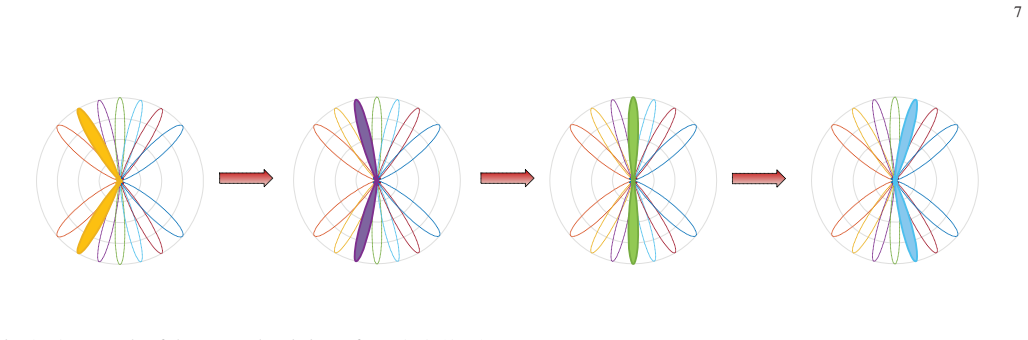
Allowing repeated use of promising Tx-Rx beam pairs during training raises the average successful tracking probability for time-varying millimeter-wave MIMO channels.
A machine-rendered reading of the paper's core claim, the machinery that carries it, and where it could break.
Core claim
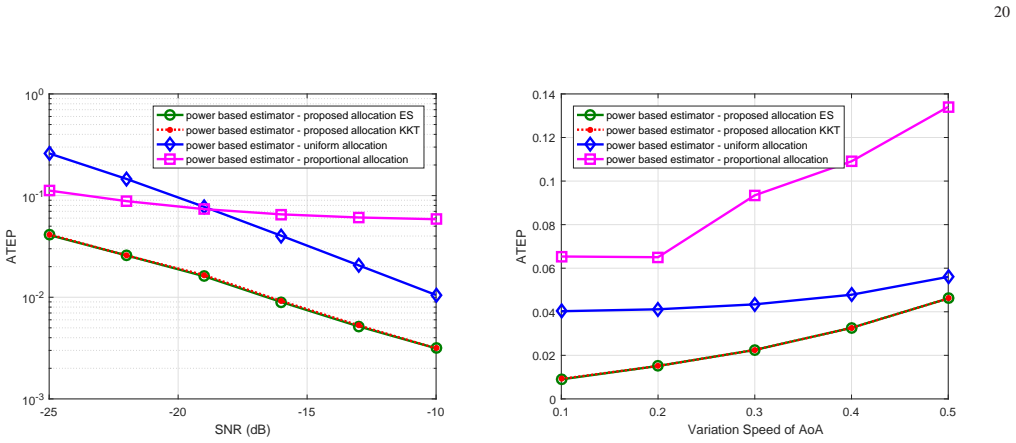
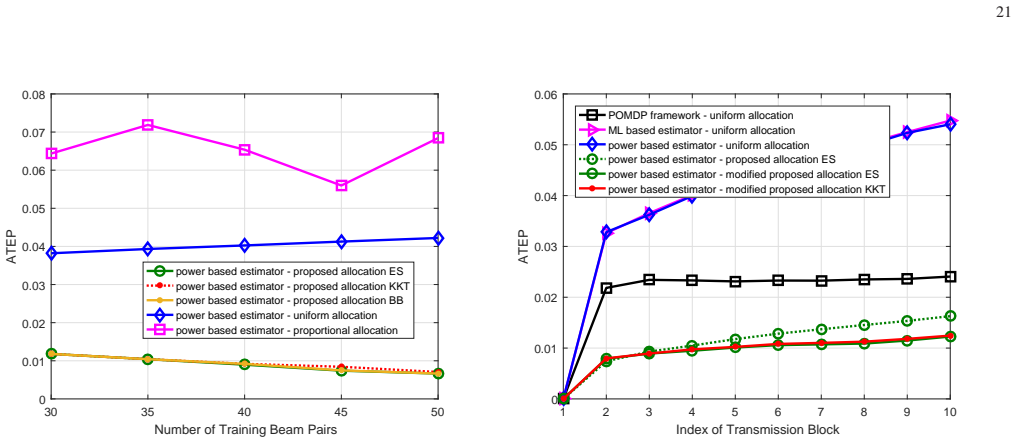
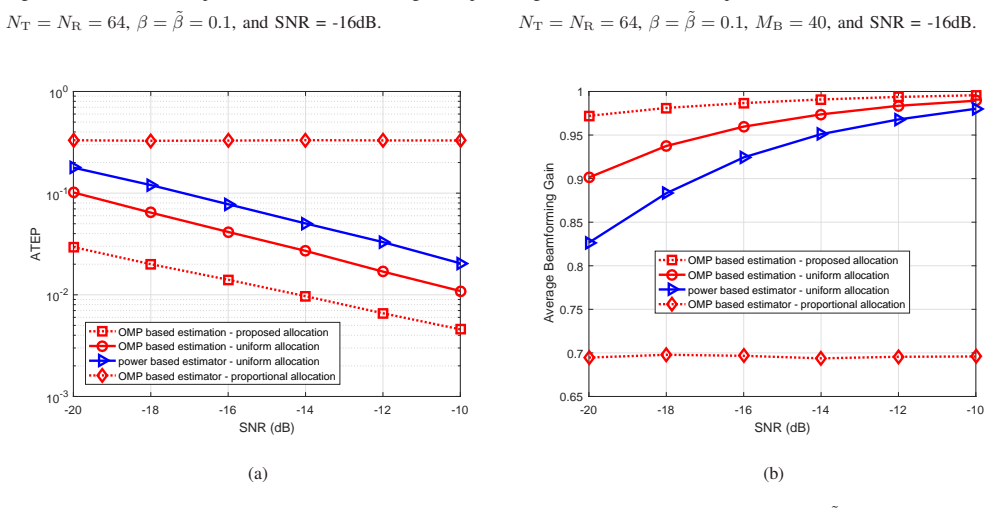
In the orthogonal-beam case the training sequence design is an I-NLP that decomposes into concave subproblems solvable by recursive nonlinear branch-and-bound or by low-complexity KKT solutions after integer relaxation; in the overlapped case OMP estimation yields a closed-form ASTP lower bound that is maximized by the allocation. Both approaches produce higher average successful tracking probability than existing single-use strategies under the modeled time-varying channel.
What carries the argument
Maximization of average successful tracking probability (ASTP) by repeated allocation of Tx-Rx beam pairs, using either a power-based estimator for orthogonal pairs or OMP with an ASTP lower bound for overlapped pairs.
If this is right
- Orthogonal beam pairs admit an exact I-NLP solution via decomposition into concave subproblems and branch-and-bound.
- Overlapped beam pairs admit a closed-form ASTP lower bound that can be maximized without an explicit ASTP expression.
- Relaxing the integer constraints and solving the resulting KKT conditions yields a low-complexity allocation that still outperforms benchmarks.
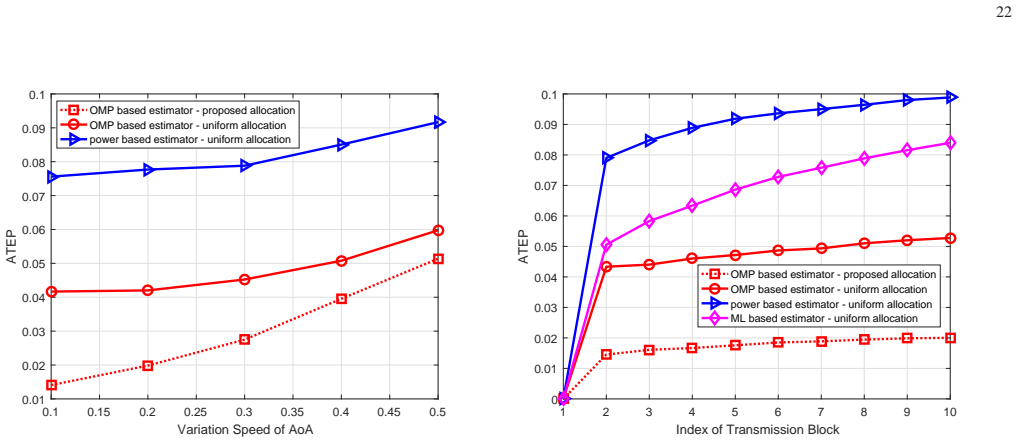
- Numerical evaluation confirms the repeated-use allocations produce higher ASTP than single-use baselines.
Where Pith is reading between the lines
- The repeated-allocation principle could be applied to other resource-limited tracking tasks where concentrating measurements on likely directions is more valuable than uniform scanning.
- If channel coherence time and angle variation statistics are known in advance, the same optimization framework might be used to set the number of repetitions dynamically.
- An online version could re-solve the allocation after each new measurement batch rather than fixing the sequence in advance.
Load-bearing premise
The time-varying angles of arrival and departure can be reliably recovered from the power measurements or OMP outputs obtained on the chosen beam pairs.
What would settle it
A direct comparison, under the paper's time-varying channel model, of realized tracking success rate when the proposed repeated allocations are used versus the single-use benchmark allocations.
Figures
read the original abstract
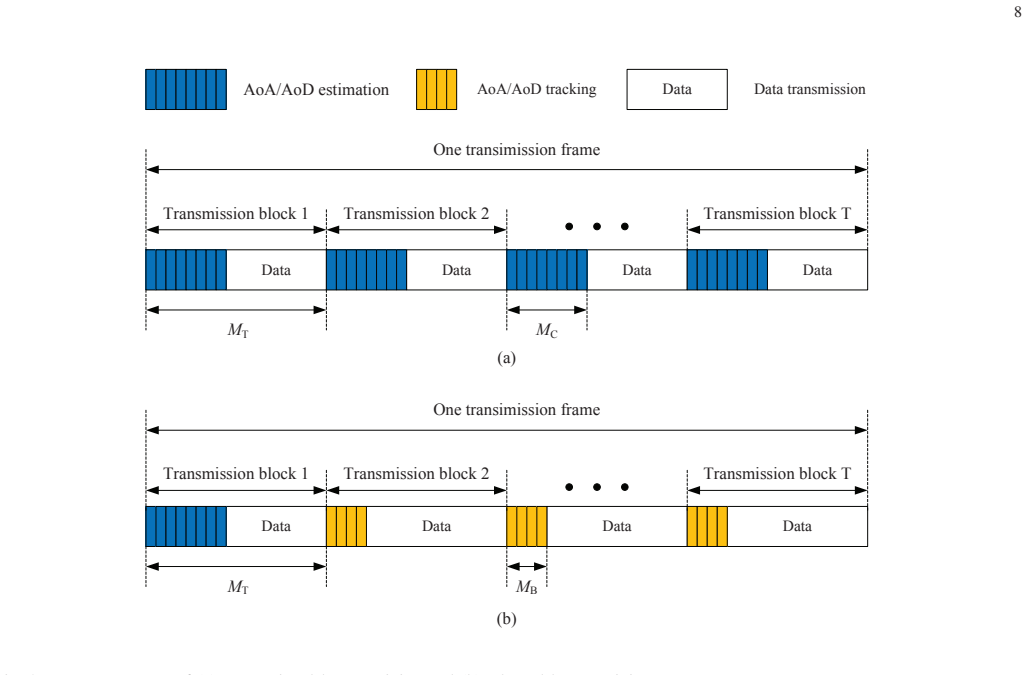
In this paper, we propose a new beam allocation strategy aiming to maximize the average successful tracking probability (ASTP) of time-varying millimeter-wave MIMO systems. In contrast to most existing works that employ one transmitting-receiving (Tx-Rx) beam pair once only in each training period, we investigate a more general framework, where the Tx-Rx beam pairs are allowed to be used repeatedly to improve the received signal powers in specific directions. In the case of orthogonal Tx-Rx beam pairs, a power-based estimator is employed to track the time-varying AoA and AoD of the channel, and the resulting training beam pair sequence design problem is formulated as an integer nonlinear programming (I-NLP) problem. By dividing the feasible region into a set of subregions, the formulated I-NLP is decomposed into a series of concave sub I-NLPs, which can be solved by recursively invoking a nonlinear branch-and-bound algorithm. To reduce the computational cost, we relax the integer constraints of each sub I-NLP and obtain a low-complexity solution via solving the Karush-Kuhn-Tucker conditions of their relaxed problems. For the case when the Tx-Rx beam pairs are overlapped in the angular space, we estimate the updated AoA and AoD via an orthogonal matching pursuit (OMP) algorithm. Moreover, since no explicit expression for the ASTP exists for the OMP-based estimator, we derive a closed-form lower bound of the ASTP, based on which a favorable beam pair allocation strategy can be obtained. Numerical results demonstrate the superiority of the proposed beam allocation strategy over existing benchmarks.
Editorial analysis
A structured set of objections, weighed in public.
Referee Report
Summary. The paper proposes a beam allocation strategy to maximize average successful tracking probability (ASTP) in time-varying mmWave MIMO systems. Unlike prior work using each Tx-Rx beam pair once per training period, it allows repeated use of pairs. For orthogonal pairs, a power-based estimator tracks AoA/AoD and the design is cast as an integer nonlinear program (I-NLP) solved by region decomposition into concave subproblems, branch-and-bound, or KKT relaxation after dropping integrality. For overlapped pairs an OMP estimator is used; because no closed-form ASTP exists, a closed-form lower bound is derived and optimized to obtain the allocation. Numerical results claim superiority over benchmarks.
Significance. If the lower-bound maximizer coincides with the true-ASTP maximizer under realistic channel dynamics, the framework could improve tracking reliability in mobile mmWave MIMO by exploiting repeated measurements and handling both orthogonal and overlapped beam sets. The decomposition of the I-NLP and the explicit lower-bound derivation are technically useful contributions.
major comments (2)
- [Abstract / OMP-based estimator paragraph] Abstract and OMP section: the beam-pair allocation for the OMP estimator is obtained by maximizing a derived closed-form lower bound on ASTP rather than ASTP itself. No analysis is provided showing that the bound is tight enough, or that the gap between bound and true ASTP is allocation-independent, under the simulated time-varying channels; therefore the reported numerical gains may be artifacts of the proxy objective.
- [Numerical results] Numerical results section: superiority is asserted via simulations, yet no robustness checks (e.g., varying bound tightness across allocations, Monte-Carlo gap statistics, or direct comparison of true ASTP for the proposed versus benchmark allocations) are reported, leaving the central claim dependent on an unverified premise.
Simulated Author's Rebuttal
We thank the referee for the constructive comments. We address the two major comments point-by-point below, indicating planned revisions where appropriate.
read point-by-point responses
-
Referee: [Abstract / OMP-based estimator paragraph] Abstract and OMP section: the beam-pair allocation for the OMP estimator is obtained by maximizing a derived closed-form lower bound on ASTP rather than ASTP itself. No analysis is provided showing that the bound is tight enough, or that the gap between bound and true ASTP is allocation-independent, under the simulated time-varying channels; therefore the reported numerical gains may be artifacts of the proxy objective.
Authors: We acknowledge the point. No closed-form ASTP exists for the OMP estimator because of the discrete support recovery step under time-varying AoA/AoD; the lower bound is obtained by combining the OMP exact-recovery condition with a worst-case bound on the residual after each iteration. The derivation assumptions (minimum singular value, noise variance) are allocation-independent, which is why we optimize the bound. The manuscript already evaluates the true (simulated) ASTP of the resulting allocation against benchmarks, but does not report bound-vs-true gaps. We will add a paragraph after the bound derivation explaining its conservatism and include one additional plot in Section V that overlays the lower-bound value and the Monte-Carlo ASTP for the proposed allocation and the two main benchmarks. revision: partial
-
Referee: [Numerical results] Numerical results section: superiority is asserted via simulations, yet no robustness checks (e.g., varying bound tightness across allocations, Monte-Carlo gap statistics, or direct comparison of true ASTP for the proposed versus benchmark allocations) are reported, leaving the central claim dependent on an unverified premise.
Authors: The current numerical results already compare the empirical ASTP (obtained by Monte-Carlo simulation of the full tracking loop) achieved by the bound-optimized allocation versus the benchmarks. We did not, however, tabulate the numerical gap between the lower bound and the realized ASTP. We will revise Section V to report (i) the average and standard deviation of the bound-true gap over the simulated channel trajectories and (ii) a direct side-by-side plot of true ASTP for the proposed allocation and the benchmarks, confirming that the ordering is preserved. These additions require only post-processing of the existing simulation data. revision: yes
Circularity Check
No significant circularity in the derivation chain
full rationale
The paper explicitly formulates beam allocation as an I-NLP for the power-based estimator and derives a closed-form lower bound on ASTP for the OMP estimator (where no explicit ASTP expression is stated to exist), then solves the resulting problems via decomposition, relaxation, and KKT conditions. These steps are standard optimization techniques applied to quantities defined from the channel model and estimators; no quoted reduction shows any 'prediction' or central result equaling its inputs by construction, no self-citation is load-bearing on the derivation, and numerical comparisons are presented as separate validation rather than tautological outcomes.
Axiom & Free-Parameter Ledger
axioms (2)
- domain assumption The mmWave channel has limited angular spread and time-varying AoA/AoD that can be tracked from beamformed power measurements.
- domain assumption The integer nonlinear program can be decomposed into concave subproblems whose solutions remain near-optimal for the original problem.
Reference graph
Works this paper leans on
-
[1]
Training beam sequence optimization for millimeter wav e MIMO tracking systems,
D. Zhang, H. Chen, M. Shirvanimoghaddam, Y . Li, B. Vuceti c, “Training beam sequence optimization for millimeter wav e MIMO tracking systems,” IEEE International Conference on Communications , pp. 1-6, Kansas City, MO, 2018
work page 2018
-
[2]
Millimeter-wav e cellular wireless networks: potentials and challenges,
S. Rangan, T. S. Rappaport, Elza Erkip, “Millimeter-wav e cellular wireless networks: potentials and challenges,” Proceedings of the IEEE, vol. 102, no. 3, pp. 366-385, 2014
work page 2014
-
[3]
Optimal relay probing in millim eter wave cellular systems with device-to-device relaying ,
N. Wei, X. Lin, Z. Zhang, “Optimal relay probing in millim eter wave cellular systems with device-to-device relaying ,” IEEE Transactions on V ehicular Technology, vol. 65, no. 12, pp. 10218 - 10222, 2016
work page 2016
-
[4]
Millimeter wave beamforming for wireless backhaul an d access in small cell networks,
S. Hur, T. Kim, D. J. Love, J. Krogmeier, T. A. Thomas, A. Gh osh, “Millimeter wave beamforming for wireless backhaul an d access in small cell networks,” IEEE Transactions on Communications , vol. 61, no. 10, pp. 4391-4403, 2013
work page 2013
-
[5]
An overview of signal processing techniques for mil limeter wave MIMO systems,
R. W. Heath, N. Gonzlez-Prelcic, S. Rangan, W. Roh, A. M. S ayeed, “An overview of signal processing techniques for mil limeter wave MIMO systems,” IEEE Journal of Selected Topics in Signal Processing , vol. 10, no. 3, pp. 436-453, 2016
work page 2016
-
[6]
J. Lee, G. Gil, Y . H. Lee, “Channel estimation via orthogo nal matching pursuit for hybrid MIMO systems in millimeter w ave communications,” IEEE Transactions on Communications , vol. 64, no. 6, pp. 2370-2386, 2016. 29
work page 2016
-
[7]
Beam codebook ba sed beamforming protocol for multi-Gbps millimeter-wave W PAN systems,
J. Wang, Z. Lan, C. Pyo, T. Baykas, et al, “Beam codebook ba sed beamforming protocol for multi-Gbps millimeter-wave W PAN systems,” IEEE Journal of Selected Areas in Communications , vol. 27, no. 8, pp. 1390-1399, 2009
work page 2009
-
[8]
Channel estim ation and hybrid precoding for millimeter wave cellular sys tems,
A. Ahmed, O. E. Ayach, G. Leus, R. W. Heath, “Channel estim ation and hybrid precoding for millimeter wave cellular sys tems,” IEEE Journal of Selected Topics in Signal Processing , vol. 8, no. 5, pp. 831-846, 2014
work page 2014
-
[9]
S. Noh, M. Zoltowski, D. J. Love, “Multi-resolution code book and adaptive beamforming sequence design for millimet er wave beam alignment,” IEEE Transactions on Wireless Communications , vol. 16, no. 9, pp. 5689-5701, 2017
work page 2017
-
[10]
Hierarchical codebook de sign for beamforming training in millimeter-wave communic ation,
Z. Xiao, T. He, P . Xia, X. Xia, “Hierarchical codebook de sign for beamforming training in millimeter-wave communic ation,”IEEE Transactions on Wireless Communications , vol. 15, no. 5, pp. 3380-3392, 2016
work page 2016
-
[11]
Milli meter wave MIMO channel estimation using overlapped beam pa tterns and rate adaptation,
M. Kokshoorn, H. Chen, P . Wang, Y . Li, B. Vucetic, “Milli meter wave MIMO channel estimation using overlapped beam pa tterns and rate adaptation,” IEEE Transactions on Signal Processing , vol. 65, no. 3, pp. 601-616, 2017
work page 2017
-
[12]
Beam-on-grap h: simultaneous channel estimation for mmWave MIMO systems with multiple users,
M. Kokshoorn, H. Chen, Y . Li, B. Vucetic, “Beam-on-grap h: simultaneous channel estimation for mmWave MIMO systems with multiple users,” IEEE Transactions on Communications , vol. 66, no. 7, pp. 2931-2946, 2018
work page 2018
-
[13]
Optimal precod ers for tracking the AoD and AoA of a mmWave path,
N. Garcia, H. Wymeersch, D. T. M. Slock, “Optimal precod ers for tracking the AoD and AoA of a mmWave path,” IEEE Transactions on Signal Processing , vol. 66, no. 21, pp. 5718-5729, 2018
work page 2018
-
[14]
Millimeter wav e MIMO channel tracking systems,
J. He, T. Kim, H. Ghauch, K. Liu, G. Wang, “Millimeter wav e MIMO channel tracking systems,” IEEE Globecom W orkshops , pp. 416-421, Austin, TX, 2014
work page 2014
-
[15]
Tracking angles of departure a nd arrival in a mobile millimeter wave channel,
C. Zhang, D. Guo, P . Fan, “Tracking angles of departure a nd arrival in a mobile millimeter wave channel,” IEEE International Conference on Communications , pp. 1-6, Kuala Lumpur, 2016
work page 2016
-
[16]
Beam tracking for mobile m illimeter wave communication systems,
V . V a, H. Vikalo, R. W. Heath, “Beam tracking for mobile m illimeter wave communication systems,” IEEE Global Conference on Signal and Information Processing , pp. 743-747, Washington, DC, 2016
work page 2016
-
[17]
Angle do main hybrid precoding and channel tracking for millimeter w ave massive MIMO systems,
J. Zhao, F. Gao, W. Jia, S. Zhang, S. Jin, H. Lin, “Angle do main hybrid precoding and channel tracking for millimeter w ave massive MIMO systems,” IEEE Transactions on Wireless Communications , vol. 16, no. 10, pp. 6868-6880, 2017
work page 2017
-
[18]
Tracking mm-Wave cha nnel dynamics: fast beam training strategies under mobilit y,
J. Palacios, D. Donno, J. Widmer, “Tracking mm-Wave cha nnel dynamics: fast beam training strategies under mobilit y,” IEEE Conference on Computer Communications , pp. 1-9, Atlanta, GA, 2017
work page 2017
-
[19]
How to mobi lize mmwave: a joint beam and channel tracking approach,
J. Li, Y . Sun, L. Xiao, S. Zhou, A. Sabharwal, “How to mobi lize mmwave: a joint beam and channel tracking approach,” IEEE International Conference on Acoustics, Speech and Signal P rocessing, pp. 3624-3628, Calgary, AB, 2018
work page 2018
-
[20]
Locatio n-aided mm-Wave channel estimation for vehicular communic ation,
N. Garcia, H. Wymeersch, E. G. Strom, D. Slock, “Locatio n-aided mm-Wave channel estimation for vehicular communic ation,” IEEE International W orkshop on Signal Processing Advances in Wi reless Communications, pp. 1-5, Edinburgh, 2016
work page 2016
-
[21]
Fast cha nnel tracking for terahertz beamspace massive MIMO systems ,
X. Gao, L. Dai, Y . Zhang, T. Xie, X. Dai, Z. Wang, “Fast cha nnel tracking for terahertz beamspace massive MIMO systems ,” IEEE Transactions on V ehicular Technology, vol. 66, no. 7, pp. 5689-5696, 2017
work page 2017
-
[22]
Fast ch annel estimation and beam tracking for millimeter wave vehi cular communications,
S. Shaham, M. Ding, M. Kokshoorn, Z. Lin, X. Yao, “Fast ch annel estimation and beam tracking for millimeter wave vehi cular communications,” arXiv preprint, available online: https://arxiv.org/abs/1806.00161, 2 018
-
[23]
Managing v ertical handovers in millimeter wave heterogeneous networ ks,
S. Zang, W. Bao, P . L. Yeoh, B. Vucetic, Y . Li, “Managing v ertical handovers in millimeter wave heterogeneous networ ks,” IEEE Transactions on Communications , vol. 67, no.2, 2019
work page 2019
-
[24]
AoD and AoA tra cking with directional sounding beam design for millimeter wave MIMO systems,
Q. Duan, T. Kim, H. Huang, K. Liu, G. Wang, “AoD and AoA tra cking with directional sounding beam design for millimeter wave MIMO systems,” IEEE Annual International Symposium on Personal, Indoor , a nd Mobile Radio Communications , pp. 2271-2276, Hong Kong, 2015
work page 2015
-
[25]
A probe-then-refine beam tracking algorithm for millimet er wave MISO systems,
D. Zhang, H. Chen, M. Kokshoorn, Y . Li, N. Wei, B. Vucetic , “A probe-then-refine beam tracking algorithm for millimet er wave MISO systems,” IEEE International Conference on Communications W orkshop s, pp. 1-6, Kansas City, MO, 2018
work page 2018
-
[26]
New Beam Tracking Technique for Millimeter Wave-band Communications
J. Bae, S. Lim, J. Y oo, J. W. Choi, “New beam tracking tech nique for millimeter wave-band communications,” arXiv preprint, available online: https://arxiv.org/abs/1702.00276, 2017
work page internal anchor Pith review Pith/arXiv arXiv 2017
-
[27]
Efficient Beam Training and Channel Estimation for Millimeter Wave Communications Under Mobility
S. H. Lim, J. Bae, S. Kim, B. Shim, J. W. Choi, “Efficient be am training and channel estimation for millimeter wave comm unications under mobility,” arXiv preprint, available online: https://arxiv.org/abs/1804.07973, 2 018. 30
work page internal anchor Pith review Pith/arXiv arXiv
-
[28]
Training beam sequence d esign for millimeter-wave MIMO systems: a POMDP framework,
J. Seo, Y . Sung, G. Lee, D. Kim, “Training beam sequence d esign for millimeter-wave MIMO systems: a POMDP framework, ” IEEE Transactions on Signal Processing , vol. 64, no. 5, pp. 1228-1242, 2016
work page 2016
-
[29]
Efficient beam alignment in millimeter wave systems using co ntextual bandits,
M. Hashemi, A. Sabharwal, C. Emre Koksal, N. B. Shroff, “ Efficient beam alignment in millimeter wave systems using co ntextual bandits,” IEEE Conference on Computer Communications , pp. 2393-2401, 2018
work page 2018
-
[30]
Deconstructing multiantenna fading cha nnels,
A. M. Sayeed, “Deconstructing multiantenna fading cha nnels,” IEEE Transactions on Signal Processing , vol. 50, no. 10, pp. 2563-2579, 2002
work page 2002
-
[31]
X. Gao, L. Dai, S. Han, C. L. I; X. Wang, “Reliable beamspa ce channel estimation for millimeter-wave massive MIMO sys tems with lens antenna array,” IEEE Transactions on Wireless Communications , vol. 16, no. 9, pp. 6010-6021, 2017
work page 2017
-
[32]
Compressed sensi ng based multi-user millimeter wave systems: how many measu rements are needed?
A. Alkhateeby, G. Leusz, R. W. Heath, “Compressed sensi ng based multi-user millimeter wave systems: how many measu rements are needed?” IEEE International Conference on Acoustics, Speech and Sig nal Processing , pp. 2909-2913, Brisbane, QLD, 2015
work page 2015
- [33]
-
[34]
Signal recovery from random measurements via orthogonal matching pursuit,
J. A. Tropp, A. C. Gilbert, “Signal recovery from random measurements via orthogonal matching pursuit,” IEEE Transactions on Information Theory , vol. 53, no. 12, pp. 4655-4666, 2007
work page 2007
-
[35]
J. Lee, G. Gil, Y . H. Lee, “Exploiting spatial sparsity f or estimating channels of hybrid MIMO systems in millimeter wave communications,” IEEE Global Communications Conference , pp. 3326-3331, Austin, TX, 2014
work page 2014
-
[36]
M. K. Simon, M. S. Alouini, “A unified approach to the prob ability of error for noncoherent and differentially cohere nt modulations over generalized fading channels,” IEEE Transactions on Communications , vol. 46, no. 12, pp. 1625-1638, 1998
work page 1998
-
[37]
I. S. Gradshteyn, I. M. Ryzhik, Table of Integrals, Series, and Products , 7th ed. San Diego, CA: Academic, 2007
work page 2007
-
[38]
Differential evolution: a surve y of the state-of-the-art,
S. Das, P . Suganthan, “Differential evolution: a surve y of the state-of-the-art,” IEEE Transactions on Evolutionary Computation , vol. 15, no. 1, pp. 4-31, 2010
work page 2010
-
[39]
Algorithms and sof tware for convex mixed integer nonlinear programs,
B. Pierre, M. Kilinc, J. Linderoth, “Algorithms and sof tware for convex mixed integer nonlinear programs,” Mixed Integer Nonlinear Programming, pp. 1-39, 2012
work page 2012
-
[40]
S. Boyd, L. V andenberghe, Convex Optimization, Cambridge University Press, 2004
work page 2004
discussion (0)
Sign in with ORCID, Apple, or X to comment. Anyone can read and Pith papers without signing in.