Pairwise Tidal Equilibrium States and the Architecture of Extrasolar Planetary Systems
Pith reviewed 2026-05-25 11:20 UTC · model grok-4.3
The pith
Planet formation arranges masses and orbits into minimum energy states with nearly equal masses on circular coplanar paths.
A machine-rendered reading of the paper's core claim, the machinery that carries it, and where it could break.
Core claim
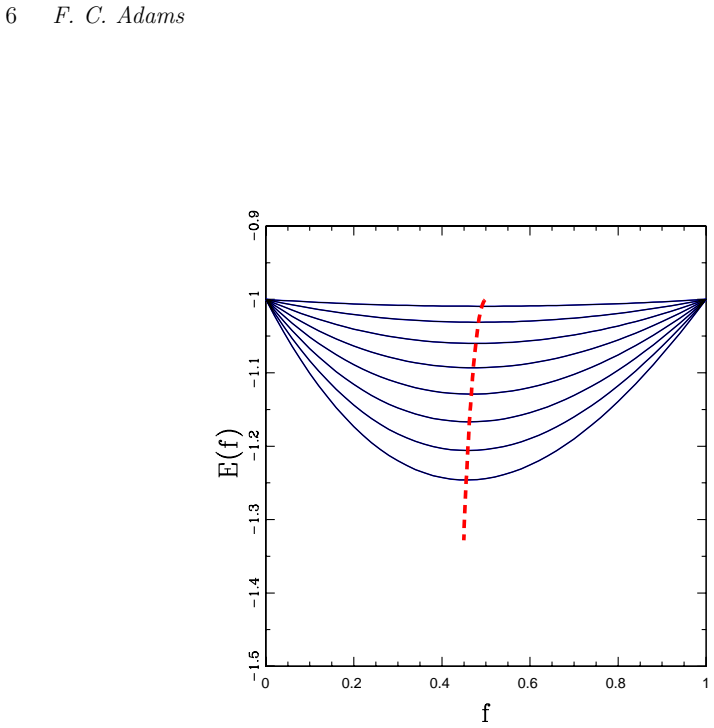
The basic conjecture explored in this paper is that the planet formation process will act to distribute planetary masses in order to achieve a minimum energy state. The resulting minimum energy configuration — subject to the constraint of constant angular momentum — corresponds to circular orbits confined to a plane, with nearly equal planetary masses (as observed). We then generalize the treatment to include multiple planet systems, where each adjacent pair of planets attains its (local) tidal equilibrium state. The properties of observed planetary systems are close to those expected from this pairwise equilibrium configuration. In contrast, observed systems do not reside in a globalminimum
What carries the argument
Pairwise tidal equilibrium states for adjacent planets, defined as the minimum energy configuration at fixed angular momentum.
If this is right
- Multi-planet systems develop nearly equal masses for neighboring planets.
- Orbits become circular and confined to a single plane.
- Each adjacent pair settles into its local equilibrium rather than the full system reaching one global state.
- The effective surface density of planets scales as sigma proportional to r to the minus two.
- Observed systems sit close to but not exactly at global minimum energy.
Where Pith is reading between the lines
- Formation may include mass-equalizing processes that operate across different orbital distances.
- The steep surface density profile could arise as a direct outcome of the equilibrium condition itself.
- This local pairwise picture might predict mass ratios for given orbital spacings in future detections.
Load-bearing premise
The planet formation process acts to distribute planetary masses in order to achieve a minimum energy state.
What would settle it
A multi-planet system with highly unequal masses on eccentric or inclined orbits that cannot be explained by later evolution would show the equilibria are not reached during formation.
Figures
read the original abstract
Current observations indicate that the planet formation process often produces multiple planet systems with nearly circular orbits, regular spacing, a narrow range of inclination angles, and similar planetary masses of order $m_{\rm p}\sim10M_\oplus$. Motivated by the observational sample, this paper determines the tidal equilibrium states for this class of extrasolar planetary systems. We start by considering two planet systems with fixed orbital spacing and variable mass ratios. The basic conjecture explored in this paper is that the planet formation process will act to distribute planetary masses in order to achieve a minimum energy state. The resulting minimum energy configuration --- subject to the constraint of constant angular momentum --- corresponds to circular orbits confined to a plane, with nearly equal planetary masses (as observed). We then generalize the treatment to include multiple planet systems, where each adjacent pair of planets attains its (local) tidal equilibrium state. The properties of observed planetary systems are close to those expected from this pairwise equilibrium configuration. In contrast, observed systems do not reside in a global minimum energy state. Both the equilibrium states of this paper and observed multi-planet systems, with planets of nearly equal mass on regularly spaced orbits, have an effective surface density of the form $\sigma\propto r^{-2}$, much steeper than most disk models.
Editorial analysis
A structured set of objections, weighed in public.
Referee Report
Summary. The paper claims that planet formation drives extrasolar systems toward minimum-energy tidal equilibrium states under fixed angular momentum, yielding circular coplanar orbits with nearly equal masses for two-planet cases; multi-planet systems reach local pairwise equilibria. Observed architectures are asserted to match these pairwise states (but not global minima) and to exhibit an effective surface density σ ∝ r^{-2}.
Significance. If the derived equilibria are correct and the formation conjecture holds, the work supplies a tidal-physics basis for the regular spacing, low eccentricities, and mass equality seen in compact multi-planet systems, while usefully distinguishing pairwise from global minima. The σ ∝ r^{-2} result is a concrete, falsifiable prediction that differs from standard disk models.
major comments (2)
- [Abstract] Abstract: the claim that 'observed planetary systems are close to those expected from this pairwise equilibrium configuration' is presented without quantitative metrics, error analysis, or statistical comparison to the calculated equilibria; this is load-bearing for the central observational match.
- [Abstract / conjecture statement] The basic conjecture (that formation actively distributes masses to reach minimum-energy states) is stated as motivated by observations but is not supported by any dynamical pathway, accretion simulation, or stability analysis showing preferential arrival at these states; without this link the match to observations remains correlative.
Simulated Author's Rebuttal
We thank the referee for the constructive comments. We address each major point below and indicate where revisions will be made.
read point-by-point responses
-
Referee: [Abstract] Abstract: the claim that 'observed planetary systems are close to those expected from this pairwise equilibrium configuration' is presented without quantitative metrics, error analysis, or statistical comparison to the calculated equilibria; this is load-bearing for the central observational match.
Authors: We agree that the abstract states the match in qualitative terms. The full manuscript supports the claim through explicit comparisons of mass ratios, orbital spacings, and the derived surface density profile for specific observed systems. To strengthen the presentation, we will add quantitative metrics (e.g., average fractional deviations in mass and spacing) and a basic statistical summary of the agreement in the revised version. revision: yes
-
Referee: [Abstract / conjecture statement] The basic conjecture (that formation actively distributes masses to reach minimum-energy states) is stated as motivated by observations but is not supported by any dynamical pathway, accretion simulation, or stability analysis showing preferential arrival at these states; without this link the match to observations remains correlative.
Authors: The conjecture is framed as an exploratory hypothesis motivated by the observed regularities (equal masses, regular spacing). The manuscript derives the equilibrium states under this assumption and shows that observed systems align with local pairwise equilibria (but not global minima). No dynamical pathway or formation simulation is provided, as the work focuses on identifying the tidal equilibria themselves rather than modeling the formation process that may reach them. The observational correspondence is therefore presented as consistent with the conjecture rather than as direct evidence for it. revision: no
- Demonstrating via dynamical pathway, accretion simulation, or stability analysis that planet formation preferentially reaches the pairwise tidal equilibrium states.
Circularity Check
Equilibria derived from conservation laws; formation link is explicit conjecture with no reduction to inputs.
full rationale
The paper calculates minimum-energy states for two-planet and multi-planet systems by minimizing total energy subject to fixed angular momentum, yielding circular coplanar orbits with equal masses as the local pairwise equilibria. These states follow directly from the stated physical constraints without reference to formation mechanisms or observational fitting. The link between formation and these states is labeled a 'basic conjecture' in the abstract and is not derived, fitted, or justified via self-citation within the provided text. Observed architectures are compared to the calculated equilibria rather than used to define them, so no step reduces by construction to its own inputs.
Axiom & Free-Parameter Ledger
axioms (2)
- domain assumption Angular momentum is conserved while the system approaches tidal equilibrium
- domain assumption Tidal interactions drive planetary systems toward minimum total energy states with circular coplanar orbits
Reference graph
Works this paper leans on
-
[1]
Abramowitz, M., & Stegun, I. A. 1972, Handbook of Mathematical Functions (New York: Dover)
work page 1972
- [2]
- [3]
-
[4]
Alessi, M., Pudritz, R. E., & Cridland, A. J. 2017, MNRAS, 464, 428
work page 2017
-
[5]
Andrews, S. M., Wilner, D. J., Hughes, A. M., Qi, C., & Dullemond, C. P. 2009, ApJ, 700, 1502
work page 2009
-
[6]
Batalha, N. M., Borucki, W. J., Bryson, S. T., et al. 2011, ApJ, 729, 27
work page 2011
- [7]
- [8]
- [9]
-
[10]
J., Koch, D., Basri, G., et al
Borucki, W. J., Koch, D., Basri, G., et al. 2010, Sci, 327, 977
work page 2010
-
[11]
Chambers, J. E, Wetherill, G. W., & Boss, A. P. 1996, Icarus, 119, 261
work page 1996
- [12]
-
[13]
Counselman, C. C. 1973, ApJ, 180, 307
work page 1973
-
[14]
Desch, S. J. 2007, ApJ, 671, 878
work page 2007
-
[15]
Fabrycky, D. C., Lissauer, J. J., Ragozzine, D., et al. 2014, ApJ, 790, 146
work page 2014
- [16]
- [17]
- [18]
-
[19]
2013, ApJ, 775, 53, Hartmann L
Hansen, B.M.S., & Murray, N. 2013, ApJ, 775, 53, Hartmann L. 2007, Physica Scripta, 130, 014012
work page 2013
- [20]
-
[21]
2010, ApJ, 719, 810 c⃝ 2019 RAS, MNRAS 000, 1–18 18 F
Ida, S., & Lin, D.N.C. 2010, ApJ, 719, 810 c⃝ 2019 RAS, MNRAS 000, 1–18 18 F. C. Adams
work page 2010
- [22]
- [23]
- [24]
-
[25]
Laughlin, G., Bodenheimer, P., & Adams, F. C. 2004, ApJ, 612, L73
work page 2004
- [26]
- [27]
- [28]
-
[29]
Millholland, S., Wang, S., & Laughlin, G. 2017, ApJ Letters, 849, L33
work page 2017
- [30]
- [31]
-
[32]
2018, in Handbook of Exoplanets, Planetary Population Synthesis, Springer, New York City, NY, USA, p
Mordasini, C. 2018, in Handbook of Exoplanets, Planetary Population Synthesis, Springer, New York City, NY, USA, p. 143
work page 2018
-
[33]
Murray, C. D., & Dermott, S. F. 1999, Solar System Dynamics (Cambridge: Cambridge Univ. Press)
work page 1999
-
[34]
Obertas, A., Van Laerhoven, C., & Tamayo, D. 2017, Icarus, 293, 52
work page 2017
-
[35]
Pakter, R., & Levin, Y. 2018, Phys. Rev. E, 97, 2221 P´ erez, L. M., Carpenter, J. M., Chandler, C., et al. 2012, ApJ, 760, L17
work page 2018
- [36]
- [37]
-
[38]
Shu, F. H., Tremaine, S., Adams, F. C., & Ruden, S. P. 1990, ApJ, 358, 495
work page 1990
- [39]
-
[40]
2012, AJ, 143, 94 Van Eylen, V., & Albrecht, S
Tremaine, S., & Dong, S. 2012, AJ, 143, 94 Van Eylen, V., & Albrecht, S. 2015, ApJ, 808, 126
work page 2012
-
[41]
Weidenschilling, S. J. 1977, MNRAS, 180, 57
work page 1977
- [42]
- [43]
-
[44]
Wu, D.-H., Zhang, R. C., Zhou, J.-L., & Steffen, J. H. 2019, MNRAS 484, 15381548 (2019)
work page 2019
-
[45]
2018, ApJ, 860, 101 c⃝ 2019 RAS, MNRAS 000, 1–18
Zhu, W., Petrovich, C., Wu, Y., Dong., S., & Xie, J. 2018, ApJ, 860, 101 c⃝ 2019 RAS, MNRAS 000, 1–18
work page 2018
discussion (0)
Sign in with ORCID, Apple, or X to comment. Anyone can read and Pith papers without signing in.