Quantization in Compressive Sensing: A Signal Processing Approach
Pith reviewed 2026-05-25 11:13 UTC · model grok-4.3
The pith
A unified statistical model merges quantization noise with signal nonsparsity to yield an exact formula for expected reconstruction error energy in compressive sensing.
A machine-rendered reading of the paper's core claim, the machinery that carries it, and where it could break.
Core claim
The central claim is that quantization noise and signal nonsparsity can be combined into one unified statistical model whose parameters produce an exact closed-form expression for the expected energy of the reconstruction error in compressive sensing, valid across arbitrary quantization bit widths and for both sparse and approximately sparse signals.
What carries the argument
The unified statistical model that folds quantization noise together with nonsparsity deviations into a single noise term whose variance enters the error-energy formula.
If this is right
- Expected reconstruction error energy becomes computable in closed form once quantization bit width and sparsity level are known.
- The same formula applies without change to signals that are only approximately sparse.
- Noise-folding contributions from quantization are automatically included in the predicted error energy.
- Floating-point arithmetic effects can be analyzed by substituting the corresponding quantization noise variance into the model.
Where Pith is reading between the lines
- Hardware designers could select the smallest number of bits that keeps predicted error below a target threshold without exhaustive simulation.
- The model supplies a quantitative link between measurement-matrix coherence and tolerable quantization coarseness.
- The formula could be inverted to find the bit depth needed to restore a desired error level when nonsparsity level is known.
Load-bearing premise
Quantization effects and nonsparsity can be treated as additive components inside one statistical model that produces an exact closed-form error expression without leftover interactions from register length or the choice of reconstruction algorithm.
What would settle it
Numerical Monte-Carlo trials of basis-pursuit or orthogonal-matching-pursuit reconstruction on quantized measurements whose measured average error energy lies systematically outside the interval predicted by the closed-form formula for the same sparsity and bit depth.
Figures



read the original abstract
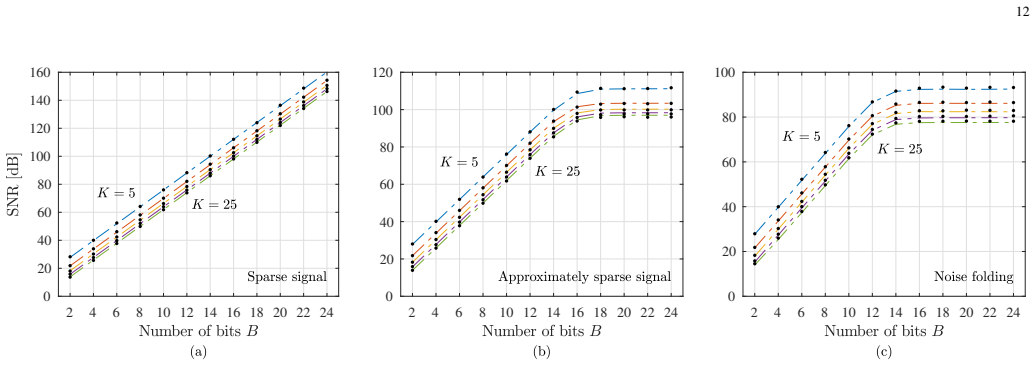
Influence of the finite-length registers and quantization effects on the reconstruction of sparse and approximately sparse signals is analyzed in this paper. For the nonquantized measurements, the compressive sensing (CS) framework provides highly accurate reconstruction algorithms that produce negligible errors when the reconstruction conditions are met. However, hardware implementations of signal processing algorithms involve the finite-length registers and quantization of the measurements. An analysis of the effects related to the measurements quantization with an arbitrary number of bits is the topic of this paper. A unified mathematical model for the analysis of the quantization noise and the signal nonsparsity on the CS reconstruction is presented. An exact formula for the expected energy of error in the CS-based reconstructed signal is derived. The theory is validated through various numerical examples with quantized measurements, including the cases of approximately sparse signals, noise folding, and floating-point arithmetics.
Editorial analysis
A structured set of objections, weighed in public.
Referee Report
Summary. The paper analyzes the effects of finite-length registers and quantization on the reconstruction of sparse and approximately sparse signals in compressive sensing (CS). It introduces a unified mathematical model combining quantization noise and signal nonsparsity, derives an exact closed-form expression for the expected energy of the reconstruction error E[||x̂ - x||²], and validates the result via numerical examples covering quantized measurements, approximately sparse signals, noise folding, and floating-point arithmetic.
Significance. If the exact formula holds under the stated assumptions, the work would provide a practical analytical tool for predicting reconstruction error in hardware-constrained CS systems, which is relevant for bridging theoretical CS guarantees with finite-bit implementations. The numerical validations across multiple scenarios, including noise folding and floating-point effects, represent a strength in demonstrating applicability beyond idealized models.
major comments (2)
- [§3] §3 (Derivation of the unified model): The exact formula for expected error energy assumes that quantization noise and nonsparsity perturbations propagate through the reconstruction operator in a manner permitting a closed-form second-moment calculation. However, for nonlinear solvers such as basis pursuit or OMP, the mapping from measurement perturbation to reconstruction error is generally nonlinear, which can introduce unmodeled cross terms or dependence on support recovery and matrix conditioning not eliminated by the statistical independence assumptions.
- [§4] §4 (Numerical validation): The examples report close agreement between the derived formula and simulations, but the manuscript does not specify which reconstruction algorithm is used in the experiments or how finite-bit effects are isolated from solver-specific nonlinearities, making it difficult to confirm that the exactness claim extends beyond the linear decoder case implicitly used in the model.
minor comments (2)
- [Abstract] The abstract and introduction use 'exact formula' without immediately clarifying the linearity or Gaussianity assumptions required for the second-moment calculation; adding a brief statement in the introduction would improve clarity.
- [§2] Notation for the quantization noise variance and the nonsparsity error term could be made more consistent across equations to avoid potential confusion when combining the two effects.
Simulated Author's Rebuttal
We thank the referee for the constructive comments, which help clarify the scope of our derivation. We respond to each major comment below.
read point-by-point responses
-
Referee: [§3] §3 (Derivation of the unified model): The exact formula for expected error energy assumes that quantization noise and nonsparsity perturbations propagate through the reconstruction operator in a manner permitting a closed-form second-moment calculation. However, for nonlinear solvers such as basis pursuit or OMP, the mapping from measurement perturbation to reconstruction error is generally nonlinear, which can introduce unmodeled cross terms or dependence on support recovery and matrix conditioning not eliminated by the statistical independence assumptions.
Authors: The derivation in §3 explicitly models the reconstruction operator as linear (e.g., a fixed matrix applied to the vector of quantized measurements), which permits the exact closed-form second-moment result under the stated independence assumptions. This linearity holds for decoders such as the pseudoinverse solution on a known or estimated support. The manuscript does not claim the formula is exact for nonlinear iterative solvers such as OMP or basis pursuit; those introduce additional dependencies that fall outside the model. We will revise the text in §3 to state the linear-reconstruction assumption explicitly and note the distinction from nonlinear solvers. revision: partial
-
Referee: [§4] §4 (Numerical validation): The examples report close agreement between the derived formula and simulations, but the manuscript does not specify which reconstruction algorithm is used in the experiments or how finite-bit effects are isolated from solver-specific nonlinearities, making it difficult to confirm that the exactness claim extends beyond the linear decoder case implicitly used in the model.
Authors: We agree that the reconstruction algorithm employed in the numerical examples should have been stated. The simulations use a linear decoder consisting of the Moore-Penrose pseudoinverse applied to the sensing matrix restricted to the (estimated) support, with quantization applied directly to the measurements prior to this linear step. This isolates the quantization and nonsparsity effects from solver nonlinearities. We will revise §4 to specify the decoder, describe the support estimation procedure, and add a short discussion confirming that the experiments match the linear model under which the formula is exact. revision: yes
Circularity Check
Exact closed-form error energy derived from unified statistical model with no reduction to fitted inputs or self-citations
full rationale
The paper presents a unified mathematical model combining quantization noise and nonsparsity effects, then derives an exact formula for expected reconstruction error energy. No quoted equations or sections indicate that this formula is obtained by fitting parameters to data and renaming the fit as a prediction, nor does any load-bearing step reduce to a self-citation chain or ansatz smuggled via prior work. The derivation is presented as a direct statistical expectation calculation under the model's assumptions, remaining self-contained against external benchmarks.
Axiom & Free-Parameter Ledger
axioms (2)
- domain assumption Quantization effects can be modeled as additive noise with specific statistical properties combinable with nonsparsity in the CS error expectation.
- domain assumption CS reconstruction conditions extend to the quantized case in a manner allowing exact error energy calculation.
Lean theorems connected to this paper
-
IndisputableMonolith/Cost/FunctionalEquation.leanwashburn_uniqueness_aczel unclear?
unclearRelation between the paper passage and the cited Recognition theorem.
A unified mathematical model for the analysis of the quantization noise and the signal nonsparsity on the CS reconstruction is presented. An exact formula for the expected energy of error ... ∥XR−XK∥²₂ = Kσ²_μ ∥X−XK∥²₂ + Kσ²_e
-
IndisputableMonolith/Foundation/RealityFromDistinction.leanreality_from_one_distinction unclear?
unclearRelation between the paper passage and the cited Recognition theorem.
The quantization error is a white noise process with a uniform distribution ... σ²_e = Δ²/12
What do these tags mean?
- matches
- The paper's claim is directly supported by a theorem in the formal canon.
- supports
- The theorem supports part of the paper's argument, but the paper may add assumptions or extra steps.
- extends
- The paper goes beyond the formal theorem; the theorem is a base layer rather than the whole result.
- uses
- The paper appears to rely on the theorem as machinery.
- contradicts
- The paper's claim conflicts with a theorem or certificate in the canon.
- unclear
- Pith found a possible connection, but the passage is too broad, indirect, or ambiguous to say the theorem truly supports the claim.
Reference graph
Works this paper leans on
-
[1]
D. Donoho, “Compressed sensing,” IEEE Transactions on Information Theory, vol. 52, no. 4, pp. 1289–1306, 2006
work page 2006
-
[2]
R. Baraniuk, “Compressive sensing,” IEEE Signal Processing Magazine, vol. 24, no. 4, pp. 118–121, 2007
work page 2007
-
[3]
E. Candes, J. Romberg and T. Tao. “Robust uncertainty principles: Exact signal reconstruction from highly incomplete frequency information,” IEEE Transactions on Information Theory , vol. 52, pp. 489–509, 2006
work page 2006
-
[4]
Stable signal recovery from incomplete and inaccurate measurements,
E. Candes, J. Romberg, and T. Tao, “Stable signal recovery from incomplete and inaccurate measurements,” Comm. Pure Appl. Math. , 59: 1207-1223., 2006, doi:10.1002/cpa.20124
-
[5]
Encoding the lp from limited measure- ments,
E. Candes, and J. Romberg. “Encoding the lp from limited measure- ments,” Data Compression Conference (DCC’06). IEEE , 2006
work page 2006
-
[6]
Missing Samples Analysis in Signals for Applications to L-estimation and Compressive Sensing,
L. Stankovi ´c, S. Stankovi ´c, and M. Amin, “Missing Samples Analysis in Signals for Applications to L-estimation and Compressive Sensing,” Signal Processing, vol. 94, pp. 401–408, January 2014
work page 2014
-
[7]
Introduction to compressed sensing,
M. Davenport, M. Duarte, Y . Eldar, and G. Kutyniok, “Introduction to compressed sensing,” Chapter in Compressed Sensing: Theory and Applications, Cambridge University Press, 2012
work page 2012
-
[8]
L. Stankovi ´c, and M. Dakovi´c, “On the Uniqueness of the Sparse Signals Reconstruction Based on the Missing Samples Variation Analysis,” Mathematical Problems in Engineering , vol. 2015, Article ID 629759, 14 pages, 2015. doi:10.1155/2015/629759
-
[9]
S. Stankovi ´c, L. Stankovi ´c, and I. Orovi ´c, “A Relationship between the Robust Statistics Theory and Sparse Compressive Sensed Signals Reconstruction,”IET Signal Processing , vol. 8, no. 3, May 2014
work page 2014
-
[10]
CoSaMP: Iterative signal recovery from incomplete and inaccurate samples,
D. Needell, and J. A. Tropp, “CoSaMP: Iterative signal recovery from incomplete and inaccurate samples,” Applied and Computational Harmonic Analysis vol.26, no.3, pp.301–321, 2009
work page 2009
-
[11]
Sampling and reconstructing signals from a union of linear subspaces,
T. Blumensath, “Sampling and reconstructing signals from a union of linear subspaces,” IEEE Transactions on Information Theory vol.57, no.7, pp.4660–4671, 2011
work page 2011
-
[12]
Iterative hard thresholding for compressed sensing,
T. Bumensath, and M. E. Davies, “Iterative hard thresholding for compressed sensing,” Applied and Computational Harmonic Analysis , vol. 23, no. 3, pp. 265–274, 2009
work page 2009
-
[13]
Stankovi ´c, Digital Signal Processing with Selected Topics
L. Stankovi ´c, Digital Signal Processing with Selected Topics. Cre- ateSpace Independent Publishing Platform, An Amazon.com Company, November, 2015
work page 2015
-
[14]
A Tutorial on Sparse Signal Reconstruction and its Applications in Signal Processing
L. Stankovi ´c, E. Sejdi ´c, S. Stankovi ´c, M. Dakovi ´c, and I. Orovi ´c “A Tutorial on Sparse Signal Reconstruction and its Applications in Signal Processing” Circuits, Systems & Signal Processing, published online 01. Aug. 2018, DOI 10.1007/s00034-018-0909-2
-
[15]
On the Errors in Randomly Sampled Nonsparse Signals Reconstructed with a Sparsity Assumption,
L. Stankovi ´c, M. Dakovi ´c, I. Stankovi ´c, and S. Vujovi ´c, “On the Errors in Randomly Sampled Nonsparse Signals Reconstructed with a Sparsity Assumption,”IEEE Geoscience and Remote Sensing Lett., V ol: 14, Issue: 12, pp. 2453–2456 , Dec. 2017, DOI: 10.1109/LGRS.2017.2768664
-
[16]
P. Boufounos, and R. Baraniuk, “1-bit Compressive Sensing,” 42nd Annual Conference on Information Sciences and Systems, Princeton, NJ, USA, 2008
work page 2008
-
[17]
Robust 1- bit compressive sensing via binary stable embeddings for sparse vectors,
L. Jacques, J. N. Laska, P. T. Boufounos, and R. G. Baraniuk, “Robust 1- bit compressive sensing via binary stable embeddings for sparse vectors,” IEEE Transactions of Information Theory, vol. 59. no. 4, pp. 2082–2102, 2011
work page 2082
-
[18]
One-Bit Compressive Sensing with Partial Support Infor- mation,
P. North, “One-Bit Compressive Sensing with Partial Support Infor- mation,” CMC Senior Theses , paper 1194, [Available online: http: //scholarship.claremont.edu/cmc theses/1194], 2015
work page 2015
-
[19]
Greedy sparse signal reconstruction from sign mea- surements,
P. T. Boufounos, “Greedy sparse signal reconstruction from sign mea- surements,” 2009 Conference Record of the 43rd Asilomar Conference on Signals, Systems and Computers , CA, USA, 2009
work page 2009
-
[20]
Quantization of sparse representations,
P. Boufounos and R. Baraniuk, “Quantization of sparse representations,” Preprint, 2008
work page 2008
-
[21]
Information Theoretical and Algorithmic Approaches to Quantized Compressive Sensing,
W. Dai, and O. Milenkovic, “Information Theoretical and Algorithmic Approaches to Quantized Compressive Sensing,” IEEE Transactions on Communications, vol. 59, no. 7, July 2011
work page 2011
-
[22]
Quantization and Compressive Sensing,
P.T. Boufounos, L. Jacques, F. Krahmer, and R. Saab, “Quantization and Compressive Sensing,” in: Boche H., Calderbank R., Kutyniok G., Vybial J. (eds) Compressed Sensing and its Applications. Applied and Numerical Harmonic Analysis . Birkh ¨auser, Cham, pp. 193–237, 2013
work page 2013
-
[23]
Information Estimations and Acqui- sition Costs for Quantized Compressive Sensing,
Y . Wang, S. Feng, and P. Zhang, “Information Estimations and Acqui- sition Costs for Quantized Compressive Sensing,” International Confer- ence on Digital Signal Processing (DSP) 2015, Singapore, Singapore, July 2015
work page 2015
-
[24]
Methods for quantized compressed sensing,
H.M. Shi, M. Case, X. Gu, S. Tu, and D. Needell, “Methods for quantized compressed sensing,” Information Theory and Applications Workshop (ITA) 2016, California, USA, 2016
work page 2016
-
[25]
O. Graf, A. Bhandari, and F. Krahmer, “One-Bit Unlimited Sampling,” ICASSP 2019, Brighton, United Kingdom, May 2019
work page 2019
-
[26]
Noise folding in compressed sensing,
E. Arias-Castro and Y . Eldar, “Noise folding in compressed sensing,” IEEE Signal Processing Letters , vol. 18, no. 8, pp. 478–481, 2011
work page 2011
-
[27]
Welch, ”Lower Bounds on the Maximum Cross Correlation of Signals”
L.R. Welch, ”Lower Bounds on the Maximum Cross Correlation of Signals”. IEEE Transactions on Information Theory. 20 (3), pp.397-399, May 1974
work page 1974
-
[28]
M. Tipping, ”Sparse Bayesian Learning and the Relevance Vector Ma- chine”, Journal of Machine Learning Research , JMLR.org, 1, pp.211– 244, 2001
work page 2001
-
[29]
S. Ji, Y . Xue, L. Carin, ”Bayesian Compressive Sensing”, IEEE Trans- actions on Signal Processing, vol. 56, no. 6, pp. 2346–2356, June 2008
work page 2008
-
[30]
Analysis of the Reconstruction of Sparse Signals in the DCT Domain Applied to Audio Sig- nals,
LJ. Stankovi ´c, and M. Brajovi ´c, “Analysis of the Reconstruction of Sparse Signals in the DCT Domain Applied to Audio Sig- nals,”IEEE/ACM Transactions on Audio, Speech, and Language Pro- cessing, vol. 26, no.7, pp.1216–1231, July 2018. 12 2 4 6 8 10 12 14 16 18 20 22 24 0 20 40 60 80 100 120 140 160 2 4 6 8 10 12 14 16 18 20 22 24 0 20 40 60 80 100 120...
work page 2018
discussion (0)
Sign in with ORCID, Apple, or X to comment. Anyone can read and Pith papers without signing in.