Device-independent quantum secure direct communication
Pith reviewed 2026-05-25 11:26 UTC · model grok-4.3
The pith
The first device-independent quantum secure direct communication protocol is absolutely secure in the noiseless case with no distance limitation.
A machine-rendered reading of the paper's core claim, the machinery that carries it, and where it could break.
Core claim
We put forward the first device-independent quantum secure direct communication protocol where no assumptions are made about the way the devices work or on what quantum system they operate. We show that in the absence of noise, the DI-QSDC protocol is absolutely secure and there is no limitation for the communication distance. Under practical noisy quantum channel condition, the photon transmission loss and photon state decoherence would reduce the communication quality and threaten its absolute security. For solving these problems, we adopt noiseless linear amplification protocol and entanglement purification protocol to modify the DI-QSDC protocol and guarantee its absolute security.
What carries the argument
Bell inequality violation for certifying security without device assumptions, combined with noiseless linear amplification and entanglement purification to restore security and quality under noise.
If this is right
- The protocol can communicate securely over arbitrary distances when noise is absent.
- Security holds without any knowledge of the internal functioning of the quantum devices.
- Noiseless linear amplification and entanglement purification restore absolute security in the presence of photon loss and decoherence.
- Communication quality improves by mitigating the effects of noisy channels while maintaining the device-independent guarantee.
Where Pith is reading between the lines
- Device-independent certification via Bell violations could be adapted to other quantum communication tasks such as key distribution.
- The modifications with amplification and purification might allow security even under partial noise if the Bell violation remains above threshold.
- Real-world tests would need entanglement sources that reliably produce the required Bell violations alongside the amplification steps.
Load-bearing premise
The devices must produce correlations that violate a Bell inequality strongly enough to certify the security of the communication.
What would settle it
An experiment showing a security breach or finite distance limit in the protocol when the devices exhibit strong Bell inequality violation in a completely noiseless setting.
Figures
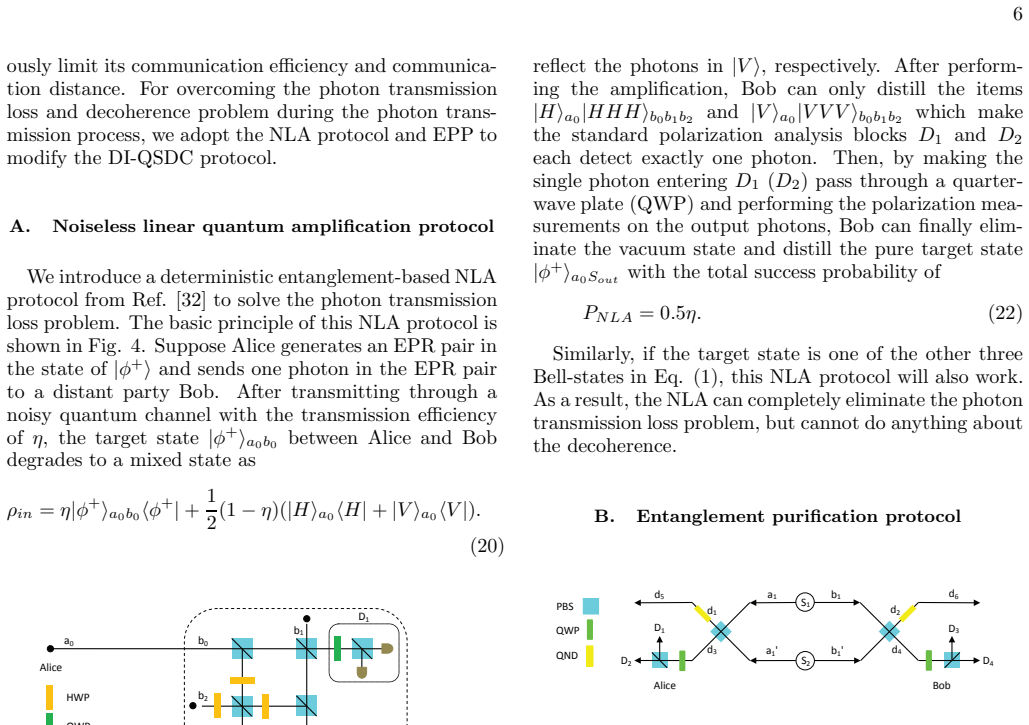
read the original abstract
"Device-independent" not only represents a relaxation of the security assumptions about the internal working of the quantum devices, but also can enhance the security of the quantum communication. In the paper, we put forward the first device-independent quantum secure direct communication (DI-QSDC) protocol, where no assumptions are made about the way the devices work or on what quantum system they operate. We show that in the absence of noise, the DI-QSDC protocol is absolutely secure and there is no limitation for the communication distance. However, under practical noisy quantum channel condition, the photon transmission loss and photon state decoherence would reduce the communication quality and threaten its absolute security. For solving the photon transmission loss and decoherence problems, we adopt noiseless linear amplification (NLA) protocol and entanglement purification protocol (EPP) to modify the DI-QSDC protocol. With the help of the NLA and EPP, we can guarantee the absolute security of the DI-QSDC and effectively improve its communication quality.
Editorial analysis
A structured set of objections, weighed in public.
Referee Report
Summary. The manuscript proposes the first device-independent quantum secure direct communication (DI-QSDC) protocol. It claims that the protocol achieves absolute security with no distance limitation in the noiseless case, and that noiseless linear amplification (NLA) combined with entanglement purification (EPP) restores absolute security and communication quality under photon loss and decoherence.
Significance. If a rigorous, protocol-specific security reduction establishing zero leakage at maximal Bell violation is supplied, the work would constitute a meaningful extension of device-independent cryptography from key distribution to direct message transmission.
major comments (2)
- [Abstract] Abstract: the headline claim of absolute security (zero leakage) in the noiseless case is load-bearing yet unsupported by any displayed Bell inequality, security bound, or reduction; a generic invocation of DI-QKD results does not automatically supply the required upper bound on Eve’s information about the transmitted message.
- [Abstract] The protocol description (implicit in the abstract) re-uses entanglement distribution plus measurement rounds; without an explicit adaptation of the Devetak-Winter bound or equivalent to the direct-communication step, an unaccounted classical leakage channel may remain even at CHSH value 2√2.
Simulated Author's Rebuttal
We thank the referee for the detailed and constructive report. The comments highlight important points regarding the security analysis that we address below. We agree that the noiseless-case security claim requires more explicit support and have revised the manuscript to include a dedicated security reduction section.
read point-by-point responses
-
Referee: [Abstract] Abstract: the headline claim of absolute security (zero leakage) in the noiseless case is load-bearing yet unsupported by any displayed Bell inequality, security bound, or reduction; a generic invocation of DI-QKD results does not automatically supply the required upper bound on Eve’s information about the transmitted message.
Authors: We accept this criticism. The original manuscript invokes DI-QKD results at the level of maximal CHSH violation but does not display an explicit bound on Eve’s information about the message bits themselves. In the revised version we add a new subsection that derives the message leakage bound directly from the observed Bell violation, using the fact that the certified state is a singlet (up to local isometries) and applying the Devetak-Winter formula to the direct-encoding step. A figure showing the Bell value versus leakage will also be included. revision: yes
-
Referee: [Abstract] The protocol description (implicit in the abstract) re-uses entanglement distribution plus measurement rounds; without an explicit adaptation of the Devetak-Winter bound or equivalent to the direct-communication step, an unaccounted classical leakage channel may remain even at CHSH value 2√2.
Authors: We agree that the adaptation must be shown explicitly rather than assumed. The revised manuscript now contains a step-by-step security reduction that maps the direct-communication phase onto an equivalent entanglement-based key-agreement task, confirming that the classical communication used for basis choice and error correction does not open an additional leakage channel once the Bell violation reaches 2√2. The same NLA+EPP post-processing is shown to restore the required violation threshold. revision: yes
Circularity Check
Derivation self-contained; no load-bearing reductions to inputs or self-citations
full rationale
The paper introduces a DI-QSDC protocol and claims absolute security in the noiseless limit from Bell-inequality violation without device assumptions. No equations, security reductions, or protocol steps in the provided text reduce the central claim to a fitted parameter, self-definition, or unverified self-citation chain. The security assertion rests on standard device-independent arguments from quantum information theory rather than any internal renaming, ansatz smuggling, or prediction-by-construction. This is the normal case of an independent derivation.
Axiom & Free-Parameter Ledger
Lean theorems connected to this paper
-
IndisputableMonolith/Foundation/RealityFromDistinction.leanreality_from_one_distinction unclear?
unclearRelation between the paper passage and the cited Recognition theorem.
We perform the CHSH tests in both two security checking processes and use the violation of CHSH inequality to guarantee the security of the DI-QSDC protocol... S1 = ⟨a1b1⟩ + ⟨a1b2⟩ + ⟨a2b1⟩ − ⟨a2b2⟩
-
IndisputableMonolith/Cost/FunctionalEquation.leanwashburn_uniqueness_aczel unclear?
unclearRelation between the paper passage and the cited Recognition theorem.
the achievable communication efficiency Ec1 ≥ 1 − h(Q2) − I2(S2)
What do these tags mean?
- matches
- The paper's claim is directly supported by a theorem in the formal canon.
- supports
- The theorem supports part of the paper's argument, but the paper may add assumptions or extra steps.
- extends
- The paper goes beyond the formal theorem; the theorem is a base layer rather than the whole result.
- uses
- The paper appears to rely on the theorem as machinery.
- contradicts
- The paper's claim conflicts with a theorem or certificate in the canon.
- unclear
- Pith found a possible connection, but the passage is too broad, indirect, or ambiguous to say the theorem truly supports the claim.
Reference graph
Works this paper leans on
-
[1]
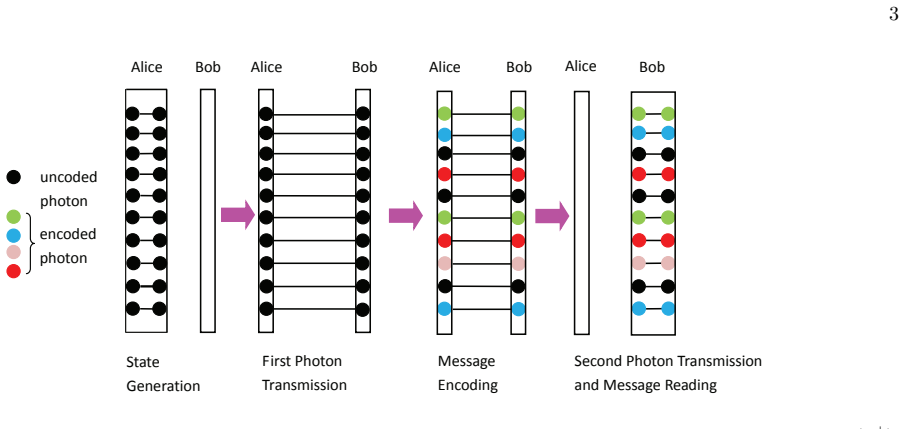
Otherwise, Alice and Bob should discard the whole communication. Step 5: If the parties entrust both the two photon transmission processes, Bob can finally read out the mes- sages from Alice by performing Bell-state analysis on the message encoded EPR pairs in his hand [45–47]. III. SECURITY AND COMMUNICATION QUALITY OF THE DI-QSDC PROTOCOL In the security...
-
[2]
of the eavesdropper in the second photon transmission process by I ′ 2(S′
-
[3]
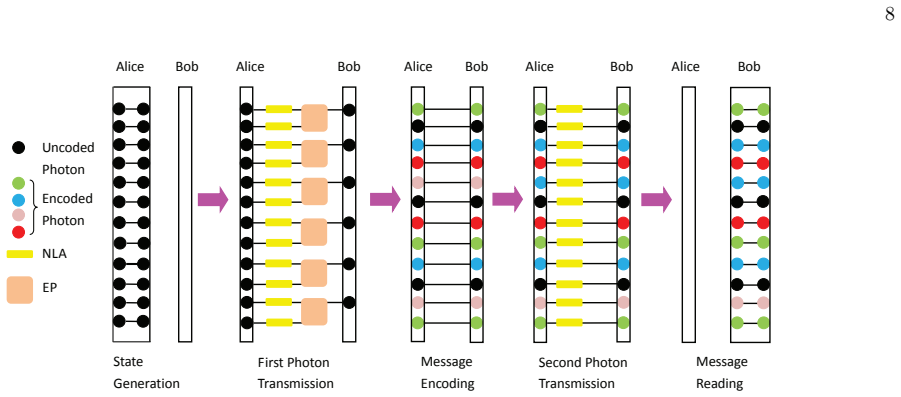
= h( 1 + √ (S′ 2/2)2 − 1 2 ). (28) According to Eq. (16), as I ′ 1 → 0, we can obtain the eavesdropper’s information interception rate of the mod- ified DI-QSDC protocol as IE → 0. (29) Eq. (29) agrees to that fact that the security of the DI- QSDC can be ensured when we can ensure the absolute 8 Alice Alice Alice Alice Bob Bob Bob NLA Uncoded Photon Encod...
-
[4]
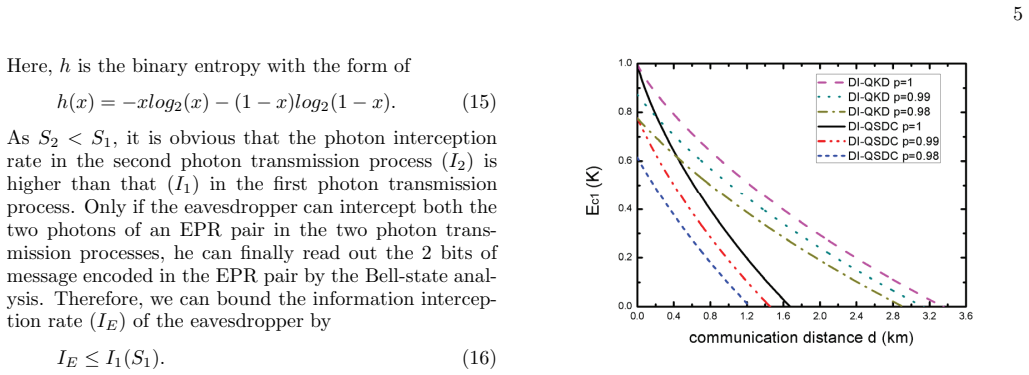
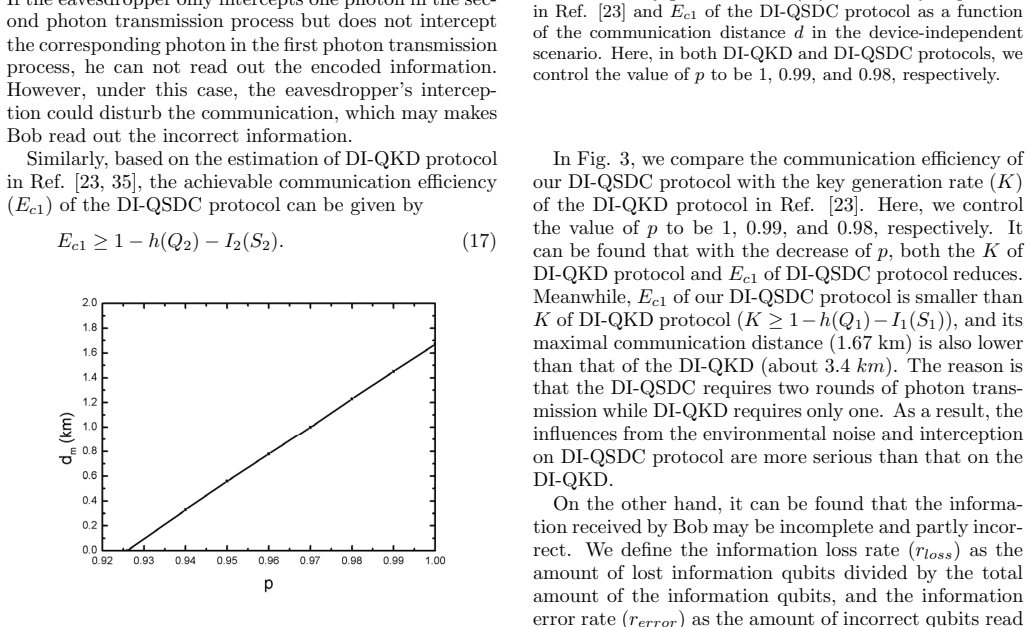
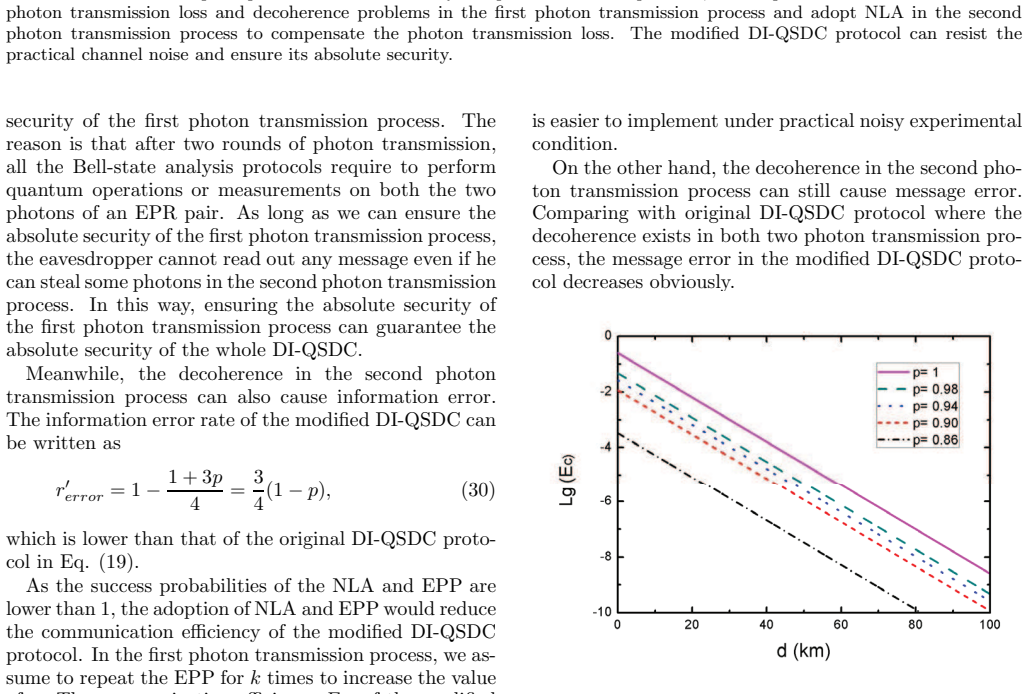
− I2(S′ 2)]. (31) For ensuring Ec2 ≥ 0, we can calculate the threshold value of p to be 0.858, which is the same as that in the DI-QKD protocol in Ref. [23]. Comparing with the original DI-QSDC protocol, the adoption of EPP in the first transmission process reduces the threshold value of p from 0.926 to 0.858. In this way, the modified DI-QSDC is easier to ...
-
[5]
C. H. Bennett and G. Brassard, Proceedings of the Inter- national Conference on Computers, Systems and Signal Processing Bangalore press, India, pp. 175-179 (1984)
work page 1984
- [6]
-
[7]
G. L. Long and X. S. Liu, Phys. Rev. A 65, 032302 (2002)
work page 2002
-
[8]
A. K. Ekert, Phys. Rev. Lett. 67, 661 (1991)
work page 1991
- [9]
- [10]
-
[11]
S. Wang, Z. Q. Yin, W. Chen, D. Y. He, X. T. Song, H. W. Li, L. J. Zhang, Z. Zhou, G. C. Guo, and Z. F. Han, Nat. Photonics 9, 832-836 (2015)
work page 2015
-
[12]
R. Horodecki, P. Horodecki, M. Horodecki, and K.Horodecki, Rev. Mod. Phys. 81, 865 (2009)
work page 2009
-
[13]
F. G. Deng, G. L. Long, and X. S. Liu, Phys. Rev. A 68, 042317 (2003)
work page 2003
-
[14]
F. G. Deng and G. L. Long, Phys. Rev. A 69, 052319 (2004)
work page 2004
-
[15]
C. Wang, F. G. Deng, Y. S. Li, X. S. Liu, and G. L. Long, Phys. Rev. A 71, 044305 (2005)
work page 2005
-
[16]
J. Y. Hu, B. Yu, M. Y. Jing, L. T. Xiao, S. T. Jia, G. Q. Qin, and G. L. Long, Light Sci. Appl. 5, e16144 (2016)
work page 2016
- [17]
-
[18]
F. Zhu, W. Zhang, Y. B. Sheng, Y. D. Huang, Sci. Bull. 62, 1519-1524 (2017)
work page 2017
-
[19]
H. K. Lo and H. F. Chau, Science, 283, 2050-2056 (1999)
work page 2050
-
[20]
E. Waks, A. Zeevi, and Y. Yamamoto, Phys. Rev. A 65, 052310 (2002)
work page 2002
- [21]
-
[22]
H. Inamori, N. L¨ utkenhaus, and D. Mayers, Eur. Phys. J. D 41, 599-627 (2007)
work page 2007
- [23]
-
[24]
Z. Q. Yin, S. Wang, W. Chen, Y. G. Han, R. Wang, G. C Guo, Z. F. Han, Nat. Commun. 9, 457 (2018)
work page 2018
-
[25]
V. Scarani, N. Gisin, N. Brunner, L. Masanes, S. Pino, and A. Ac ´in, Phys. Rev. A 74, 042339 (2006)
work page 2006
- [26]
-
[27]
S. Pironio, A. Ac ´in, N. Brunner, N. Gisin, S. Massar, and V. Scarani, New J. Phys. 11, 045021 (2009)
work page 2009
- [28]
- [29]
-
[30]
C. C. W. Lim, C. Portmann, M. Tomamichel, R. Renner, N. Gisin, Phys. Rev. X 3, 031006 (2013)
work page 2013
-
[31]
J. S. Bell, On the Einstein Podolsky Rosen Paradox, Physics 1, 195 (1964)
work page 1964
-
[32]
J. F. Clauser, M.A. Horne, A. Shimony, and R. A. Holt, Phys. Rev. Lett. 23, 880 (1969)
work page 1969
-
[33]
T. C. Ralph and A. P. Lund, in Proceedings of the 9th International Conference on Quantum Communica- tion Measurement and Computing, A. lvovsky, ed. (AIP, 2009), pp. 155-160
work page 2009
-
[34]
C. I. Osorio, N. Bruno, N. Sangouard, H. Zbinden, N. Gisin, and R. T. Thew, Phys. Rev. A 86, 023815 (2012)
work page 2012
-
[35]
M. Bula, K. Bartkiewicz, A. ˘Cernoch, and K. Lemr, Phys. Rev. A 87, 033826 (2013)
work page 2013
-
[36]
E. Meyer-Scott, M. Bula, K. Bartkiewicz, A. ˘Crnoch, J. Soubusta, T. Jennewein, and K. Lemr, Phys. Rev. A 88, 012327 (2013)
work page 2013
- [37]
- [38]
- [39]
-
[40]
D. Pitkanen, X. Ma, R. Wickert, P. van Loock, and N. L¨ utkenhaus, Phys. Rev. A84, 022325 (2011)
work page 2011
- [41]
-
[42]
F. Monteiro, E. Verbanis, V. Vivoli Caprara, A. Martin, N. Gisin, H. Zbinden ,and R. T. Thew, Quantum Sci. Technol. 2, 024008 (2017). 11
work page 2017
-
[43]
C. H. Bennett, G. Brassard, S. Popescu, B. Schumacher, J. Smolin, and W. K. Wootters, Phys. Rev. Lett. 76, 722 (1996)
work page 1996
- [44]
-
[45]
J. W. Pan, C. Simon, and A. Zellinger, Nature 410, 1067- 1070 (2001)
work page 2001
-
[46]
Y. B. Sheng, F. G. Deng, H. Y. Zhou, Phys. Rev. A 77, 042308 (2008)
work page 2008
-
[47]
M. Zwerger, H. J. Briegel, and W. D¨ ur, Phys. Rev. Lett. 110, 260503 (2013)
work page 2013
-
[48]
V. Scarani, H. Bechmann-Pasquinucci, N. J. Cerf, M. Du˘sek, N. L¨ utkenhaus, M. Peev, Rev. Mod. Phys. 81, 1301 (2009)
work page 2009
- [49]
-
[50]
N. L¨ utkenhaus, J. Calsamiglia, and K. A. Suominen, Phys. Rev. A 59, 3295 (1999)
work page 1999
- [51]
-
[52]
E. Halenkov´a, A. ˘Cernoch, K.Lemr, J. Soubusta, and S. Drusov´a, Appl. Opt. 51, 474 (2012)
work page 2012
- [53]
discussion (0)
Sign in with ORCID, Apple, or X to comment. Anyone can read and Pith papers without signing in.