A Gradient Sampling method based on Ideal direction for solving nonsmooth nonconvex optimization problems: convergence analysis and numerical experiments
Pith reviewed 2026-05-25 11:09 UTC · model grok-4.3
The pith
The Ideal direction replaces the quadratic subproblem in Gradient Sampling, satisfies Armijo, and preserves global convergence for nonsmooth nonconvex problems.
A machine-rendered reading of the paper's core claim, the machinery that carries it, and where it could break.
Core claim
By defining the Ideal direction directly from the sampled gradients without any subproblem, the approach satisfies the Armijo condition, yields a useful reduction, and the resulting iteration sequence converges to a stationary point under the same assumptions as the original Gradient Sampling method; moreover an explicit upper bound holds for the number of serious steps.
What carries the argument
The Ideal direction, a descent direction computed directly from sampled gradients without solving quadratic or linear subproblems.
If this is right
- The computational burden per iteration is reduced by eliminating the QP solve.
- Global convergence to a stationary point is retained.
- An upper bound on serious iterations is available under moderate assumptions.
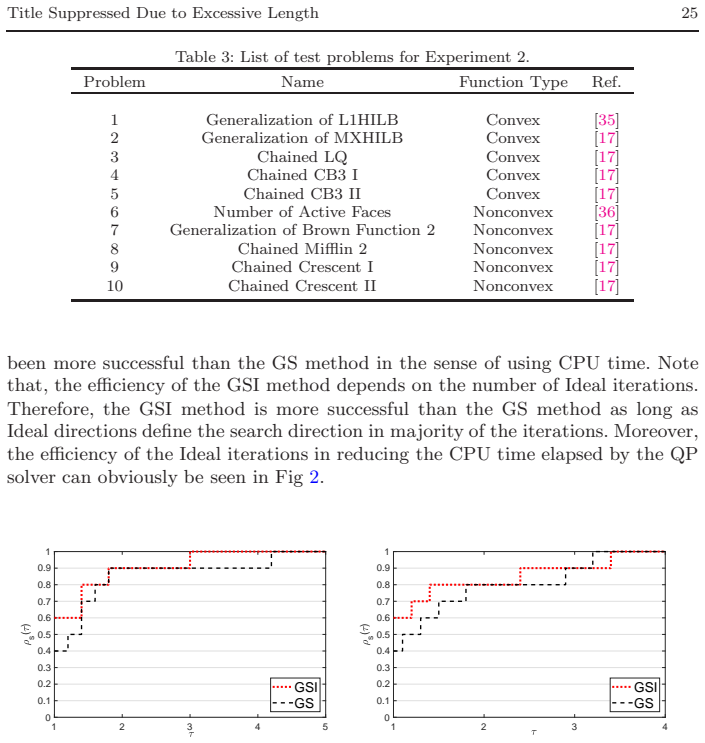
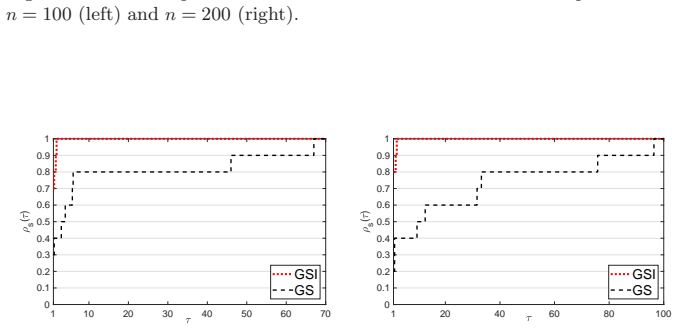
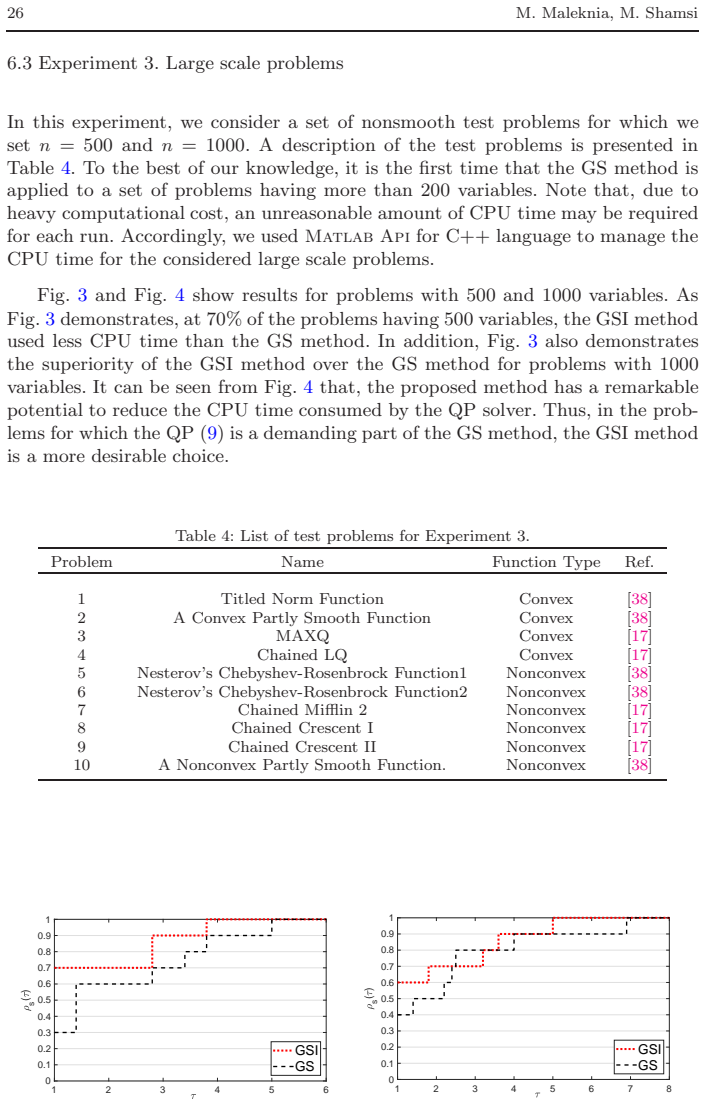
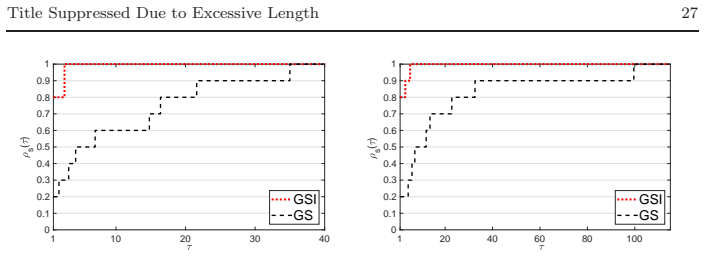
- The method performs well on problems of varying scales in experiments.
Where Pith is reading between the lines
- The approach may extend to other first-order methods that rely on similar subproblems for direction finding.
- Bounds on iteration counts could inform practical stopping criteria or adaptive sampling rates.
- Large-scale applications may benefit from the reduced per-iteration cost.
Load-bearing premise
The objective function satisfies local Lipschitz continuity and the regularity conditions required by the original Gradient Sampling convergence theory.
What would settle it
A nonsmooth nonconvex function on which the Ideal direction violates the Armijo condition for every step size or on which the modified algorithm fails to reach a stationary point.
Figures
read the original abstract
In this paper, a modification to the Gradient Sampling (GS) method for minimizing nonsmooth nonconvex functions is presented. One drawback in GS method is the need of solving a Quadratic optimization Problem (QP) at each iteration, which is time-consuming especially for large scale objectives. To resolve this difficulty, we propose a new descent direction, namely Ideal direction, for which there is no need to consider any quadratic or linear optimization subproblem. It is shown that, this direction satisfies Armijo step size condition and can be used to make a substantial reduction in the objective function. Furthermore, we prove that using Ideal directions preserves the global convergence of the GS method. Moreover, under some moderate assumptions, we present an upper bound for the number of serious iterations. Using this upper bound, we develop a different strategy to study the convergence of the method. We also demonstrate the efficiency of the proposed method using small, medium and large scale problems in our numerical experiments.
Editorial analysis
A structured set of objections, weighed in public.
Referee Report
Summary. The manuscript proposes replacing the quadratic program in the Gradient Sampling (GS) algorithm for nonsmooth nonconvex minimization with a closed-form 'Ideal direction' that requires no optimization subproblem. It claims this direction satisfies the Armijo line-search condition, produces a substantial objective decrease, inherits the global convergence of the original GS method, and admits an explicit upper bound on the number of serious iterations under moderate assumptions; numerical experiments on small-, medium-, and large-scale problems are included to illustrate practical efficiency.
Significance. If the convergence inheritance is rigorously established, the work would provide a computationally lighter GS variant that retains theoretical guarantees, which could be useful for large-scale nonsmooth nonconvex problems where QP solves dominate runtime. The iteration bound and alternative convergence argument are additional positive features. The significance is tempered by the fact that the key inner-product decrease property required for the original GS analysis is not obviously inherited from the given closed-form construction.
major comments (2)
- [convergence analysis section (around the proof that Ideal directions preserve GS convergence)] The definition of the Ideal direction (closed-form expression avoiding the QP) is not shown to guarantee the uniform sufficient-decrease relation <v_k, d_k> ≤ −c ||v_k||^2 (or equivalent) for an arbitrary convex combination v_k of sampled gradients. This relation is load-bearing for carrying over the serious-step analysis and global convergence from the original GS theory; without it, the inheritance claim does not follow.
- [section presenting the iteration bound and alternative convergence argument] The upper bound on the number of serious iterations is stated under 'moderate assumptions,' but the manuscript does not explicitly list those assumptions or verify that they remain compatible with the Ideal-direction construction; this makes the bound's applicability and the 'different strategy' for convergence study difficult to assess.
minor comments (2)
- [abstract and introduction] The abstract and introduction should more clearly distinguish which parts of the GS convergence theory are reused verbatim versus which are reproved for the Ideal direction.
- [preliminaries and algorithm description] Notation for the sampled gradient set and the convex combination v_k should be introduced once and used consistently when stating the inner-product property.
Simulated Author's Rebuttal
We thank the referee for the careful reading and constructive comments. We address the two major comments point by point below and will revise the manuscript to improve clarity on both issues.
read point-by-point responses
-
Referee: [convergence analysis section (around the proof that Ideal directions preserve GS convergence)] The definition of the Ideal direction (closed-form expression avoiding the QP) is not shown to guarantee the uniform sufficient-decrease relation <v_k, d_k> ≤ −c ||v_k||^2 (or equivalent) for an arbitrary convex combination v_k of sampled gradients. This relation is load-bearing for carrying over the serious-step analysis and global convergence from the original GS theory; without it, the inheritance claim does not follow.
Authors: We appreciate the referee highlighting this point. The global-convergence proof in the manuscript proceeds by verifying that the Ideal direction satisfies the key properties required by the original GS analysis, including a uniform sufficient-decrease relation derived directly from its closed-form expression. To make this inheritance fully explicit and easier to follow, we will add a short lemma in the revised convergence section that states and proves <v_k, d_k> ≤ −(1/2) ||v_k||^2 (with the constant obtained from the definition of the Ideal direction) for any convex combination v_k of the sampled gradients. This addition will not alter the existing arguments but will clarify how the serious-step analysis carries over unchanged. revision: yes
-
Referee: [section presenting the iteration bound and alternative convergence argument] The upper bound on the number of serious iterations is stated under 'moderate assumptions,' but the manuscript does not explicitly list those assumptions or verify that they remain compatible with the Ideal-direction construction; this makes the bound's applicability and the 'different strategy' for convergence study difficult to assess.
Authors: We agree that the assumptions should be stated more transparently. In the revised manuscript we will insert an explicit enumerated list of the moderate assumptions at the start of the iteration-bound section and add a brief paragraph confirming that none of them is affected by replacing the QP solution with the closed-form Ideal direction (the sampling procedure, the function class, and the line-search parameters remain identical). This will also make the alternative convergence strategy based on the iteration bound easier to evaluate. revision: yes
Circularity Check
No circularity; Ideal direction defined independently and its properties proven from standard GS assumptions
full rationale
The manuscript introduces the Ideal direction via an explicit closed-form expression that bypasses the QP subproblem, then separately verifies that this direction satisfies the Armijo condition and inherits the global convergence of the original Gradient Sampling method under the same local Lipschitz and regularity assumptions. No step reduces a claimed result to a fitted parameter, self-citation chain, or definitional equivalence; the convergence inheritance is established by direct verification of the required decrease properties rather than by renaming or smuggling prior results. External citations to the GS literature supply the baseline theory but do not bear the load of the new direction's properties.
Axiom & Free-Parameter Ledger
Reference graph
Works this paper leans on
-
[1]
Singapore: World Scientific Publishing Co
M¨ akel¨ a, M.M., Neittaanm¨ aki, P.: Nonsmooth optimization: Analysis and al- gorithms with applications to optimal control. Singapore: World Scientific Publishing Co. (1992)
work page 1992
-
[2]
application to the processing of outliers
Nikolova, M.: Minimizers of cost-functions involving no nsmooth data-fidelity terms. application to the processing of outliers. SIAM Jour nal on Numerical Analysis 40(3), 965–994 (2002)
work page 2002
-
[3]
Astorino, A., Gaudioso, M.: Polyhedral separability thr ough successive LP. J. Optim. Theory Appl 112(2), 265–293 (2002)
work page 2002
-
[4]
Lavor, C., Liberti, L., Maculan, N.: Molecular distance g eometry problem (2nd ed.). Springer (2009) 28 M. Maleknia, M. Shamsi
work page 2009
-
[5]
Witten, I.H., Frank, E.: Data mining: Practical machine l earning tools and techniques (2nd ed.). Elsevier Inc (2005)
work page 2005
- [6]
-
[7]
Kiwiel, K.C.: Methods of descent for nondifferentiable op timization. Springer- Verlag (1985)
work page 1985
-
[8]
Shor, N.Z.: Minimization methods for non-differentiable functions. Springer (1985)
work page 1985
-
[9]
A Series of Comprehensive Studies in Mathematics
Hiriart-Urruty, J.B., chal, C.L.: Convex Analysis and Mi nimization Algorithms I. A Series of Comprehensive Studies in Mathematics. Spring er-Verlag (1993)
work page 1993
-
[10]
A Series of Comprehensive Studies in Mathematics
Hiriart-Urruty, J.B., chal, C.L.: Convex Analysis and M inimization Algorithms II. A Series of Comprehensive Studies in Mathematics. Sprin ger-Verlag (1993)
work page 1993
-
[11]
Uryasev, S.P.: New variable metric algorithms for nondi fferentiable optimiza- tion problems. J. Optim. Theory Appl 71, 359–388 (1991)
work page 1991
-
[12]
Vlˇ cek, J., Lukˇ san, L.: Globally convergent variable m etric method for non- convex nondifferentiable unconstrained minimization. J. O ptim. Theory Appl 111(2), 407–430 (2001)
work page 2001
-
[13]
Bagirov, A.M., Jin, L., Karmitsa, N., Al Nuaimat, A., Sul tanova, N.: A sub- gradient method for nonconvex nonsmooth optimization. J. O ptim. Theory Appl 157, 416–435 (2013)
work page 2013
-
[14]
Mahdavi-Amiri, N., Yousefpour, R.: An effective nonsmoo th optimization algo- rithm for locally Lipschitz functions. J. Optim. Theory App l 155(1), 180–195 (2012)
work page 2012
-
[15]
Nesterov, Y.: Primal-dual subgradient methods for conv ex problems. Math. Program 120(1), 221–259 (2009)
work page 2009
-
[16]
Bagirov, A.M., Ganjehlou, A.N.: A quasisecant method fo r minimizing nons- mooth functions. Optim. Methods Softw 25(1), 3–18 (2010)
work page 2010
-
[17]
Haarala, M., Miettinen, K., M¨ akel¨ a, M.M.: New limited memory bundle method for large-scale nonsmooth optimization. Optim. Met hods Softw 19(6), 673–692 (2004)
work page 2004
-
[18]
Lukˇ san, L., Vlˇ cek, J.: A bundle-Newton method for nonsmooth unconstrained minimization. Math. Program 83(1), 373–391 (1998)
work page 1998
-
[19]
Burke, J.V., Lewis, A.S., Overton, M.L.: A robust gradie nt sampling algo- rithm for nonsmooth, nonconvex optimization. SIAM J. Optim 15(3), 751–779 (2005)
work page 2005
-
[20]
Burke, J.V., Curtis, F.E., Lewis, A.S., Overton, M.L., S im˜ oes, L.E.A.: Gradi- ent sampling methods for nonsmooth optimization. arXiv : 18 04.11003 (2018)
work page 2018
-
[21]
Kiwiel, K.C.: Convergence of the gradient sampling algo rithm for nonsmooth nonconvex optimization. SIAM J. Optim 18(2), 379–388 (2007)
work page 2007
-
[22]
Kiwiel, K.C.: A nonderivative version of the gradient sa mpling algorithm for nonsmooth nonconvex optimization. SIAM J. Optim 20(4), 1983–1994 (2010)
work page 1983
-
[23]
Curtis, F.E., Que, X.: An adaptive gradient sampling alg orithm for nonconvex nonsmooth optimization. Optim. Methods Softw 28(6), 1302–1324 (2013)
work page 2013
-
[24]
Nocedal, J., Wright, S.J.: Numerical Optimization, sec ond edition. Springer (2006)
work page 2006
-
[25]
Curtis, F.E., Overton, M.L.: A sequential quadratic pro gramming algorithm for nonconvex, nonsmooth constrained optimization. SIAM J . Optim 22(2), 474–500 (2012)
work page 2012
-
[26]
Helou, E.S., Santos, A.S., Sim˜ oes, L.E.A.: On the local convergence analysis of the gradient sampling method for finite max-functions. J. Optim. Theory Title Suppressed Due to Excessive Length 29 Appl 175(1), 137–157 (2017)
work page 2017
-
[27]
Bagirov, A., Karmitsa, N., M¨ akel¨ a, M.M.: Introductio n to nonsmooth opti- mization. Springer (2014)
work page 2014
-
[28]
Evans, L.C., Gariepy, R.F.: Measure theory and fine prope rties of functions, Revised Edition. CRC Press (1992)
work page 1992
-
[29]
Rockafellar, R.T., Wets, R.J.B.: Variational analysis . Springer (2004)
work page 2004
-
[30]
Princeton Univers ity Press (1970)
Rockafellar, R.T.: Convex Analysis. Princeton Univers ity Press (1970)
work page 1970
-
[31]
Bazaraa, M.S., Sherali, H.D., Shetty, C.M.: Nonlinear P rogramming. John Wiley & Sons, Inc. (2006)
work page 2006
- [32]
-
[33]
Lukˇ san, L., Vlˇ cek, J.: Test problems for nonsmooth unconstrained and linearly constrained optimization. Tech. rep., Institute of Comput er Science, Academy of Sciences of the Czech Republic (2000)
work page 2000
-
[34]
Master’s thesis, New York University (2010)
Skaaja, M.: Limited memory BFGS for nonsmooth optimizat ion. Master’s thesis, New York University (2010)
work page 2010
-
[35]
interactive system for universal functional optimization
Lukˇ san, L., Tcma, M., Siska, M., Vlˇ cek, J., Ramesova, N.: Ufo 2002. interactive system for universal functional optimization. Tech. rep., Institute of Computer Science, Academy of Sciences of the Czech Republic (2002)
work page 2002
-
[36]
Grothey, A.: Decomposition methods for nonlinear nonco nvex optimization problems. Ph.D. thesis, University of Edinburgh (2001)
work page 2001
-
[37]
Dolan, E., Mor´ e, J.: Benchmarking optimization softwa re with performance profiles. Math. Program 91(2), 201–213 (2002)
work page 2002
-
[38]
Lewis, A.S., Overton, M.L.: Nonsmooth optimization via BFGS URL https://cs.nyu.edu/overton/papers/nonsmoothalg.html
discussion (0)
Sign in with ORCID, Apple, or X to comment. Anyone can read and Pith papers without signing in.