Sensitivity of quantum PageRank
Pith reviewed 2026-05-25 14:56 UTC · model grok-4.3
The pith
Finite dimensional perturbation theory estimates how small analytic changes to the Google matrix affect quantum PageRank.
A machine-rendered reading of the paper's core claim, the machinery that carries it, and where it could break.
Core claim
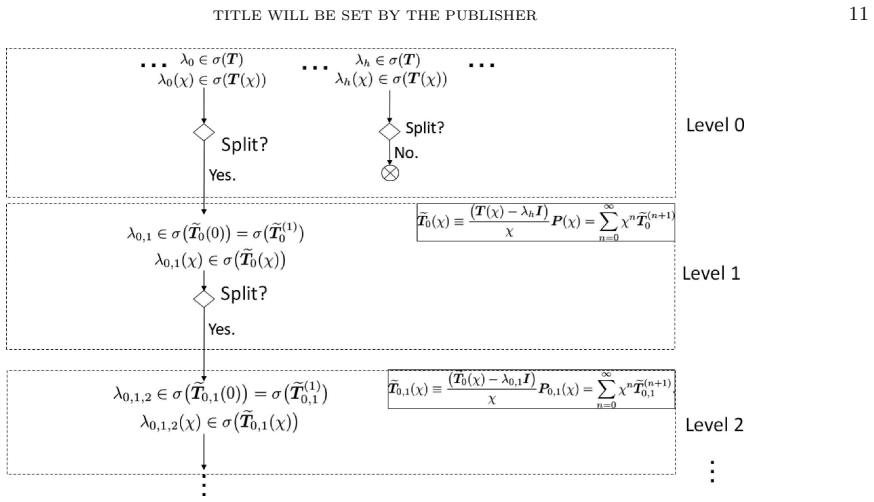
By using the finite dimensional perturbation theory, we estimate the change of the quantum PageRank under a small analytical perturbation on the Google matrix. In addition, we will show the way to estimate the lower bound of the convergence radius as well as the error bound of the finite sum in the expansion of the perturbed PageRank.
What carries the argument
finite-dimensional perturbation expansion applied to the quantum PageRank operator defined from the Google matrix
If this is right
- The quantum PageRank admits a convergent power series in the perturbation parameter inside a disk whose radius can be bounded from below.
- Truncation of the series after finitely many terms produces an explicit error estimate for the perturbed ranking vector.
- Small norm changes to the Google matrix produce correspondingly small changes in the quantum PageRank vector, controlled by the leading term of the expansion.
Where Pith is reading between the lines
- The same perturbation machinery could be tested numerically on small directed graphs to see whether the derived radius bounds are sharp in practice.
- If the Google matrix arises from a real web crawl, the radius estimates might indicate how much link noise can be tolerated before the quantum ranking order changes.
- The approach supplies a template that could be reused for other quantum algorithms whose transition operators depend analytically on a parameter.
Load-bearing premise
The perturbation on the Google matrix is both small in norm and analytic so that the standard perturbation series converges inside a positive radius.
What would settle it
Take a small analytic perturbation of a Google matrix on a modest-sized graph, compute the exact quantum PageRank by direct diagonalization, expand the series to a few terms with the paper's error bound, and check whether the difference exceeds that bound.
Figures
read the original abstract
In this paper, we discuss the sensitivity of quantum PageRank. By using the finite dimensional perturbation theory, we estimate the change of the quantum PageRank under a small analytical perturbation on the Google matrix. In addition, we will show the way to estimate the lower bound of the convergence radius as well as the error bound of the finite sum in the expansion of the perturbed PageRank.
Editorial analysis
A structured set of objections, weighed in public.
Referee Report
Summary. The manuscript applies finite-dimensional perturbation theory to estimate the change in quantum PageRank under small analytic perturbations of the Google matrix and derives a lower bound on the convergence radius together with an error bound on the truncated series expansion of the perturbed PageRank.
Significance. If the central claims hold, the work would supply a quantitative sensitivity analysis for quantum PageRank, which could be useful for assessing robustness of quantum-walk-based ranking algorithms under graph perturbations or noise.
major comments (2)
- [Abstract and §3 (perturbation expansion)] The application of Kato-style finite-dimensional perturbation theory to the quantum PageRank requires that the map from the Google matrix G to the quantum PageRank operator (or its value) be holomorphic in a neighborhood of the unperturbed G. The manuscript supplies neither an explicit definition of the quantum PageRank operator nor a verification that this map is analytic; without this step the cited perturbation theorems do not apply.
- [§4 (convergence radius and error bound)] No derivation is given showing that the claimed lower bound on the convergence radius follows from the norm of the perturbation or from the spectral gap of the unperturbed operator; the radius estimate therefore appears to rest on an external theorem whose hypotheses are not checked for the quantum construction.
minor comments (2)
- [§2] Notation for the quantum PageRank operator is introduced without a self-contained definition or reference to the precise equation in the original quantum PageRank literature.
- [Abstract vs. §3] The abstract states the intended bounds but the main text does not display the explicit series expansion or the operator to which it is applied.
Simulated Author's Rebuttal
We thank the referee for the careful reading and the constructive comments on our manuscript. We address each major comment below, indicating the revisions we plan to make to strengthen the presentation.
read point-by-point responses
-
Referee: [Abstract and §3 (perturbation expansion)] The application of Kato-style finite-dimensional perturbation theory to the quantum PageRank requires that the map from the Google matrix G to the quantum PageRank operator (or its value) be holomorphic in a neighborhood of the unperturbed G. The manuscript supplies neither an explicit definition of the quantum PageRank operator nor a verification that this map is analytic; without this step the cited perturbation theorems do not apply.
Authors: We agree that an explicit definition of the quantum PageRank operator and a verification of its holomorphicity are required to rigorously apply the cited perturbation theorems. In the revised manuscript we will insert a new subsection at the beginning of §3 that (i) gives the precise operator definition of quantum PageRank in terms of the Google matrix G and the associated quantum walk, and (ii) proves that this map is holomorphic in a disk around the unperturbed G by showing that the resolvent and the relevant spectral projections remain analytic under small perturbations of G. This will explicitly confirm that the hypotheses of Kato’s finite-dimensional perturbation theory are satisfied. revision: yes
-
Referee: [§4 (convergence radius and error bound)] No derivation is given showing that the claimed lower bound on the convergence radius follows from the norm of the perturbation or from the spectral gap of the unperturbed operator; the radius estimate therefore appears to rest on an external theorem whose hypotheses are not checked for the quantum construction.
Authors: We acknowledge that the derivation of the convergence-radius lower bound was not spelled out in sufficient detail. In the revised version of §4 we will add a self-contained derivation that (a) recalls the relevant external theorem, (b) verifies that its hypotheses hold for the quantum PageRank operator by relating the radius explicitly to the norm of the perturbation and the spectral gap of the unperturbed operator, and (c) shows how the same quantities yield the error bound for the truncated series. The added steps will make the application of the theorem transparent. revision: yes
Circularity Check
No circularity; applies external perturbation theory to quantum PageRank without self-referential reduction.
full rationale
The paper states it uses finite-dimensional perturbation theory to bound changes in quantum PageRank under analytic perturbations of the Google matrix and to estimate convergence radius and truncation error. No equations or claims reduce these bounds to fitted parameters, self-defined quantities, or prior self-citations by the same author. The derivation chain rests on standard external results (Kato-style perturbation expansions) applied to the given operator, which is self-contained against external benchmarks and does not rename or smuggle in its own inputs.
Axiom & Free-Parameter Ledger
axioms (1)
- domain assumption Finite-dimensional perturbation theory applies directly to the quantum PageRank operator under small analytic perturbations of the Google matrix.
Reference graph
Works this paper leans on
-
[1]
D. Aharonov et al. (2001), “Quantum walks on graphs,” In: Proceedings of ACM Symposium on Theory of Computation (STOC’01), July 2001, p. 50-59
work page 2001
-
[2]
Quantum walk algorithm for element distin ctness,
A. Ambainis, “Quantum walk algorithm for element distin ctness,” In Proc. of the 45th IEEE Symposium on Foundations o f Computer Science (FOCS), 22-31 (2004)
work page 2004
-
[3]
Positive Operat or Semigroups : From Finite to Infinite Dimensions,
A. B´ atkai, M. K. Fijavˇ z and A. Rhandi, “Positive Operat or Semigroups : From Finite to Infinite Dimensions, ” Birkh¨ a user Basel, 2017. DOI:10.1007/978-3-319-42813-0
-
[4]
The Anatomy of a Large-Scale H ypertextual W eb Search Engine,
S. Brin and L. Page (1998), “The Anatomy of a Large-Scale H ypertextual W eb Search Engine,” In: Seventh International W orld-Wide W eb Conference (WWW 1998), Brisbane, Australia , 1998
work page 1998
-
[5]
A fast quantum mechanical algorithm for da tabase search,
L. K. Grover, “A fast quantum mechanical algorithm for da tabase search,” In Proc. of the 28th Annual ACM Symposium on the Theory of Computing (STOC), 212-219 (1996)
work page 1996
-
[6]
H. Honda, Revisiting the sensitivity analysis of Google fs PageRank, IEICE Communications Express, 2018, Volume 7, Issue 12, Pages 444–449
work page 2018
-
[7]
Perturbation Theory for Linear Operators,
T. Kato, “Perturbation Theory for Linear Operators,” Sp ringer, Berlin, 1980
work page 1980
-
[8]
Theory of functions (English transla tion), Part I,
K. Knopp. (1945), “Theory of functions (English transla tion), Part I,” Dover, New York
work page 1945
-
[9]
A. N. Langville and C. D. Meyer, Google’s PageRank and Beyond: The Science of Search Engine R ankings, Princeton University Press, Princeton, 2006
work page 2006
-
[10]
McKiernan, On the nth derivative of composite functions, Amer
M. McKiernan, On the nth derivative of composite functions, Amer. Math. Monthly, 1956, Volume 63, Pages 331–333
work page 1956
-
[11]
Quantum Computat ion and Quantum Information: 10th Anniversary Edition,
M. A. Nielsen and I. L. Chuang (2011), “Quantum Computat ion and Quantum Information: 10th Anniversary Edition,” Cambridge University Press New York, 2011
work page 2011
-
[12]
G. D. Paparo and A. Martin-Delgado, “Google in a Quantum Network,” Nature scientific reports, 2012
work page 2012
-
[13]
Quantum speed-up of Markov Chain based alg orithm,
M. Szegedy, “Quantum speed-up of Markov Chain based alg orithm,” Proc. the 45th Annual IEEE Symp. Foundations of Computer Science, 32–41 (2004)
work page 2004
-
[14]
Quantum simulations of classical random w alks and undirected graph connectivity,
J. W atrous, “Quantum simulations of classical random w alks and undirected graph connectivity,” Journal of Comput er and System Sciences, vol.62, 374–391 (2001)
work page 2001
discussion (0)
Sign in with ORCID, Apple, or X to comment. Anyone can read and Pith papers without signing in.