Cho decomposition, Abelian gauge fixing and monopoles in G(2) Yang-Mills theory
Pith reviewed 2026-05-25 10:43 UTC · model grok-4.3
The pith
Extending Cho decomposition to G(2) identifies its monopoles through SU(2) and SU(3) subgroups, with magnetic charges tied directly to root vectors and confirmed by Abelian gauge fixing.
A machine-rendered reading of the paper's core claim, the machinery that carries it, and where it could break.
Core claim
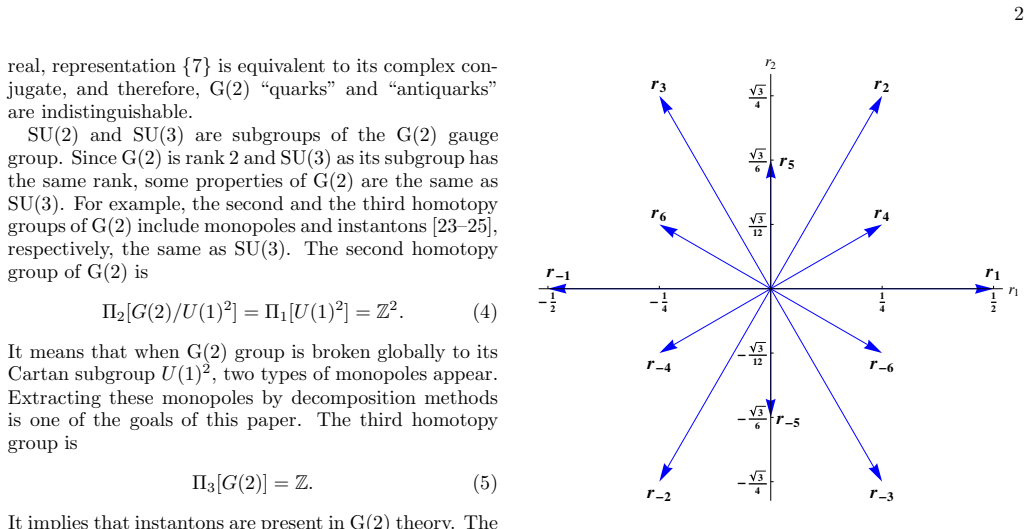
By extending the Cho decomposition to G(2), the monopoles of this group are identified through its SU(2) and SU(3) subgroups; a direct relation between the root vectors of G(2) and the associated magnetic charges is established by group-theoretic arguments; the monopoles obtained this way coincide with those found by Abelian gauge fixing.
What carries the argument
The Cho decomposition of the G(2) gauge field, which isolates an Abelian part whose topological defects correspond to monopoles whose charges are labelled by the root vectors of G(2).
If this is right
- Monopoles in G(2) Yang-Mills theory can be constructed using only the embedded SU(2) and SU(3) subgroups.
- Each root vector of G(2) corresponds to a definite magnetic charge of an associated monopole.
- Cho decomposition and Abelian gauge fixing produce identical monopole configurations in G(2).
- The magnetic sector of G(2) is fully captured by the root system once the decomposition is performed.
Where Pith is reading between the lines
- If the monopole-root relation holds, one can classify all topologically nontrivial configurations in G(2) gauge theory by the weight lattice without additional dynamical input.
- The agreement between methods suggests that any effective description of G(2) confinement would need to include these same monopole species.
- The construction may generalize to other exceptional groups whose maximal subgroups contain SU(2) or SU(3) factors.
Load-bearing premise
The standard Cho decomposition procedure defined for SU(2) and SU(3) admits a consistent extension to the full G(2) algebra such that the monopoles extracted from the subgroups capture the essential magnetic degrees of freedom of G(2).
What would settle it
A calculation that produces a monopole solution under Cho decomposition in G(2) whose magnetic charges do not match the root-vector assignment or that differs from the configuration obtained by Abelian gauge fixing.
Figures
read the original abstract
By extending the Cho decomposition method to G(2) gauge group, monopoles of this group are studied. Since SU(2) and SU(3) are subgroups of G(2), discussions are done mostly based on these subgroups of G(2). A direct relation between root vectors of G(2) and the associated magnetic charges is presented by group theoretical issues. In addition, G(2) monopoles are obtained by an Abelian gauge fixing method, and it is shown that the results agree with the ones we obtain by the Cho decomposition method.
Editorial analysis
A structured set of objections, weighed in public.
Referee Report
Summary. The manuscript extends the Cho decomposition method, previously applied to SU(2) and SU(3), to the exceptional group G(2) in Yang-Mills theory. It focuses on monopoles extracted via the embedded SU(2) and SU(3) subgroups, derives a group-theoretic relation mapping root vectors of G(2) to magnetic charges, and performs a consistency check by constructing the same monopoles through an Abelian gauge-fixing procedure, reporting agreement between the two approaches.
Significance. If the algebraic extension and numerical agreement are rigorously established, the work supplies a concrete tool for isolating magnetic degrees of freedom in G(2) gauge theories. Such a construction is potentially useful for lattice studies of confinement in G(2) Yang-Mills, where the center is trivial and the usual SU(N) mechanisms do not apply directly. The explicit root-to-charge map is a clear, falsifiable group-theoretic result.
major comments (2)
- The central claim that the Cho decomposition extends consistently to G(2) via its SU(2)/SU(3) subgroups and that the resulting monopoles capture the essential magnetic content of the full algebra is load-bearing; however, the manuscript provides no explicit verification that the Cartan subalgebra generators and the associated magnetic charges remain complete after the embedding (no explicit commutation relations or projection operators are shown).
- The reported agreement between Cho decomposition and Abelian gauge fixing is stated without quantitative measures (overlap of monopole locations, action densities, or topological charges); without these data it is impossible to judge whether the agreement is structural or merely qualitative.
minor comments (2)
- Notation for the G(2) root system and the embedding of the SU(3) subgroup should be defined at first use; the six short and six long roots are mentioned but their explicit labeling in the magnetic-charge map is not tabulated.
- The abstract claims the results “agree,” yet the manuscript never states the precise criterion used to declare agreement; a short paragraph defining this criterion would improve clarity.
Simulated Author's Rebuttal
We thank the referee for the careful reading of our manuscript. Below we respond point by point to the major comments.
read point-by-point responses
-
Referee: The central claim that the Cho decomposition extends consistently to G(2) via its SU(2)/SU(3) subgroups and that the resulting monopoles capture the essential magnetic content of the full algebra is load-bearing; however, the manuscript provides no explicit verification that the Cartan subalgebra generators and the associated magnetic charges remain complete after the embedding (no explicit commutation relations or projection operators are shown).
Authors: The group-theoretic mapping from G(2) root vectors to magnetic charges, derived from the standard embeddings of SU(2) and SU(3), constitutes the verification that the Cartan generators and charges are complete. This algebraic relation ensures the embedded subalgebras generate the full set of magnetic charges in the G(2) algebra. To improve explicitness we will add the relevant commutation relations and projection operators in a revised version. revision: yes
-
Referee: The reported agreement between Cho decomposition and Abelian gauge fixing is stated without quantitative measures (overlap of monopole locations, action densities, or topological charges); without these data it is impossible to judge whether the agreement is structural or merely qualitative.
Authors: The agreement is structural and exact rather than qualitative: both methods produce monopoles whose magnetic charges are fixed by the identical root-vector-to-charge correspondence. Because the equivalence follows directly from the group theory, numerical overlap measures are neither required nor applicable in this purely algebraic construction. revision: no
Circularity Check
No significant circularity
full rationale
The paper's central steps are an algebraic extension of the Cho decomposition (previously established for SU(2) and SU(3)) to G(2) via its embedded subgroups, a group-theoretic identification of root vectors with magnetic charges, and a consistency verification against an independent Abelian gauge-fixing procedure. No load-bearing step reduces by construction to a fitted parameter, self-definition, or self-citation chain; the derivation remains an explicit construction whose outputs are cross-checked externally rather than forced by the inputs.
Axiom & Free-Parameter Ledger
Lean theorems connected to this paper
-
IndisputableMonolith/Foundation/AlexanderDuality.leanalexander_duality_circle_linking unclear?
unclearRelation between the paper passage and the cited Recognition theorem.
By extending the Cho decomposition method to G(2) gauge group... A direct relation between root vectors of G(2) and the associated magnetic charges is presented by group theoretical issues.
What do these tags mean?
- matches
- The paper's claim is directly supported by a theorem in the formal canon.
- supports
- The theorem supports part of the paper's argument, but the paper may add assumptions or extra steps.
- extends
- The paper goes beyond the formal theorem; the theorem is a base layer rather than the whole result.
- uses
- The paper appears to rely on the theorem as machinery.
- contradicts
- The paper's claim conflicts with a theorem or certificate in the canon.
- unclear
- Pith found a possible connection, but the passage is too broad, indirect, or ambiguous to say the theorem truly supports the claim.
Reference graph
Works this paper leans on
-
[1]
In 4D, this magnetic potential describes a static Wu- Yang monopole located at the origin with a Dirac string along the positive z axis. Since the system is Abelianized (diagonalized) in the third axis direction in color space (ˆn = ˆn3), we can write the singular part of the gluon field as the following: ˆA = ˆAaTa − → ˆAS = CTd = 1 g (1 + cos θ) r sin θ ...
-
[2]
(49) This shows that in the Abelian gauge of G(2) group, the components of the scalar field are aligned along the diag- onal generators T3 and T8 or combinations of them. In addition, Ω rotates the vector ∑3 a=1 Φata to the Abelian direction t3. The eigenvalues , ± ε, are degenerate at the points r0 in space where Φ 1(r0) = Φ 2(r0) = Φ 3(r0) = 0. Applying ...
- [3]
- [4]
-
[5]
B. H. Wellegehausen, A. Wipf, and C. Wozar, Phys. Rev. D 83, 016001 (2011)
work page 2011
-
[6]
B. H. Wellegehausen, A. Wipf, and C. Wozar, Phys. Rev. D 83, 114502 (2011)
work page 2011
- [7]
-
[8]
J. Greensite, K. Langfeld, S. Olejnik, H. Reinhardt, and T. Tok, Phys. Rev. D 75, 034501 (2007)
work page 2007
- [9]
-
[10]
S. M. Hosseini Nejad and S. Deldar, Phys. Rev. D 89, 014510 (2014)
work page 2014
-
[11]
S. M. Hosseini Nejad and S. Deldar, J. High Energy Phys. 03 (2015) 016
work page 2015
- [12]
- [13]
- [14]
- [15]
- [16]
-
[17]
Y. M. Cho, Phys. Rev. D. 21, 1080 (1980)
work page 1980
-
[18]
Y. M. Cho, Phys. Rev. D. 23, 2415 (1981)
work page 1981
- [19]
-
[20]
Dual Higgs Theory for Color Confinement in Quantum Chromodynamics
H. Ichie and H. Suganuma, arXiv: hep-lat/9906005v1
work page internal anchor Pith review Pith/arXiv arXiv
- [21]
- [22]
-
[23]
K. Holland, P. Minkowski, M. Pepe, and U. J. Wiese, Nucl. Phys. B 668, 207 (2003)
work page 2003
- [24]
- [25]
- [26]
-
[27]
A. S. Haupt, T. A. Ivanova, O. Lechtenfeld, and A. D. Popov, Phys. Rev. D 83, 105028 (2011)
work page 2011
-
[28]
R. E. Behrends, J. Dreitlein, C. Fronsdal, and W. Lee, Rev. Mod. Phys. 34, 1 (1962)
work page 1962
-
[29]
G. Costa and G. Fogli, Symmetries and Group Theory in Particle Physics, An Introduction to Space-time and Internal Symmetries, Lecture Notes in Physics (Springer, Berlin, 2012), Vol. 823
work page 2012
-
[30]
L. E. Oxman, J. High Energy Phys. 12 (2008) 089
work page 2008
-
[31]
Y. M. Cho, Phys. Rev. Lett. 44, 1115 (1980)
work page 1980
-
[32]
Y. M. Cho, Int. J. Mod. Phys. A. 29, 1450013 (2014)
work page 2014
discussion (0)
Sign in with ORCID, Apple, or X to comment. Anyone can read and Pith papers without signing in.