MetaAnalysis of Methods for Scaling Blockchain Technology for Automotive Uses
Pith reviewed 2026-05-25 08:55 UTC · model grok-4.3
The pith
Scalability advances in blockchain can make decentralized solutions viable for the automotive industry.
A machine-rendered reading of the paper's core claim, the machinery that carries it, and where it could break.
Core claim
By conducting a meta-analysis of scaling methods, the paper establishes that recent advances aim to resolve the scalability barriers that currently make blockchain unusable in the mobility sector, thereby informing readers about technologies that could enable efficient, scalable, and cost-effective decentralized solutions in automotive infrastructure.
What carries the argument
Meta-analysis surveying blockchain scaling methods that target throughput limits and consensus costs.
If this is right
- Increased transaction processing rates would allow blockchain to handle data from connected vehicle fleets.
- Decentralized peer-to-peer coordination could replace centralized systems in automotive networks.
- Lower consensus costs would reduce overall expenses for trusted vehicle interactions.
- Reduced attack surfaces would improve security for connected cars and infrastructure.
Where Pith is reading between the lines
- Adaptation of general scaling methods may still be needed to meet vehicle-specific real-time constraints.
- Hardware limitations in vehicles could require further engineering even after technical scaling succeeds.
- Regulatory requirements in different regions might limit deployment regardless of performance gains.
Load-bearing premise
That the scalability advances surveyed in the literature can be directly transferred to automotive use cases without additional mobility-specific barriers.
What would settle it
A demonstration that the surveyed scaling methods fail to reach transaction rates or latency levels required for real-time vehicle coordination.
Figures
read the original abstract
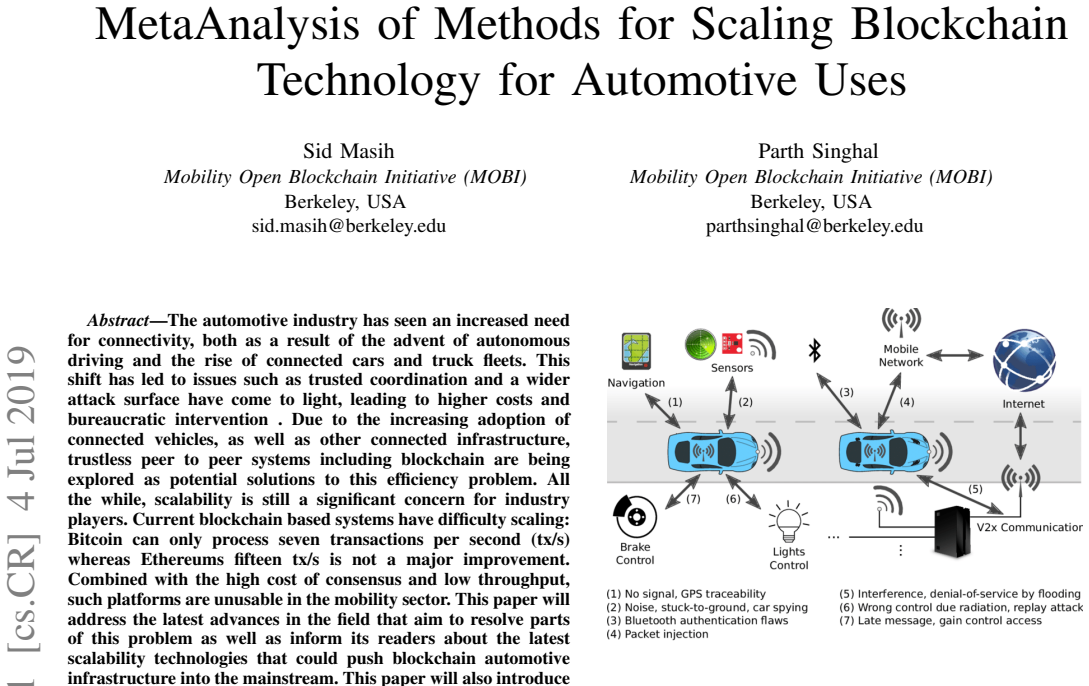
The automotive industry has seen an increased need for connectivity, both as a result of the advent of autonomous driving and the rise of connected cars and truck fleets. This shift has led to issues such as trusted coordination and a wider attack surface have come to light, leading to higher costs and bureaucratic interventions. Due to the increasing adoption of connected vehicles, as well as other connected infrastructure, trustless peer to peer systems including blockchain are being explored as potential solution to this efficiency problem. All the while, scalability is still a significant concern for industry players. Current blockchain based systems have difficulty scaling: Bitcoin can only process seven transactions per second (tx/s) whereas Ethereum's fifteen tx/s is not a major improvement. Combined with the high cost of consensus and low throughput, such platforms are unusable with the mobility sector. This paper will address the latest advances in the field that aim to resolve parts of this problem as well as inform its readers about the scalability technologies that could push blockchain automotive infrastructure into the mainstream. This paper will also introduce the theoretical tools and advancements that, if implemented, could bring the mobility industry closer toward adopting efficient, scalable, and cost effective decentralized solutions.
Editorial analysis
A structured set of objections, weighed in public.
Referee Report
Summary. The paper surveys scalability challenges and solutions for blockchain in automotive/mobility applications. It states that Bitcoin (7 tx/s) and Ethereum (15 tx/s) are unusable for the sector due to low throughput and high consensus costs, then reviews advances (sharding, layer-2, etc.) and theoretical tools that could enable mainstream adoption of decentralized solutions for connected vehicles and autonomous driving.
Significance. If the survey provided a rigorous mapping of scaling techniques to automotive constraints, it could serve as a useful reference for the intersection of blockchain and mobility; however, as a purely descriptive review with no original data, error analysis, performance benchmarks, or verification of transferability, its contribution is modest and does not advance the central claim beyond restating known blockchain limitations.
major comments (2)
- Abstract: the central claim that surveyed advances 'could push blockchain automotive infrastructure into the mainstream' and 'bring the mobility industry closer toward adopting efficient, scalable... solutions' is load-bearing but unsupported; the text supplies no comparison of scaled throughput/latency against mobility requirements such as sub-100 ms V2X latency, ECU resource limits, or regulatory constraints, leaving the transfer assumption unexamined.
- Abstract (problem statement paragraph): the assertion that 'such platforms are unusable with the mobility sector' is presented as a direct consequence of the 7 tx/s and 15 tx/s figures, yet the paper offers neither domain-specific workload analysis nor evidence that the cited throughput numbers are the binding constraint once mobility-specific factors (real-time guarantees, hardware) are considered.
minor comments (1)
- Abstract: sentence structure is awkward in places ('This shift has led to issues such as trusted coordination and a wider attack surface have come to light'), which reduces readability.
Simulated Author's Rebuttal
We thank the referee for the constructive feedback on the abstract and problem statement. We respond to each major comment below and indicate planned revisions.
read point-by-point responses
-
Referee: Abstract: the central claim that surveyed advances 'could push blockchain automotive infrastructure into the mainstream' and 'bring the mobility industry closer toward adopting efficient, scalable... solutions' is load-bearing but unsupported; the text supplies no comparison of scaled throughput/latency against mobility requirements such as sub-100 ms V2X latency, ECU resource limits, or regulatory constraints, leaving the transfer assumption unexamined.
Authors: As a meta-analysis, the manuscript compiles and describes existing scalability techniques rather than generating new empirical mappings or benchmarks. We agree the forward-looking statements in the abstract would benefit from greater qualification. We will revise the abstract to use more measured phrasing (e.g., 'offer pathways that may support' rather than implying direct enablement) and add a short discussion subsection referencing published automotive requirements (such as V2X latency targets) drawn from the mobility literature, noting alignments reported for the surveyed techniques. This will address the transfer assumption explicitly while preserving the survey scope. revision: partial
-
Referee: Abstract (problem statement paragraph): the assertion that 'such platforms are unusable with the mobility sector' is presented as a direct consequence of the 7 tx/s and 15 tx/s figures, yet the paper offers neither domain-specific workload analysis nor evidence that the cited throughput numbers are the binding constraint once mobility-specific factors (real-time guarantees, hardware) are considered.
Authors: The cited throughput values are standard benchmarks used across the blockchain literature to illustrate scalability limits. We concur that framing them as rendering the platforms unusable for mobility would be more precise if other domain factors were acknowledged. We will revise the problem statement paragraph to present the throughput and consensus costs as key limitations highlighted in the surveyed works, and we will add cross-references in the discussion to automotive workload characteristics reported in related mobility studies. revision: partial
- Original domain-specific workload analysis, performance benchmarks, or empirical verification of transferability to automotive hardware and regulatory constraints, as these would require new primary research outside the scope of this meta-analysis survey.
Circularity Check
No circularity: purely descriptive meta-analysis survey
full rationale
The paper is a literature survey/meta-analysis with no original derivations, equations, predictions, fitted parameters, or theoretical claims that could reduce to inputs. No load-bearing self-citations, ansatzes, or uniqueness theorems are invoked. All content consists of descriptive summaries of external scaling techniques (sharding, layer-2, etc.) applied to the automotive domain. This matches the expected non-finding for survey papers; the transfer assumption noted by the skeptic is a correctness/scope issue, not a circularity reduction.
Axiom & Free-Parameter Ledger
Reference graph
Works this paper leans on
-
[1]
H. Hartenstein and L. P. Laberteaux, ”A tutorial survey on vehicular ad hoc networks,” in IEEE Communications Magazine, vol. 46, no. 6, pp. 164-171, June 2008
work page 2008
-
[2]
R. Brendha and V . S. J. Prakash, ”A survey on routing protocols for vehicular Ad Hoc networks,” 2017 4th International Conference on Advanced Computing and Communication Systems (ICACCS), Coim- batore, 2017, pp. 1-7
work page 2017
-
[3]
S. Schwarz, J. C. Ikuno, M. imko, M. Taranetz, Q. Wang and M. Rupp, ”Pushing the Limits of LTE: A Survey on Research Enhancing the Standard,” in IEEE Access, vol. 1, pp. 51-62, 2013
work page 2013
-
[4]
M Rudlang, ”Comparative Analysis of Bitcoin and Ethereum” June 2017
work page 2017
-
[5]
A. Fox, E. A. Brewer, ”Harvest yield and scalable tolerant systems”, Hot Topics in Operating Systems 1999. Proceedings of the Seventh Workshop on, pp. 174-178, 1999
work page 1999
-
[6]
E. A. Brewer, ”Towards robust distributed systems”, PODC, vol. 7, 2000
work page 2000
-
[7]
Jiao Yu and B. M. Wilamowski, ”Recent advances in in-vehicle em- bedded systems,” IECON 2011 - 37th Annual Conference of the IEEE Industrial Electronics Society, Melbourne, VIC, 2011, pp. 4623-4625
work page 2011
-
[8]
P. Cuenot et al., ”Managing Complexity of Automotive Electronics Using the EAST-ADL,” 12th IEEE International Conference on Engi- neering Complex Computer Systems (ICECCS 2007), Auckland, 2007, pp. 353-358
work page 2007
-
[9]
P. Waszecki, P. Mundhenk, S. Steinhorst, M. Lukasiewycz, R. Karri and S. Chakraborty, ”Automotive Electrical and Electronic Architecture Security via Distributed In-Vehicle Traffic Monitoring,” in IEEE Trans- actions on Computer-Aided Design of Integrated Circuits and Systems, vol. 36, no. 11, pp. 1790-1803, Nov. 2017
work page 2017
-
[10]
G. Karagiannis et al., ”Vehicular Networking: A Survey and Tutorial on Requirements, Architectures, Challenges, Standards and Solutions,” in IEEE Communications Surveys & Tutorials, vol. 13, no. 4, pp. 584-616, Fourth Quarter 2011
work page 2011
-
[11]
A. Nshimiyimana, D. Agrawal and W. Arif, ”Comprehensive survey of V2V communication for 4G mobile and wireless technology,” 2016 In- ternational Conference on Wireless Communications, Signal Processing and Networking (WiSPNET), Chennai, 2016, pp. 1722-1726
work page 2016
-
[12]
M. Giordani, A. Zanella, T. Higuchi, O. Altintas, M. Zorzi. ”On the Feasibility of Integrating mmWave and IEEE 802.11p for V2V Communications”, 2018
work page 2018
- [13]
-
[14]
[Online] Available: https://software.intel.com/ sites/default/ files/managed/48/88/329298-002.pdf
-
[15]
M. Azizian, S. Cherkaoui and A. S. Hafid, ”Vehicle Software Updates Distribution with SDN and Cloud Computing,” in IEEE Communica- tions Magazine, vol. 55, no. 8, pp. 74-79, Aug. 2017
work page 2017
-
[16]
Nakamoto ”Bitcoin: A Peer-to-Peer Electronic Cash System”
S. Nakamoto ”Bitcoin: A Peer-to-Peer Electronic Cash System”
-
[17]
G. Wood ”Ethereum: A Secure Decentralized Generalized Transaction Ledger Byzantium Version 69351d5”, 2018
work page 2018
-
[18]
Buchman ”Tendermint: Byzantine Fault Tolerance in the Age of Blockchains”, 2016
E. Buchman ”Tendermint: Byzantine Fault Tolerance in the Age of Blockchains”, 2016
work page 2016
- [19]
-
[20]
J. R. Douceur. ”The Sybil attack”, in Proceedings of the 1st International Workshop on Peer-to-Peer Systems (IPTPS 02), Cambridge, MA, Mar. 2002
work page 2002
-
[21]
[Online] BitcoinWiki. Proof of stake. Available: https://en.bitcoin.it/wiki/Proof of Stake, 2017
work page 2017
-
[22]
[Online] BitcoinWiki. Bitcoin scalability. Available: https://en.bitcoin.it/wiki/Scalability, 2017
work page 2017
-
[23]
J. Poon, T. Dryja ”The Bitcoin Lightning Network: Scalable Off-Chain Instant Payments”, 2016
work page 2016
-
[24]
[Online] Raiden Network 101, Available: https://raiden.network/101.html
-
[25]
J. Poon, V . Buterin, ”Plasma: Scalable Autonomous Smart Contracts”, 2017
work page 2017
-
[26]
R. Pass, L. Seeman, A. Shelat, ”Analysis of the Blockchain Protocol in Asynchronous Networks”, 2016
work page 2016
-
[27]
[Online] BitcoinWiki. Orphan Block. Available: https://en.bitcoin.it/wiki/Orphan Block, 2018
work page 2018
- [28]
- [29]
- [30]
-
[31]
U. Klarman, S. Basu, A. Kuzmanovic, E.G. Sirer, ”bloXroute: A Scalable Trustless Blockchain Distribution Network”, 2018
work page 2018
-
[32]
[Online] Ethereum. Ethereum 2.0 specs. Available: https://github.com /ethereum/eth2.0-specs
- [33]
- [34]
-
[35]
Codebase Available: https://github.com/ nearprotocol
[Online] Near Protocol. Codebase Available: https://github.com/ nearprotocol
-
[36]
Zilliqa Team, ”The Zilliqa Technical Whitepaper”, 2017
work page 2017
- [37]
-
[38]
E. Kokoris-Kogias, P. Jovanovic, L. Gasser, N. Gailly, E. Syta, B. Ford, ”OmniLedger: A Secure, Scale-Out, Decentralized Ledger via Sharding”
-
[39]
L. Luu, V . Narayanan, C. Zheng, K. Baweja, S. Gilbert, P. Saxena,”A Secure Sharding Protocol For Open Blockchains”, 2016
work page 2016
-
[40]
S. Li, M. Yu, S. Avestimehr, S. Kannan, P. Viswanath ”PolyShard: Coded Sharding Achieves Linearly Scaling Efficiency and Security Simultaneously”, 2018
work page 2018
-
[41]
M. Al-Bassam, A. Sonnino, V . Buterin ”Fraud Proofs: Maximising Light Client Security and Scaling Blockchains with Dishonest Majorities”, 2019
work page 2019
-
[42]
E. Syta, P. Jovanovic, E. Kokoris-Kogias, N. Gailly, L. Gasser, I. Khoffi, M. J. Fischer, and B. Ford. ”Scalable Bias-Resistant Distributed Randomness.” In 38th IEEE Symposium on Security and Privacy, May 2017
work page 2017
-
[43]
W, Wang, H. Dinh Thai, Z. Xiong, D. Niyato, P. Wang, P. Hu, Y . Wen. ”A Survey on Consensus Mechanisms and Mining Management in Blockchain Networks”, 2018
work page 2018
- [44]
-
[45]
”The honeybadger of BFT protocols.” In: Cryptology ePrint Archive 2016/199, 2016
Miller, A., Xia, Y ., Croman, K., Shi, E., Song, D. ”The honeybadger of BFT protocols.” In: Cryptology ePrint Archive 2016/199, 2016
work page 2016
-
[46]
D. Schwartz, N. Youngs, A. Britto, ”The Ripple Protocol Consensus Algorithm”, 2014
work page 2014
-
[47]
Mazires, ”The Stellar Consensus Protocol: A Federated Model for Internet-level Consensus”, 2016
D. Mazires, ”The Stellar Consensus Protocol: A Federated Model for Internet-level Consensus”, 2016
work page 2016
-
[48]
X. Li, P. Jiang, T. Chen, X. Luo, Q. Wen, ”A Survey on the Security of Blockchain Systems”, 2018
work page 2018
-
[49]
Y . Sompolinksy, A. Zohar, ”Secure High-Rate Transaction Processing in Bitcoin”, 2013
work page 2013
-
[50]
Y . Sompolinksy, Y . Lewenberg, A. Zohar, ”SPECTRE: Serialization of Proof-of-work Events: Confirming Transactions via Recursive Elec- tions”, 2016
work page 2016
-
[51]
Y . Sompolinksy, A. Zohar, ”PHANTOM, GHOSTDAG: Two Scalable BlockDAG protocols”, 2018
work page 2018
-
[52]
Y . Sompolinksy, Y . Lewenberg, A. Zohar, ”Inclusive Block Chain Protocols”, 2015
work page 2015
-
[53]
Team Rocket, ”Snowflake to Avalanche: A Novel Metastable Consensus Protocol Family for Cryptocurrencies”, 2018
work page 2018
-
[54]
R. Pass, E. Shi, ”Thunderella: Blockchains with Optimistic Instant Confirmation”, 2017
work page 2017
- [55]
- [56]
-
[57]
[Online] Intel, Sawtooth Lake (2017), Available: https://intelledger.github.io/
work page 2017
-
[58]
T-H. H. Chan, R. Pass, E. Shi, ”PaLa: A Simple Partially Synchronous Blockchain”, 2018
work page 2018
-
[59]
Ginnever, ”Set: Hub and Spoke Cryptographic Payment Channels”
N. Ginnever, ”Set: Hub and Spoke Cryptographic Payment Channels”
- [60]
-
[61]
V . Petrov et al., ”Achieving End-to-End Reliability of Mission-Critical Traffic in Softwarized 5G Networks,” in IEEE Journal on Selected Areas in Communications, vol. 36, no. 3, pp. 485-501, March 2018
work page 2018
-
[62]
D. Ratasich, F. Khalid, F. Geibler, R. Grosu, ”A Roadmap Towards Resilient Internet of Things for Cyber-Physical Systems”, 2018
work page 2018
-
[63]
J. Choi, V . Va, N. Gonzalez-Prelcic, R. Daniels, C. R. Bhat and R. W. Heath, ”Millimeter-Wave Vehicular Communication to Support Massive Automotive Sensing,” in IEEE Communications Magazine, vol. 54, no. 12, pp. 160-167, December 2016
work page 2016
-
[64]
[Online] Available: https://github.com/libp2p/ go-libp2p-quic-transport
-
[65]
A. Langley 2017. ”The QUIC Transport Protocol: Design and Internet- Scale Deployment.” In Proceedings of the Conference of the ACM Special Interest Group on Data Communication (SIGCOMM ’17)
work page 2017
-
[66]
Benet ”IPFS - Content Addressed, Versioned, P2P File System”
J. Benet ”IPFS - Content Addressed, Versioned, P2P File System”
-
[67]
G. Xionghui, T. Kot, L. Xing ”Dora” Available: https://dora.network/static/white paper 1 1 2 en.pdf
-
[68]
”Randao: Verifiable Random Number Generation,” Available: https://randao.org/whitepaper/Randao v0.85 en.pdf
-
[69]
[Online] Available: https://github.com/bitcoin/bips/blob/master/bip- 0152.mediawiki
-
[70]
J. Kwon, E. Buchman ”Cosmos”
-
[71]
Wood ”Polkadot: Vision for a Heterogeneous Multi-Chain Frame- work”
G. Wood ”Polkadot: Vision for a Heterogeneous Multi-Chain Frame- work”
- [72]
discussion (0)
Sign in with ORCID, Apple, or X to comment. Anyone can read and Pith papers without signing in.