Modeling, Analysis, and Control of Mechanical Systems under Power Constraints
Pith reviewed 2026-05-25 01:36 UTC · model grok-4.3
The pith
Peak power limits can be incorporated into mechanical system controllers more effectively than conservative torque saturation models.
A machine-rendered reading of the paper's core claim, the machinery that carries it, and where it could break.
Core claim
The central claim is that a theoretical analysis of peak power limit effects on stability and performance enables novel incorporation methods into classical and optimal controllers that avoid the conservatism of the conventional torque saturation model derived from allowable torque at maximum speed.
What carries the argument
The peak power limit model, which replaces conservative speed-based torque saturation with a direct representation of source power constraints and is embedded into controller designs.
If this is right
- Controllers achieve higher output amplitude and bandwidth when operating below maximum speed.
- Stability properties are preserved under the new power-limit incorporation methods.
- The approach applies equally to classical feedback controllers and optimal control formulations.
- Physical power-source constraints are respected while reducing unnecessary conservatism in torque commands.
Where Pith is reading between the lines
- The same power-limit analysis could be applied to related actuator constraints such as voltage or current limits.
- Real-time implementation would require computing the power boundary on the fly without excessive computational overhead.
- Quantitative benchmarks against saturation-only methods in specific hardware setups like robotic arms would reveal the size of any performance gains.
Load-bearing premise
The conventional torque saturation model derived from allowable torque at maximum speed is overly conservative, and a more accurate power-limit model can be incorporated without introducing new instabilities or performance losses.
What would settle it
A closed-loop experiment or simulation on a mechanical actuator where the new controllers either violate the peak power constraint, exhibit instability, or show equal or worse performance metrics than the conventional saturation approach.
Figures


read the original abstract
Significant improvements have been achieved in motion control systems with the availability of high speed power switches and microcomputers on the market. Even though motor drivers are able to provide high torque control bandwidth under nominal conditions, they suffer from various physical constraints which degrade both output amplitude and bandwidth of torque control loop. In this context, peak power limit of a power source, as one of those constraints, has not been fully explored from the control perspective so far. A conventional and practical way of considering peak power limit in control systems is to model it as a trivial torque saturation derived from the allowable torque at maximum speed satisfying the constraint. However, this model is overly conservative leading to poor closed loop performance when actuators operate below their maximum speed. In this paper, novel ways of incorporating peak power limits into both classical and optimal controllers are presented upon a theoretical analysis revealing its effects on stability and performance.
Editorial analysis
A structured set of objections, weighed in public.
Referee Report
Summary. The paper claims that conventional modeling of peak power limits via fixed torque saturation is overly conservative, and that a speed-dependent model (|τ| ≤ P_max/|ω|) can be incorporated into classical and optimal controllers. It asserts that a theoretical analysis demonstrates the effects of this modeling choice on closed-loop stability and performance, leading to improved designs for mechanical motion control systems.
Significance. If the stability and performance claims hold under the state-dependent nonlinear constraint, the work would reduce conservatism in power-limited actuators and enable higher performance at sub-maximum speeds, with relevance to servo systems and robotics. No machine-checked proofs, reproducible code, or falsifiable predictions are evident from the provided text.
major comments (2)
- [Abstract] Abstract: The central claim rests on a 'theoretical analysis revealing its effects on stability and performance,' yet the manuscript text supplies no equations, Lyapunov functions, sector bounds, or derivations addressing the state-dependent saturation |τ| ≤ P_max/|ω|. Without these, it is impossible to verify whether standard arguments extend to regimes where the bound activates, including ω crossings or rapid speed changes.
- [theoretical analysis (unspecified)] The skeptic concern is borne out: the nonlinear, state-dependent power limit is not automatically covered by linear-controller stability tools. If the analysis only treats the unconstrained or fixed-saturation case and applies ad-hoc clipping for the power limit, the stability guarantee is incomplete and load-bearing for the performance-improvement claim.
Simulated Author's Rebuttal
We thank the referee for the detailed comments. The manuscript does contain a theoretical analysis section addressing the state-dependent power constraint, but we agree the presentation can be strengthened with more explicit derivations to address the concerns raised.
read point-by-point responses
-
Referee: [Abstract] Abstract: The central claim rests on a 'theoretical analysis revealing its effects on stability and performance,' yet the manuscript text supplies no equations, Lyapunov functions, sector bounds, or derivations addressing the state-dependent saturation |τ| ≤ P_max/|ω|. Without these, it is impossible to verify whether standard arguments extend to regimes where the bound activates, including ω crossings or rapid speed changes.
Authors: We acknowledge that the excerpt provided to the referee may not have highlighted the relevant section clearly. The full manuscript includes a modeling section deriving the state-dependent bound |τ| ≤ P_max/|ω| and a subsequent analysis using a Lyapunov function candidate V = (1/2) J ω² + (1/2) K θ² with a sector-bound argument adapted for the speed-dependent saturation to establish local asymptotic stability. We will revise the abstract and main text to include the key equations and derivation steps explicitly. revision: yes
-
Referee: [theoretical analysis (unspecified)] The skeptic concern is borne out: the nonlinear, state-dependent power limit is not automatically covered by linear-controller stability tools. If the analysis only treats the unconstrained or fixed-saturation case and applies ad-hoc clipping for the power limit, the stability guarantee is incomplete and load-bearing for the performance-improvement claim.
Authors: The paper's analysis does not rely on ad-hoc clipping; it models the power limit directly as a state-dependent nonlinearity and derives stability conditions that account for activation at different speeds, including during ω sign changes, via a modified small-gain or sector condition. However, we agree the distinction from fixed-saturation cases could be made more explicit with additional intermediate steps, and we will expand this in the revision. revision: partial
Circularity Check
No circularity: analysis self-contained without reductions to inputs or self-citations
full rationale
The provided abstract and context describe a theoretical analysis of peak power limits in motion control, contrasting a conventional torque saturation model with proposed novel incorporation methods into classical and optimal controllers. No equations, fitted parameters, self-citations for load-bearing uniqueness theorems, ansatzes, or renamings of empirical patterns are visible. The central claim of improved performance without new instabilities is presented as arising from independent stability and performance analysis rather than any self-definitional loop or prediction that reduces to a fit by construction. This matches the expectation that most papers lack circularity when no specific reduction can be quoted.
Axiom & Free-Parameter Ledger
Lean theorems connected to this paper
-
IndisputableMonolith/Cost/FunctionalEquation.leanwashburn_uniqueness_aczel unclear?
unclearRelation between the paper passage and the cited Recognition theorem.
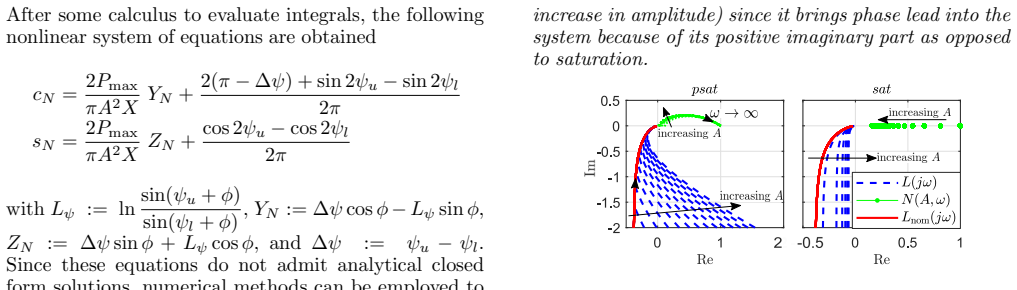
psat(ui,˙qi)=¯Pi/˙qi otherwise … describing function N(A,ω) … Lyapunov function V(q,˙q)=½˙qTM(q)˙q+½qTKpq … CLF-QP min(u−u0)TΦ(u−u0) s.t. … uTΩu+˙qTu≤Pmax
-
IndisputableMonolith/Foundation/RealityFromDistinction.leanreality_from_one_distinction unclear?
unclearRelation between the paper passage and the cited Recognition theorem.
Theorem 3 … xT[(A(H)+BΠ(H))TQ+Q(A(H)+BΠ(H))]x<0 … LMI program (18)
What do these tags mean?
- matches
- The paper's claim is directly supported by a theorem in the formal canon.
- supports
- The theorem supports part of the paper's argument, but the paper may add assumptions or extra steps.
- extends
- The paper goes beyond the formal theorem; the theorem is a base layer rather than the whole result.
- uses
- The paper appears to rely on the theorem as machinery.
- contradicts
- The paper's claim conflicts with a theorem or certificate in the canon.
- unclear
- Pith found a possible connection, but the passage is too broad, indirect, or ambiguous to say the theorem truly supports the claim.
Reference graph
Works this paper leans on
- [1]
-
[2]
G. A. Landis, Exploring Mars with Solar-Powered Rovers, in: Conf. Record of the 31st IEEE Photovoltaic Specialists Conf., 2005
work page 2005
- [3]
-
[4]
H. Kolvenbach, M. Hutter, Life Extension: An Autonomous Docking Station for Recharging Quadrupedal Robots, in: Proc. of the 11th Int. Conf. on Field and Service Robotics, 2017
work page 2017
-
[5]
G. D. Kenneally, A. De, D. E. Koditschek, Design Principles for a Family of Direct-Drive Legged Robots, IEEE Robotics and Automation Letters 1 (2) (2016) 900–907
work page 2016
- [6]
-
[7]
S. Rezazadeh, A. Abate, R. L. Hatton, J. W. Hurst, Robot Leg Design : A Constructive Framework, IEEE Access 6 (2018) 54369 – 54387
work page 2018
-
[8]
S. Collins, A. Ruina, R. Tedrake, M. Wisse, Efficient Bipedal Robots Based on Passive-Dynamic Walkers, Science 307 (5712) (2005) 1082–1085
work page 2005
- [9]
-
[10]
S. Seok, A. Wang, D. Otten, S. Kim, Actuator Design for High Force Proprioceptive Control in Fast Legged Locomotion, in: Proc. of the IEEE/RSJ Int. Conf. on Intelligent Robots and Systems, 2012
work page 2012
-
[11]
J. C. Doyle, R. S. Smith, D. F. Enns, Control of Plants with Input Saturation Nonlinearities, in: Proc. of the American Control Conf., 1987
work page 1987
-
[12]
J. W. Choi, S. C. Lee, Antiwindup Strategy for PI-Type Speed Controller, IEEE Trans. on Industrial Electronics 56 (6) (2009) 2039–2046
work page 2009
-
[13]
H. A. Fertik, C. W. Ross, Direct Digital Control Algoritm With Anti-Windup Feature, ISA Transactions 6 (4) (1967) 317–328
work page 1967
- [14]
-
[15]
E. Gilbert, I. Kolmanovsky, Nonlinear Tracking Control in the Presence of State and Control Constraints : A Generalized Reference Governor, Automatica 38 (12) (2002) 2063–2073
work page 2002
-
[16]
I. Kolmanovsky, E. Garone, S. D. Cairano, Reference and Command Governors : A Tutorial on Their Theory and Automative Applications, in: Proc. of the American Control Conf., 2014
work page 2014
-
[17]
A. S. Hodel, C. E. Hall, Variable-Structure PID Control to Prevent Integrator Windup, IEEE Trans. on Industrial Electronics 48 (2) (2001) 442–451
work page 2001
-
[18]
S. Galeani, S. Tarbouriech, M. Turner, L. Zaccarian, A Tutorial on Modern Anti-Windup Design, European Journal of Control 3 (4) (2009) 418–440
work page 2009
-
[19]
K. J. Astrom, L. Rundqwist, Integrator Windup and How to Avoid It?, in: Proc. of the American Control Conf., 1989
work page 1989
- [20]
-
[21]
E. F. Mulder, M. V. Kothare, M. Morari, Multivariable Anti-Windup Controller Synthesis Using Linear Matrix Inequalities, Automatica 37 (9) (2001) 1407–1416
work page 2001
- [22]
- [23]
-
[24]
D. Wu, R. Todd, A. J. Forsyth, Adaptive Rate-Limit Control for Energy Storage Systems, IEEE Trans. on Industrial Electronics 62 (7) (2015) 4231–4240
work page 2015
-
[25]
A. Gelb, W. E. V. Velde, Multiple-Input Describing Functions and Nonlinear System Design, McGraw-Hill, 1968
work page 1968
-
[26]
H. Li, J. Shang, B. Zhang, X. Zhao, N. Tan, C. Liu, Stability Analysis With Considering the Transition Interval for PWM DC-DC Converters Based on Describing Function Method, IEEE Access 6 (2018) 48113–48124
work page 2018
-
[27]
I. Boiko, Analysis of Sliding Modes in the Frequency Domain, International Journal of Control 50 (9) (2009) 1442–1446
work page 2009
-
[28]
S. F. Hsiao, D. Chen, C. J. Chen, H. S. Nien, A New Multiplefrequency Small-Signal Model for High-Bandwidth Computer V-core Regulator Applications, IEEE Transactions on Power Electronics 31 (1) (2016) 733–742
work page 2016
-
[29]
U. Perez-Ventura, L. Fridman, Design of Super-Twisting Control Gains : A Describing Function Based Methodology, Automatica 99 (2019) 175–180
work page 2019
-
[30]
Munkres, Section 26 in Topology, 2nd Edition, Pearson, 2000
J. Munkres, Section 26 in Topology, 2nd Edition, Pearson, 2000
work page 2000
-
[31]
M. Reyhanoglu, A. van der Schaft, N. Mcclamroch, I. Kolmanovsky, Dynamics and Control of a Class of Underactuated Mechanical Systems, IEEE Trans. on Automatic Control 44 (9) (1999) 1663–1671. doi:10.1109/ 9.788533
work page 1999
- [32]
-
[33]
R. M. Murray, Z. Li, S. S. Sastry, Section 5.4 in A Mathematical Introduction to Robotic Manipulation, CRC Press, 1994
work page 1994
-
[34]
Visioli, Section 3.3.2 in Practical PID Control, Springer, 2006
A. Visioli, Section 3.3.2 in Practical PID Control, Springer, 2006
work page 2006
-
[35]
L. Zaccarian, A. R. Teel, Section 2.3.5 in Modern Anti- windup Synthesis, Princeton University Press, 2011
work page 2011
-
[36]
T. Hu, Z. Lin, B. M. Chen, An Analysis and Design Method for Linear Systems Subject to Actuator Saturation and Disturbance, Automatica 38 (2) (2002) 351–359. doi: 10.1016/s0005-1098(01)00209-6
-
[37]
C. Lin, Q. Wang, T. H. Lee, An Improvement on Multivariable PID Controller Design via Iterative LMI Approach, Automatica 40 (3) (2004) 519–525
work page 2004
-
[38]
D. E. Koditschek, The Application of Total Energy as a Lyapunov Function for Mechanical Control Systems, Tech. rep., University of Pennsylvania (1989)
work page 1989
-
[39]
P. Tomei, Adaptive PD Controller for Robot Manipulators, IEEE Trans.on Robotics and Automation 7 (4) (1991) 565– 570
work page 1991
-
[40]
H. K. Khalil, Section 4.2. Nonlinear Systems, Prentice Hall, 2002. 18
work page 2002
-
[41]
S. Boyd, L. Vandenberghe, Section 4.4 in Convex Optimization, Cambridge University Press, 2004
work page 2004
-
[42]
J. M. Ortega, Numerical Analysis : A Second Approach, Vol. 3 of Classics in Applied Mathematics, SIAM, 1990
work page 1990
-
[43]
R. Freeman, P. Kokotovic, Optimal Nonlinear Controllers for Feedback Linearizable Systems, in: Proc. of the American Control Conference, 1995
work page 1995
-
[44]
R. A. Freeman, P. V. Kokotovic, Inverse Optimality in Robust Stabilization, SIAM Journal on Control and Optimization 34 (4) (1996) 1365–1391
work page 1996
-
[45]
A. D. Ames, K. Galloway, J. W. Grizzle, K. Sreenath, Rapidly exponentially stabilizing control lyapunov functions and hybrid zero dynamics, IEEE Transactions on Automatic Control 59 (4) (2014) 876–891
work page 2014
-
[46]
K. Y. Chao, M. J. Powell, A. D. Ames, P. Hur, Unification of Locomotion Pattern Generation and Control Lyapunov Function-Based Quadratic Programs, in: Proc. of the American Control Conference, 2016
work page 2016
-
[47]
J. M. Lee, Chapter 9 in Introduction to Smooth Manifolds, Springer, 2012
work page 2012
-
[48]
J. A. Primbs, V. Nevistic, J. C. Doyle, Nonlinear Optimal Control : A Control Lyapunov Function and Receding Horizon Perspective, Asian Journal of Control 1 (1) (1999) 14–24
work page 1999
-
[49]
K. Galloway, K. Sreenath, A. D. Ames, J. W. Grizzle, Torque Saturation in Bipedal Robotic Walking Through Control Lyapunov Function-Based Quadratic Programs, IEEE Access 3 (2015) 323–332
work page 2015
- [50]
-
[51]
M. W. Spong, The Swing Up Control for the Acrobot, IEEE Control Systems Magazine 15 (1) (1995) 49–55
work page 1995
-
[52]
K. J. Astrom, K. Furuta, Swinging up a pendulum by energy control, in: Proc. of the IFAC 13th World Congress, 1996. 19
work page 1996
discussion (0)
Sign in with ORCID, Apple, or X to comment. Anyone can read and Pith papers without signing in.