Fundamental limits of quantum-secure covert communication over bosonic channels
Pith reviewed 2026-05-25 00:06 UTC · model grok-4.3
The pith
Up to c times sqrt(n) covert bits can be sent reliably over lossy thermal bosonic channels without detection by an unlimited adversary.
A machine-rendered reading of the paper's core claim, the machinery that carries it, and where it could break.
Core claim
Given noise uncontrolled by the adversary, the square root law governs covert communication over the lossy thermal noise bosonic channel: up to c sqrt(n) covert bits can be transmitted reliably in n channel uses. The expression for c is derived, and a QPSK constellation on coherent states achieves the optimal value of c, identical to that obtained with a circularly symmetric complex Gaussian prior; binary phase shift keying is strictly suboptimal for the covert task.
What carries the argument
The square-root law (SRL) constant c for the bosonic channel, obtained from the channel's thermal noise statistics and the adversary's quantum detection capabilities.
If this is right
- Reliable transmission of up to c sqrt(n) covert bits is possible in n uses.
- Any attempt to exceed c sqrt(n) bits results in detection probability approaching 1.
- QPSK modulation achieves the optimal c for the bosonic channel.
- BPSK modulation achieves strictly less than the optimal c under covert constraints.
Where Pith is reading between the lines
- Simple discrete constellations suffice to reach the fundamental covert limit, suggesting low-complexity implementations may be viable.
- The distinction between standard capacity-achieving inputs and covert-optimal inputs may appear in other quantum channels with similar noise.
- The result separates the covert scaling from the usual Holevo capacity scaling at low SNR.
Load-bearing premise
The analysis requires that some thermal noise remains outside the adversary's control.
What would settle it
A calculation or experiment in which an adversary who can control or correlate with all thermal noise detects any scheme attempting more than c sqrt(n) covert bits with probability approaching 1.
Figures


read the original abstract
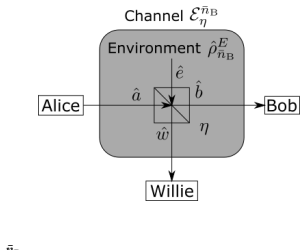
We investigate the fundamental limit of quantum-secure covert communication over the lossy thermal noise bosonic channel, the quantum-mechanical model underlying many practical channels. We assume that the adversary has unlimited quantum information processing capabilities as well as access to all transmitted photons that do not reach the legitimate receiver. Given existence of noise that is uncontrolled by the adversary, the square root law (SRL) governs covert communication: up to c*sqrt{n} covert bits can be transmitted reliably in n channel uses. Attempting to surpass this limit results in detection with unity probability as n approaches infinity. Here we present the expression for c, characterizing the SRL for the bosonic channel. We also prove that discrete-valued coherent state quadrature phase shift keying (QPSK) constellation achieves the optimal c, which is the same as that achieved by a circularly-symmetric complex-valued Gaussian prior on coherent state amplitude. Finally, while binary phase shift keying (BPSK) achieves the Holevo capacity for non-covert bosonic channels in the low received signal-to-noise ratio regime, we show that it is strictly sub-optimal for covert communication.
Editorial analysis
A structured set of objections, weighed in public.
Referee Report
Summary. The manuscript derives the precise constant c governing the square-root law for quantum-secure covert communication over the lossy thermal-noise bosonic channel. Conditioned on the existence of adversary-uncontrolled noise, up to c sqrt(n) covert bits can be sent reliably in n uses; the paper presents an explicit expression for c and proves that a QPSK constellation on coherent states achieves this optimal value (matching the circularly symmetric complex Gaussian prior), while BPSK is strictly suboptimal despite its optimality for non-covert low-SNR bosonic communication.
Significance. If the derivation holds, the result supplies the exact fundamental limit for covert bosonic communication under the standard noise model, with the explicit optimality of discrete QPSK constituting a notable strength that simplifies implementation while preserving the Gaussian rate. The work is a parameter-free derivation from the channel model and the definition of covertness, and the upfront conditioning on uncontrolled noise is clearly stated.
minor comments (2)
- [Abstract] The abstract states that an expression for c is presented and that optimality of QPSK is proved, but does not display the expression itself; including the closed-form expression for c in the abstract would improve immediate readability.
- Notation for the bosonic channel parameters (e.g., transmissivity, thermal noise mean photon number) should be introduced with a brief reminder of their physical meaning in the first section where the model is defined, to aid readers outside the immediate subfield.
Simulated Author's Rebuttal
We thank the referee for their positive assessment of the manuscript and for recommending acceptance. We are pleased that the derivation of the constant c and the optimality of QPSK were found to be clear and significant.
Circularity Check
No significant circularity; derivation is self-contained
full rationale
The paper derives the constant c characterizing the square-root law for covert communication over the lossy thermal-noise bosonic channel directly from the channel model, the definition of covertness (adversary detection probability), and standard quantum information-theoretic techniques. The optimality of QPSK is shown to match the Gaussian prior via explicit comparison of achievable rates. No equations reduce by construction to fitted inputs, no load-bearing self-citations are invoked for uniqueness theorems, and the central result is explicitly conditioned on the stated noise model. This is a standard conditional information-theoretic derivation with no internal reduction to its own outputs.
Axiom & Free-Parameter Ledger
axioms (2)
- domain assumption The lossy thermal-noise bosonic channel is the correct quantum-mechanical model for the physical link.
- domain assumption The adversary has unlimited quantum information processing and receives all photons that miss the legitimate receiver.
Reference graph
Works this paper leans on
-
[1]
Square root law for communication with low probability of detection on AWGN channels,
B. A. Bash, D. Goeckel, and D. Towsley, “Square root law for communication with low probability of detection on AWGN channels,” in Proc. IEEE Int. Symp. Inform. Theory (ISIT) , Cambridge, MA, Jul. 2012
work page 2012
-
[2]
Limits of reliable communication with low probability of detection on AWGN channels,
——, “Limits of reliable communication with low probability of detection on AWGN channels,” IEEE J. Select. Areas Commun., vol. 31, no. 9, pp. 1921–1930, 2013
work page 1921
-
[3]
Covert communication over noisy channels: A resolvability perspective,
M. R. Bloch, “Covert communication over noisy channels: A resolvability perspective,” IEEE Trans. Inf. Theory , vol. 62, no. 5, pp. 2334–2354, May 2016
work page 2016
-
[4]
Fundamental limits of communication with low probability of detection,
L. Wang, G. W. Wornell, and L. Zheng, “Fundamental limits of communication with low probability of detection,” IEEE Trans. Inf. Theory , vol. 62, no. 6, pp. 3493–3503, Jun. 2016
work page 2016
-
[5]
Reliable Deniable Communication: Hiding Messages in Noise
P. H. Che, M. Bakshi, and S. Jaggi, “Reliable deniable communication: Hiding messages in noise,” in Proc. IEEE Int. Symp. Inform. Theory (ISIT) , Istanbul, Turkey, Jul. 2013, arXiv:1304.6693
work page internal anchor Pith review Pith/arXiv arXiv 2013
-
[6]
First and second order asymptotics in covert communication,
M. Tahmasbi and M. R. Bloch, “First and second order asymptotics in covert communication,” IEEE Trans. Inf. Theory , vol. 65, no. 4, pp. 2190–2212, Apr. 2019
work page 2019
-
[7]
Hiding information in noise: Fundamental limits of covert wireless communication,
B. A. Bash, D. Goeckel, S. Guha, and D. Towsley, “Hiding information in noise: Fundamental limits of covert wireless communication,” IEEE Commun. Mag. , vol. 53, no. 12, 2015
work page 2015
-
[8]
Demonstration of microwave multiplexed readout of DC-biased superconducting nanowire detectors,
A. K. Sinclair, E. Schroeder, D. Zhu, M. Colangelo, J. Glasby, P. D. Mauskopf, H. Mani, and K. K. Berggren, “Demonstration of microwave multiplexed readout of DC-biased superconducting nanowire detectors,” IEEE Trans. Appl. Supercond., vol. 29, no. 5, Aug. 2019
work page 2019
-
[9]
A. N. McCaughan, D. M. Oh, and S. W. Nam, “A stochastic SPICE model for superconducting nanowire single photon detectors and other nanowire devices,” IEEE Trans. Appl. Supercond. , vol. 29, no. 5, Aug 2019
work page 2019
-
[10]
Multi-pulse fitting of transition edge sensor signals from a near-infrared continuous-wave source,
J. Lee, L. Shen, A. Cerà ´l, T. Gerrits, A. E. Lita, S. W. Nam, and C. Kurtsiefer, “Multi-pulse fitting of transition edge sensor signals from a near-infrared continuous-wave source,” Rev. Sci. Instrum. , vol. 89, no. 12, p. 123108, 2018
work page 2018
-
[11]
Wilde, Quantum Information Theory , 2nd ed
M. Wilde, Quantum Information Theory , 2nd ed. Cambridge University Press, 2016, arXiv:1106.1445v7
-
[12]
Quantum-secure covert communication on bosonic channels,
B. A. Bash, A. H. Gheorghe, M. Patel, J. L. Habif, D. Goeckel, D. Towsley, and S. Guha, “Quantum-secure covert communication on bosonic channels,” Nat. Commun. , vol. 6, Oct. 2015
work page 2015
-
[13]
A. J. Menezes, S. A. Vanstone, and P. C. V . Oorschot, Handbook of Applied Cryptography . Boca Raton, FL, USA: CRC Press, Inc., 1996
work page 1996
-
[14]
T. H. Cormen, C. E. Leiserson, R. L. Rivest, and C. Stein, Introduction to Algorithms, 2nd ed. Cambridge, Massachusetts: MIT Press, 2001
work page 2001
-
[15]
Coherent-state constellations and polar codes for thermal gaussian channels,
F. Lacerda, J. M. Renes, and V . B. Scholz, “Coherent-state constellations and polar codes for thermal gaussian channels,” Phys. Rev. A , vol. 95, p. 062343, Jun. 2017
work page 2017
-
[16]
Covert communication in the presence of an uninformed jammer,
T. V . Sobers, B. A. Bash, S. Guha, D. Towsley, and D. Goeckel, “Covert communication in the presence of an uninformed jammer,” IEEE Trans. Wireless Commun. , vol. 16, no. 9, pp. 6193–6206, Sep. 2017
work page 2017
-
[17]
Strong converse and stein’s lemma in quantum hypothesis testing,
T. Ogawa and H. Nagaoka, “Strong converse and stein’s lemma in quantum hypothesis testing,” IEEE Trans. Inf. Theory , vol. 46, no. 7, pp. 2428–2433, Nov. 2000
work page 2000
-
[18]
Classical capacity of the lossy bosonic channel: The exact solution,
V . Giovannetti, S. Guha, S. Lloyd, L. Maccone, J. H. Shapiro, and H. P. Yuen, “Classical capacity of the lossy bosonic channel: The exact solution,” Phys. Rev. Lett. , vol. 92, p. 027902, Jan. 2004
work page 2004
-
[19]
Communication theory of secrecy systems,
C. E. Shannon, “Communication theory of secrecy systems,” Bell System Technical Journal , vol. 28, pp. 656–715, 1949
work page 1949
-
[20]
Notes on the matrix exponential and logarithm,
H. E. Haber, “Notes on the matrix exponential and logarithm,” http://scipp.ucsc.edu/~haber/webpage/MatrixExpLog.pdf, 2018
work page 2018
-
[21]
C. W. Helstrom, Quantum Detection and Estimation Theory . New York, NY , USA: Academic Press, Inc., 1976
work page 1976
-
[22]
Computationally efficient deniable communication,
Q. Zhang, M. Bakshi, and S. Jaggi, “Computationally efficient deniable communication,” in Proc. IEEE Int. Symp. Inform. Theory (ISIT) , Jul. 2016, pp. 2234–2238
work page 2016
-
[23]
Multiple-user quantum information theory for optical communication channels,
S. Guha, “Multiple-user quantum information theory for optical communication channels,” Ph.D. dissertation, Mas- sachusetts Institute of Technology, 2008
work page 2008
-
[24]
Ultimate channel capacity of free-space optical communications,
J. H. Shapiro, S. Guha, and B. I. Erkmen, “Ultimate channel capacity of free-space optical communications,” Journal of Optical Networking , vol. 4, no. 8, pp. 501–516, Aug. 2005
work page 2005
-
[25]
Polar codes for classical-quantum channels,
M. M. Wilde and S. Guha, “Polar codes for classical-quantum channels,” IEEE Trans. Inf. Theory , vol. 59, no. 2, pp. 1175–1187, Feb. 2013
work page 2013
-
[26]
Polar codes for arbitrary classical-quantum channels and arbitrary cq-macs,
R. Nasser and J. M. Renes, “Polar codes for arbitrary classical-quantum channels and arbitrary cq-macs,” IEEE Trans. Inf. Theory , vol. 64, no. 11, pp. 7424–7442, Nov. 2018
work page 2018
-
[27]
General formulas for capacity of classical-quantum channels,
M. Hayashi and H. Nagaoka, “General formulas for capacity of classical-quantum channels,” IEEE Trans. Inf. Theory , vol. 49, no. 7, pp. 1753–1768, Jul. 2003
work page 2003
-
[28]
An information-spectrum approach to classical and quantum hypothesis testing for simple hypotheses,
H. Nagaoka and M. Hayashi, “An information-spectrum approach to classical and quantum hypothesis testing for simple hypotheses,” IEEE Trans. Inf. Theory , vol. 53, no. 2, pp. 534–549, Feb. 2007
work page 2007
-
[29]
LPD Communication when the Warden Does Not Know When,
B. A. Bash, D. Goeckel, and D. Towsley, “LPD Communication when the Warden Does Not Know When,” in Proc. IEEE Int. Symp. Inform. Theory (ISIT) , Honolulu, HI, Jul. 2014
work page 2014
-
[30]
Covert communication gains from adversary’s ignorance of transmission time,
——, “Covert communication gains from adversary’s ignorance of transmission time,” IEEE Trans. Wireless Commun. , vol. 15, no. 12, pp. 8394–8405, Dec. 2016
work page 2016
-
[31]
Keyless asynchronous covert communication,
K. S. K. Arumugam and M. R. Bloch, “Keyless asynchronous covert communication,” in Proc. Inform. Theory Workshop (ITW), Sep. 2016
work page 2016
-
[32]
Covert communication over classical-quantum channels,
A. Sheikholeslami, B. A. Bash, D. Towsley, D. Goeckel, and S. Guha, “Covert communication over classical-quantum channels,” in Proc. IEEE Int. Symp. Inform. Theory (ISIT) , Barcelona, Spain, Jul. 2016, arXiv:1601.06826 [quant-ph]
-
[33]
Framework for covert and secret key expansion over classical-quantum channels,
M. Tahmasbi and M. R. Bloch, “Framework for covert and secret key expansion over classical-quantum channels,” Phys. Rev. A, vol. 99, p. 052329, May 2019
work page 2019
-
[34]
An optimum receiver for the binary coherent state quantum channel,
S. J. Dolinar, “An optimum receiver for the binary coherent state quantum channel,” M.I.T. Res. Lab. Electron. Quart. Progr. Rep. 111, pp. 115–120, 1973
work page 1973
-
[35]
Achieving minimum-error discrimination of an arbitrary set of laser-light pulses,
M. P. da Silva, S. Guha, and Z. Dutton, “Achieving minimum-error discrimination of an arbitrary set of laser-light pulses,” Phys. Rev. A , vol. 87, p. 052320, May 2013
work page 2013
discussion (0)
Sign in with ORCID, Apple, or X to comment. Anyone can read and Pith papers without signing in.