Two Neutron Correlation Study in Photofission of Actinides
Pith reviewed 2026-05-24 22:20 UTC · model grok-4.3
The pith
Two neutrons from photofission are emitted mostly in opposite directions.
A machine-rendered reading of the paper's core claim, the machinery that carries it, and where it could break.
Core claim
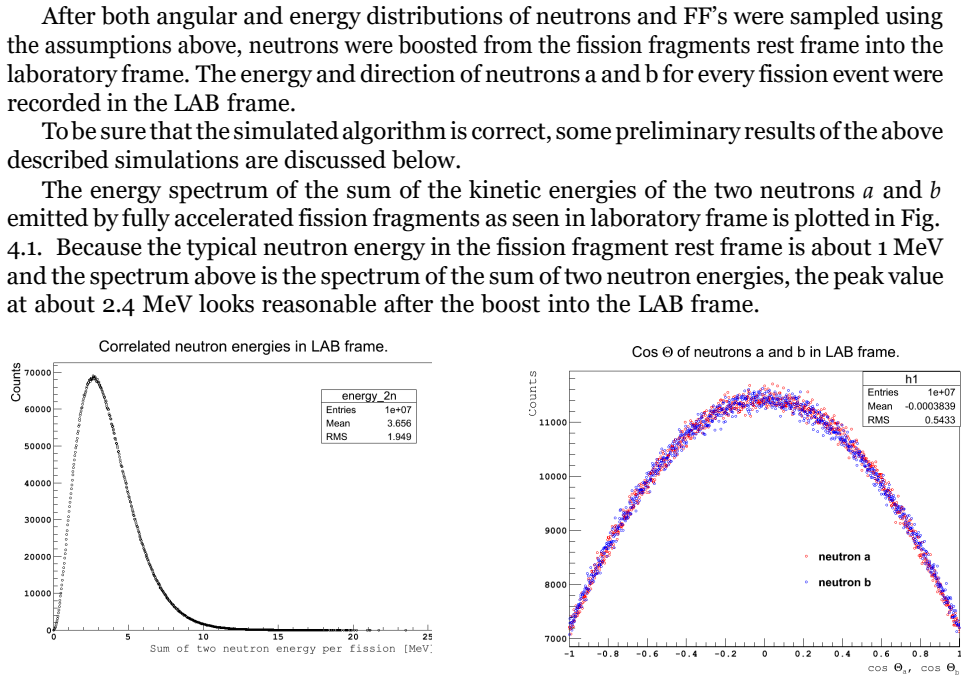
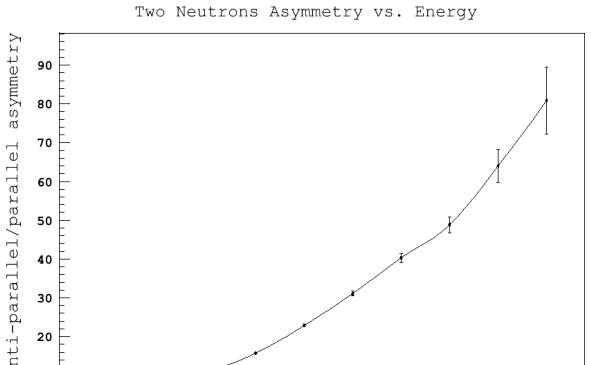
The two neutron correlation shows a huge asymmetry effect with many more neutrons emitted anti-parallel to each other than parallel to each other. That asymmetry becomes even more if the energy cut on each neutron is done. This arises because the fission fragments are emitted essentially back to back in the laboratory frame.
What carries the argument
The mapping of neutron emission directions from the back-to-back fission fragment rest frames into the laboratory frame.
If this is right
- This asymmetry can serve as a unique signature of fissionable materials.
- Neutron measurements can carry information about fission fragment energy and angular spectra.
- The study can improve knowledge of correlated neutron emission.
- It may enable new techniques for actinide detection in homeland security and safeguards.
Where Pith is reading between the lines
- The proposed measurement could be performed with existing neutron detector arrays without requiring fragment detection.
- Different actinide targets or photon energies might produce measurable differences in the asymmetry strength.
Load-bearing premise
That the known back-to-back emission of fission fragments, combined with standard assumptions about neutron emission in the fragment rest frame, is sufficient to produce a reliable quantitative prediction of the lab-frame two-neutron angular correlation without experimental validation or detailed modeling of the photofission process.
What would settle it
An experimental measurement of the two-neutron angular distribution in photofission that finds equal numbers of neutron pairs at 0 degrees and 180 degrees.
Figures
read the original abstract
It is well known that two fission fragments (FF's) are emitted essentially back to back in the laboratory frame. That can be used widely in many applications as a unique signature of fissionable materials. However, such fission fragments are difficult to detect. The energy and angular distributions of neutrons, on the other hand, are easy to measure, and that distribution will carry information about the fission fragment's energy and angular spectra, as well as the neutron spectra in the fission fragment rest frame. We propose to investigate the two neutron correlation yield resulting from two FF's as a function of different targets, the angle between the two neutrons and the neutron energies. The preliminary calculation of the two neutron correlation shows a huge asymmetry effect: many more neutrons are emitted anti-parallel to each other than parallel to each other. That asymmetry becomes even more if the energy cut on each neutron is done. This study will potentially permit a new technique for actinide detection for homeland security and safeguards applications as well as improve our knowledge of correlated neutron emission.
Editorial analysis
A structured set of objections, weighed in public.
Referee Report
Summary. The manuscript proposes a study of two-neutron angular correlations in photofission of actinides, motivated by the back-to-back emission of fission fragments. It claims that a preliminary calculation already demonstrates a large asymmetry favoring anti-parallel neutron emission over parallel emission, with the asymmetry increasing when energy cuts are applied to the neutrons. The work aims to develop this correlation as a detection signature for actinides in homeland security applications and to improve understanding of correlated neutron emission.
Significance. If the reported asymmetry proves robust under realistic photofission kinematics, the proposed neutron-correlation technique could supply a measurable alternative to fragment detection for actinide identification. The manuscript, however, presents no equations, input distributions, or validation steps for the calculation, so the potential impact cannot be assessed from the current text.
major comments (2)
- [Abstract] Abstract: The central claim that 'the preliminary calculation of the two neutron correlation shows a huge asymmetry effect' is unsupported by any equations, fragment velocity distributions, neutron multiplicity model, center-of-mass angular distribution, pre-scission component, or integration procedure. This omission is load-bearing because the entire proposed technique rests on the existence and magnitude of the asymmetry.
- [Abstract] Abstract: The assertion that the asymmetry 'becomes even more if the energy cut on each neutron is done' is stated without showing how the boost from the fragment rest frame to the lab frame, combined with the chosen energy thresholds, produces this enhancement. No test against known fission data or alternative models is provided.
Simulated Author's Rebuttal
We thank the referee for the constructive comments on our proposal. The manuscript is a concise outline of the idea and preliminary result; we agree the supporting details are absent and will expand the text to address the concerns.
read point-by-point responses
-
Referee: [Abstract] Abstract: The central claim that 'the preliminary calculation of the two neutron correlation shows a huge asymmetry effect' is unsupported by any equations, fragment velocity distributions, neutron multiplicity model, center-of-mass angular distribution, pre-scission component, or integration procedure. This omission is load-bearing because the entire proposed technique rests on the existence and magnitude of the asymmetry.
Authors: We agree the current text provides no supporting details for the calculation. The preliminary result was obtained by assuming back-to-back fission fragments with velocities drawn from literature distributions for actinides, isotropic neutron emission in the fragment rest frame using a Maxwellian spectrum, and Lorentz boosting to the lab frame before integrating over angles and energies. We will add an explicit description of the model, the boost equations, the assumed multiplicity and angular distributions, and the numerical integration procedure in the revised manuscript. revision: yes
-
Referee: [Abstract] Abstract: The assertion that the asymmetry 'becomes even more if the energy cut on each neutron is done' is stated without showing how the boost from the fragment rest frame to the lab frame, combined with the chosen energy thresholds, produces this enhancement. No test against known fission data or alternative models is provided.
Authors: The enhancement arises because lab-frame energy cuts preferentially select neutrons emitted forward in the fragment rest frame, which are kinematically aligned with the fragment velocity vector and therefore strengthen the anti-parallel correlation. We acknowledge that neither the kinematic derivation nor any comparison to existing fission data is shown. In revision we will include a quantitative demonstration of the effect with and without cuts together with references to measured neutron spectra for validation. revision: yes
Circularity Check
No derivation or equations presented; claim rests on unspecified preliminary calculation.
full rationale
The manuscript proposes a study of two-neutron correlations in photofission but contains no equations, models, integration procedures, or derivation steps. The sole quantitative claim ('preliminary calculation ... shows a huge asymmetry effect') is stated without supporting formalism, fitted parameters, or self-citations that could reduce to inputs by construction. Because no load-bearing derivation chain exists in the text, the circularity criteria cannot be triggered and the score is 0.
Axiom & Free-Parameter Ledger
axioms (1)
- domain assumption Fission fragments are emitted essentially back to back in the laboratory frame.
Reference graph
Works this paper leans on
-
[1]
Krane, IBntroductory Nuclear Physics, John Wiley & Sons, Inc., New York, 1988
K.S. Krane, IBntroductory Nuclear Physics, John Wiley & Sons, Inc., New York, 1988
work page 1988
-
[2]
Wong, Introductory Nuclear Physics, John Wiley & Sons, Inc., New York, 1988
S.S.M. Wong, Introductory Nuclear Physics, John Wiley & Sons, Inc., New York, 1988
work page 1988
-
[3]
V.Weisskopf, ”Statistics and Nuclear Reactions”, Phys. Rev. 52, 295 (1937)
work page 1937
-
[4]
M.Goldhaber and E.Teller, ”On Nuclear Dipole Vibrations”, Phys. Rev. 74, 1046– 1049 (1948)
work page 1948
-
[5]
A.Bohr, On the theory of nuclear fission, Proc. 1st UN Int. Conf. on peaceful uses of atomic energy, Vol 2, 151, New York 1956
work page 1956
-
[6]
E.J.Winhold, P.T.Demos, and I.Halpern, Phys. Rev. 85, 728(A) (1952)
work page 1952
-
[7]
E.J.Winhold, P.T.Demos, and I.Halpern, ”The Angular Distribution of Fission Frag- ments in the Photofission of Thorium”, Phys. Rev. 87, 1139– 1140 (1952)
work page 1952
-
[8]
A.W.Fairhall, I.Halpern, and E.J.Winhold, ”Angular Anisotropy of Specific Thorium Photofission Fragments”, Phys. Rev. 94, 733– 734 (1954)
work page 1954
-
[9]
E.J.Winhold and I.Halpern, ”Anisotropic Photofission”, Phys. Rev. 103, 990– 1000 (1956)
work page 1956
-
[10]
H.R. Bowman, S.G. Thompson, J.C.D. Milton, and W.J. Swiatecki, Velocity and An- gular Distributions of Prompt Neutrons from Spontaneous Fission of Cf 252 , Phys. Rev., 126, 2120 (1962)
work page 1962
- [11]
-
[12]
-H.Knitter, Simultaneous investigation of fission fragments and neutrons in 252 Cf (SF), Nucl
C.Budtz-Jorgensen and H. -H.Knitter, Simultaneous investigation of fission fragments and neutrons in 252 Cf (SF), Nucl. Phys. A490, 307 (1988)
work page 1988
- [13]
-
[14]
A. De Clercq, E. Jacobs, D. De Frenne, H. Thierens, P. D’hondt, and A. J. Deruytter, Fragment mass and kinetic energy distribution for the photofission of 235 U and 238 U with 25-MeV end-point bremsstrahlung, Phys. Rev. C 13, 1536 (1976). 25
work page 1976
-
[15]
E.Jacobs, A.De Clercq, H.Thie rens, D.De Frenne, P.D’hondt, P.De Gelder, and A.J.Deruytter. Fragment mass and kinetic energy distributions for the photofission of 235U with 12-, 15-, 20-, 30-, and 70- MeV bremsstrahlung, Phys. Rev. C 24, 1795– 1798 (1981)
work page 1981
-
[16]
W.Wilke, U.Kneissl, Th.Weber and all., Photofission of 238 U with monochromatic gamma rays in the energy range 11–16 MeV, Phys. Rev. C 42, 2148– 2156 (1990)
work page 1990
-
[17]
Talou, P. and Becker, B. and Kawano, T. and Chadwick, M. B. and Danon, Y. Advanced Monte Carlo modeling of prompt fission neutrons for thermal and fast neutron- induced fission reactions on 239 Pu, Phys. Rev. C, 83, 064612 (2011)
work page 2011
-
[18]
V. F. Apalin, Yu.N. Gritsyuk, I. E. Kutikov, V. I. Lebedev, and L. A. Mikaelian, Nucl. Phys. 71, 553 (1965)
work page 1965
-
[19]
C.Wagemans, E.Allaert, A.Deruytter, R.Barth´el´emy, and P.Schillebeeckx, Comparison of the energy and mass characteristics of the 239 Pu(nth, f ) and the 240 Pu(sf ) fragments, Phys. Rev. C 30, 218 (1984)
work page 1984
-
[20]
V.M.Surin, A.I.Sergachev, N.I.Rezchikov, B.D.Kuz’minov ”Yields and kinetic energies of fragments in the fission of U233 and Pu239 by 5.5- and 15-MeV neutrons”, Yad. Fiz. 14, 935 (1971)
work page 1971
-
[21]
C.Tsuchiya, Y.Nakagome, H.Yamana, H.Moriyama, K.Nishio, I.Kanno, K.Shin, and I.Kimura, ”Simultaneous Measurement of Pr ompt Neutrons and Fission Fragments for 239Pu(nth, f )”, J. Nucl. Sci. Technol. 37, 941 (2000)
work page 2000
-
[22]
M.Asghar, F.Caitucoli, P.Perrin, and C.Wagemans, ”Fission fragment energy correla- tion measurements for the thermal neutron fission of 239 Pu and 235 U ”, Nucl. Phys. A 311, 205 (1978)
work page 1978
-
[23]
P.Talou, T.Kawano, O.Bouland, J.E.Lynn, P.M¨oller, and M.B.Chadwick Proceedings of the International Conference on Nuclear Data for Science & Technology ND2010, April 26– 30, 2010, Jeju Island, Korea
work page 2010
-
[24]
K.-H. Schmidt and B. Jurado. ”Entropy Driven Excitation Energy Sorting in Superfluid Fission Dynamics”, Phys. Rev. Lett. 104, 212501 (2010)
work page 2010
-
[25]
National Nuclear Data Center, http://www.nndc.bnl.gov/
-
[26]
Burcham, William Ernest, Elements of nuclear physics, Longman Inc., New York 1979
work page 1979
-
[27]
Yujong Kim, Private communication, ISU Physics Department, 2011
work page 2011
discussion (0)
Sign in with ORCID, Apple, or X to comment. Anyone can read and Pith papers without signing in.