Interference Exploitation via Symbol-Level Precoding: Overview, State-of-the-Art and Future Directions
Pith reviewed 2026-05-24 22:45 UTC · model grok-4.3
The pith
Known interference can be turned from a liability into a performance asset in multi-antenna wireless systems by steering it constructively at each receiver with symbol-level precoding.
A machine-rendered reading of the paper's core claim, the machinery that carries it, and where it could break.
Core claim
By manipulating the interfering signals such that they add up constructively at the receiver side, known interference can be made beneficial and further improve the system performance in a variety of wireless scenarios, achieved by symbol-level precoding (SLP). The paper begins with the classification of constructive interference (CI) and destructive interference (DI), presents the definition and mathematical characterization of CI for popular modulation types, discusses optimization-based precoding techniques, describes extensions to other application scenarios and hardware efficiency, demonstrates proof-of-concept testbeds, and lists open problems and practical challenges.
What carries the argument
Symbol-level precoding (SLP), the design of a precoding vector computed individually for each transmitted symbol using instantaneous channel state and symbol knowledge to steer interference into the constructive region at the intended receiver.
If this is right
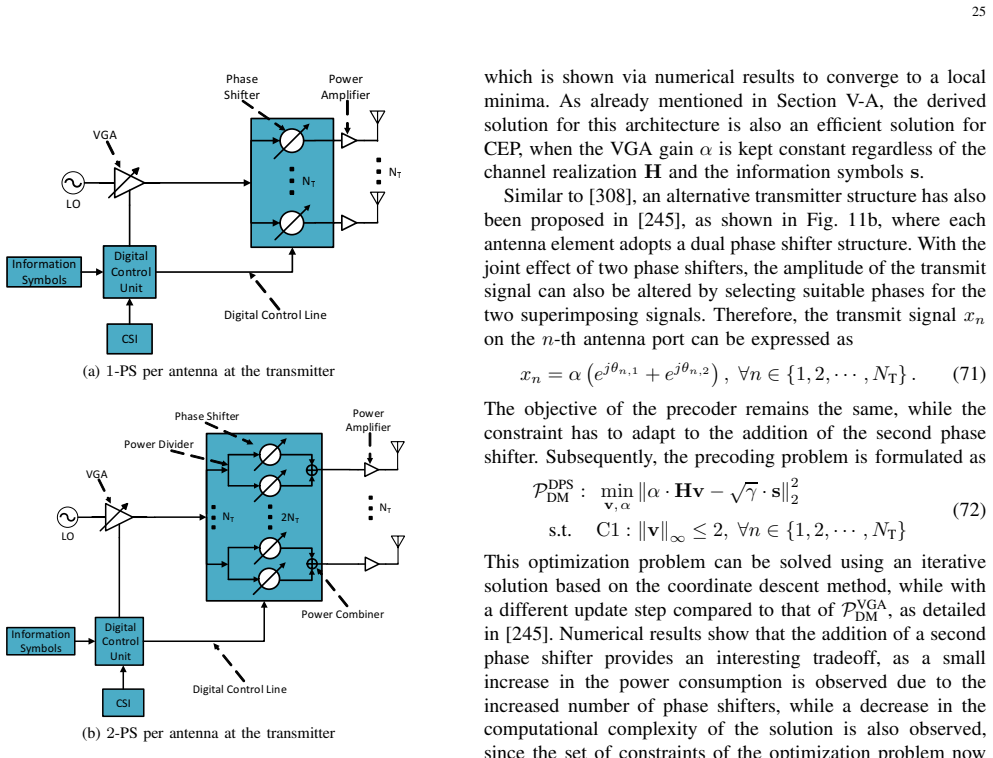
- Optimization-based SLP formulations can convert interference power into useful signal power at the receiver for common modulations.
- The same constructive-interference design extends to hardware-efficiency scenarios such as constant-envelope or low-resolution precoding.
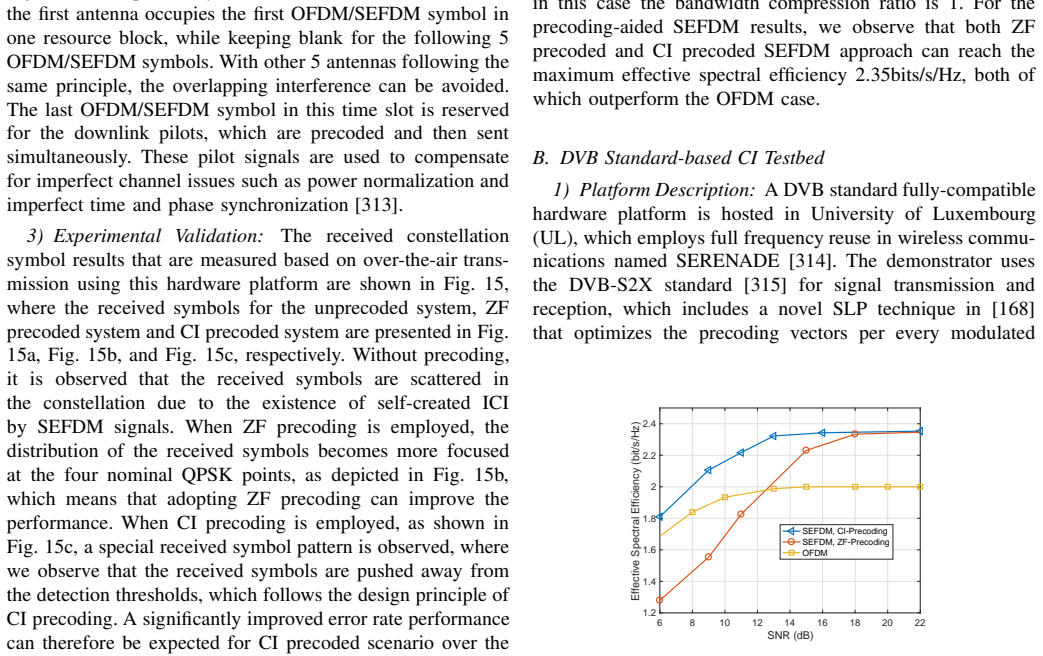
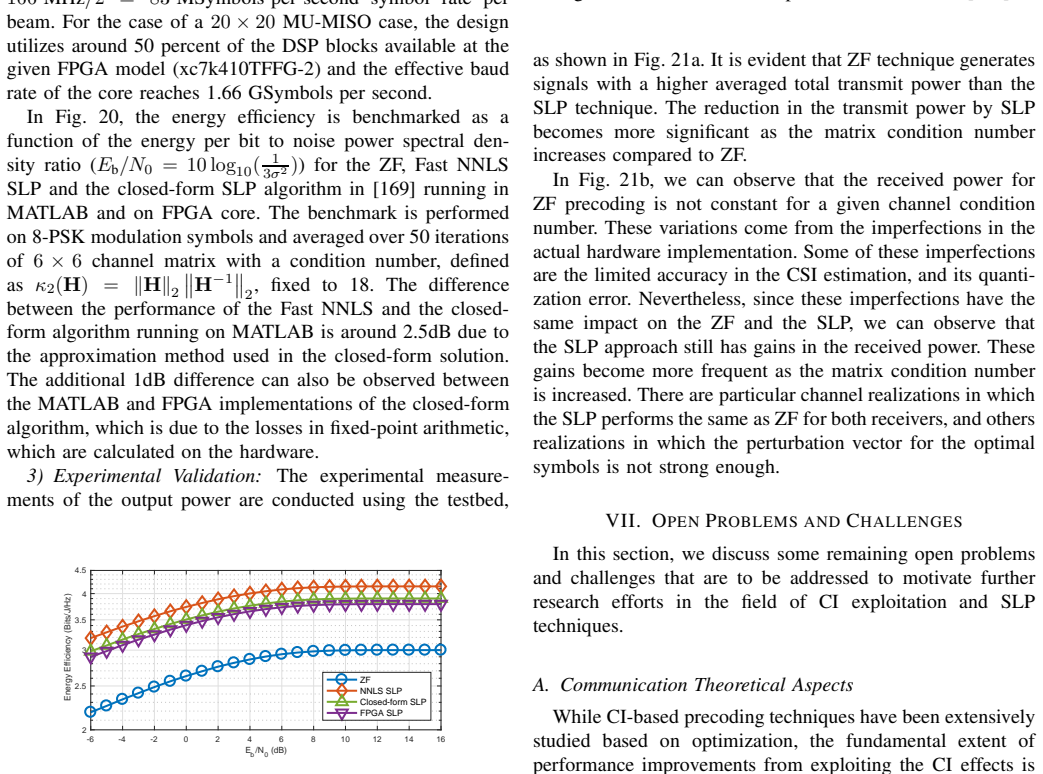
- Proof-of-concept testbeds already demonstrate that the computed precoders can be realized in real time.
- A range of open implementation challenges remain before the technique moves into standardized systems.
Where Pith is reading between the lines
- If the perfect-knowledge premise holds only approximately, the net gain may shrink unless robust formulations are developed.
- The approach could combine with massive MIMO or mmWave deployments where symbol-level processing overhead becomes relatively smaller.
- A direct test would compare total energy per bit of SLP against conventional block-level precoding under identical total power and channel conditions.
Load-bearing premise
The transmitter has perfect instantaneous knowledge of both the channels to all receivers and the exact symbols being sent so that the precoder can be recomputed symbol by symbol.
What would settle it
A controlled over-the-air experiment that measures whether the reported rate or error-rate gains remain when realistic channel estimation error of a few percent is introduced into the precoder calculation.
Figures






read the original abstract
Interference is traditionally viewed as a performance limiting factor in wireless communication systems, which is to be minimized or mitigated. Nevertheless, a recent line of work has shown that by manipulating the interfering signals such that they add up constructively at the receiver side, known interference can be made beneficial and further improve the system performance in a variety of wireless scenarios, achieved by symbol-level precoding (SLP). This paper aims to provide a tutorial on interference exploitation techniques from the perspective of precoding design in a multi-antenna wireless communication system, by beginning with the classification of constructive interference (CI) and destructive interference (DI). The definition for CI is presented and the corresponding mathematical characterization is formulated for popular modulation types, based on which optimization-based precoding techniques are discussed. In addition, the extension of CI precoding to other application scenarios as well as for hardware efficiency is also described. Proof-of-concept testbeds are demonstrated for the potential practical implementation of CI precoding, and finally a list of open problems and practical challenges are presented to inspire and motivate further research directions in this area.
Editorial analysis
A structured set of objections, weighed in public.
Referee Report
Summary. The manuscript is a tutorial survey on interference exploitation via symbol-level precoding (SLP) in multi-antenna wireless systems. It classifies constructive interference (CI) versus destructive interference (DI), formulates mathematical characterizations of CI for common modulations, reviews optimization-based SLP designs, covers extensions to additional scenarios and hardware-efficient implementations, presents proof-of-concept testbeds, and enumerates open problems.
Significance. As a survey that consolidates the CI/DI classification, standard mathematical formulations, and practical demonstrations from the literature, the paper offers a useful entry point and reference for researchers working on multi-user MIMO precoding. The explicit discussion of testbeds and open challenges adds practical value beyond a simple literature list.
minor comments (3)
- [Abstract] The abstract states that mathematical characterizations are 'formulated' for popular modulations; a brief table or explicit list of the modulations treated (e.g., QPSK, 16-QAM) would improve scannability.
- Notation for the received signal model and CI regions should be checked for consistency between the introductory classification section and the later optimization formulations.
- [Open problems] The open-problems section would benefit from explicit pointers to the specific prior works that leave each listed challenge unresolved.
Simulated Author's Rebuttal
We thank the referee for the positive evaluation of the manuscript and the recommendation to accept.
Circularity Check
Survey paper presents no derivation chain or predictions
full rationale
The document is explicitly a tutorial review and overview that classifies CI/DI, reproduces standard characterizations for modulations from prior literature, surveys optimization-based SLP techniques, describes extensions and testbeds, and lists open problems. No new central technical claim, prediction, or derivation is advanced; all mathematical content is presented as reproduction of external work rather than a self-contained chain that reduces to its own inputs by construction.
Axiom & Free-Parameter Ledger
Reference graph
Works this paper leans on
-
[1]
Diversity and Multiplexing: A F undamen- tal Tradeoff in Multiple-Antenna Channels,
L. Zheng and D. N. C. Tse, “Diversity and Multiplexing: A F undamen- tal Tradeoff in Multiple-Antenna Channels,” IEEE Trans. Inf. Theory , vol. 49, no. 5, pp. 1073–1096, May 2003
work page 2003
-
[2]
M. Costa, “Writing on Dirty Paper,” IEEE Trans. Inf. Theory , vol. IT-29, no. 3, pp. 439–441, May 1983
work page 1983
-
[3]
Linear Transmit Processing in MIMO Communication Systems,
M. Joham, W. Utschick, and J. A. Nossek, “Linear Transmit Processing in MIMO Communication Systems,” IEEE Trans. Sig. Process., vol. 53, no. 8, pp. 2700–2712, Aug. 2005
work page 2005
-
[4]
Performance of MIMO Systems with Channel Inversion,
T. Haustein, C. von Helmolt, E. Jorswieck, V . Jungnickel , and V . Pohl, “Performance of MIMO Systems with Channel Inversion,” in V ehicular Technology Conference. IEEE 55th V ehicular Technology Con ference. VTC Spring 2002 (Cat. No.02CH37367) , vol. 1, 2002
work page 2002
-
[5]
MIMO Transmission for Single-fed ESPAR with Quantized Loads,
A. Li and C. Masouros, “MIMO Transmission for Single-fed ESPAR with Quantized Loads,” IEEE Trans. Commun. , vol. 65, no. 7, pp. 2863–2876, July 2017
work page 2017
-
[6]
Exploiting Mutual Coupling by Means of Analog-Digi tal Zero Forcing,
——, “Exploiting Mutual Coupling by Means of Analog-Digi tal Zero Forcing,” in 2017 IEEE International Conference on Acoustics, Speech and Signal Processing (ICASSP) , New Orleans, LA, 2017, pp. 3564– 3568
work page 2017
-
[7]
C. B. Peel, B. M. Hochwald, and A. L. Swindlehurst, “A V ect or- Perturbation Technique for Near-Capacity Multiantenna Mu ltiuser Communication-part I: Channel Inversion and Regularizati on,” IEEE Trans. Commun., vol. 53, no. 1, pp. 195–202, Jan. 2005
work page 2005
-
[8]
Optimal and Suboptimal T ransmit Beamforming,
M. Bengtsson and B. Ottersten, “Optimal and Suboptimal T ransmit Beamforming,” Handbook of Antennas in Wireless Communications , Jan. 2001
work page 2001
-
[9]
Solution of the Multiuser Down link Beamforming Problem with Individual SINR Constraints,
M. Schubert and H. Boche, “Solution of the Multiuser Down link Beamforming Problem with Individual SINR Constraints,” IEEE Trans. V eh. Tech., vol. 53, no. 1, pp. 18–28, Jan. 2004
work page 2004
-
[10]
Linear Pr ecoding via Conic Optimization for Fixed MIMO Receivers,
A. Wiesel, Y . C. Eldar, and S. Shamai (Shitz), “Linear Pr ecoding via Conic Optimization for Fixed MIMO Receivers,” IEEE Trans. Sig. Process., vol. 54, no. 1, pp. 161–176, Jan. 2006
work page 2006
-
[11]
Semidefi nite Relaxation of Quadratic Optimization Problems,
Z.-Q. Luo, W. K. Ma, A. M. So, Y . Y ., and S. Zhang, “Semidefi nite Relaxation of Quadratic Optimization Problems,” IEEE Sig. Process. Mag., vol. 27, no. 3, pp. 20–34, May 2010
work page 2010
-
[12]
Rank-Constrained Separabl e Semidefi- nite Programming with Applications to Optimal Beamforming ,
Y . Huang and D. P . Palomar, “Rank-Constrained Separabl e Semidefi- nite Programming with Applications to Optimal Beamforming ,” IEEE Trans. Sig. Process. , vol. 58, no. 2, pp. 664–678, Feb. 2010
work page 2010
-
[13]
——, “A Dual Perspective on Separable Semidefinite Progr amming with Applications to Optimal Downlink Beamforming,” IEEE Trans. Sig. Process., vol. 58, no. 8, pp. 4254–4271, Aug. 2010
work page 2010
-
[14]
General Ran k Multiuser Downlink Beamforming with Shaping Constraints U sing Real-V alued OSTBC,
K. L. Law, X. Wen, M. T. Vu, and M. Pesavento, “General Ran k Multiuser Downlink Beamforming with Shaping Constraints U sing Real-V alued OSTBC,” IEEE Trans. Sig. Process. , vol. 63, no. 21, pp. 5758–5771, Nov. 2015
work page 2015
-
[15]
M. F. Hanif, L.-N. Tran, A. Tolli, and M. Juntti, “Comput ationally Efficient Robust Beamforming for SINR Balancing in Multicel l Down- link with Applications to Large Antenna Array Systems,” IEEE Trans. Commun., vol. 62, no. 6, pp. 1908–1920, June 2014
work page 1908
-
[16]
Transmit Beamforming for M ultiuser Downlink with Per-Antenna Power Constraints,
F. Wang, X. Wang, and Y . Zhu, “Transmit Beamforming for M ultiuser Downlink with Per-Antenna Power Constraints,” in 2014 IEEE Inter- national Conference on Communications (ICC) , Sydney, NSW, 2014
work page 2014
-
[17]
Joint Beamforming and User Association Scheme for Full- Dimension Massive MIMO Networks,
R. Dong, A. Li, W. Hardjawana, Y . Li, X. Ge, and B. Vucetic , “Joint Beamforming and User Association Scheme for Full- Dimension Massive MIMO Networks,” IEEE Trans. V eh. Tech. , DOI:10.1109/TVT.2019.2923415, 2019
-
[18]
Coo perative Beamforming for Multi-Cell Full Dimensional Massive MIMO N et- works,
R. Dong, W. Hardjawana, A. Li, Y . Li, and B. Vucetic, “Coo perative Beamforming for Multi-Cell Full Dimensional Massive MIMO N et- works,” in 2019 IEEE International Conference on Communications (ICC), Shanghai, 2019
work page 2019
-
[19]
Cognitive Radio Techniques under Practical Imper fections: A Survey,
S. K. Sharma, T. E. Bogale, S. Chatzinotas, B. Ottersten , L. B. Le, and X. Wang, “Cognitive Radio Techniques under Practical Imper fections: A Survey,” IEEE Commun. Surveys &Tut., vol. 17, no. 4, pp. 1858– 1884, fourthquarter 2015
work page 2015
-
[20]
Advances in Cognitive Radio Net works: A Survey,
B. Wang and K. J. R. Liu, “Advances in Cognitive Radio Net works: A Survey,” IEEE J. Sel. Topics Sig. Process. , vol. 5, no. 1, pp. 5–23, Feb. 2011
work page 2011
-
[21]
A Survey of Spectrum Sensing Alg orithms for Cognitive Radio Applications,
T. Y ucek and H. Arslan, “A Survey of Spectrum Sensing Alg orithms for Cognitive Radio Applications,” IEEE Commun. Surveys &Tut., vol. 11, no. 1, pp. 116–130, firstquarter 2009
work page 2009
-
[22]
Spectru m Sensing for Cognitive Radio: State-of-the-Art and Recent Advances ,
E. Axell, G. Leus, E. G. Larsson, and H. V . Poor, “Spectru m Sensing for Cognitive Radio: State-of-the-Art and Recent Advances ,” IEEE Sig. Process. Mag., vol. 29, no. 3, pp. 101–116, May 2012
work page 2012
-
[23]
Exploiting Multi-Antennas for O pportunistic Spectrum Sharing in Cognitive Radio Networks,
R. Zhang and Y . Liang, “Exploiting Multi-Antennas for O pportunistic Spectrum Sharing in Cognitive Radio Networks,” IEEE J. Sel. Topics Sig. Process., vol. 2, no. 1, pp. 88–102, Feb. 2008
work page 2008
-
[24]
MMSE-SLNR Precoding for Mult i-Antenna Cognitive Radio,
Y . Richter and I. Bergel, “MMSE-SLNR Precoding for Mult i-Antenna Cognitive Radio,” IEEE Trans. Sig. Process., vol. 62, no. 10, pp. 2719– 2729, May 2014
work page 2014
-
[25]
Beamforming Dual ity and Algorithms for Weighted Sum Rate Maximization in Cognitive Radio Networks,
I. Lai, L. Zheng, C. Lee, and C. W. Tan, “Beamforming Dual ity and Algorithms for Weighted Sum Rate Maximization in Cognitive Radio Networks,” IEEE J. Sel. Areas Commun. , vol. 33, no. 5, pp. 832–847, May 2015
work page 2015
-
[26]
Robust beamformi ng in cognitive radio,
G. Zheng, S. Ma, K.-K. Wong, and T. Ng, “Robust beamformi ng in cognitive radio,” IEEE Trans. Wireless Commun. , vol. 9, no. 2, pp. 570–576, Feb. 2010
work page 2010
-
[27]
An Efficient Zero-F orcing Precoding Design for Cognitive MIMO Broadcast Channels,
V . Nguyen, H. V . Nguyen, and O. Shin, “An Efficient Zero-F orcing Precoding Design for Cognitive MIMO Broadcast Channels,” IEEE Commun. Lett. , vol. 20, no. 8, pp. 1575–1578, Aug. 2016
work page 2016
-
[28]
I. Wajid, M. Pesavento, Y . C. Eldar, and D. Ciochina, “Ro bust Down- link Beamforming with Partial Channel State Information fo r Con- ventional and Cognitive Radio Networks,” IEEE Trans. Sig. Process. , vol. 61, no. 14, pp. 3656–3670, July 2013
work page 2013
-
[29]
E. A. Gharavol, Y . Liang, and K. Mouthaan, “Robust Downl ink Beamforming in Multiuser MISO Cognitive Radio Networks wit h Imperfect Channel-State Information,” IEEE Trans. V eh. Tech., vol. 59, no. 6, pp. 2852–2860, July 2010
work page 2010
-
[30]
Chance Constrained Robust Beamformin g in Cognitive Radio Networks,
S. Ma and D. Sun, “Chance Constrained Robust Beamformin g in Cognitive Radio Networks,” IEEE Commun. Lett. , vol. 17, no. 1, pp. 67–70, Jan. 2013
work page 2013
-
[31]
S. Cai and Y . Gong, “Cognitive Beamforming for Throughp ut Max- imization with Statistical Cross Channel State Informatio n,” IEEE Commun. Lett. , vol. 18, no. 11, pp. 2031–2034, Nov. 2014
work page 2031
-
[32]
Optimal Rela y Selection and Beamforming in MIMO Cognitive Multi-Relay Networks,
Q. Li, Q. Zhang, R. Feng, L. Luo, and J. Qin, “Optimal Rela y Selection and Beamforming in MIMO Cognitive Multi-Relay Networks,” IEEE Commun. Lett. , vol. 17, no. 6, pp. 1188–1191, June 2013
work page 2013
-
[33]
Cognitive Beamforming in Und erlay Two- Way Relay Networks with Multiantenna Terminals,
Y . Cao and C. Tellambura, “Cognitive Beamforming in Und erlay Two- Way Relay Networks with Multiantenna Terminals,” IEEE Trans. Cog. Commun. Netw., vol. 1, no. 3, pp. 294–304, Sept. 2015
work page 2015
-
[34]
Robust Cognitive Radio Cooperative Beamforming,
S. Singh, P . D. Teal, P . A. Dmochowski, and A. J. Coulson, “Robust Cognitive Radio Cooperative Beamforming,” IEEE Trans. Wireless Commun., vol. 13, no. 11, pp. 6370–6381, Nov. 2014
work page 2014
-
[35]
C. Masouros and T. Ratnarajah, “Interference as a Sourc e of Green Signal Power in Cognitive Relay Assisted Co-Existing MIMO W ireless Transmissions,” IEEE Trans. Commun. , vol. 60, no. 2, pp. 525–536, Feb. 2012
work page 2012
-
[36]
Interferen ce-Driven Lin- ear Precoding in Multiuser MISO Downlink Cognitive Radio Ne twork,
F. A. Khan, C. Masouros, and T. Ratnarajah, “Interferen ce-Driven Lin- ear Precoding in Multiuser MISO Downlink Cognitive Radio Ne twork,” IEEE Trans. V eh. Tech., vol. 61, no. 6, pp. 2531–2543, July 2012
work page 2012
-
[37]
K. L. Law, C. Masouros, and M. Pesavento, “Bivariate Pro babilistic Constrained Programming for Interference Exploitation in the Cog- nitive Radio,” in 2017 IEEE International Conference on Acoustics, Speech and Signal Processing (ICASSP) , New Orleans, LA, 2017
work page 2017
-
[38]
Transmit Precoding for Interference Exploitatio n in the Under- lay Cognitive Radio Z-Channel,
——, “Transmit Precoding for Interference Exploitatio n in the Under- lay Cognitive Radio Z-Channel,” IEEE Trans. Sig. Process. , vol. 65, no. 14, pp. 3617–3631, July 2017
work page 2017
-
[39]
Hybrid Massive MIMO Unlicensed T rans- mission with 1-Bit Quantization,
A. Li and C. Masouros, “Hybrid Massive MIMO Unlicensed T rans- mission with 1-Bit Quantization,” in 2017 IEEE Globecom W orkshops (GC Wkshps) , Singapore, 2017
work page 2017
-
[40]
Symbol ba sed Precoding in the Downlink of Cognitive MISO Channel,
M. Alodeh, S. Chatzinotas, and B. Ottersten, “Symbol ba sed Precoding in the Downlink of Cognitive MISO Channel,” in International Confer- ence on Cognitive Radio Oriented Wireless Networks (CROWNC OM), Doha, Qatar, 2015
work page 2015
-
[41]
Simultaneous Wireless Information and Power T ransfer in Modern Communication Systems,
I. Krikidis, S. Timotheou, S. Nikolaou, G. Zheng, D. W. K . Ng, and R. Schober, “Simultaneous Wireless Information and Power T ransfer in Modern Communication Systems,” IEEE Commun. Mag. , vol. 52, no. 11, pp. 104–110, Nov. 2014
work page 2014
-
[42]
Wireless Information an d Power Transfer: Architecture Design and Rate-Energy Tradeoff,
X. Zhou, R. Zhang, and C. K. Ho, “Wireless Information an d Power Transfer: Architecture Design and Rate-Energy Tradeoff,” IEEE Trans. Commun., vol. 61, no. 11, pp. 4754–4767, Nov. 2013
work page 2013
-
[43]
MIMO Broadcasting for Simultaneo us Wire- less Information and Power Transfer,
R. Zhang and C. K. Ho, “MIMO Broadcasting for Simultaneo us Wire- less Information and Power Transfer,” IEEE Trans. Wireless Commun. , vol. 12, no. 5, pp. 1989–2001, May 2013
work page 1989
-
[44]
Joint Beamforming Design for Mul ti-User Wireless Information and Power Transfer,
H. Son and B. Clerckx, “Joint Beamforming Design for Mul ti-User Wireless Information and Power Transfer,” IEEE Trans. Wireless Com- mun., vol. 13, no. 11, pp. 6397–6409, Aug. 2014
work page 2014
-
[45]
Multiuser MISO Beamforming for Simultaneous Wireless Information and Power Transfer,
J. Xu, L. Liu, and R. Zhang, “Multiuser MISO Beamforming for Simultaneous Wireless Information and Power Transfer,” IEEE Trans. Sig. Process., vol. 62, no. 18, pp. 4798–4810, Sept. 2014. 32
work page 2014
-
[46]
SWIPT in MISO Multicast ing Systems,
M. R. Khandaker and K.-K. Wong, “SWIPT in MISO Multicast ing Systems,” IEEE Wireless Commun. Lett. , vol. 3, no. 3, pp. 277–280, June 2014
work page 2014
-
[47]
Joint Transmit Beamf orming and Receive Power Splitting for MISO SWIPT Systems,
Q. Shi, L. Liu, W. Xu, and R. Zhang, “Joint Transmit Beamf orming and Receive Power Splitting for MISO SWIPT Systems,” IEEE Trans. Wireless Commun., vol. 13, no. 6, pp. 3269–3280, June 2014
work page 2014
-
[48]
Opt imal Transceiver Design for SWIPT in K-User MIMO Interference Ch an- nels,
Z. Zong, H. Feng, F. R. Y u, N. Zhao, T. Y ang, and B. Hu, “Opt imal Transceiver Design for SWIPT in K-User MIMO Interference Ch an- nels,” IEEE Trans. Wireless Commun., vol. 15, no. 1, pp. 430–445, Jan. 2016
work page 2016
-
[49]
Collaborative Wireless En ergy and Information Transfer in Interference Channel,
S. Lee, L. Liu, and R. Zhang, “Collaborative Wireless En ergy and Information Transfer in Interference Channel,” IEEE Trans. Wireless Commun., vol. 14, no. 1, pp. 545–557, Sept. 2015
work page 2015
-
[50]
Joint Wireless Information and Energy Trans- fer in a K-User MIMO Interference Channel,
J. Park and B. Clerckx, “Joint Wireless Information and Energy Trans- fer in a K-User MIMO Interference Channel,” IEEE Trans. Wireless Commun., vol. 13, no. 10, pp. 5781–5796, Oct. 2014
work page 2014
-
[51]
J. Xiao, C. Xu, X. Huang, and J. Qin, “Robust Transceiver Design for Two-User MIMO Interference Channel with Simultaneous W ireless Information and Power Transfer,” IEEE Trans. V eh. Tech., vol. 65, no. 5, pp. 3823–3828, May 2016
work page 2016
-
[52]
Secrecy Wireless In formation and Power Transfer: Challenges and Opportunities,
X. Chen, D. W. K. Ng, and H.-H. Chen, “Secrecy Wireless In formation and Power Transfer: Challenges and Opportunities,” IEEE Wireless Commun., vol. 23, no. 2, pp. 54–61, May 2016
work page 2016
-
[53]
Secure Beamfor ming for MIMO Broadcasting with Wireless Information and Power Tran sfer,
Q. Shi, W. Xu, J. Wu, E. Song, and Y . Wang, “Secure Beamfor ming for MIMO Broadcasting with Wireless Information and Power Tran sfer,” IEEE Trans. Wireless Commun. , vol. 14, no. 5, pp. 2841–2853, Jan. 2015
work page 2015
-
[54]
Secrecy Wireless Info rmation and Power Transfer with MISO Beamforming,
L. Liu, R. Zhang, and K.-C. Chua, “Secrecy Wireless Info rmation and Power Transfer with MISO Beamforming,” IEEE Trans. Sig. Process. , vol. 62, no. 7, pp. 1850–1853, April 2014
work page 2014
-
[55]
S. Wang and B. Wang, “Robust Secure Transmit Design in MI MO Channels with Simultaneous Wireless Information and Power Transfer,” IEEE Sig. Process. Lett. , vol. 22, no. 11, pp. 2147–2151, Nov. 2015
work page 2015
-
[56]
G. Zheng, C. Masouros, I. Krikidis, and S. Timotheou, “E xploring Green Interference Power for Wireless Information and Ener gy Trans- fer in the MISO Downlink,” in 2015 IEEE International Conference on Communications (ICC) , London, 2015
work page 2015
-
[57]
S ymbol- Level Precoding in MISO Broadcast Channels for SWIPT System s,
S. Timotheou, G. Zheng, C. Masouros, and I. Krikidis, “S ymbol- Level Precoding in MISO Broadcast Channels for SWIPT System s,” in 2016 23rd International Conference on Telecommunications (ICT), Thessaloniki, 2016
work page 2016
-
[58]
——, “Exploiting Constructive Interference for Simult aneous Wireless Information and Power Transfer in Multiuser Downlink Syste ms,” IEEE J. Sel. Areas Commun. , vol. 34, no. 5, pp. 1772–1784, May 2016
work page 2016
-
[59]
Energy Efficient MIMO SWIPT by Hy- brid Analog-Digital Beamforming,
A. Li and C. Masouros, “Energy Efficient MIMO SWIPT by Hy- brid Analog-Digital Beamforming,” in 2017 IEEE 18th International W orkshop on Signal Processing Advances in Wireless Communi cations (SPAWC), Sapporo, 2017
work page 2017
-
[60]
Energy-Efficient SWIPT: From Fully Digital to Hybr id Analog- Digital Beamforming,
——, “Energy-Efficient SWIPT: From Fully Digital to Hybr id Analog- Digital Beamforming,” IEEE Trans. V eh. Tech., vol. 67, no. 4, pp. 3390– 3405, April 2018
work page 2018
-
[61]
A Survey on Wireles s Security: Technical Challenges, Recent Advances, and Futu re Trends,
Y . Zou, J. Zhu, X. Wang, and L. Hanzo, “A Survey on Wireles s Security: Technical Challenges, Recent Advances, and Futu re Trends,” Proceedings of the IEEE , vol. 104, no. 9, pp. 1727–1765, Sept. 2016
work page 2016
-
[62]
P hysical layer security in wireless networks: A tutorial,
Y . Shiu, S. Y . Chang, H. Wu, S. C.-H. Huang, and H. Chen, “P hysical layer security in wireless networks: A tutorial,” IEEE Wireless Com- mun., vol. 18, no. 2, pp. 66–74, April 2011
work page 2011
-
[63]
Principles of Physical Layer Security in Multiuser Wirele ss Networks: A Survey,
A. Mukherjee, S. A. A. Fakoorian, J. Huang, and A. L. Swin dlehurst, “Principles of Physical Layer Security in Multiuser Wirele ss Networks: A Survey,” IEEE Commun. Surveys &Tut., vol. 16, no. 3, pp. 1550– 1573, thirdquarter 2014
work page 2014
-
[64]
Safeguarding 5G Wireless Communication Networks using Ph ysical Layer Security,
N. Y ang, L. Wang, G. Geraci, M. Elkashlan, J. Y uan, and M. D. Renzo, “Safeguarding 5G Wireless Communication Networks using Ph ysical Layer Security,” IEEE Commun. Mag. , vol. 53, no. 4, pp. 20–27, April 2015
work page 2015
-
[65]
Maximization of Worse-Cas e Secrecy Rates in MIMO Wiretap Channels,
A. Wolf and E. A. Jorswieck, “Maximization of Worse-Cas e Secrecy Rates in MIMO Wiretap Channels,” in 2010 Conference Record of the F orty F ourth Asilomar Conference on Signals, Systems and Computers, Pacific Grove, CA, 2010
work page 2010
-
[66]
Optimal and Robust Transmit Designs for MISO Channel Secrecy by Semidefinite Programming,
Q. Li and W.-K. Ma, “Optimal and Robust Transmit Designs for MISO Channel Secrecy by Semidefinite Programming,” IEEE Trans. Sig. Process., vol. 59, no. 8, pp. 3799–3812, Aug. 2011
work page 2011
-
[67]
Robust Secure Transmi ssion in MISO Channels based on Worst-Case Optimization,
J. Huang and A. L. Swindlehurst, “Robust Secure Transmi ssion in MISO Channels based on Worst-Case Optimization,” IEEE Trans. Sig. Process., vol. 60, no. 4, pp. 1696–1707, April 2012
work page 2012
-
[68]
Guaranteeing Secrecy using Artific ial Noise,
S. Goel and R. Negi, “Guaranteeing Secrecy using Artific ial Noise,” IEEE Trans. Wireless Commun. , vol. 7, no. 6, pp. 2180–2189, June 2008
work page 2008
-
[69]
W. Liao, T. Chang, W. K. Ma, and C. Chi, “QoS-based Transm it Beam- forming in the Presence of Eavesdroppers: An Optimized Arti fical- Noise-Aided Approach,” IEEE Trans. Sig. Process. , vol. 59, no. 3, pp. 1202–1216, Mar. 2011
work page 2011
-
[70]
Robust Beamformi ng for Security in MIMO Wiretap Channels with Imperfect CSI,
A. Mukherjee and A. L. Swindlehurst, “Robust Beamformi ng for Security in MIMO Wiretap Channels with Imperfect CSI,” IEEE Trans. Sig. Process., vol. 59, no. 1, pp. 351–361, Jan. 2011
work page 2011
-
[71]
Q. Li and W.-K. Ma, “Spatially Selective Artificial-Noi se Aided Trans- mit Optimization for MISO Multi-Eves Secrecy Rate Maximiza tion,” IEEE Trans. Sig. Process. , vol. 61, no. 10, pp. 2704–2717, May 2013
work page 2013
-
[72]
Distributed Beamforming fo r Physical- Layer Security of Two-Way Relay Networks,
H. Wang, Q. Yin, and X. Xia, “Distributed Beamforming fo r Physical- Layer Security of Two-Way Relay Networks,” IEEE Trans. Sig. Pro- cess., vol. 60, no. 7, pp. 3532–3545, July 2012
work page 2012
-
[73]
Hybrid Cooperative B eam- forming and Jamming for Physical-Layer Security of Two-Way Relay Networks,
H. Wang, M. Luo, Q. Yin, and X. Xia, “Hybrid Cooperative B eam- forming and Jamming for Physical-Layer Security of Two-Way Relay Networks,” IEEE Trans. Information F orensics and Security , vol. 8, no. 12, pp. 2007–2020, Dec. 2013
work page 2007
-
[74]
Enhancing Wireless Secrecy via Coop eration: Signal Design and Optimization,
H. Wang and X. Xia, “Enhancing Wireless Secrecy via Coop eration: Signal Design and Optimization,” IEEE Commun. Mag., vol. 53, no. 12, pp. 47–53, Dec. 2015
work page 2015
-
[75]
Transmit Antenna Selection for Security Enhancement in MI MO Wiretap Channels,
N. Y ang, P . L. Y eoh, M. Elkashlan, R. Schober, and I. B. Co llings, “Transmit Antenna Selection for Security Enhancement in MI MO Wiretap Channels,” IEEE Trans. Commun. , vol. 61, no. 1, pp. 144– 154, Jan. 2013
work page 2013
-
[76]
Directional Modulation Via Symbol-Level Precoding : A Way to Enhance Security,
A. Kalantari, M. Soltanalian, S. Maleki, S. Chatzinota s, and B. Otter- sten, “Directional Modulation Via Symbol-Level Precoding : A Way to Enhance Security,” IEEE J. Sel. Topics Sig. Process. , vol. 10, no. 8, pp. 1478–1493, Dec. 2016
work page 2016
-
[77]
Secure M-PSK Communication via Directional Modul ation,
——, “Secure M-PSK Communication via Directional Modul ation,” in 2016 IEEE International Conference on Acoustics, Speech an d Signal Processing (ICASSP) , Shanghai, 2016
work page 2016
-
[78]
Construc tive Inter- ference based Secure Precoding: A New Dimension in Physical Layer Security,
M. R. Khandaker, C. Masouros, and K.-K. Wong, “Construc tive Inter- ference based Secure Precoding: A New Dimension in Physical Layer Security,” IEEE Trans. Information F orensics and Security , vol. 13, no. 9, pp. 2256–2268, Sept. 2018
work page 2018
-
[79]
Secure SWIPT by Exploiting Constructive Interference and Artificial Noise,
M. R. Khandaker, C. Masouros, K.-K. Wong, and S. Timothe ou, “Secure SWIPT by Exploiting Constructive Interference and Artificial Noise,” IEEE Trans. Commun. , vol. 67, no. 2, pp. 1326–1340, Feb. 2018
work page 2018
-
[80]
S. K. Sharma, T. E. Bogale, L. B. Le, S. Chatzinotas, X. Wa ng, and B. Ottersten, “Dynamic Spectrum Sharing in 5G Wireless Netw orks With Full-Duplex Technology: Recent Advances and Research Chal- lenges,” IEEE Commun. Surveys &Tut., vol. 20, no. 1, pp. 674–707, firstquarter 2018
work page 2018
discussion (0)
Sign in with ORCID, Apple, or X to comment. Anyone can read and Pith papers without signing in.