Effects of using carbon Nano-tubes on thermal and ductility properties of bitumen
Pith reviewed 2026-05-24 22:04 UTC · model grok-4.3
The pith
Adding carbon nanotubes to bitumen increases its softening point and decreases penetration and ductility.
A machine-rendered reading of the paper's core claim, the machinery that carries it, and where it could break.
Core claim
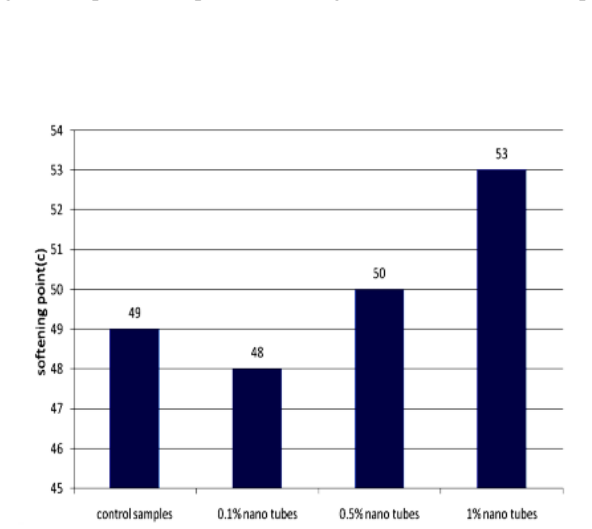
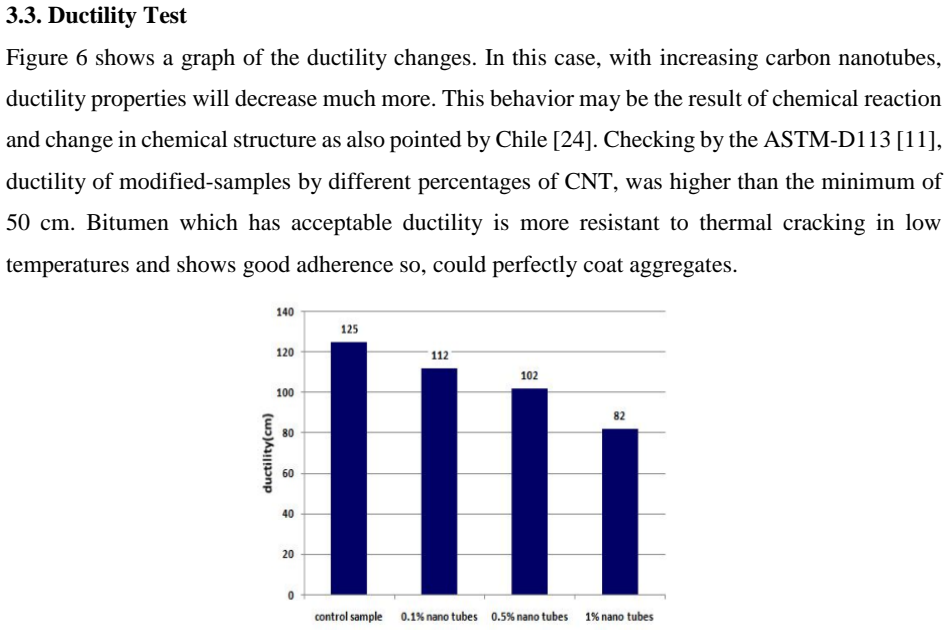
In this study, carbon nano-tubes were added to bitumen through the dry process at contents of 0.1, 0.5, and 1 percent. Evaluation using penetration, softening point, and ductility tests showed that the addition increases the softening point, decreases the penetration, and decreases the ductility compared to unmodified bitumen.
What carries the argument
Dry-process incorporation of carbon nano-tubes into bitumen, assessed via penetration, softening point, and ductility tests.
If this is right
- The softening point rises, suggesting better performance at higher temperatures.
- Penetration decreases, indicating a stiffer material.
- Ductility decreases, which may limit flexibility in applications.
- Effects are observed across the tested nanotube concentrations from 0.1 to 1 percent.
Where Pith is reading between the lines
- If the changes hold in field conditions, nanotube-modified bitumen could lead to pavements with improved thermal stability but potentially higher cracking risk due to lower ductility.
- Additional research on other mechanical properties like fatigue resistance would help assess overall suitability for road use.
- The dry mixing method's simplicity might make this modification accessible for industrial pavement production.
Load-bearing premise
The dry-process mixing produces uniform dispersion of the nanotubes without other variables affecting the test results.
What would settle it
Conducting the same penetration, softening point, and ductility tests on bitumen samples mixed with carbon nanotubes using a wet process or with controlled variations in mixing parameters to verify if the property changes remain consistent.
Figures
read the original abstract
New plans should be used to improve quality and to increase productivity and durability of conventional pavements. In this investigation, it has been attempted to promote technical characteristics of bitumen using carbon nanotubes as an additive. Wet and dry process methods are most practical ways of mixing CNF in AC. It was decided that the best method to adopt for this investigation was the dry process. In this study thermal and ductility properties of modified bitumen by 0.1, 0.5, and 1% carbon nano-tube content in bitumen were evaluated considering bitumen penetration, softening point, and ductility tests, then the results were compared to those of unmodified bitumen. It was found that adding carbon nano-tubes effects on thermal properties of bitumen by increasing the softening point and decreasing the bitumen penetration. It was also shown that bitumen ductility decreases by carbon nano-tubes modification process.
Editorial analysis
A structured set of objections, weighed in public.
Referee Report
Summary. The manuscript reports an experimental investigation into modifying bitumen with carbon nanotubes (CNTs) at dosages of 0.1%, 0.5%, and 1% by the dry mixing process. Thermal properties are assessed via penetration and softening-point tests, and ductility via the ductility test; the central claim is that CNT addition increases softening point, decreases penetration, and reduces ductility relative to unmodified bitumen.
Significance. If the directional effects can be isolated from processing artifacts and supported by quantitative data, the work would supply preliminary evidence that low-dose CNT modification can alter bitumen performance metrics relevant to pavement durability. The absence of numerical results, replication details, and controls currently prevents any assessment of practical significance or effect size.
major comments (3)
- [Abstract] Abstract and Results: the claims of increased softening point, decreased penetration, and decreased ductility are stated without any numerical values, number of replicates, error bars, or statistical tests, so the support for the stated effects cannot be evaluated.
- [Methods] Methods: no information is supplied on mixing temperature, duration, shear protocol, or whether unmodified control samples experienced identical thermal histories; bitumen properties are known to shift under prolonged heating or oxidation, so the design cannot isolate the nanotube contribution.
- [Methods] Experimental design: the manuscript provides no characterization (e.g., microscopy or dispersion analysis) to confirm uniform nanotube distribution in the dry process, leaving open the possibility that observed property shifts arise from incomplete mixing rather than the CNTs themselves.
minor comments (2)
- The title capitalizes 'Nano-tubes' inconsistently with standard usage; consider 'nanotubes'.
- [Abstract] The abstract states 'effects on thermal properties' where 'affects' would be grammatically correct.
Simulated Author's Rebuttal
We thank the referee for the constructive comments on our manuscript. We address each major comment below and indicate where revisions will be made to strengthen the presentation of results and methods.
read point-by-point responses
-
Referee: [Abstract] Abstract and Results: the claims of increased softening point, decreased penetration, and decreased ductility are stated without any numerical values, number of replicates, error bars, or statistical tests, so the support for the stated effects cannot be evaluated.
Authors: We agree that the abstract and results lack specific numerical data and statistical details. The revised manuscript will include the measured values for penetration, softening point, and ductility at each CNT dosage (0.1%, 0.5%, 1%), along with the number of replicates and any available measures of variability. revision: yes
-
Referee: [Methods] Methods: no information is supplied on mixing temperature, duration, shear protocol, or whether unmodified control samples experienced identical thermal histories; bitumen properties are known to shift under prolonged heating or oxidation, so the design cannot isolate the nanotube contribution.
Authors: The referee is correct that these procedural details were omitted. We will revise the methods section to specify the mixing temperature, duration, shear protocol, and confirm that control samples received identical thermal histories to isolate the effect of CNT addition. revision: yes
-
Referee: [Methods] Experimental design: the manuscript provides no characterization (e.g., microscopy or dispersion analysis) to confirm uniform nanotube distribution in the dry process, leaving open the possibility that observed property shifts arise from incomplete mixing rather than the CNTs themselves.
Authors: We acknowledge the lack of dispersion characterization in the original work. The dry mixing approach was selected for practicality, but without direct evidence of uniformity the results could be influenced by mixing quality. In revision we will add an explicit discussion of this limitation and its implications for interpreting the property changes. revision: yes
Circularity Check
No circularity: purely experimental reporting with no models or derivations
full rationale
The paper consists solely of descriptions of standard laboratory tests (penetration, softening point, ductility) performed on bitumen samples modified with 0.1–1 % carbon nanotubes via a dry mixing process. No equations, fitted parameters, predictions, ansatzes, or self-citations appear in the provided text or abstract. Claims are presented as direct empirical outcomes of the tests, with no derivation chain that could reduce to its own inputs. This is the expected non-finding for an experimental methods paper lacking any theoretical or modeling component.
Axiom & Free-Parameter Ledger
axioms (1)
- domain assumption Standard penetration, softening point, and ductility tests accurately measure the relevant thermal and mechanical properties of bitumen
Lean theorems connected to this paper
-
IndisputableMonolith/Cost/FunctionalEquation.leanwashburn_uniqueness_aczel unclear?
unclearRelation between the paper passage and the cited Recognition theorem.
It was found that adding carbon nano-tubes effects on thermal properties of bitumen by increasing the softening point and decreasing the bitumen penetration.
What do these tags mean?
- matches
- The paper's claim is directly supported by a theorem in the formal canon.
- supports
- The theorem supports part of the paper's argument, but the paper may add assumptions or extra steps.
- extends
- The paper goes beyond the formal theorem; the theorem is a base layer rather than the whole result.
- uses
- The paper appears to rely on the theorem as machinery.
- contradicts
- The paper's claim conflicts with a theorem or certificate in the canon.
- unclear
- Pith found a possible connection, but the passage is too broad, indirect, or ambiguous to say the theorem truly supports the claim.
Reference graph
Works this paper leans on
-
[1]
M. Sc. student, Department of civil engineering, University of Guilan, I. R. Iran
-
[2]
Professor, Department of civil engineering, University of Guilan, I. R. Iran
-
[3]
Professor, Department of textile engineering, University of Guilan, I. R. Iran
-
[4]
Assistant professor, Department of textile engineering, University of Guilan, I. R. Iran Masoud.faramarzi67@gmail.com Arabani@guilan.ac.ir Haghi@guilan.ac.ir motaghitalab@guilan.ac.ir Abstract New plans should be used to improve quality and to increase productivity and durability of conventional pavements. In this investigation, it has been a ttempted to ...
-
[5]
INTRODUCTION Nanotechnology is a relatively new field in science dealing with structures that are on the nano - scale. To illustrate how miniscule the nano-scale is, the following comparison could be made: if a human hair has a diameter of a football field, a nano -sized particle would have the diameter of a pencil. In 1985, Kroto and Smalley first discov...
work page 1985
-
[6]
MATERIALS AND METHODS 2.1. Material Materials used in the experimental investigation included a neat bitumen 60/70-penetration grade from Tehran mineral oil refinery with the physical properties listed in Table 1. Table 1. Properties of used bitumen Purity Grade Deflagration Softening Point Penetration Grade Density % ºC ºC mm/10 @ 25 ºC 99 262 49 53 1.03...
-
[7]
Penetration Degree Test Figure 5 shows a graph of the penetration degree changes
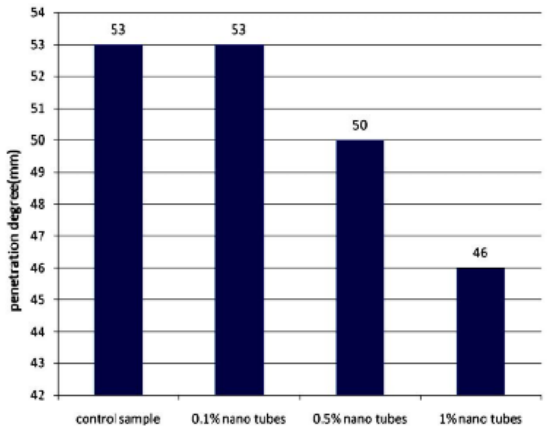
Results and Analysis 3.1. Penetration Degree Test Figure 5 shows a graph of the penetration degree changes. According to Figure 5, at first, it can be seen that there is no change in graph between control sample and 0.1% modified bitumen. It is because of the negative effect of aging, which happens during mixing process in high temperatures. With the addi...
-
[8]
A sample is containing 0.0005 carbon nanotubes by weight of bitumen
CONCLUSIONS Due to the increasing development of nanotechnology and special features of carbon nanotubes, you can use them as the ideal choice in asphalt mixtures. The aim of this study was experimental investigation on the effects of using carbon nano-tubes on rheological properties of bitumen binder. Based on the laboratory test results, the following c...
-
[9]
Kroto, H.W., Heath, J.R., O'Brien, S.C., Curl, R.F., and Smalley, R.E. (1985). C60: Buckminsterfullerene, Nature, Vol. 318, pp. 162-163
work page 1985
-
[10]
Arabani, M., & Faramarzi, M. (2015). Characterization of CNTs-modified HMA’s mechanical properties. Construction and Building Materials, 83, 207-215
work page 2015
-
[11]
Faramarzi, M., Arabani, M., Haghi, A. K., & Mottaghitalab, V. (2015). Carbon nanotubes - modified asphalt binder: preparation and characterization. International Journal of Pavement Research and Technology, 8(1), 29-37
work page 2015
-
[12]
Koshio, A., Yudasaka, M., and Iijima, S. (2002). Metal -free production of high -quality multi- wall carbon, in which the innermost nanotubes have a diameter of 0.4nm, Chemical Physics Letters, Vol. 356, pp. 595600
work page 2002
-
[13]
Yu, M., Lourie, O., Dyer, M.J., Moloni, K., Kelly, T.F., and Ruoff, R.F. (2000). Strength and Breaking Mechanism of Multiwalled Carbon Nanotubes Under Tensile Load, Science, Vol. 287, pp. 637-640
work page 2000
-
[14]
Wu, S., Wang, J., and Liu J. (2010). Preparation and fatigue property of nanoclay modified asphalt binder, Mechanic Automation and Control Engineering (MACE), International Conference, pp. 1595 – 1598, Wuhan, China
work page 2010
-
[15]
Liu, G., Wu, S., van de Ven, M., Molenaar, A., and Besamusca, J. (2010). Characterization of Organic Surfactant on
work page 2010
-
[16]
Montmorillonite Nanoclay to Be Used in Bitumen, ASCE Journal of Materials in Civil Engineering, 22(8), pp. 794-799
-
[17]
Faramarzi, M., Arabani, M., Haghi, A. K., & Motaghitalab, V. (2013). A study on the effects of CNT’s on hot mix asphalt marshal-parameters. Proceedings of the 7thSASTech, 1-9. 11.ASTM D 113, (2002), Standard Test Method for ductility Test, Annual Book o f ASTM Standards, American Society for Testing and Materials, West Conshohocken
work page 2013
discussion (0)
Sign in with ORCID, Apple, or X to comment. Anyone can read and Pith papers without signing in.