Evaporation of ethanol-water droplet at different substrate temperatures and compositions
Pith reviewed 2026-05-24 23:40 UTC · model grok-4.3
The pith
Evaporating ethanol-water droplets exhibit non-monotonic lifetimes with rising ethanol concentration due to non-ideal mixing.
A machine-rendered reading of the paper's core claim, the machinery that carries it, and where it could break.
Core claim
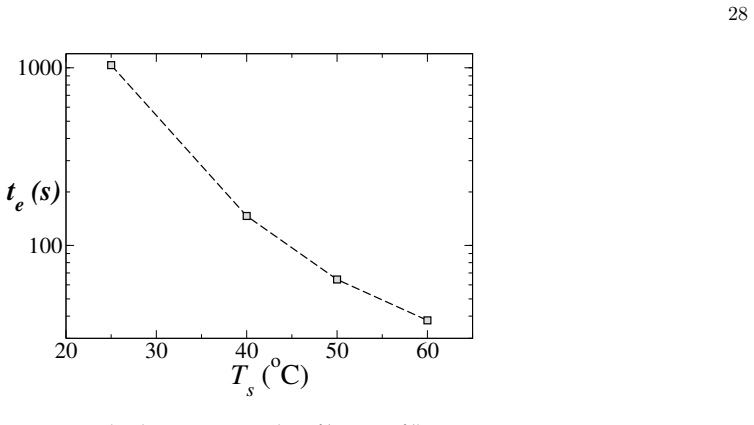
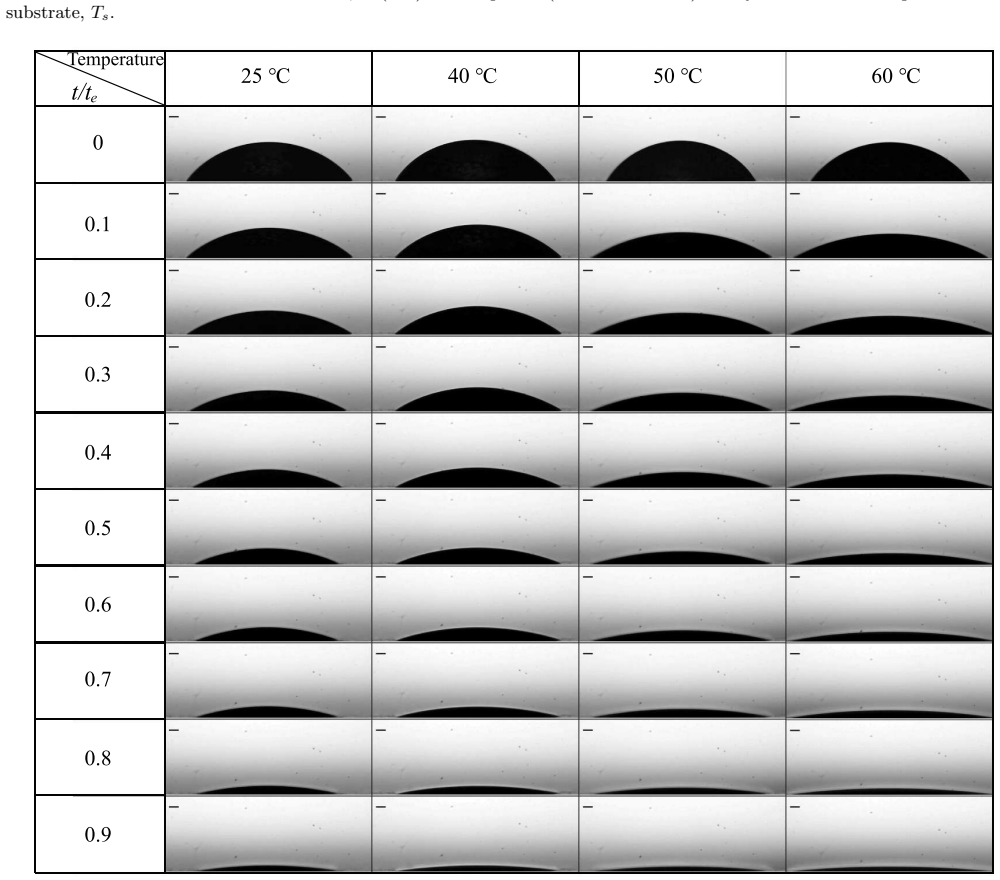
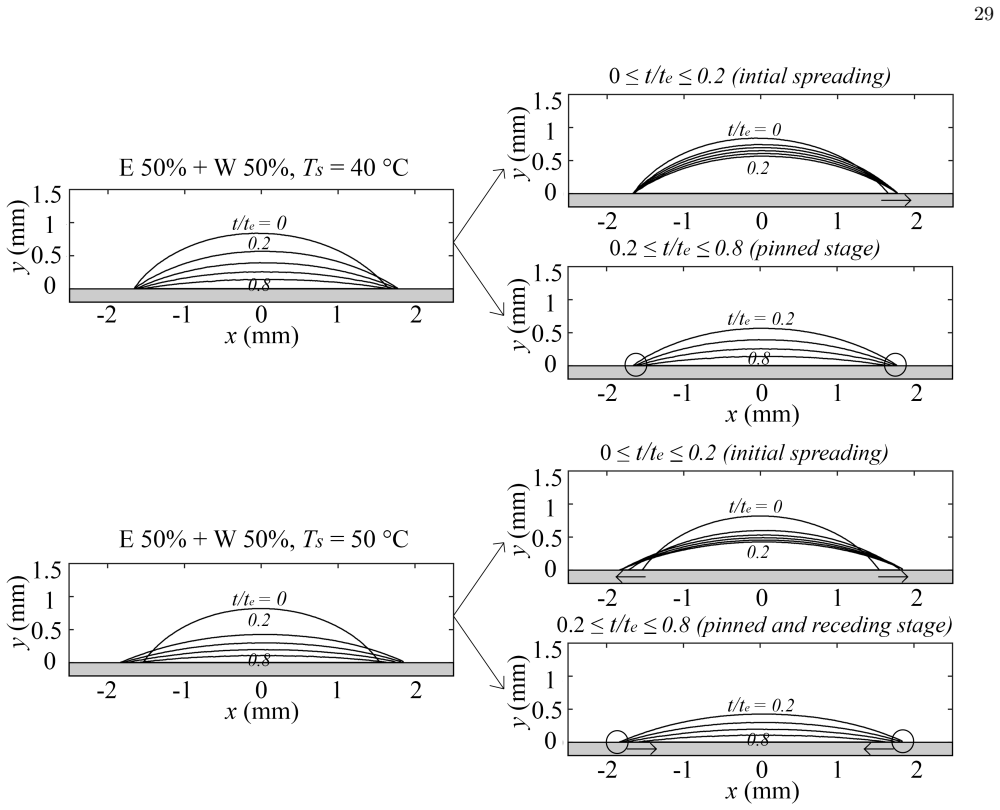
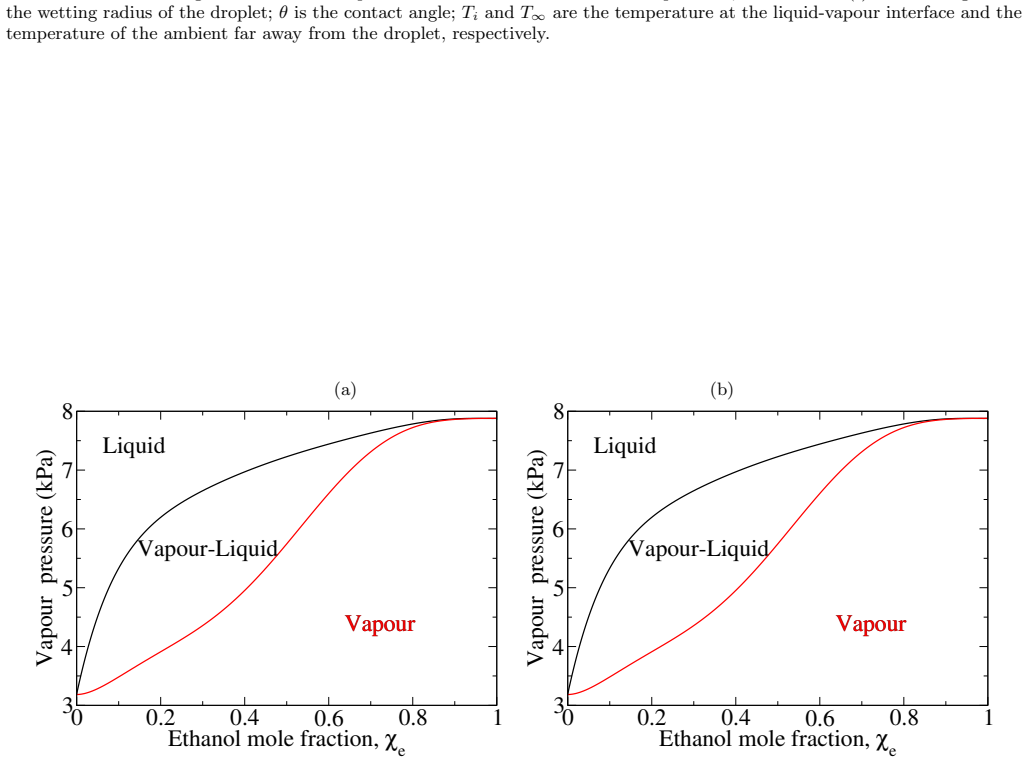
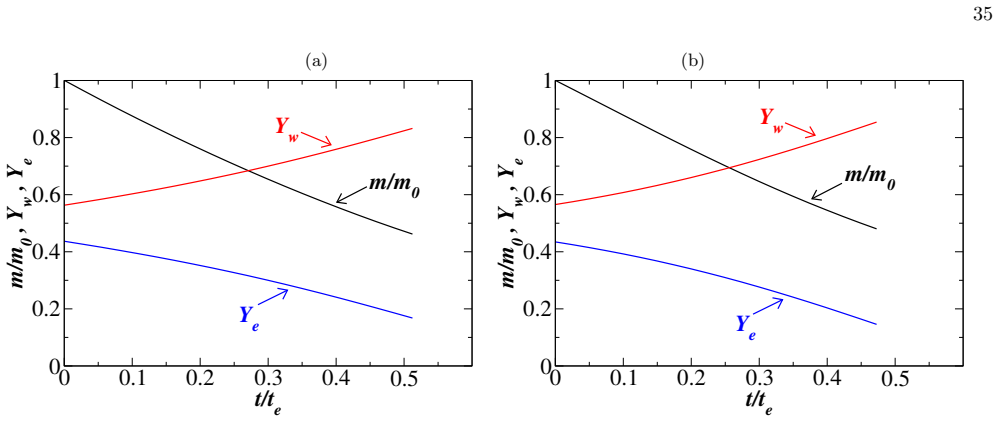
The lifetime of the droplet exhibits a non-monotonic trend with the increase in ethanol concentration in the binary mixture, which can be attributed to the non-ideal behaviour of water-ethanol binary mixtures. Increasing substrate temperature decreases the lifetime of the 50 % ethanol droplet on a logarithmic scale, and the evaporation dynamics for different compositions at 60 °C exhibit a self-similar trend.
What carries the argument
Non-ideal thermodynamic mixing of ethanol and water that alters the effective volatility and thereby produces the observed non-monotonic dependence of total evaporation time on composition.
If this is right
- Lifetime of the 50 % mixture decreases logarithmically as substrate temperature rises from 25 °C to 60 °C.
- At 60 °C an early spreading stage precedes the pinned and receding stages for the 50 % mixture.
- Late-stage interfacial instability and droplet break-up occur for some but not all binary compositions.
- Evaporation rates of both pure and binary droplets are compared directly with an existing theoretical model.
Where Pith is reading between the lines
- If non-ideal mixing is the dominant cause, the same non-monotonic lifetime curve should appear in other binary systems that deviate strongly from Raoult’s law.
- The self-similar collapse at high temperature suggests a temperature-driven scaling that could be tested by varying droplet volume or substrate material while holding temperature fixed.
- Composition could be used as a control knob to set evaporation time in processes that rely on sessile binary droplets.
Load-bearing premise
The non-monotonic change in lifetime with ethanol fraction is produced by the non-ideal properties of the mixture rather than by unmeasured internal flows or surface-tension gradients.
What would settle it
Plotting measured lifetime against ethanol fraction for a different binary pair whose mixing is known to be nearly ideal and checking whether the non-monotonic shape disappears.
Figures










read the original abstract
We experimentally investigate the evaporation dynamics of sessile droplets of a fixed volume consisting of different compositions of ethanol-water binary mixture at different substrate temperatures (T_s). At T_s=25oC, we observe pinned-stage linear evaporation for pure droplets, but a binary droplet undergoes two distinct evaporation stages: an early pinned stage and a later receding stage. In the binary droplet, the more volatile ethanol, evaporates faster leading to a nonlinear trend in the evaporation process at the early stage. The phenomenon observed in the present study at T_s=25oC is similar to that presented by previous researchers at room temperature. More interesting dynamics is observed in the evaporation process of a binary droplet at an elevated substrate temperature. We found that the lifetime of the droplet exhibits a non-monotonic trend with the increase in ethanol concentration in the binary mixture, which {can be attributed to} the non-ideal behaviour of water-ethanol binary mixtures. Increasing T_s decreases the lifetime of the (50\% ethanol + 50 \% water) binary droplet in a logarithmic scale. For this composition, at T_s=60oC, we observed an early spreading stage, an intermediate pinned stage and a late receding stage of evaporation. Unlike T_s=25oC, at the early times of the evaporation process, the contact angle of the droplet of pure water at T_s=60oC is greater than 90. Late stage interfacial instability and even droplet break-up are observed for some (though not all) binary mixture compositions. The evaporation dynamics for different compositions at T_s=60oC exhibit a self-similar trend. Finally, the evaporation rates of pure and binary droplets at different substrate temperatures are compared against a theoretical model developed for pure and binary mixture droplets.
Editorial analysis
A structured set of objections, weighed in public.
Referee Report
Summary. The manuscript experimentally investigates the evaporation of fixed-volume sessile ethanol-water binary mixture droplets on substrates at 25°C and 60°C. It reports pinned-to-receding stages at room temperature, a non-monotonic droplet lifetime versus ethanol concentration at elevated temperature (attributed to non-ideal mixture behavior), logarithmic lifetime reduction with increasing T_s for the 50-50 composition, an additional early spreading stage and late instabilities at 60°C, self-similar dynamics across compositions at 60°C, and comparisons of measured evaporation rates to an existing theoretical model for pure and binary droplets.
Significance. If the non-monotonic lifetime trend can be rigorously isolated as arising from thermodynamic non-ideality rather than hydrodynamic effects, the observations would extend prior room-temperature binary droplet studies to elevated temperatures and provide data on temperature-dependent stage transitions and instabilities useful for applications such as spray cooling or thin-film deposition.
major comments (2)
- [Abstract] Abstract: the central claim that the non-monotonic lifetime trend with increasing ethanol concentration 'can be attributed to the non-ideal behaviour of water-ethanol binary mixtures' is load-bearing for the interpretation at both 25°C and 60°C, yet the manuscript provides no activity-coefficient data, vapor-liquid equilibrium measurements, or model decomposition that separates thermodynamic non-ideality from possible Marangoni flows or internal convection, which could produce equivalent non-monotonicity.
- [Results (T_s=60°C)] Results section on T_s=60°C experiments: the reported self-similar evaporation dynamics and three-stage sequence (spreading-pinned-receding) for the 50-50 mixture lack quantitative metrics such as normalized time scales, contact-line velocity data, or error bars on lifetime values, preventing direct assessment of the model comparison and the claimed logarithmic T_s dependence.
minor comments (2)
- [Abstract] Abstract and throughout: temperature is written as '25oC' and '60oC' rather than the conventional 25°C; this should be standardized.
- [Discussion] The final model comparison paragraph does not specify whether the theoretical curves are parameter-free predictions or involve any fitting, nor does it report quantitative agreement metrics (e.g., RMS deviation) for the binary cases.
Simulated Author's Rebuttal
We thank the referee for the constructive comments on our manuscript. We address each major comment below and indicate the revisions we will make.
read point-by-point responses
-
Referee: [Abstract] Abstract: the central claim that the non-monotonic lifetime trend with increasing ethanol concentration 'can be attributed to the non-ideal behaviour of water-ethanol binary mixtures' is load-bearing for the interpretation at both 25°C and 60°C, yet the manuscript provides no activity-coefficient data, vapor-liquid equilibrium measurements, or model decomposition that separates thermodynamic non-ideality from possible Marangoni flows or internal convection, which could produce equivalent non-monotonicity.
Authors: We agree that the manuscript does not contain new activity-coefficient measurements or a full decomposition isolating non-ideality from hydrodynamics. The attribution draws on well-established non-ideal VLE behavior of ethanol-water mixtures documented in the literature. In revision we will (i) add explicit citations to activity-coefficient models and VLE data, (ii) discuss why Marangoni or convection effects are unlikely to produce the observed non-monotonic lifetime trend given the contact-line dynamics we record, and (iii) tone the abstract claim to 'consistent with' rather than 'can be attributed to'. No new experiments are feasible, but the added discussion and citations will strengthen the interpretation. revision: partial
-
Referee: [Results (T_s=60°C)] Results section on T_s=60°C experiments: the reported self-similar evaporation dynamics and three-stage sequence (spreading-pinned-receding) for the 50-50 mixture lack quantitative metrics such as normalized time scales, contact-line velocity data, or error bars on lifetime values, preventing direct assessment of the model comparison and the claimed logarithmic T_s dependence.
Authors: We will revise the T_s=60°C results section to include normalized time scales for each stage, contact-line velocity versus time plots (with error bars from repeated trials), and error bars on all reported lifetimes. These additions will enable quantitative comparison with the model and direct verification of the logarithmic dependence. revision: yes
Circularity Check
No significant circularity; experimental observations compared to external model
full rationale
The paper reports direct experimental measurements of droplet lifetimes, stages (pinned/receding/spreading), and trends with composition and substrate temperature. The non-monotonic lifetime trend is presented as an observed fact and interpreted via the known non-ideal thermodynamics of ethanol-water mixtures; no equations are fitted to the present data and then re-used as 'predictions.' The comparison to 'a theoretical model developed for pure and binary mixture droplets' is external benchmarking, not a self-referential reduction. No self-citation chains, ansatzes, or uniqueness theorems are invoked as load-bearing steps for the central claims. The derivation chain is therefore self-contained against external benchmarks.
Axiom & Free-Parameter Ledger
axioms (2)
- domain assumption Evaporation of sessile droplets proceeds through distinct pinned, receding, and (at elevated temperature) spreading stages as established in prior literature.
- domain assumption Non-ideal thermodynamic behavior of ethanol-water mixtures governs composition-dependent evaporation rates and lifetimes.
Reference graph
Works this paper leans on
-
[1]
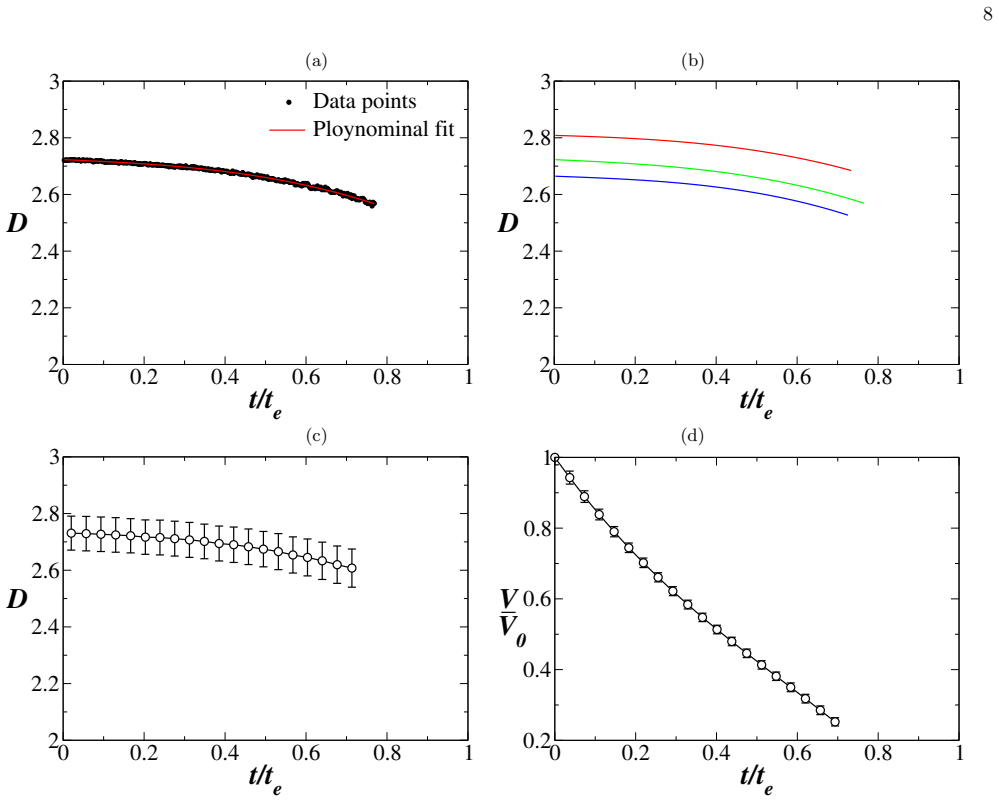
for an ethanol-water droplet on a teflon substrate for different compositions at 24 ◦C. The dynamics observed in 7 (a) Original image (b) Filtered image (c) Binary image (d) Droplet image (e) Droplet profile . . FIG. 4: The image processing steps for a typical ethanol-water droplet recorded using the camera. (a) Typical original image of a droplet, (b) the ...
-
[2]
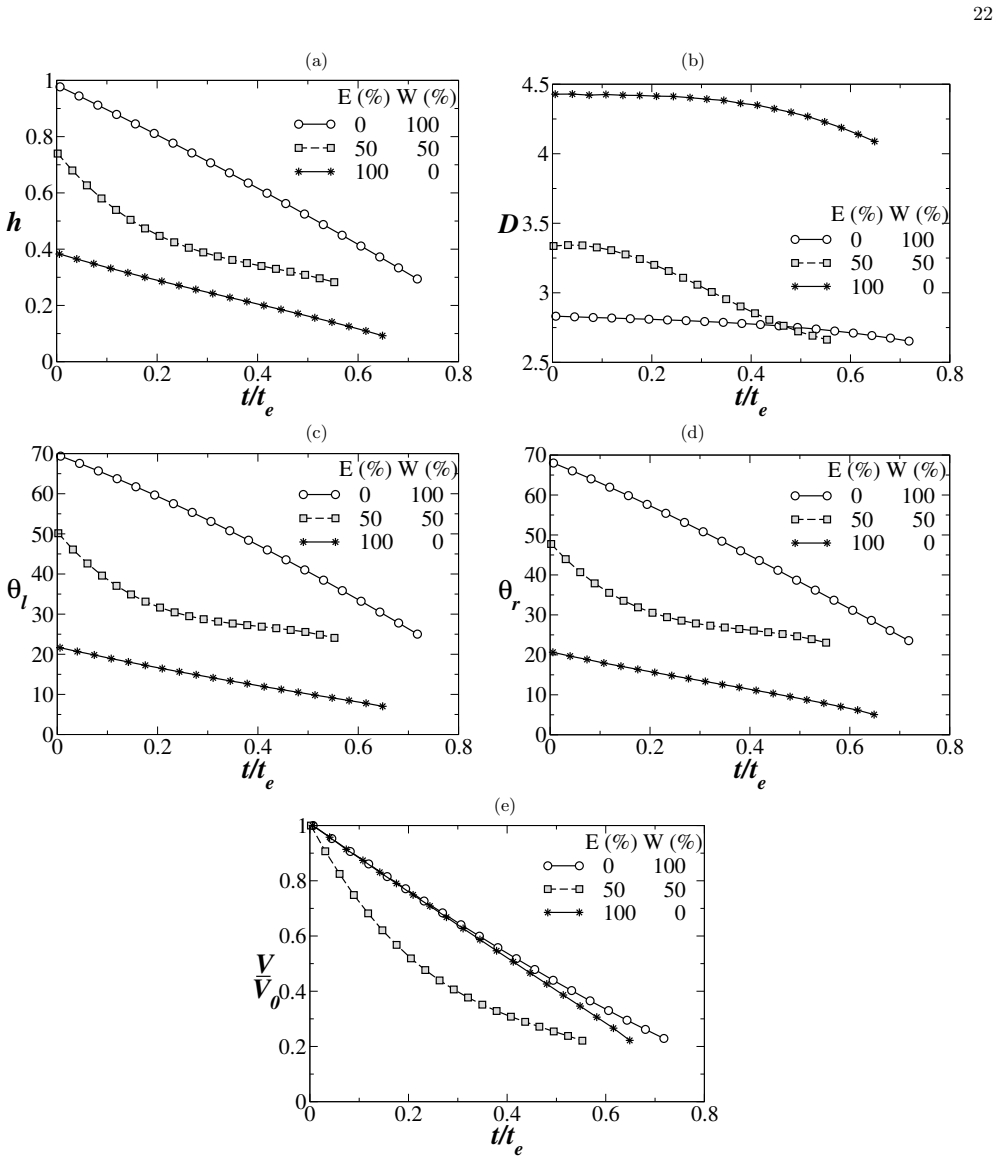
and the droplet begins to recede for t/te > 0.2 (bottom right panel of Figure 7). The non-monotonic behaviour of the binary droplet is further highlighted in Figures 8(a)-(e), where the variations of the droplet height (h in mm), the wetting diameter (D in mm), the left contact angle (θl), the right contact angle (θr) (based on field of camera view) and of...
-
[3]
The diffusion limited model The diffusion limited droplet evaporation model is relatively well-developed and widely used by several research groups to model evaporation flux of pure droplets at room temperatures [1]. In our case, all the droplets can be 13 assumed to have a spherical cap profile during the evaporation process, which in turn implies that θl =θ...
-
[4]
The impact of the natural convection on droplet evaporation was studied by [20]
Model for free convection While the evaporation of a droplet on an unheated substrate is primarily governed by the diffusive fluxes, the evaporation dynamics of a droplet on a heated substrate depends on both the Stefan flow and the natural convection, particularly for the more volatile ethanol liquid that boils at 78 ◦C [35]. The impact of the natural conve...
-
[5]
Passive transport due to free convection of air The relation considered so far incorporates the effects of both the diffusive mass flux and the convective mass flux due to the gradients in vapour concentration. But in the case of a sessile droplet on a heated substrate, additional terms arise due to the temperature gradient driven free convection of air. Whil...
work page 2017
-
[6]
Brutin, Droplet wetting and evaporation: from pure to complex fluids (Academic Press, 2015)
D. Brutin, Droplet wetting and evaporation: from pure to complex fluids (Academic Press, 2015)
work page 2015
-
[7]
M. K. Yau and R. R. Rogers, A short course in cloud physics (Elsevier, 1996)
work page 1996
-
[8]
M. K. Tripathi and K. C. Sahu, Procedia IUTAM 15, 201 (2015)
work page 2015
-
[9]
S. T. Chang and O. D. Velev, Langmuir 22, 1459 (2006)
work page 2006
- [10]
-
[11]
N. Shahidzadeh-Bonn, S. Rafai, A. Azouni, and D. Bonn, J. Fluid Mech. 549, 307 (2006)
work page 2006
-
[12]
R. G. Picknett and R. Bexon, J. Colloid Interface Sci. 61, 336 (1977)
work page 1977
- [13]
-
[14]
H. Y. Erbil, Adv. Colloid Interface Sci. 170, 67 (2012)
work page 2012
- [15]
-
[16]
K. S. Birdi, D. T. Vu, and A. Winter, J. Phys. Chem. 93, 3702 (1989)
work page 1989
-
[17]
C. Bourges-Monnier and M. E. R. Shanahan, Langmuir 11, 2820 (1995)
work page 1995
-
[18]
N. M. Kovalchuk, A. Trybala, and V. M. Starov, Curr. Opin. Colloid Interface Sci. 19, 336 (2014)
work page 2014
- [19]
-
[20]
L. Y. Barash, T. P. Bigioni, V. M. Vinokur, and L. N. Shchur, Phys. Rev. E. 79, 046301 (2009)
work page 2009
-
[21]
W. D. Ristenpart, P. G. Kim, C. Domingues, J. Wan, and H. A. Stone, Phys. Rev. Lett. 99, 234502 (2007)
work page 2007
- [22]
-
[23]
P. J. S´ aenz, A. W. Wray, Z. Che, O. K. Matar, P. Valluri, J. Kim, and K. Sefiane, Nat. Commun. 8, 14783 (2017)
work page 2017
-
[24]
E. Y. Gatapova, A. A. Semenov, D. V. Zaitsev, and O. A. Kabov, Colloids. Surf. A. 441, 776 (2014)
work page 2014
- [25]
- [26]
-
[27]
P. L. Kelly-Zion, C. J. Pursell, S. Vaidya, and J. Batra, Colloids Surf. A. 381, 31 (2011)
work page 2011
- [28]
-
[29]
J. R. E. Christy, Y. Hamamoto, and K. Sefiane, Phys. Rev. Lett. 106, 205701 (2011)
work page 2011
- [30]
-
[31]
F. G. H. Schofield, S. K. Wilson, D. Pritchard, and K. Sefiane, J. Fluid Mech. 851, 231 (2018)
work page 2018
-
[32]
Z. Wang, X.-F. Peng, A. S. Mujumdar, A. Su, and D.-J. Lee, Dry. Technol. 26, 806 (2008)
work page 2008
-
[33]
L. Shi, P. Shen, D. Zhang, Q. Lin, and Q. Jiang, Surf. Interface Anal. 41, 951 (2009)
work page 2009
-
[34]
A. K. H. Cheng, D. M. Soolaman, and H.-Z. Yu, J. Phys. Chem. B. 110, 11267 (2006)
work page 2006
- [35]
- [36]
- [37]
-
[38]
G. Karapetsas, K. C. Sahu, K. Sefiane, and O. K. Matar, Langmuir 30, 4310 (2014)
work page 2014
- [39]
-
[40]
E. W. Lemmon, M. L. Huber, and M. O. McLinden, Standard Reference Data Program, Gaithersburg (2007)
work page 2007
-
[41]
A. N. Sterlyagov, V. N. Letushko, M. I. Nizovtsev, and V. Y. Borodulin, in J. Phys. Conf. Ser. (IOP Publishing, 2018), vol. 1105, p. 012068
work page 2018
-
[42]
Bejan, Advanced engineering thermodynamics (John Wiley & Sons, 2016)
A. Bejan, Advanced engineering thermodynamics (John Wiley & Sons, 2016)
work page 2016
-
[43]
S. Semenov, A. Trybala, R. G. Rubio, N. Kovalchuk, V. Starov, and M. G. Velarde, Adv. Colloid Interface Sci. 206, 382 (2014)
work page 2014
- [44]
- [45]
- [46]
-
[47]
P. L. Kelly-Zion, C. J. Pursell, G. N. Wassom, B. V. Mandelkorn, and C. Nkinthorn, Int. J. Heat Mass Transf. 118, 355 (2018)
work page 2018
-
[48]
A. K. Pal and A. K. Barua, J. Phys, D. Appl. Phys. 1, 71 (1968)
work page 1968
- [49]
-
[50]
M. Lapuerta, J. P. Hern´ andez, and J. R. Agudelo, Appl. Therm. Eng. 73, 539 (2014)
work page 2014
-
[51]
W. D. Hall and H. R. Pruppacher, J. Atmos. Sci. 33, 1995 (1976)
work page 1995
-
[52]
J. R. Lloyd and W. R. Moran, J. Heat Transfer 96, 443 (1974)
work page 1974
-
[53]
S. I. Sandler, Chemical, biochemical, and engineering thermodynamics (John Wiley & Sons, 2017)
work page 2017
- [54]
-
[55]
C. Williams and J. Buttriss, Industrial Solvents Handbook (William Andrew Publishing Noyes, 1998)
work page 1998
-
[56]
K. N. Marsh and A. E. Richards, Aust. J. Chem. 33, 2121 (1980)
work page 1980
-
[57]
J. Jim´ enez, J. Manrique, and F. Mart´ ınez, Rev. Colomb. Cienc. Qu´ ım. Farm.33, 145 (2004)
work page 2004
- [58]
-
[59]
(null)">(null)</latexit><latexit sha1_base64=
C. Liu, E. Bonaccurso, and H.-J. Butt, Phys. Chem. Chem. Phys. 10, 7150 (2008). 22 (a) (b) 0 0.2 0.4 0.6 0.8 t/te 0 0.2 0.4 0.6 0.8 1 h 0 100 50 50 100 0 E (%) W (%) 0 0.2 0.4 0.6 0.8 t/te 2.5 3 3.5 4 4.5 D 0 100 50 50 100 0 E (%) W (%) (c) (d) 0 0.2 0.4 0.6 0.8 t/te 0 10 20 30 40 50 60 70 θl 0 100 50 50 100 0 E (%) W (%) 0 0.2 0.4 0.6 0.8 t/te 0 10 20 30...
work page 2008
discussion (0)
Sign in with ORCID, Apple, or X to comment. Anyone can read and Pith papers without signing in.