Early stages of spreading and sintering
Pith reviewed 2026-05-24 22:11 UTC · model grok-4.3
The pith
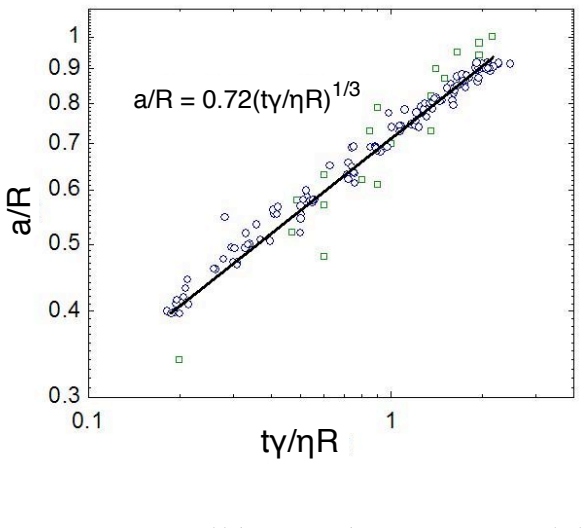
Early viscous droplet spreading and sintering follow contact radius a = (3 π γ R² t / (32 η))^{1/3}.
A machine-rendered reading of the paper's core claim, the machinery that carries it, and where it could break.
Core claim
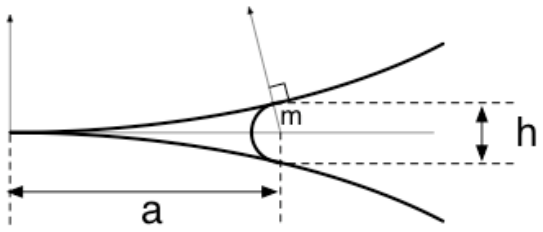
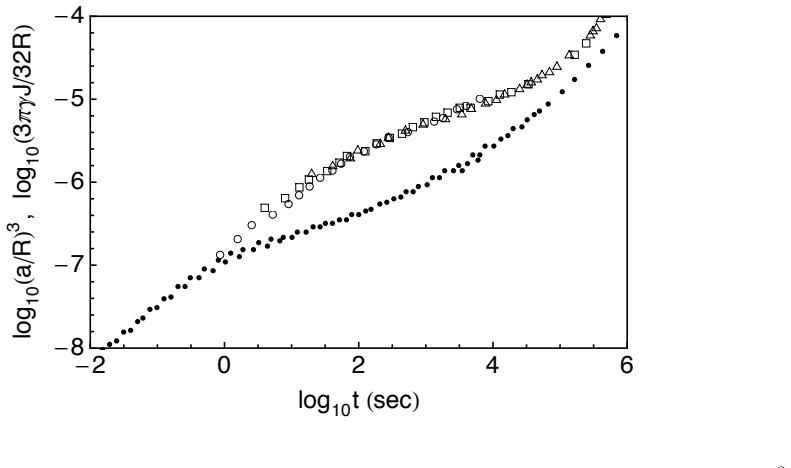
The flows in both spreading and sintering are closely analogous to the displacements in a Hertzian elastic contact. This analogy yields the early-time contact radius growth a = (3 π γ R² t / (32 η))^{1/3} and, for viscoelastic fluids, the general relation that a³(t) is proportional to the creep compliance J(t).
What carries the argument
Analogy between the viscous flows near the contact zone and the elastic displacements inside a Hertzian contact, which converts the problem into a known elastic solution.
If this is right
- The early-stage scaling holds before the system enters the low-contact-angle Tanner regime.
- For viscoelastic fluids the cube of the contact radius tracks the creep compliance J(t) rather than time itself.
- The same scaling law governs both droplet spreading on a substrate and sintering between two droplets.
Where Pith is reading between the lines
- The Hertzian analogy may extend to other early-time coalescence problems that share a similar near-contact geometry.
- Polymer melts or other soft glassy materials could be tested to confirm the viscoelastic generalization.
- The result supplies a parameter-free starting point for modeling the full time course of viscous sintering.
Load-bearing premise
The flows in both spreading and sintering problems are closely analogous to the displacements in a Hertzian elastic contact.
What would settle it
Measure contact radius versus time at early times in a high-viscosity droplet spreading experiment and test whether a³ grows linearly with t.
Figures
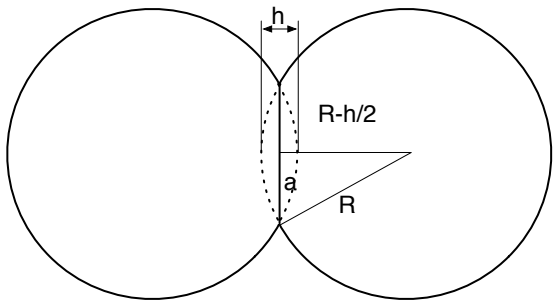
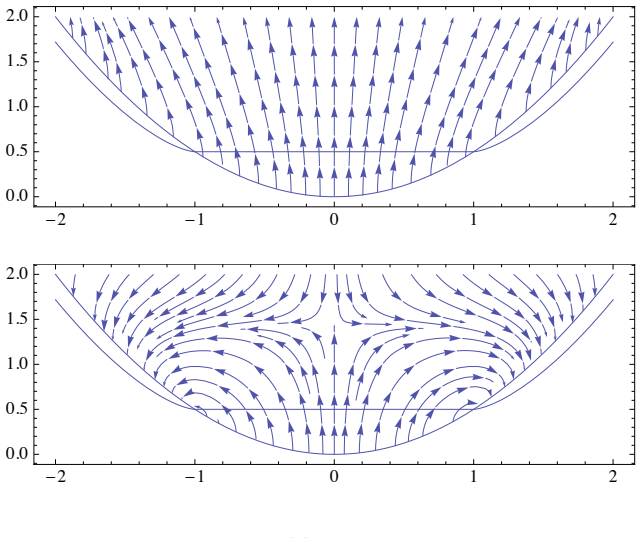
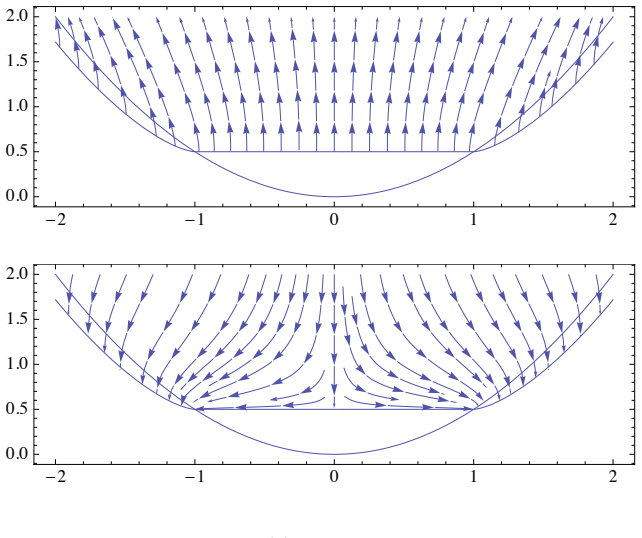
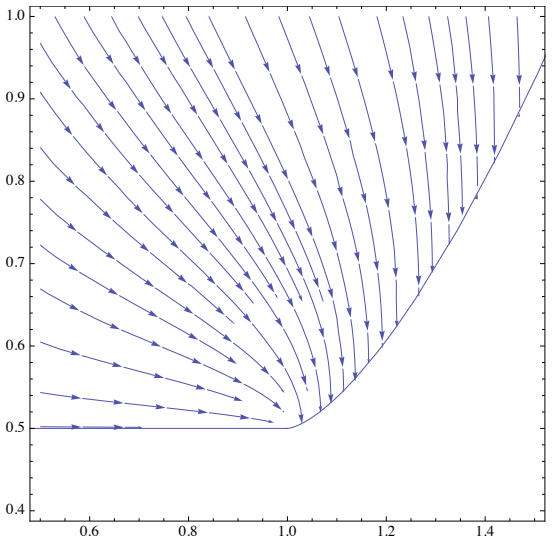
read the original abstract
The early stages of sintering of highly viscous droplets are very similar to the early stages of a viscous droplet spreading on a solid substrate. The flows in both problems are closely analogous to the displacements in a Hertzian elastic contact. We exploit that analogy to provide both a scaling argument and a calculation for the early growth of the contact radius $a$ with time, namely $a=(3 \pi \gamma R^2 t/(32 \eta))^{1/3}$. (This result is complementary to the well-known Tanner law for spreading, $a \sim t^{1/10}$, which holds in the regime of low contact angles.) For viscoelastic fluids, the linear scaling of $a^3$ with time is replaced by the general result that $a^3(t)$ is proportional to the creep compliance $J(t)$.
Editorial analysis
A structured set of objections, weighed in public.
Referee Report
Summary. The paper claims that early-stage spreading and sintering of highly viscous droplets are analogous to displacements in a Hertzian elastic contact. This analogy is used to derive both a scaling argument and an explicit result for the contact radius growth a = (3 π γ R² t / (32 η))^{1/3} in the viscous case (complementary to Tanner's law a ∼ t^{1/10} at low contact angles) and the generalization a³(t) ∝ J(t) for viscoelastic fluids, where J(t) is the creep compliance.
Significance. If the Hertzian analogy can be rigorously established, the result supplies a parameter-free prediction with a definite numerical prefactor for early-time contact growth in both viscous and viscoelastic regimes. This would be useful for modeling sintering and spreading processes where the early dynamics are not captured by Tanner's law, and the viscoelastic extension provides a direct link to measurable material functions.
major comments (2)
- [Abstract and derivation of the contact-radius formula] The central result a = (3 π γ R² t / (32 η))^{1/3} and its viscoelastic extension rest on the assertion that the velocity field inside the droplet is identical (up to a time-dependent factor) to the elastic displacement field under a Hertzian pressure distribution. The manuscript does not supply the explicit mapping or address how the free-surface capillary boundary condition and the spherical-cap far-field geometry (rather than a half-space) preserve this equivalence at leading order; any mismatch would alter the prefactor 3π/32 or invalidate the direct substitution of J(t).
- [Discussion of the Hertzian analogy] The pressure distribution over the contact zone is assumed to follow the Hertz profile without perturbation from the droplet's free surface or finite contact angle (order-1). No estimate is given for the regime of validity of this assumption or for the error incurred when the contact angle is not small.
minor comments (1)
- The abstract states the result but does not indicate where in the manuscript the explicit calculation (as opposed to the scaling argument) is presented; a dedicated section or appendix with the derivation steps would improve clarity.
Simulated Author's Rebuttal
We thank the referee for the careful reading and constructive comments, which highlight areas where the presentation of the Hertzian analogy can be strengthened. We address each major comment below and will incorporate revisions to improve clarity and rigor.
read point-by-point responses
-
Referee: [Abstract and derivation of the contact-radius formula] The central result a = (3 π γ R² t / (32 η))^{1/3} and its viscoelastic extension rest on the assertion that the velocity field inside the droplet is identical (up to a time-dependent factor) to the elastic displacement field under a Hertzian pressure distribution. The manuscript does not supply the explicit mapping or address how the free-surface capillary boundary condition and the spherical-cap far-field geometry (rather than a half-space) preserve this equivalence at leading order; any mismatch would alter the prefactor 3π/32 or invalidate the direct substitution of J(t).
Authors: We agree that the manuscript would benefit from a more explicit derivation of the mapping. In the revision we will add a dedicated subsection that maps the Stokes flow problem (with capillary boundary conditions on the free surface) onto the elastic Hertz problem, showing that the leading-order equivalence holds for small contact radii a ≪ R because the far-field geometry approaches a half-space and the capillary pressure acts as a perturbation that does not alter the singular pressure distribution inside the contact zone at this order. This will also justify the direct substitution of the creep compliance J(t) for the viscoelastic case. revision: yes
-
Referee: [Discussion of the Hertzian analogy] The pressure distribution over the contact zone is assumed to follow the Hertz profile without perturbation from the droplet's free surface or finite contact angle (order-1). No estimate is given for the regime of validity of this assumption or for the error incurred when the contact angle is not small.
Authors: The referee is correct that an explicit error estimate is missing. We will add a paragraph providing an order-of-magnitude estimate for the perturbation to the Hertz pressure caused by the free-surface curvature and O(1) contact angle. The estimate shows that the relative error remains small provided a/R ≪ 1, consistent with the early-time regime targeted by the analysis; we will also note that the result is complementary to Tanner’s law precisely because the latter applies only after the contact angle has become small. revision: yes
Circularity Check
No circularity; result obtained from external Hertzian analogy
full rationale
The derivation maps the viscous flow problem to the known elastic displacement field under Hertzian contact pressure, yielding a = (3 π γ R² t / (32 η))^{1/3} and the viscoelastic extension a³(t) ∝ J(t). This uses a standard external result from contact mechanics rather than any self-referential definition, fitted input renamed as prediction, or load-bearing self-citation. The paper presents the mapping as an analogy to be exploited, with the numerical prefactor arising from that calculation; no step reduces the output to the input by construction.
Axiom & Free-Parameter Ledger
axioms (1)
- domain assumption The flows in spreading and sintering problems are closely analogous to the displacements in a Hertzian elastic contact.
Lean theorems connected to this paper
-
IndisputableMonolith/Cost/FunctionalEquation.leanwashburn_uniqueness_aczel unclear?
unclearRelation between the paper passage and the cited Recognition theorem.
the linear scaling of a³ with time is replaced by the general result that a³(t) is proportional to the creep compliance J(t)
-
IndisputableMonolith/Foundation/AlexanderDuality.leanalexander_duality_circle_linking unclear?
unclearRelation between the paper passage and the cited Recognition theorem.
The flows in both problems are closely analogous to the displacements in a Hertzian elastic contact
What do these tags mean?
- matches
- The paper's claim is directly supported by a theorem in the formal canon.
- supports
- The theorem supports part of the paper's argument, but the paper may add assumptions or extra steps.
- extends
- The paper goes beyond the formal theorem; the theorem is a base layer rather than the whole result.
- uses
- The paper appears to rely on the theorem as machinery.
- contradicts
- The paper's claim conflicts with a theorem or certificate in the canon.
- unclear
- Pith found a possible connection, but the passage is too broad, indirect, or ambiguous to say the theorem truly supports the claim.
Reference graph
Works this paper leans on
-
[1]
Crawford, ed., Rotational Moulding of Plastics (Wiley, New York, 1992)
R. Crawford, ed., Rotational Moulding of Plastics (Wiley, New York, 1992)
work page 1992
- [2]
-
[3]
K. Johnson, K. Kendall, and A. Roberts, Proc R Soc Lon Ser-A 324, 301 (1971)
work page 1971
-
[4]
Tanner, J Phys D Appl Phys 12, 1473 (1979)
L. Tanner, J Phys D Appl Phys 12, 1473 (1979)
work page 1979
-
[5]
Hertz, Miscellaneous papers (Macmillan, London, 1896), p
H. Hertz, Miscellaneous papers (Macmillan, London, 1896), p. 146
-
[6]
L. Landau and E. Lifshitz, Theory of Elasticity (Butterworth Heinemann, Oxford, UK, 1986), pp. 26–31
work page 1986
- [7]
-
[8]
Skorokhod, Powder Metallurgy and Metal Ceramics 34, 521 (1995)
V. Skorokhod, Powder Metallurgy and Metal Ceramics 34, 521 (1995)
work page 1995
- [9]
-
[10]
L. Ramirez, S. Milner, C. Snyder, R. Colby, and D. Velegol (2010), to appear in Langmuir
work page 2010
-
[11]
C. Bellehumeur, M. Bisaria, and J. Vlachopoulos, Polym Eng Sci 36, 2198 (1996)
work page 1996
- [12]
- [13]
- [14]
-
[15]
J. Ross, W. Miller, and G. Weatherly, J Appl Phys 52, 3884 (1981)
work page 1981
- [16]
-
[17]
Y. Lin, C. Hui, and A. Jagota, J Coll. Int. Sci. 237, 267 (2001)
work page 2001
-
[18]
M. J. Kirchhof, H. J. Schmid, and W. Peukert, Physical Review E 80, 026319 (2009)
work page 2009
- [19]
- [20]
- [21]
- [22]
-
[23]
W. Yao, H. Maris, P. Pennington, and G. Seidel, Physical Review E 71, 016309 (2005)
work page 2005
-
[24]
C. Bellehumeur, M. Kontopoulou, and J. Vlachopoulos, Rheol Acta 37, 270 (1998)
work page 1998
- [25]
- [26]
-
[27]
C. Hui, J. Baney, and E. Kramer, Langmuir 14, 6570 (1998)
work page 1998
- [28]
discussion (0)
Sign in with ORCID, Apple, or X to comment. Anyone can read and Pith papers without signing in.